Plant Science Adjunct Faculty Gainesville, GA, US HIRING PROCESS : All submitted application materials are forwarded to the appropriate department for review. Hiring recommendations are made at the ...
Quick apply
Plant Science Adjunct Faculty Gainesville, GA, US HIRING PROCESS : All submitted application materials are forwarded to the appropriate department for review. Hiring recommendations are made at the ...
Quick apply
Plant Science Adjunct Faculty Gainesville, GA, US HIRING PROCESS : All submitted application materials are forwarded to the appropriate department for review. Hiring recommendations are made at the ...
Woodland Park, CO · On-site
$90K - $105K/yr
PhD in Biostatistics, Statistics, Quantitative Genetics, Plant Breeding, Computational Biology, Data Science, or a related field; industry experience a plus * MS in Biostatistics, Statistics ...
Woodland Park, CO · On-site
$90K - $105K/yr
PhD in Biostatistics, Statistics, Quantitative Genetics, Plant Breeding, Computational Biology, Data Science, or a related field; industry experience a plus * MS in Biostatistics, Statistics ...
Woodland, CA · On-site
$90K - $105K/yr
PhD in Biostatistics, Statistics, Quantitative Genetics, Plant Breeding, Computational Biology, Data Science, or a related field; industry experience a plus or * MS in Biostatistics, Statistics ...
Quick apply
Woodland, CA · On-site
$90K - $105K/yr
PhD in Biostatistics, Statistics, Quantitative Genetics, Plant Breeding, Computational Biology, Data Science, or a related field; industry experience a plus or * MS in Biostatistics, Statistics ...
Orlando, FL · On-site
$15.75 - $20.75/hr
Plant Science Internship at Walt Disney Parks and Resorts "We make magic." That's our motto at Walt Disney Parks and Resorts. And it permeates everything we do. At Disney, you'll help inspire that ...
Orlando, FL · On-site
$15.75 - $20.75/hr
Plant Science Internship at Walt Disney Parks and Resorts "We make magic." That's our motto at Walt Disney Parks and Resorts. And it permeates everything we do. At Disney, you'll help inspire that ...
WI · On-site
The American Society of Plant Biologists is looking for an experienced Plant Scientist at the Wisconsin Crop Innovation Center, University of Wisconsin-Madison. This role involves serving as a ...
WI · On-site
The American Society of Plant Biologists is looking for an experienced Plant Scientist at the Wisconsin Crop Innovation Center, University of Wisconsin-Madison. This role involves serving as a ...
This posting is to apply to work as a Plant Science Intern within the greenhouses at The Land Pavilion in Epcot. This internship begins on January 5, 2027 (arrival) and ends on June 17, 2027 ...
This posting is to apply to work as a Plant Science Intern within the greenhouses at The Land Pavilion in Epcot. This internship begins on January 5, 2027 (arrival) and ends on June 17, 2027 ...
Olivette, MO · On-site
$92K - $117K/yr
DONALD DANFORTH PLANT SCIENCE CENTER - OLIVETTE, MO 63132 Position Type: Full Time Education Level: Graduate Degree The Taylor Lab at the Donald Danforth Plant Science Center is seeking to fill an ...
Olivette, MO · On-site
$92K - $117K/yr
DONALD DANFORTH PLANT SCIENCE CENTER - OLIVETTE, MO 63132 Position Type: Full Time Education Level: Graduate Degree The Taylor Lab at the Donald Danforth Plant Science Center is seeking to fill an ...
Announcement Information Posting Number Title Plant Science Instructor (Reedley College) Part-Time Faculty Pool Campus Location Reedley College Start Date Essential Functions of Position The ideal ...
Announcement Information Posting Number Title Plant Science Instructor (Reedley College) Part-Time Faculty Pool Campus Location Reedley College Start Date Essential Functions of Position The ideal ...
Fresno, CA · On-site
$45.49 - $61.78/hr
Posting Details Announcement Information Posting Number Title Plant Science Instructor (Reedley College) Part-Time Faculty Pool Campus Location Reedley College Start Date Essential Functions of ...
Fresno, CA · On-site
$45.49 - $61.78/hr
Posting Details Announcement Information Posting Number Title Plant Science Instructor (Reedley College) Part-Time Faculty Pool Campus Location Reedley College Start Date Essential Functions of ...
Weekend Supervisor - Plant Science / Agriculture Kelly Science & Clinical is seeking a Weekend Supervisor to support the Pesticide Discovery organization of a leading global agricultural sciences ...
Quick apply
Weekend Supervisor - Plant Science / Agriculture Kelly Science & Clinical is seeking a Weekend Supervisor to support the Pesticide Discovery organization of a leading global agricultural sciences ...
Stockton, CA · On-site
$72.73 - $108.56/hr
Instruct courses in Horticulture/Plant Science in accordance with credit course outlines approved by the Board of Trustees. Maintain expertise in current teaching methods, discipline knowledge, and ...
Stockton, CA · On-site
$72.73 - $108.56/hr
Instruct courses in Horticulture/Plant Science in accordance with credit course outlines approved by the Board of Trustees. Maintain expertise in current teaching methods, discipline knowledge, and ...
Fresno, CA · On-site
$5.5K - $6.6K/mo
The Department of Plant Science at California State University, Fresno is located in the nation's most productive agricultural valley. Our graduates acquire a sound academic background that is deeply ...
Fresno, CA · On-site
$5.5K - $6.6K/mo
The Department of Plant Science at California State University, Fresno is located in the nation's most productive agricultural valley. Our graduates acquire a sound academic background that is deeply ...
Fresno, CA · On-site
$5.5K - $6.6K/mo
The Department of Plant Science at California State University, Fresno is located in the nation's most productive agricultural valley. Our graduates acquire a sound academic background that is deeply ...
Fresno, CA · On-site
$5.5K - $6.6K/mo
The Department of Plant Science at California State University, Fresno is located in the nation's most productive agricultural valley. Our graduates acquire a sound academic background that is deeply ...
Stockton, CA · On-site
$72.73 - $108.56/hr
Instruct courses in Horticulture/Plant Science in accordance with credit course outlines approved by the Board of Trustees. * Maintain expertise in current teaching methods, discipline knowledge, and ...
Stockton, CA · On-site
$72.73 - $108.56/hr
Instruct courses in Horticulture/Plant Science in accordance with credit course outlines approved by the Board of Trustees. * Maintain expertise in current teaching methods, discipline knowledge, and ...
Adjunct Instructor - Botany/Plant Science Apply now Job no: 503479 Work type: Adjunct, Faculty - Part-Time Location: Knoxville Categories: Faculty, Adjunct Title: Adjunct Instructor - Botany/Plant ...
Adjunct Instructor - Botany/Plant Science Apply now Job no: 503479 Work type: Adjunct, Faculty - Part-Time Location: Knoxville Categories: Faculty, Adjunct Title: Adjunct Instructor - Botany/Plant ...
Saint Louis, MO · On-site
$92K - $117K/yr
The Taylor Lab at the Donald Danforth Plant Science Center is seeking to fill an advanced position to lead a team operating and optimization high-throughput cassava transformation and genome editing ...
Saint Louis, MO · On-site
$92K - $117K/yr
The Taylor Lab at the Donald Danforth Plant Science Center is seeking to fill an advanced position to lead a team operating and optimization high-throughput cassava transformation and genome editing ...
Saint Louis, MO · On-site
$92K - $117K/yr
The Taylor Lab at the Donald Danforth Plant Science Center is seeking to fill an advanced position to lead a team operating and optimization high-throughput cassava transformation and genome editing ...
Saint Louis, MO · On-site
$92K - $117K/yr
The Taylor Lab at the Donald Danforth Plant Science Center is seeking to fill an advanced position to lead a team operating and optimization high-throughput cassava transformation and genome editing ...
Pomona, CA · On-site
Huntley College of Agriculture The Department of Plant Science at California State Polytechnic University, Pomona invites applications for Part-Time Lecturer positions. About Cal Poly Pomona Pomona ...
Pomona, CA · On-site
Huntley College of Agriculture The Department of Plant Science at California State Polytechnic University, Pomona invites applications for Part-Time Lecturer positions. About Cal Poly Pomona Pomona ...
Huntsville, TX · On-site
$13 - $16.50/hr
Posting Details Posting Information Requisition 202500215ST Title Student Employee-Ag Business & Plant Science-Assistant Employee Class Student Employee College Work Study Position No Department ...
Huntsville, TX · On-site
$13 - $16.50/hr
Posting Details Posting Information Requisition 202500215ST Title Student Employee-Ag Business & Plant Science-Assistant Employee Class Student Employee College Work Study Position No Department ...
Fresno, CA · On-site
$5.5K - $6.6K/mo
26-27 Temporary Faculty Pool (Lecturer) - Plant Science Job No: 555920 • Work Type: Instructional Faculty - Temporary/Lecturer • Location: Central California: Fresno • Categories: Bargaining ...
Fresno, CA · On-site
$5.5K - $6.6K/mo
26-27 Temporary Faculty Pool (Lecturer) - Plant Science Job No: 555920 • Work Type: Instructional Faculty - Temporary/Lecturer • Location: Central California: Fresno • Categories: Bargaining ...
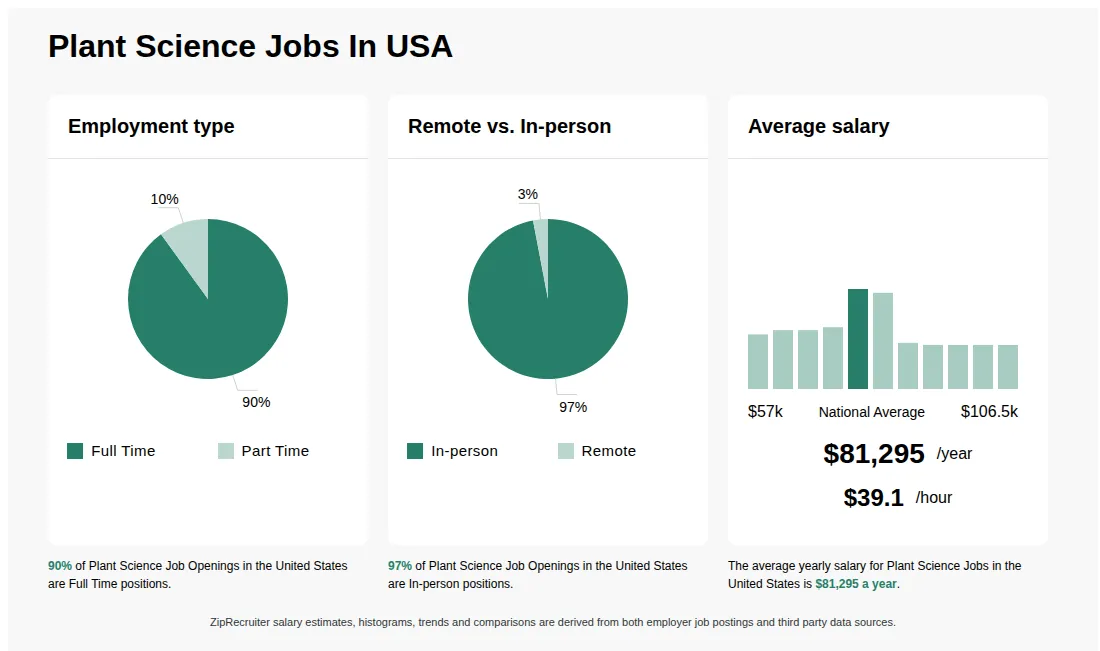
$57K - $61.5K
8% of jobs
$61.5K - $66K
9% of jobs
$69.4K is the 25th percentile. Wages below this are outliers.
$66K - $70.5K
9% of jobs
$70.5K - $75K
9% of jobs
The median wage is $78.8K / yr.
$75K - $79.5K
16% of jobs
$79.5K - $84K
15% of jobs
$84K - $88.5K
7% of jobs
$88.7K is the 75th percentile. Wages above this are outliers.
$88.5K - $93K
6% of jobs
$93K - $97.5K
6% of jobs
$97.5K - $102K
6% of jobs
$102K - $106.5K
6% of jobs
$57K
$81.3K
$106.5K
Plant science jobs focus on studying the biological and chemical aspects of plant growth. Careers in plant science may concentrate on agriculture and botany. The duties of an agricultural scientist include studying the growth of crops and finding ways to increase yield or protect against adverse conditions or pests. A botanist may perform research on existing plants or breed new species to meet agricultural needs. Some plant scientists focus on conservation and the environment. Their responsibilities revolve around working to preserve wild plant life and study how plants and trees grow in nature. Other possible jobs for plant science majors include working as an agronomist, ecologist, naturalist, plant geneticist, research assistant, and science teacher to name a few.
| Aspect | Plant Science | Agronomist |
|---|---|---|
| Credentials | Bachelor's or higher in Plant Science, Biology, or related fields | Bachelor's or higher in Agronomy, Agriculture, or related fields |
| Work Environment | Research labs, greenhouses, field research sites | Farms, research stations, consulting firms |
| Industry Usage | Academic, research institutions, biotech companies | Agricultural production, consulting, crop management |
| Common Search/Comparison | Plant Science vs Agronomist |
Plant Science and Agronomist roles share similar educational backgrounds and work environments focused on plant growth and crop production. However, Plant Science often emphasizes research and development in labs and academic settings, while Agronomists typically work directly with farmers and in field settings to improve crop yields and manage agricultural practices.
Cities with the most Plant Science job openings:
The most popular types of Plant Science jobs are:
States with the most job openings for Plant Science jobs include:
The top searched job categories for Plant Science jobs are:

Gainesville, GA • On-site
Other
Re-posted 20 days ago
Adjunct Faculty
Gainesville, GA, US
HIRING PROCESS: All submitted application materials are forwarded to the appropriate department for review. Hiring recommendations are made at the departmental level. Department representatives will contact candidates directly if an interview is scheduled or if further information is required. The information provided in each job listing below is the extent of what is available to interested candidates. No additional information is available.
Brenau only accepts applications/resumes for advertised positions.
PRE-EMPLOYMENT SCREENINGS: Brenau University will conduct criminal background checks on all persons being considered for initial employment. In some circumstances, an FBI fingerprint report may be necessary to satisfy the requirement. Once employed, employees must hold and continue to maintain a favorable criminal history background. Random background checks are performed. Credit checks may be performed on candidates/employees who are selected for a position that regularly engages in handling credit cards or other company monies. A Motor Vehicle Report (MVR) may be performed during the hiring process, or as part of a random check. MVR checks are required to meet insurance requirements for those employees operating a university vehicle or participating in any driving activity on behalf of Brenau University, (including operating a golf cart, rented vehicle or one’s personal vehicle). Employees who travel must be at least 25 years of age, have a valid Georgia driver’s license, and good driving record. All employees who operate university vehicles, who are employed in a sensitive position, or who travel regularly as part of their job responsibilities may be subject to post-hire drug screening and random drug-screening. All employees are subject to reasonable suspicion drug screening.
EQUAL OPPORTUNITY: Brenau practices and believes in equal opportunity for all students, employees and job applicants. We do not discriminate on the bases of age, race, color, religion, sex (including pregnancy and gender identity), sexual orientation, national origin, disability, genetic information, military service, or any other characteristic protected by federal, state or local law or ordinance. These protections extend to all conditions and privileges of employment, including, without limitation, to recruitment, hiring, compensation, benefits, transfers, promotions, discipline, and termination.
DRUG-FREE WORKPLACE: Brenau University is a drug-free workplace as certified by the Georgia Workers Compensation Board. –View Policy
The Brenau University Department of Math and Science is seeking adjuncts to teach a plant science course. While we are primarily seeking an instructor for our Plant Science course, there may be additional opportunities to teach other biology-based courses. The candidate must be available to teach during the day and on our historic Gainesville campus.
Minimum Qualifications
Preferred Qualifications
Duties and Responsibilities
Environmental and Working Conditions:
Normal environment found in an educational setting
Physical Demands and Aptitudes:
Able to lift 5 pounds on a regular basis and 20 pounds maximum, periodically.
To Apply:
Please complete the online application and submit a cover letter and CV.
Home Campus Designation:
This position is based in Gainesville, GA.
Licensure Requirements:
If the position you are applying for necessitates that you hold a professional degree, license, or certification, then proof of such professional degree, license, or certification must be provided in addition to this application for Brenau University to consider your application for employment. Failure to provide proof of professional degree, license, or certification when applicable may result in rejection of an application.
All positions will be filled pending budgetary review.

Sourced by ZipRecruiter
Colleges, universities, and professional schools
201 - 500 Employees
Gainesville, GA, US
1878