Adjunct Instructor - Botany/Plant Science Required Documents Needed to Upload at Time of Application: • Resume • Unofficial Transcripts Position Summary: To provide quality instruction for ...
Adjunct Instructor - Botany/Plant Science Required Documents Needed to Upload at Time of Application: • Resume • Unofficial Transcripts Position Summary: To provide quality instruction for ...

The Miller and Baxter Laboratories at the Donald Danforth Plant Science Center has an opportunity for a part-time, seasonal Research Assistant position for summer 2026. Research in the Miller lab ...
The Miller and Baxter Laboratories at the Donald Danforth Plant Science Center has an opportunity for a part-time, seasonal Research Assistant position for summer 2026. Research in the Miller lab ...
The Miller and Baxter Laboratories at the Donald Danforth Plant Science Center has an opportunity for a part-time, seasonal Research Assistant position for summer 2026. Research in the Miller lab ...
The Miller and Baxter Laboratories at the Donald Danforth Plant Science Center has an opportunity for a part-time, seasonal Research Assistant position for summer 2026. Research in the Miller lab ...
Field Research Technician I - Temporary
Olivette, MO · On-site
$18.50 - $25.25/hr
The Donald Danforth Plant Science Center is seeking a skilled and dependable Field Research Technician I to support scientific research in a field setting. This position is ideal for candidates who ...
Field Research Technician I - Temporary
Olivette, MO · On-site
$18.50 - $25.25/hr
The Donald Danforth Plant Science Center is seeking a skilled and dependable Field Research Technician I to support scientific research in a field setting. This position is ideal for candidates who ...
Field Research Technician I - Temporary
$18.50 - $25.25/hr
The Donald Danforth Plant Science Center is seeking a skilled and dependable Field Research Technician I to support scientific research in a field setting. This position is ideal for candidates who ...
Field Research Technician I - Temporary
$18.50 - $25.25/hr
The Donald Danforth Plant Science Center is seeking a skilled and dependable Field Research Technician I to support scientific research in a field setting. This position is ideal for candidates who ...

Department Head Plant Science and Landscape Architecture Search #: 499238 Work type: Full-time Location: UConn Storrs Categories: Faculty Department Head/Director INTRODUCTION The Department of Plant ...
Department Head Plant Science and Landscape Architecture Search #: 499238 Work type: Full-time Location: UConn Storrs Categories: Faculty Department Head/Director INTRODUCTION The Department of Plant ...

Student Employee-Ag Business / Plant Science-Assistant
Huntsville, TX · On-site
$13 - $16.50/hr
Posting Details Posting Information Requisition 202600035ST Title Student Employee-Ag Business / Plant Science-Assistant Employee Class Student Employee College Work Study Position No Department ...
Student Employee-Ag Business / Plant Science-Assistant
Huntsville, TX · On-site
$13 - $16.50/hr
Posting Details Posting Information Requisition 202600035ST Title Student Employee-Ag Business / Plant Science-Assistant Employee Class Student Employee College Work Study Position No Department ...
Posting Information Requisition 202600035ST Title Student Employee-Ag Business / Plant Science-Assistant Employee Class Student Employee College Work Study Position No Department School of ...
Posting Information Requisition 202600035ST Title Student Employee-Ag Business / Plant Science-Assistant Employee Class Student Employee College Work Study Position No Department School of ...
Soil Conservationist (District Conservationist)
Cooperstown, NY · On-site
$89K/yr
Courses in soil fertility, soil chemistry, soil genesis, plant physiology, plant science, and field crops are examples of specialized courses that contribute towards meeting the required 12 semester ...
Soil Conservationist (District Conservationist)
Cooperstown, NY · On-site
$89K/yr
Courses in soil fertility, soil chemistry, soil genesis, plant physiology, plant science, and field crops are examples of specialized courses that contribute towards meeting the required 12 semester ...

Announcement Information Posting Number Title Plant Science Instructor (Part-Time Faculty Pool) Madera Community College Campus Location Madera Community College Start Date Essential Functions of ...
Announcement Information Posting Number Title Plant Science Instructor (Part-Time Faculty Pool) Madera Community College Campus Location Madera Community College Start Date Essential Functions of ...

NY · On-site
$89K/yr
Courses in soil fertility, soil chemistry, soil genesis, plant physiology, plant science, and field crops are examples of specialized courses that contribute towards meeting the required 12 semester ...
NY · On-site
$89K/yr
Courses in soil fertility, soil chemistry, soil genesis, plant physiology, plant science, and field crops are examples of specialized courses that contribute towards meeting the required 12 semester ...
Soil Conservationist (District Conservationist)
Florence, SC · On-site
$89K/yr
Courses in soil fertility, soil chemistry, soil genesis, plant physiology, plant science, and field crops are examples of specialized courses that contribute towards meeting the required 12 semester ...
Soil Conservationist (District Conservationist)
Florence, SC · On-site
$89K/yr
Courses in soil fertility, soil chemistry, soil genesis, plant physiology, plant science, and field crops are examples of specialized courses that contribute towards meeting the required 12 semester ...
Soil Conservationist (District Conservationist)
Canton, NY · On-site
$89K/yr
Courses in soil fertility, soil chemistry, soil genesis, plant physiology, plant science, and field crops are examples of specialized courses that contribute towards meeting the required 12 semester ...
Soil Conservationist (District Conservationist)
Canton, NY · On-site
$89K/yr
Courses in soil fertility, soil chemistry, soil genesis, plant physiology, plant science, and field crops are examples of specialized courses that contribute towards meeting the required 12 semester ...
NY · On-site
$89K/yr
Courses in soil fertility, soil chemistry, soil genesis, plant physiology, plant science, and field crops are examples of specialized courses that contribute towards meeting the required 12 semester ...
NY · On-site
$89K/yr
Courses in soil fertility, soil chemistry, soil genesis, plant physiology, plant science, and field crops are examples of specialized courses that contribute towards meeting the required 12 semester ...
NY · On-site
$89K/yr
Courses in soil fertility, soil chemistry, soil genesis, plant physiology, plant science, and field crops are examples of specialized courses that contribute towards meeting the required 12 semester ...
NY · On-site
$89K/yr
Courses in soil fertility, soil chemistry, soil genesis, plant physiology, plant science, and field crops are examples of specialized courses that contribute towards meeting the required 12 semester ...
Soil Conservationist (District Conservationist)
Saint George, SC · On-site
$89K/yr
Courses in soil fertility, soil chemistry, soil genesis, plant physiology, plant science, and field crops are examples of specialized courses that contribute towards meeting the required 12 semester ...
Soil Conservationist (District Conservationist)
Saint George, SC · On-site
$89K/yr
Courses in soil fertility, soil chemistry, soil genesis, plant physiology, plant science, and field crops are examples of specialized courses that contribute towards meeting the required 12 semester ...
Soil Conservationist (District Conservationist)
Riverhead, NY · On-site
$89K/yr
Courses in soil fertility, soil chemistry, soil genesis, plant physiology, plant science, and field crops are examples of specialized courses that contribute towards meeting the required 12 semester ...
Soil Conservationist (District Conservationist)
Riverhead, NY · On-site
$89K/yr
Courses in soil fertility, soil chemistry, soil genesis, plant physiology, plant science, and field crops are examples of specialized courses that contribute towards meeting the required 12 semester ...
Soil Conservationist (District Conservationist)
Walton, NY · On-site
$89K/yr
Courses in soil fertility, soil chemistry, soil genesis, plant physiology, plant science, and field crops are examples of specialized courses that contribute towards meeting the required 12 semester ...
Soil Conservationist (District Conservationist)
Walton, NY · On-site
$89K/yr
Courses in soil fertility, soil chemistry, soil genesis, plant physiology, plant science, and field crops are examples of specialized courses that contribute towards meeting the required 12 semester ...
Soil Conservationist (District Conservationist)
Bishopville, SC · On-site
$89K/yr
Courses in soil fertility, soil chemistry, soil genesis, plant physiology, plant science, and field crops are examples of specialized courses that contribute towards meeting the required 12 semester ...
Soil Conservationist (District Conservationist)
Bishopville, SC · On-site
$89K/yr
Courses in soil fertility, soil chemistry, soil genesis, plant physiology, plant science, and field crops are examples of specialized courses that contribute towards meeting the required 12 semester ...
Soil Conservationist (District Conservationist)
Riverhead, NY · On-site
$89K/yr
Courses in soil fertility, soil chemistry, soil genesis, plant physiology, plant science, and field crops are examples of specialized courses that contribute towards meeting the required 12 semester ...
Soil Conservationist (District Conservationist)
Riverhead, NY · On-site
$89K/yr
Courses in soil fertility, soil chemistry, soil genesis, plant physiology, plant science, and field crops are examples of specialized courses that contribute towards meeting the required 12 semester ...
Plant Science information
See salary details
$57K - $61.5K
8% of jobs
$61.5K - $66K
9% of jobs
$69.4K is the 25th percentile. Wages below this are outliers.
$66K - $70.5K
9% of jobs
$70.5K - $75K
9% of jobs
The median wage is $78.8K / yr.
$75K - $79.5K
16% of jobs
$79.5K - $84K
15% of jobs
$84K - $88.5K
7% of jobs
$88.7K is the 75th percentile. Wages above this are outliers.
$88.5K - $93K
6% of jobs
$93K - $97.5K
6% of jobs
$97.5K - $102K
6% of jobs
$102K - $106.5K
6% of jobs
$57K
$81.3K
$106.5K
How much do plant science jobs pay per year?
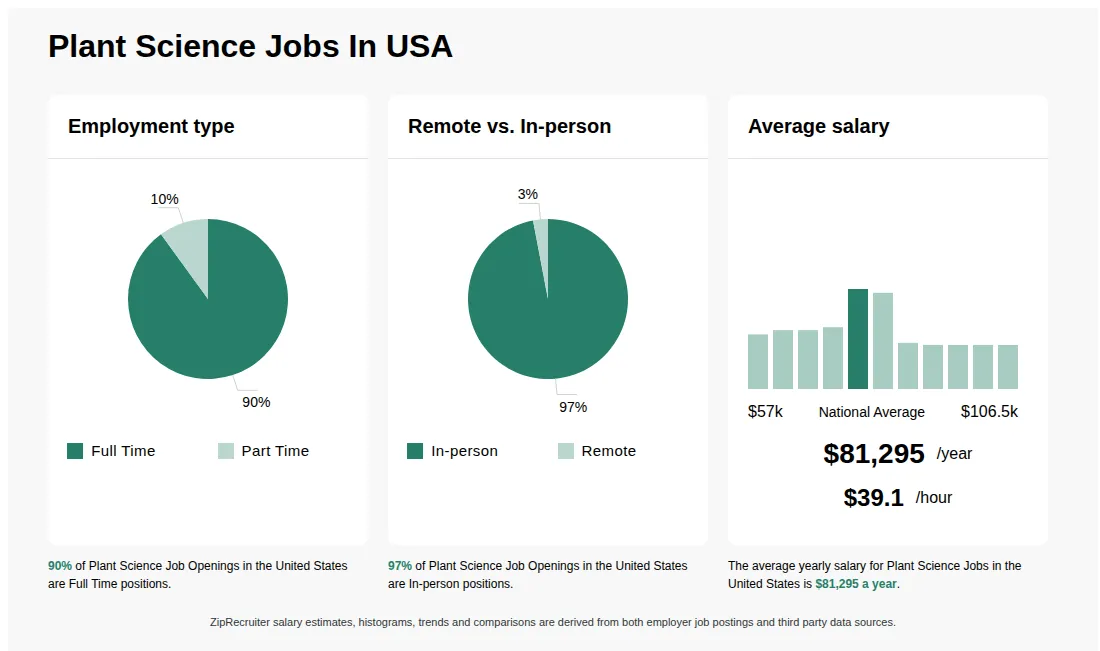
As of Jul 14, 2026, the average yearly pay for plant science in the United States is $81,295.00, according to ZipRecruiter salary data. Most workers in this role earn between $70,000.00 and $92,500.00 per year, depending on experience, location, and employer.
What is the difference between Plant Science vs Agronomist?
| Aspect | Plant Science | Agronomist |
|---|---|---|
| Credentials | Bachelor's or higher in Plant Science, Biology, or related fields | Bachelor's or higher in Agronomy, Agriculture, or related fields |
| Work Environment | Research labs, greenhouses, field research sites | Farms, research stations, consulting firms |
| Industry Usage | Academic, research institutions, biotech companies | Agricultural production, consulting, crop management |
| Common Search/Comparison | Plant Science vs Agronomist |
Plant Science and Agronomist roles share similar educational backgrounds and work environments focused on plant growth and crop production. However, Plant Science often emphasizes research and development in labs and academic settings, while Agronomists typically work directly with farmers and in field settings to improve crop yields and manage agricultural practices.
Does NASA hire botanists?
NASA employs scientists including botanists in roles related to space biology and life sciences research, often focusing on plant growth in microgravity environments. These positions typically require expertise in plant science, laboratory skills, and sometimes advanced degrees. Botanists working for NASA may contribute to experiments on the International Space Station or develop sustainable life support systems for long-duration space missions.
What are some common challenges plant scientists face when conducting field research, and how can they be addressed?
Plant scientists often encounter unpredictable weather, difficult terrain, and variability in plant populations when conducting field research. These challenges can impact data collection and experimental consistency. To address them, scientists typically plan for flexible schedules, use standardized protocols, and employ specialized equipment to gather accurate data under varying conditions. Collaboration with local experts and thorough site preparation can also help mitigate many of these obstacles, ensuring more reliable research outcomes.
What are careers in plant science?
Careers in plant science include roles such as plant biologist, agronomist, horticulturist, and crop scientist. These jobs involve research, crop management, and development of sustainable farming practices, often requiring knowledge of biology, ecology, and laboratory techniques.
What are the key skills and qualifications needed to thrive as a Plant Scientist, and why are they important?
To thrive as a Plant Scientist, you need a solid background in botany, genetics, soil science, and research methodologies, often supported by at least a bachelor's or master's degree in plant science or a related field. Familiarity with laboratory equipment, data analysis software (such as R or SAS), and Geographic Information Systems (GIS) is typically required, along with certifications in pesticide application or laboratory safety when relevant. Analytical thinking, attention to detail, and strong written and verbal communication skills help Plant Scientists collaborate effectively and present their findings. These competencies are crucial for advancing research, solving agricultural challenges, and supporting sustainable food production.
What do plant scientists do?
Plant scientists study the biology, physiology, genetics, and ecology of plants to improve crop yields, understand plant diseases, and promote sustainable agriculture. They may conduct laboratory experiments, fieldwork, or both to research plant growth, breeding, and responses to environmental factors. Their work contributes to food security, environmental conservation, and the development of new plant-based products. Plant scientists often collaborate with farmers, agronomists, and other researchers to apply their findings in real-world settings.
What is the highest paying job in plant science?
The highest paying jobs in plant science are often executive roles such as plant biotech company executives or senior research directors, which can earn six-figure salaries. Specialized roles like plant geneticists with advanced degrees and industry experience also tend to have higher compensation, especially in biotechnology and agricultural corporations.
Is plant science a good degree?
Plant science is a valuable degree for careers in agriculture, research, and environmental management, often leading to roles such as agronomist, horticulturist, or plant biologist. It provides knowledge of plant biology, ecology, and laboratory skills, which are in demand in various industries focused on sustainable agriculture and food security.
What Are Plant Science Jobs?
Plant science jobs focus on studying the biological and chemical aspects of plant growth. Careers in plant science may concentrate on agriculture and botany. The duties of an agricultural scientist include studying the growth of crops and finding ways to increase yield or protect against adverse conditions or pests. A botanist may perform research on existing plants or breed new species to meet agricultural needs. Some plant scientists focus on conservation and the environment. Their responsibilities revolve around working to preserve wild plant life and study how plants and trees grow in nature. Other possible jobs for plant science majors include working as an agronomist, ecologist, naturalist, plant geneticist, research assistant, and science teacher to name a few.
More about Plant Science jobs
What cities are hiring for Plant Science jobs? Cities with the most Plant Science job openings:
What are the most commonly searched types of Plant Science jobs? The most popular types of Plant Science jobs are:
What states have the most Plant Science jobs? States with the most job openings for Plant Science jobs include:
What job categories do people searching Plant Science jobs look for? The top searched job categories for Plant Science jobs are:

Full-time
Re-posted 8 days ago
Job description
Title: Adjunct Instructor - Botany/Plant Science
Required Documents Needed to Upload at Time of Application:
• Resume
• Unofficial Transcripts
Position Summary: To provide quality instruction for student learning and to maintain a positive learning environment in the classroom. The major emphasis will be placed on teaching and evaluating students in the classroom and laboratories.
Department: School of Sciences and Nursing
Duties and Responsibilities:
1. Planning and teaching classes as assigned and as outlined in the course descriptions and course syllabi.
2. Supervising the study and learning activities of students assigned.
3. Submitting requests through the department head, program coordinator, or lead teacher for equipment, supplies, textbooks, and other instructional aids.
4. Evaluating the academic progress of students.
5. Demonstrating knowledge of services, regulations, and procedures as defined in the Adjunct Faculty Handbook.
6. Submitting course grades and performing other administrative duties as required.
7. Scheduling two office hours. For extenuating circumstances in which office hours cannot be scheduled, the adjunct faculty member must submit a written plan to the Dean describing how students can access the instructor. Office hours are not paid during the summer session.
Required Qualifications: Master's degree or higher from a regionally accredited college/university with at least 18 graduate semester hours in Botany/Plant Science the teaching field
Availability/Closing Date: This posting is not a guarantee of an open position. Applications for adjunct faculty positions are accepted continuously and reviewed by the department if openings are available. Adjuncts are hired on an as-needed basis. Future teaching assignments are on a term-by-term basis, which may include fall, spring, and summer. Postings close yearly on January 31; to maintain your application within the system, you will need to re-apply each year.
Special Instructions to Applicants: To be considered for a position at Pellissippi State, you must create an on-line application. Your skills, abilities, qualifications, and years of experience will be evaluated using only what is recorded on your application. Please note: attaching a resume does not substitute for completion of the application form. Part-time work experience is calculated at 50% of full-time experience.
Please note: to scan, upload, or attach documents, a computer and scanner are available at the Hardin Valley Campus Educational Resources Center, if needed.
Pellissippi State Community College does not discriminate on the basis of race, color, religion, creed, ethnicity or national origin, sex, sexual orientation, gender identity/expression, pregnancy, disability, age (40+), status as a protected veteran, genetic information, or any other class protected by Federal or State laws and regulations and by Tennessee Board of Regents policies concerning all employment and education programs and activities. View the nondiscrimination policy. For questions or concerns, please contact George Underwood at gtunderwood@pstcc.edu or 865-539-7354.
The College reserves the right to assign every employee work that fulfills the strategic priorities and mission of the College
If you have any problems or questions, please contact Pellissippi State Community College's Human Resource Office at 865-694-6607 or by email at recruiting@pstcc.edu.
If you are interested in this position, click on the link to the top "right" to apply.
#mrp
Required Documents Needed to Upload at Time of Application:
• Resume
• Unofficial Transcripts
Position Summary: To provide quality instruction for student learning and to maintain a positive learning environment in the classroom. The major emphasis will be placed on teaching and evaluating students in the classroom and laboratories.
Department: School of Sciences and Nursing
Duties and Responsibilities:
1. Planning and teaching classes as assigned and as outlined in the course descriptions and course syllabi.
2. Supervising the study and learning activities of students assigned.
3. Submitting requests through the department head, program coordinator, or lead teacher for equipment, supplies, textbooks, and other instructional aids.
4. Evaluating the academic progress of students.
5. Demonstrating knowledge of services, regulations, and procedures as defined in the Adjunct Faculty Handbook.
6. Submitting course grades and performing other administrative duties as required.
7. Scheduling two office hours. For extenuating circumstances in which office hours cannot be scheduled, the adjunct faculty member must submit a written plan to the Dean describing how students can access the instructor. Office hours are not paid during the summer session.
Required Qualifications: Master's degree or higher from a regionally accredited college/university with at least 18 graduate semester hours in Botany/Plant Science the teaching field
Availability/Closing Date: This posting is not a guarantee of an open position. Applications for adjunct faculty positions are accepted continuously and reviewed by the department if openings are available. Adjuncts are hired on an as-needed basis. Future teaching assignments are on a term-by-term basis, which may include fall, spring, and summer. Postings close yearly on January 31; to maintain your application within the system, you will need to re-apply each year.
Special Instructions to Applicants: To be considered for a position at Pellissippi State, you must create an on-line application. Your skills, abilities, qualifications, and years of experience will be evaluated using only what is recorded on your application. Please note: attaching a resume does not substitute for completion of the application form. Part-time work experience is calculated at 50% of full-time experience.
Please note: to scan, upload, or attach documents, a computer and scanner are available at the Hardin Valley Campus Educational Resources Center, if needed.
Pellissippi State Community College does not discriminate on the basis of race, color, religion, creed, ethnicity or national origin, sex, sexual orientation, gender identity/expression, pregnancy, disability, age (40+), status as a protected veteran, genetic information, or any other class protected by Federal or State laws and regulations and by Tennessee Board of Regents policies concerning all employment and education programs and activities. View the nondiscrimination policy. For questions or concerns, please contact George Underwood at gtunderwood@pstcc.edu or 865-539-7354.
The College reserves the right to assign every employee work that fulfills the strategic priorities and mission of the College
If you have any problems or questions, please contact Pellissippi State Community College's Human Resource Office at 865-694-6607 or by email at recruiting@pstcc.edu.
If you are interested in this position, click on the link to the top "right" to apply.
#mrp

About Tennessee Board of Regents
Sourced by ZipRecruiter
Industry
Colleges, universities, and professional schools
Company size
51 - 200 Employees
Headquarters location
Nashville, TN, US
Year founded
1972