Safety Monitor PT Eves
Providence, RI · On-site
Will also assist clinical staff as needed. clinical staff with de-escalation efforts, patient ... Monitor patients, visitors, and the environment to help maintain a safe and secure setting. Conduct ...
Providence, RI · On-site
Will also assist clinical staff as needed. clinical staff with de-escalation efforts, patient ... Monitor patients, visitors, and the environment to help maintain a safe and secure setting. Conduct ...
Providence, RI · On-site
Will also assist clinical staff as needed. clinical staff with de-escalation efforts, patient ... Monitor patients, visitors, and the environment to help maintain a safe and secure setting. Conduct ...
Sharon, PA · On-site
$15/hr
Patient monitoring and observation are essential to the patient safety observer role. Levels of observation include routine safety checks, constant observation (1:1) and line of sight observation.
New
Sharon, PA · On-site
$15/hr
Patient monitoring and observation are essential to the patient safety observer role. Levels of observation include routine safety checks, constant observation (1:1) and line of sight observation.
New
Linton, IN · On-site
Under the supervision of a nurse, the Patient Safety Attendant provides continuous observation and ... Monitors patient physical and emotional condition and communicates any changes in status to nursing ...
Linton, IN · On-site
Under the supervision of a nurse, the Patient Safety Attendant provides continuous observation and ... Monitors patient physical and emotional condition and communicates any changes in status to nursing ...
Linton, IN · On-site
Patient Safety Attendant Under the supervision of a nurse, the Patient Safety Attendant provides ... Monitors patient physical and emotional condition and communicates any changes in status to nursing ...
Linton, IN · On-site
Patient Safety Attendant Under the supervision of a nurse, the Patient Safety Attendant provides ... Monitors patient physical and emotional condition and communicates any changes in status to nursing ...
$16 - $22/hr
A Patient Safety Assistant would need to be comfortable supervising and monitoring patients such as, but not limited to suicide-watch patients. Education High school graduate or equivalent with GED;
$16 - $22/hr
A Patient Safety Assistant would need to be comfortable supervising and monitoring patients such as, but not limited to suicide-watch patients. Education High school graduate or equivalent with GED;
Linton, IN · On-site
Under the supervision of a nurse, the Patient Safety Attendant provides continuous observation and ... Monitors patient physical and emotional condition and communicates any changes in status to nursing ...
Linton, IN · On-site
Under the supervision of a nurse, the Patient Safety Attendant provides continuous observation and ... Monitors patient physical and emotional condition and communicates any changes in status to nursing ...
Fort Wayne, IN · On-site
$16 - $22/hr
A Patient Safety Assistant would need to be comfortable supervising and monitoring patients such as, but not limited to suicide-watch patients. Education High school graduate or equivalent with GED;
Fort Wayne, IN · On-site
$16 - $22/hr
A Patient Safety Assistant would need to be comfortable supervising and monitoring patients such as, but not limited to suicide-watch patients. Education High school graduate or equivalent with GED;
Asheville, NC · On-site
Utilizes the patient safety platform tracking system to monitor completion and effectiveness of corrective actions Safety Program Development * Reviews, develops and maintains patient safety policies ...
Asheville, NC · On-site
Utilizes the patient safety platform tracking system to monitor completion and effectiveness of corrective actions Safety Program Development * Reviews, develops and maintains patient safety policies ...
Fort Wayne, IN · On-site
$10.58 - $15.87/hr
A Patient Safety Assistant would need to be comfortable supervising and monitoring patients such as, but not limited to suicide-watch patients. Education High school graduate or equivalent with GED;
Fort Wayne, IN · On-site
$10.58 - $15.87/hr
A Patient Safety Assistant would need to be comfortable supervising and monitoring patients such as, but not limited to suicide-watch patients. Education High school graduate or equivalent with GED;
Fort Wayne, IN · On-site
$16 - $22/hr
A Patient Safety Assistant would need to be comfortable supervising and monitoring patients such as, but not limited to suicide-watch patients. Education High school graduate or equivalent with GED;
Fort Wayne, IN · On-site
$16 - $22/hr
A Patient Safety Assistant would need to be comfortable supervising and monitoring patients such as, but not limited to suicide-watch patients. Education High school graduate or equivalent with GED;
Glen Burnie, MD · On-site
$17 - $22.47/hr
General Summary Provides constant observation and support to patients who require close monitoring ... P.R. procedure as needed to ensure patient care and safety. 8. Maintains infection control ...
Glen Burnie, MD · On-site
$17 - $22.47/hr
General Summary Provides constant observation and support to patients who require close monitoring ... P.R. procedure as needed to ensure patient care and safety. 8. Maintains infection control ...
Fort Wayne, IN · On-site
$16 - $22/hr
The Patient Safety Assistant is responsible for: assisting with unit clerical activities; providing supervision and continuous monitoring of the patient to ensure the patient's safety; reporting any ...
Fort Wayne, IN · On-site
$16 - $22/hr
The Patient Safety Assistant is responsible for: assisting with unit clerical activities; providing supervision and continuous monitoring of the patient to ensure the patient's safety; reporting any ...
Cape May Court House, NJ · On-site
$61/hr
Develops and monitors corrective action plans; ensures compliance with regulatory reporting ... Maintain patient safety investigation files and support documentation. * Facilitates ...
Cape May Court House, NJ · On-site
$61/hr
Develops and monitors corrective action plans; ensures compliance with regulatory reporting ... Maintain patient safety investigation files and support documentation. * Facilitates ...
Lanham, MD · On-site
$17 - $22.36/hr
Patient Safety Attendant Maintains safety and security of patients. Provides assistance to nursing ... Monitors patient behavior closely. Remains in close proximity and/or maintains line-of-site ...
Lanham, MD · On-site
$17 - $22.36/hr
Patient Safety Attendant Maintains safety and security of patients. Provides assistance to nursing ... Monitors patient behavior closely. Remains in close proximity and/or maintains line-of-site ...
Responsible for facilitating patient safety monitoring, reporting and improvement activities. Facilitates assigned teams that are consistent with the organization's Strategic Plan, Quality and ...
Responsible for facilitating patient safety monitoring, reporting and improvement activities. Facilitates assigned teams that are consistent with the organization's Strategic Plan, Quality and ...
Lincoln, NE · On-site
Responsible for facilitating patient safety monitoring, reporting and improvement activities. Facilitates assigned teams that are consistent with the organization's Strategic Plan, Quality and ...
Lincoln, NE · On-site
Responsible for facilitating patient safety monitoring, reporting and improvement activities. Facilitates assigned teams that are consistent with the organization's Strategic Plan, Quality and ...
Fort Wayne, IN · On-site
$10.58 - $15.87/hr
A Patient Safety Assistant would need to be comfortable supervising and monitoring patients such as, but not limited to suicide-watch patients. Education High school graduate or equivalent with GED;
Fort Wayne, IN · On-site
$10.58 - $15.87/hr
A Patient Safety Assistant would need to be comfortable supervising and monitoring patients such as, but not limited to suicide-watch patients. Education High school graduate or equivalent with GED;
Fort Wayne, IN · On-site
$16 - $22/hr
A Patient Safety Assistant would need to be comfortable supervising and monitoring patients such as, but not limited to suicide-watch patients. Education High school graduate or equivalent with GED;
Fort Wayne, IN · On-site
$16 - $22/hr
A Patient Safety Assistant would need to be comfortable supervising and monitoring patients such as, but not limited to suicide-watch patients. Education High school graduate or equivalent with GED;
Milwaukee, WI · On-site
$17.75 - $22.75/hr
Conducts and facilitates credible systematic investigations on patient safety events through to implementation and control phase of monitoring to sustain improvement. Reports barriers to success in a ...
Milwaukee, WI · On-site
$17.75 - $22.75/hr
Conducts and facilitates credible systematic investigations on patient safety events through to implementation and control phase of monitoring to sustain improvement. Reports barriers to success in a ...
Fort Wayne, IN · On-site
$16 - $22/hr
A Patient Safety Assistant would need to be comfortable supervising and monitoring patients such as, but not limited to suicide-watch patients. Education High school graduate or equivalent with GED;
Fort Wayne, IN · On-site
$16 - $22/hr
A Patient Safety Assistant would need to be comfortable supervising and monitoring patients such as, but not limited to suicide-watch patients. Education High school graduate or equivalent with GED;
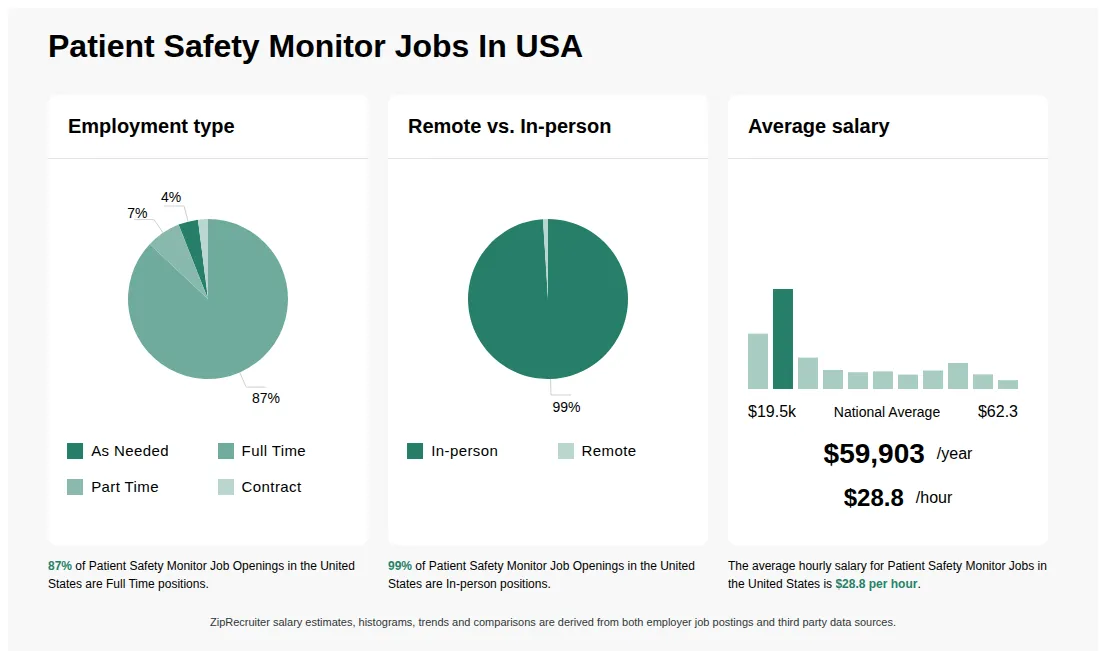
$9.38 - $14.18
18% of jobs
$15.22 is the 25th percentile. Wages below this are outliers.
$14.18 - $18.99
32% of jobs
$18.99 - $23.80
10% of jobs
$23.80 - $28.61
5% of jobs
$28.61 - $33.41
5% of jobs
$37.74 is the 75th percentile. Wages above this are outliers.
$33.41 - $38.22
5% of jobs
$38.22 - $43.03
4% of jobs
$43.03 - $47.84
5% of jobs
$47.84 - $52.64
9% of jobs
$52.64 - $57.45
4% of jobs
$57.45 - $62.26
2% of jobs
$9
$28
$62
A Patient Safety Monitor is responsible for observing patients to prevent falls, injuries, or other safety risks in a healthcare setting. They ensure that patients follow safety protocols and report any concerns to nursing staff. Their role is crucial for maintaining a safe environment, particularly for high-risk or vulnerable patients. This position requires strong attention to detail and communication skills to respond quickly to patient needs.
A typical day for a Patient Safety Monitor involves conducting regular safety rounds, reviewing incident reports, and monitoring compliance with safety protocols across various hospital units or departments. You will work closely with nurses, physicians, and other healthcare staff to investigate safety events, identify patterns or potential hazards, and recommend process improvements. Documentation and reporting of findings, as well as assisting with staff training on patient safety procedures, are also key responsibilities. This role is dynamic and requires adaptability, as priorities may shift based on emerging safety concerns or new regulatory requirements.
A Patient Safety Monitor needs a solid understanding of healthcare regulations, clinical procedures, and patient safety principles, often supported by experience in healthcare settings and sometimes a background in nursing or public health. Familiarity with incident reporting systems, data analysis tools, and compliance tracking software is highly beneficial. Strong attention to detail, analytical thinking, and effective communication skills help Patient Safety Monitors excel in identifying risks and collaborating with staff. These competencies are crucial for proactively addressing safety concerns and optimizing the overall quality of patient care.
Cities with the most Patient Safety Monitor job openings:
The most popular types of Patient Safety Monitor jobs are:
States with the most job openings for Patient Safety Monitor jobs include:
The top searched job categories for Patient Safety Monitor jobs are:

Part-time
Re-posted 12 days ago
7.4
Based on 33 frontline employees who took The Breakroom Quiz
266th of 898 rated healthcare providers
Security Guard work in our Emergency Room and throughout Butler Hospital campus. Responsible to perform scanning procedures on all non-staff entering the department. Will also assist clinical staff as needed. clinical staff with de-escalation efforts, patient interventions, and other security-related support as needed.
Duties & Responsibilities
Perform security screening procedures for non-staff entering the Patient Assessment and Emergency Department areas.
Monitor patients, visitors, and the environment to help maintain a safe and secure setting.
Conduct routine rounds of designated areas and report unusual conditions, safety concerns, or security incidents.
Assist clinical staff with de-escalation efforts, patient interventions, and other security-related support as needed.
Support the detection, confiscation, and secure handling of prohibited items in accordance with established procedures.
Complete required logs, reports, and other documentation accurately and in a timely manner.
Follow hospital policies, safety procedures, infection control standards, and confidentiality requirements.
Provide professional, respectful service to patients, visitors, and staff while responding to security needs.
Requirements
Education:
High School or GED PreferredExperience:Minimum 6 Months to 1 Year
Previous background preferred:
Healthcare Security
Police
Military
Emergency Medical Service (EMS)
Licenses: Valid driver's license
Knowledge, Skills, & Abilities:
Knowledge of basic hospital security and safety procedures.
Ability to observe, assess situations, and respond appropriately.
Skill in using screening equipment and documenting incidents.
Effective communication and customer service skills.
Ability to remain calm, maintain confidentiality, and work well with others.
Schedule: 20/40 Part Time Evenings
About UsCare New England Health System (CNE) and its member institutions, Butler Hospital, Women & Infants Hospital, Kent Hospital, VNA of Care New England, Integra, The Providence Center, and Care New England Medical Group, is a trusted, integrated health care organization that fuels the latest advances in medical research, attracts the nation's top specialty-trained doctors, hones renowned services and innovative programs, and engages in the important discussions people need to have about their health and end-of-life wishes. Care New England is helping to transform the future of health care, providing a leading voice in the ongoing effort to ensure the health of the individuals and communities we serve.
Americans with Disability Act Statement: External and internal applicants, as well as position incumbents who become disabled must be able to perform the essential job-specific functions either unaided or with the assistance of a reasonable accommodation, to be determined by the organization on a case-by-case basis.
EEOC Statement: Care New England is an equal opportunity employer. All applicants will be considered for employment without attention to race, color, religion, sex, sexual orientation, gender identity, national origin, veteran or disability status
Ethics Statement: Employee conducts himself/herself consistent with the ethical standards of the organization including, but not limited to hospital policy, mission, vision, and values.
Employment Type: PART_TIMEGet the full story on Breakroom

Sourced by ZipRecruiter
Health care and social assistance
1,001 - 5,000 Employees
Providence, RI, US
1996