1

Motion Capture Actor Jobs (NOW HIRING)

... Squared members, acting as the primary liaison between program members and the 10 Squared ... Experience using force plates, motion capture camera systems and other data collection devices

Senior Coach

Austin, TX · On-site

$110K - $130K/yr

... Squared members, acting as the primary liaison between program members and the 10 Squared ... Experience using force plates, motion capture camera systems and other data collection devices

... acting as a key liaison for a seamless experience. • Committing to ongoing education and training ... plates, motion capture camera systems and other data collection devices • Knowledge and ...

Direct on-set talent (engineers, executives, actors) and serve as a primary visual lead on set ... motion graphics partners for major campaigns. * Brand & Stills Photography (Secondary): Capture ...

Direct on-set talent (engineers, executives, actors) and serve as a primary visual lead on set ... motion graphics partners for major campaigns. * Brand & Stills Photography (Secondary): Capture ...

Direct on-set talent (engineers, executives, actors) and serve as a primary visual lead on set ... motion graphics partners for major campaigns. * Brand & Stills Photography (Secondary): Capture ...

Direct on-set talent (engineers, executives, actors) and serve as a primary visual lead on set ... motion graphics partners for major campaigns. * Brand & Stills Photography (Secondary): Capture ...

Sports Videographer

San Leandro, CA · On-site

$15.50 - $20/hr

Travels to various games, camps and events to capture shots and video footage. * May assist other ... motion graphics, color correction, and publishing. * Proven ability to be detail oriented, meet ...

Showing results 21-40

Motion Capture Actor information

See salary details

$5

$22

$54

How much do motion capture actor jobs pay per hour?

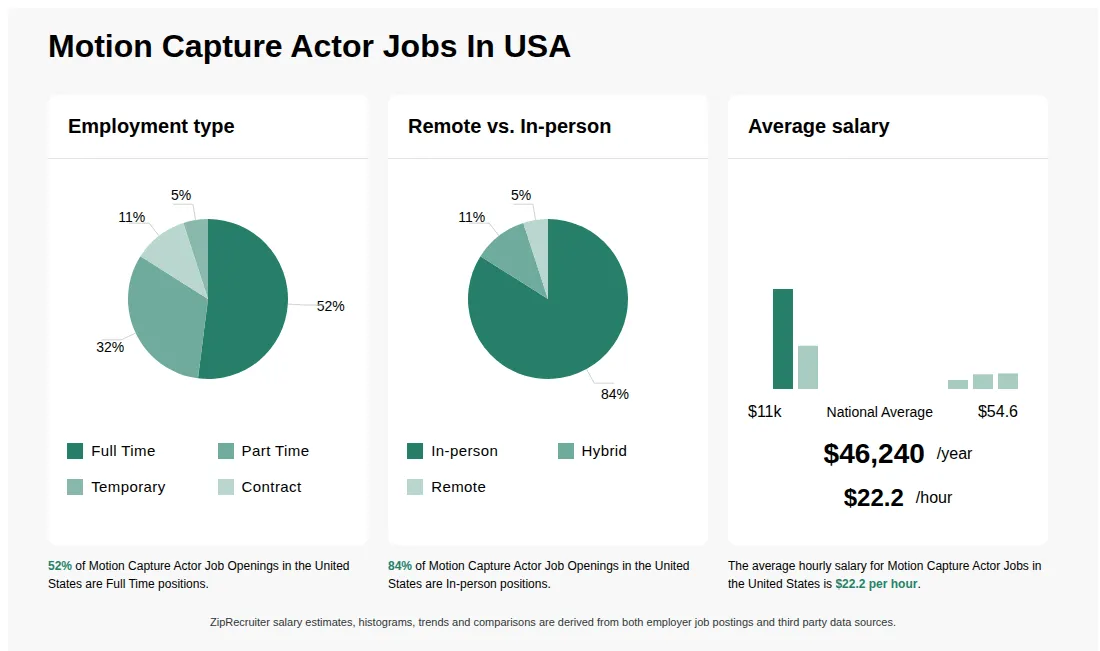
As of Sep 13, 2026, the average hourly pay for motion capture actor in the United States is $22.23, according to ZipRecruiter salary data. Most workers in this role earn between $11.06 and $43.75 per hour, depending on experience, location, and employer.

What is a motion capture actor?

A Motion Capture (MoCap) Actor performs physical movements, gestures, and expressions that are recorded using special sensors and cameras to create digital characters for video games, movies, and animations. Their movements help bring CGI characters to life by providing realistic and natural motion. MoCap actors often wear a special suit fitted with markers or sensors that track their motions in real-time. This data is then used by animators and VFX artists to refine and integrate the performance into a project.

What does a typical day look like for a motion capture actor on set?

A typical day for a Motion Capture Actor involves suiting up in specialized sensors and performing choreographed actions or delivering lines in a studio equipped with multiple cameras. You may be asked to perform a range of movements—from walking or running to complex fight sequences—often repeating actions for different camera angles or data fidelity. Collaborating closely with directors, animators, and other actors is common, as feedback is provided in real time to adjust your performance. Adaptability is key, as you may need to embody various characters or creatures depending on the project. Each day can present new creative and physical challenges, making the work both demanding and rewarding.

What are the key skills and qualifications needed to thrive as a motion capture actor?

To thrive as a Motion Capture Actor, you need strong physical performance abilities, body awareness, and often a background in acting, dance, or movement-based disciplines. Experience with motion capture suits, facial capture rigs, and familiarity with software like Vicon or OptiTrack can be beneficial. Flexibility, clear communication, and the ability to collaborate with directors and animators are valuable soft skills. These skills are important as motion capture acting requires precise physical expression and seamless teamwork to accurately bring digital characters to life.

More about Motion Capture Actor jobs

What cities are hiring for Motion Capture Actor jobs?

Cities with the most Motion Capture Actor job openings:

What are the most commonly searched types of Motion Capture Actor jobs?

The most popular types of Motion Capture Actor jobs are:

What states have the most Motion Capture Actor jobs?

States with the most job openings for Motion Capture Actor jobs include:

What are popular job titles related to Motion Capture Actor jobs?

For Motion Capture Actor jobs, the most frequently searched job titles are:

Infographic showing various Motion Capture Actor job openings in the United States as of September 2026, with employment types broken down into 77% Full Time, 15% Part Time, and 8% Contract. Highlights an 70% In-person, 15% Hybrid, and 15% Remote job distribution, with an average salary of $46,240 per year, or $22.2 per hour.

Sr. Software Engineer - Data Collection

San Francisco, CA • On-site

$144K - $190K/yr

Full-time

Posted 26 days ago


Job description

You'll be the reason Anvil's data collection system goes from "the parts work" to "the whole thing works."
Anvil is building the platform layer for Physical AI: robotics hardware and software that is radically more accessible than legacy industrial solutions. We own and operate our own manufacturing, and in our first 12 months we built and shipped 200+ robots to customers in 60+ countries: NVIDIA's GEAR lab (the team behind GR00T), Physical Intelligence (the frontier lab behind pi0), Qualcomm, Toyota, Google, and the robot learning labs at Stanford, MIT, Columbia, CMU, and Georgia Tech. The researchers who define this field run their experiments on our hardware, and many of them bought it with their own money.
Devkits are the wedge, not the business. That volume has earned us a custom force sensing actuator partnership with major actuator OEMs, and the install base becomes both the distribution channel for our next generation robots and a platform for the data and software layers above them. The handheld data collection system is the front end of that strategy: the instrument that turns real world tasks into training data at scale.
Our handheld data collection system lets people capture high quality demonstration data for training robots to do real tasks, wherever the task actually happens, with no teleoperation rig and no motion capture stage required.
The situation you're walking into:
  • Anvil already has specialist engineers deep in each piece of this system: pose tracking, model training, SoC/chip integration, and industrial design. Each piece works, but nobody currently owns making them work together as one product a customer can actually pick up and use. That is the gap you would fill.

What you'll own:
  • Full technical ownership of pulling the handheld data collection software system together end to end.
  • Acting as the systems and product engineer across specialist teams, including pose tracking, model training, SoC/chip, and industrial design. You will not personally do their deep technical work, but you are the one who understands how it all needs to fit together, catches the gaps between teams, and makes the call on what integrates now versus later.
  • Building real infrastructure for parts of the system that do not have it yet, including turning the model team's scripts into something repeatable.

What the first 100 days look like:
  • By day 30: ramped on every major piece of the system, including pose tracking, app software, cloud pipeline, and the model team's current workflow, well enough to know where the real gaps are, not just the documented ones. Has personally used the device to collect data end to end at least once.
  • By day 60: has shipped a first concrete integration or reliability improvement that makes two previously disconnected pieces of the system actually work together better.
  • By day 100: is the person other engineers, including those in pose tracking, model training, SoC/chip, and industrial design, go to when something is not fitting together. Trusted with real technical judgment calls across team boundaries without formal authority over any of those teams.

Who you are:
  • You have done systems or product integration work for a robotic or perception based product before. You have been the person who made disparate technical pieces (hardware, perception, software, sometimes ML) work together into something a real user relied on. This matters more than depth in any single domain.
  • You have genuine, provable depth in at least one of the following, along with familiarity with several of the others:
    • Perception/robotics systems (SLAM, VIO, sensor fusion, mapping)
    • Embedded application development: you have gotten real applications built, deployed, and running reliably on constrained or embedded hardware
    • Cloud scale pose estimation or perception pipeline engineering: building systems that turn sensor data into trustworthy estimates reliably at scale
    • ML workflow, training, and deployment engineering
    • Physical AI and robot learning deployment, for example VLA style policies, getting a trained model to actually make a robot do something
  • You can operate as a team of one across teams you don't manage, building enough technical credibility in each domain to know when something's actually wrong versus just unfamiliar to you.
  • You default to shipping the smallest thing that actually closes an integration gap, rather than hacking something bespoke every time or overbuilding a general platform nobody's asked for yet.
  • Based in or willing to relocate to Taiwan, the USA, or Trinidad & Tobago. This is the same role and scope regardless of location.

Education & experience:
  • Master's degree in robotics, computer science, electrical engineering, or a related field - or a bachelor's with equivalent hands-on depth. A PhD is not required; this is a product integration role, not a research role.
  • Years matter less to us than trajectory. The typical shape is 3-5 years of engineering experience, but 2-3 unusually fast-growing years count fully if they were spent working directly alongside a staff or principal engineer on a shipped robotics or perception product. Our ideal candidate has been the second chair on a real integration effort - watched how the cross-team calls get made, made a growing share of them under a senior engineer's cover - and is ready to own the whole thing for the first time.

What this role is not:
  • Not a role where you'll personally develop the core SLAM algorithms, train the models, or design the chip. Those are owned by dedicated specialist engineers and teams. Your job is integration and systems and product judgment across their work, not doing their jobs for them.
  • Not a management role. No direct reports today. You will drive alignment and technical decisions across teams you have no formal authority over. The "tech lead" part of this role is earned through judgment and trust, not a title.
  • Not a narrow software engineering role focused on one clean layer of the stack. If you want to specialize in a single domain and hand off everything else, this isn't the right fit.
  • Not a role with mature ML and data infrastructure to inherit. Where that does not exist yet, you are building it, not maintaining someone else's.