1

Level 1 Trauma Rn Jobs (NOW HIRING)

next page

Showing results 1-20

Level 1 Trauma Rn information

See salary details

$298

$2.5K

$3.8K

How much do level 1 trauma rn jobs pay per week?

As of Jun 25, 2026, the average weekly pay for level 1 trauma rn in the United States is $2,493.62, according to ZipRecruiter salary data. Most workers in this role earn between $1,942.31 and $3,019.23 per week, depending on experience, location, and employer.

What is a Level 1 Trauma RN?

A Level 1 Trauma RN is a registered nurse who works in a Level 1 trauma center, the highest designation for trauma care. These nurses are specially trained to provide rapid, advanced care to patients with severe and life-threatening injuries. Their role includes triage, emergency interventions, and collaborating closely with trauma surgeons and other healthcare professionals. They must be skilled in critical care, quick decision-making, and operating in high-pressure environments. Level 1 Trauma RNs are essential members of the trauma response team and often require certifications such as ACLS (Advanced Cardiovascular Life Support) and TNCC (Trauma Nursing Core Course).

How to make 150,000 as a nurse?

To earn $150,000 as a Level 1 Trauma RN, gaining experience in high-acuity settings, obtaining specialized certifications like TNCC or ENPC, and working in hospitals with higher pay scales or overtime opportunities can help increase earnings. Working additional shifts, pursuing advanced roles such as charge nurse, or relocating to areas with higher compensation may also contribute to reaching this salary goal.

What are some common challenges faced by a Level 1 Trauma RN, and how can I prepare for them?

Level 1 Trauma RNs often encounter high-pressure situations, including rapidly changing patient conditions and a fast-paced work environment. You may need to make quick decisions, prioritize multiple critical patients, and collaborate closely with physicians, surgeons, and other team members. Building strong critical thinking skills, staying calm under stress, and practicing clear communication are essential for success. Many new trauma nurses benefit from shadowing experienced colleagues and participating in ongoing training specific to trauma care protocols.

What to do with a nursing degree when you hate nursing?

A Level 1 Trauma RN with a nursing degree who dislikes nursing can consider transitioning to related healthcare roles such as healthcare administration, case management, or medical education, which utilize clinical knowledge without direct patient care. Additional certifications or training in areas like health informatics or public health can open alternative career paths within the healthcare industry.

What are the key skills and qualifications needed to thrive as a Level 1 Trauma RN, and why are they important?

To thrive as a Level 1 Trauma RN, you need advanced clinical skills in emergency nursing, trauma assessment, and acute care, underpinned by a nursing degree, RN licensure, and often certifications like TNCC (Trauma Nursing Core Course) or ACLS (Advanced Cardiac Life Support). Familiarity with trauma registry systems, electronic health records (EHRs), and rapid-response medical equipment is crucial. Quick decision-making, resilience under pressure, and exceptional teamwork and communication set outstanding trauma nurses apart. These competencies are essential for delivering lifesaving care efficiently and safely in high-stakes, fast-paced trauma environments.

What is the difference between Level 1 Trauma Rn vs Level 2 Trauma Rn?

AspectLevel 1 Trauma RnLevel 2 Trauma Rn
CertificationsRN license, trauma certification preferredRN license, trauma certification optional
Work EnvironmentMajor trauma centers, high-acuity casesCommunity hospitals, less complex trauma cases
ResponsibilitiesAdvanced trauma care, leadership in trauma protocolsInitial trauma assessment, supportive care

The main difference between a Level 1 Trauma Rn and a Level 2 Trauma Rn lies in the scope of practice and work environment. Level 1 Trauma Rns work in major trauma centers handling complex cases and often participate in trauma team leadership, while Level 2 Trauma Rns typically work in community hospitals managing less severe trauma cases. Both roles require RN licensure and trauma knowledge, but Level 1 positions often demand additional certifications and experience.

What do level 1 trauma nurses do?

Level 1 trauma nurses provide immediate care to critically injured patients in emergency and trauma settings, performing assessments, administering treatments, and coordinating care with a multidisciplinary team. They must have strong clinical skills, often hold certifications like ACLS and PALS, and work in fast-paced environments such as trauma centers or emergency departments.

How to make $300,000 as a nurse?

To earn $300,000 as a Level 1 Trauma RN, you typically need extensive experience, advanced certifications, and work in high-paying settings such as specialized trauma units or travel nursing. Working overtime, taking on leadership roles, or pursuing additional certifications like CCRN can also increase earning potential. Salary varies by location and facility, so negotiating pay and seeking opportunities in high-demand areas are important strategies.
More about Level 1 Trauma Rn jobs
What cities are hiring for Level 1 Trauma Rn jobs? Cities with the most Level 1 Trauma Rn job openings:
What states have the most Level 1 Trauma Rn jobs? States with the most job openings for Level 1 Trauma Rn jobs include:
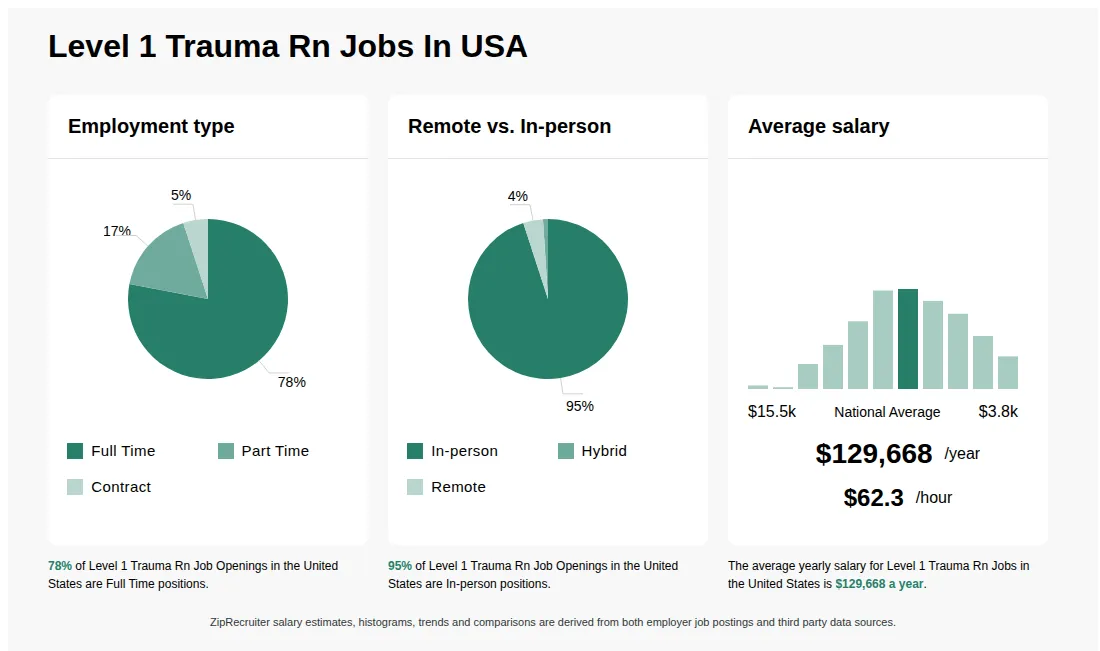
Infographic showing various Level 1 Trauma Rn job openings in the United States as of June 2026, with employment types broken down into 3% As Needed, 12% Full Time, 67% Part Time, and 18% Contract. Highlights an 93% Physical, 1% Hybrid, and 6% Remote job distribution, with an average salary of $129,668 per year, or $62.3 per hour.
Registered Nurse - Level 1 Trauma - Emergency Department 7p-7a

Registered Nurse - Level 1 Trauma - Emergency Department 7p-7a

Sentara Health

Norfolk, VA

$10K/mo

Full-time, Other

Medical, Dental, Vision, Life, Retirement, PTO

Posted 4 days ago


Sentara Health rating

6.8

Company rating: 6.8 out of 10

Based on 385 frontline employees who took The Breakroom Quiz

485th of 875 rated healthcare providers


Job description

City/State
Norfolk, VA
Work Shift
Third (Nights)
Overview:
Sentara Norfolk General Hospital is seeking a Registered Nurse (RN) for the (ED) - Level 1 Trauma Center
Shift: Full Time- Night shift - 7p - 7a
Sign-On Bonus available for Qualified Candidates and Relocation Assistance Available!
The Norfolk General Hospital's Emergency Department is a 53-bed unit. Our Trauma One Facility is equipped to handle a variety of medical emergencies, and approximately 10% are Trauma related.
**Sentara Norfolk General Emergency Department is one of only 94 in the United States to receive the Lantern Award from the Emergency Nurses' Association this year.
**The Lantern Award honors "exceptional and innovative leadership, practice, education, advocacy, and research."
Sentara Norfolk General Hospital is the region's first Magnet Hospital. It is a 525-bed medical center, serves as a primary teaching facility, and home to the area's only Level 1 Trauma Center within a 126-mile region.
Our Norfolk General facility has four intensive care units and two intensive care units in our 112-bed Nationally Ranked Heart Hospital that sits on our campus.
As aRegistered Nursewith Sentara, you can excel in your career. There are many different specialties where you can perform and grow your nursing skills in areas of interest to you. If you desire, there are promotional opportunities into leadership or to advance your level of care in a variety of settings. This position's primary duties include assessing/admitting patients, rounding checks, giving medications, talking with family members, and being responsible for the overall care of your patients. You will find that teamwork is exceptional, with everyone working together to ensure the best care for our patients. Click to hear Felicia tell us about a day in the life of a Registered Nurse (RN) with Sentara Healthcare.
Benefits: Sentara offers an attractive array of full-time benefits to include Medical, Dental, Vision, Paid Time Off, Sick, Tuition Reimbursement, a 401k/403B with matching funds, 401a, Performance Plus Bonus, Career Advancement Opportunities, Work Perks, and more.
Our success is supported by a family-friendly culture that encourages community involvement and creates unlimited opportunities for development and growth.
Be a part of an excellent healthcare organization that cares about our People, Quality, Patient Safety, Service, and Integrity. Join a team that has a mission to improve health every day and a vision to be the healthcare choice of the communities that we serve!
Keywords: Talroo - Nursing, RN, Registered Nurse, Emergency Department, Urgent Care, ER
.
Benefits: Caring For Your Family and Your Career
• Medical, Dental, Vision plans
• Adoption, Fertility and Surrogacy Reimbursement up to $10,000
• Paid Time Off and Sick Leave
• Paid Parental & Family Caregiver Leave
• Emergency Backup Care
• Long-Term, Short-Term Disability, and Critical Illness plans
• Life Insurance
• 401k/403B with Employer Match
• Tuition Assistance - $5,250/year and discounted educational opportunities through Guild Education
• Student Debt Pay Down - $10,000
• Reimbursement for certifications and free access to complete CEUs and professional development
• Pet Insurance
• Legal Resources Plan
• Colleagues may have the opportunity to earn an annual discretionary bonus if established system and employee eligibility criteria is met
Here at Sentara, we are committed to consistently enhancing our training, advancement tracks, work-life benefits, and more. Our goal is to make you feel more excited to be here every day!
Sentara Norfolk General Hospital , located in Norfolk, VA, is a 525-bed tertiary care facility that is home to the only Level I Adult Trauma Center and burn trauma unit in Hampton Roads, and also serves as the primary teaching hospital for Eastern Virginia Medical School.
In addition to the high-quality heart program at Sentara Heart Hospital, our facility is home to Nightingale Regional Air Ambulance and several other dedicated facilities and specialized services. As a recognized accredited Comprehensive Stroke Center, and Magnet hospital for nursing excellence, our hospital specializes in heart and vascular, neurosciences, neurosurgery, urology, oncology, spine care, advanced imaging, behavioral health, maternity, and women's health, including a state-of-the-art neonatal intensive care unit.
Sentara Health is an equal opportunity employer and prides itself on the diversity and inclusiveness of its close to an almost 30,000-member workforce. Diversity, inclusion, and belonging is a guiding principle of the organization to ensure its workforce reflects the communities it serves.
In support of our mission “to improve health every day,” this is a tobacco-free environment.
For positions that are available as remote work, Sentara Health employs associates in the following states:
Alabama, Delaware, Florida, Georgia, Idaho, Indiana, Kansas, Louisiana, Maine, Maryland, Minnesota, Nebraska, Nevada, New Hampshire, North Carolina, North Dakota, Ohio, Oklahoma, Pennsylvania, South Carolina, South Dakota, Tennessee, Texas, Utah, Virginia, Washington, West Virginia, Wisconsin, and Wyoming.

What Sentara Health employees say

Pay

Benefits

Hours and flexibility

Workplace

Get the full story on Breakroom