1

Hypnosis Jobs (NOW HIRING)

... hypnosis. 6. Uses quantitative/qualitative methods to calculate fluid/blood loss during surgery. Administers intravenous fluids, blood and/or blood products based on above criteria and including ...

Psychologist 2 (NY HELPS)

Lansing, NY · On-site

$86K - $109K/yr

Non-qualifying degree programs/majors include but are not limited to the following: education, counseling, clinical counseling, clinical hypnosis, community counseling, educational counseling ...

... hypnosis. 6. Uses quantitative/qualitative methods to calculate fluid/blood loss during surgery. Administers intravenous fluids, blood and/or blood products based on above criteria and including ...

next page

Showing results 1-20

Hypnosis information

See salary details

$18

$42

$66

How much do hypnosis jobs pay per hour?

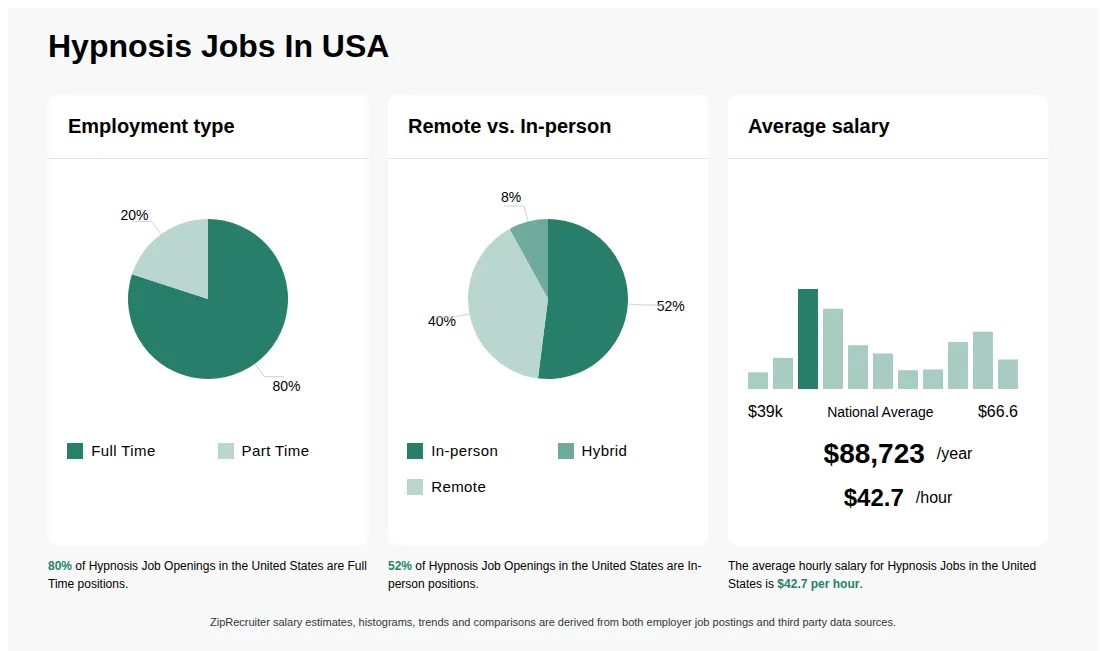
As of Jun 7, 2026, the average hourly pay for hypnosis in the United States is $42.66, according to ZipRecruiter salary data. Most workers in this role earn between $31.25 and $56.97 per hour, depending on experience, location, and employer.

What is hypnosis and how does it work?

Hypnosis is a trance-like state of focused attention and heightened suggestibility, often used for therapeutic purposes. During hypnosis, a trained practitioner guides an individual into a relaxed state where they are more open to positive suggestions and changes in perception or behavior. It is not mind control, and individuals remain aware of their surroundings and in control at all times. Hypnosis can be used to help with issues like stress, pain management, and breaking unwanted habits. The effectiveness of hypnosis varies from person to person.

What are some common challenges faced by professional hypnotists when working with clients?

Professional hypnotists often encounter challenges such as building trust and rapport with clients who may be skeptical or anxious about hypnosis. It is also common to face varying levels of client responsiveness, which requires adaptability in technique and communication. Additionally, hypnotists must maintain clear ethical boundaries and be well-versed in recognizing when a client's needs exceed the scope of hypnosis, necessitating a referral to another healthcare professional. Working collaboratively with clients and sometimes coordinating with other practitioners is essential for effective outcomes.

What is the difference between Hypnosis vs Hypnotherapist?

AspectHypnosisHypnotherapist
CredentialsTypically no formal certification required for self-hypnosis or general practiceRequires certification or licensing from accredited hypnotherapy programs
Work EnvironmentSelf-practice, clinical settings, or workshopsClinics, private practices, wellness centers
Industry UsageUsed as a technique within therapy, entertainment, or self-helpProfessionally trained practitioner providing therapy or coaching

Hypnosis is a technique or state of focused attention, often used for self-improvement or entertainment. A hypnotherapist is a trained professional who uses hypnosis as a therapeutic tool to help clients with various issues. While anyone can practice self-hypnosis, hypnotherapists have specialized training to guide others safely and effectively.

What are the key skills and qualifications needed to thrive as a Hypnotist, and why are they important?

To thrive as a Hypnotist, you need a solid understanding of human psychology, hypnosis techniques, and often a certification from a recognized hypnosis or hypnotherapy organization. Familiarity with tools such as guided scripts, audio recording devices, and client management systems is also common. Exceptional interpersonal skills, empathy, and strong communication abilities help build trust and rapport with clients. These competencies are crucial for creating a safe and effective environment, enabling clients to achieve their therapeutic or behavioral goals through hypnosis.

What Are the Qualifications to Get a Hypnosis Job?

The qualifications and skills that you need to start a career in hypnosis depend on the responsibilities of your job. If you use hypnosis for clinical purposes, you need an advanced degree in most states. The American Society of Clinical Hypnosis only offers certification for doctors, psychologists, and nurses with a master’s degree. Another professional organization, the American Association of Professional Hypnotherapists, requires classroom work for certification but does not have educational or professional requirements. Hypnotherapists without a medical background can still practice hypnosis, but they cannot offer any medical services or diagnose clients.


What cities are hiring for Hypnosis jobs? Cities with the most Hypnosis job openings:
What are the most commonly searched types of Hypnosis jobs? The most popular types of Hypnosis jobs are:
What states have the most Hypnosis jobs? States with the most job openings for Hypnosis jobs include:
Infographic showing various Hypnosis job openings in the United States as of May 2026, with employment types broken down into 93% Full Time, and 7% Part Time. Highlights an 84% Physical, 3% Hybrid, and 13% Remote job distribution, with an average salary of $88,723 per year, or $42.7 per hour.
Pediatric CRNA - CHM

Pediatric CRNA - CHM

TH Medical

Detroit, MI • On-site

Other

Medical, Dental, Vision, Life, Retirement, PTO

Posted 26 days ago


Job description

Detroit Medical Center Central Campus is committed to providing exceptional patient care in a supportive and collaborative environment. As a member of our team, you will have the opportunity to work with advanced technology and be part of a healthcare community dedicated to making a positive impact on the lives of our patients.

Benefit Statement:

At Tenet Healthcare, we understand that our greatest asset is our dedicated team of professionals. That's why we offer more than a job - we provide a comprehensive benefit package that prioritizes your health, professional development, and work-life balance. The available plans and programs include:
   Medical, dental, vision, and life insurance
   401(k) retirement savings plan with employer match
   Generous paid time off (PTO)
   Career development and continuing education opportunities
   Health savings accounts, healthcare C dependent flexible spending accounts
   Employee Assistance program, Employee discount program
   Voluntary benefits include pet insurance, legal insurance, accident and critical illness insurance, long term care, elder C childcare, auto C home insurance.

Note: Eligibility for benefits may vary by location and is determined by employment status

Job Summary:

Under general supervision and in collaboration with a physician, the CRNA will fulfill responsibilities according to educational preparation, clinical expertise and established standards, protocols and practices of advanced practice nurses. Responsibilities include the administration of anesthetics and adjunctive medications to render patients insensible to pain; monitoring patient's condition while under anesthesia; initiation of corrective actions using professional judgment; and functioning as a team member to perform preoperative reassessment, preoperative assessment, anesthetic management and post-anesthesia care of the patient. Responsibilities also include leadership and educational functions. 

PRINCIPAL DUTIES AND RESPONSIBILITIES: 

1. Establishes preoperative rapport with patients and patients' families; provides clear/concise explanations to patients' questions and/or concerns, using tact and sensitivity in all interactions. Informs patient of the anesthetic options and associated risk and benefits. 

2. Develops, in collaboration with a physician, a comprehensive and individualized anesthetic care plan based on complete review of patient history, planned procedure and the physical status of the patient. Requests or orders additional tests as indicated. Reassesses patient condition and proposed anesthetic plan immediately prior to surgery. 

3. Assesses and documents the integrity of all equipment and necessary supplies prior to the initiation of anesthesia. 

4. Determines the need for invasive and non-invasive techniques/procedures and monitoring equipment. Selects, applies and/or inserts the necessary equipment, catheters and/or monitors to deliver continuous and safe patient care. 

5. Implements the anesthetic plan and technique as developed which includes the administration of intravenous, inhalation, Monitored Anesthesia Care (MAC), local and/or regional anesthetic agents and/or adjunctive medications to produce and maintain general anesthesia, regional anesthesia, sedation, analgesia and/or hypnosis. 

6. Uses quantitative/qualitative methods to calculate fluid/blood loss during surgery. Administers intravenous fluids, blood and/or blood products based on above criteria and including sound judgment and in accordance with specific patient rights and preference. 

7. Provides continuous monitoring according to established guidelines and documentation of significant events occurring during induction of, maintenance of and emergence from anesthesia; evaluates and interprets patient's responses and various test results via the use of a variety of monitoring modalities such as precordial or esophageal stethoscope, temperature monitor, gas analyzer, pulse oximetry, capnography, electrocardiography, blood pressure, spirometry, blood gases, central venous pressure and pulmonary artery pressure. Adjusts the anesthetic care plan according to direct patient observation and/or information from various monitoring methods. 

8. Transports patients to the recovery area, conducts assessment and provides summary report of the patient's condition to the recovery room personnel for continuum of care; assesses and treats adverse reactions to anesthesia in postoperative area. 

9. Uses established criteria to evaluate and discharge patients from recovery room according to established departmental guidelines. Provides a summary of post anesthetic condition following surgery including reference to anesthesia-related complications 

10. Provides professional support and resuscitative care, including tracheal intubation on an emergency/urgent basis throughout the hospital and adjacent facilities 

11. Demonstrates skill in the use of a variety of anesthetic equipment including trouble-shooting and basic maintenance. Follows appropriate procedure to identify, label and report defective equipment. 

12. Develops and demonstrates ongoing professional growth and development; serves as an expert and/or consultant for other personnel in the system. 

13. Actively participates with physicians as a team member to manage patients with acute and/or chronic pain. 

14. Demonstrates active involvement in required educational experiences and assignments (e.g., supervising, mentoring and evaluating students and other health care personnel. 

15. Maintains a working knowledge of the DMC and department policies, procedures, goals and objectives. Actively participates in departmental quality assurance, committees and continuous improvement programs. 

16. Conducts research independently and/or in collaboration with students or other disciplines. Uses research data and continuous quality improvement processes to make recommendations for changes in clinical practice that will result in improvement of patient outcomes and system changes 

17. Integrates clinical and management skills with fiscal responsibility. 

18. Provides leadership for committees/task forces to address departmental, regional and system concerns. 

19. Functions in a collaborative manner to precept and mentor individuals involved in patient care. 

20. Demonstrates active involvement in community activities and those activities that are congruent with the mission of the organization. 

21. In addition to the general responsibilities, CRNA's may seek application for affiliation to the academic program with responsibilities for didactic education for students/residents associated with certified anesthesia programs. 

1. Graduate from an accredited school of nursing. 

2. Graduate from an accredited school of anesthesia. 

3. National CRNA certification and/or re-certification. 

4. Michigan license to practice as a registered nurse. 

5. Michigan Specialty Certification in Anesthesia. 

6. Current member of American Association of Nurse Anesthetists. 

7. Masters degree in anesthesia or other related area, preferred. 

Facility Description:

The Detroit Medical Center (DMC) is a nationally recognized health care system that serves patients and families throughout Michigan and beyond. A premier healthcare resource, our mission is to help people live happier, healthier lives. The hospitals of the Detroit Medical Center are the Children's Hospital of Michigan, Detroit Receiving Hospital, Harper University Hospital, Hutzel Women's Hospital, the DMC Heart Hospital, Huron Valley-Sinai Hospital, the Rehabilitation Institute of Michigan and Sinai-Grace Hospital.

DMC's 150-year legacy of medical excellence and service provides patients and families world-class care in cardiovascular health, women's services, neurosciences, stroke treatment, orthopedics, pediatrics, rehabilitation, organ transplant and other general and specialty services.
DMC is a key partner in Detroit's resurgence, which continues to draw national and international attention. A dedicated corporate citizen with strong community ties, DMC is one of the largest and most diverse employers in Southeast Michigan.

EEO Statement:

Employment practices will not be influenced or affected by an applicant's or employee's race, color, religion, sex (including pregnancy), national origin, age, disability, genetic information, sexual orientation, gender identity or expression, veteran status or any other legally protected status. Tenet will make reasonable accommodations for qualified individuals with disabilities unless doing so would result in an undue hardship.

Tenet participates in the E-Verify program.

Follow the link below for additional information. 

E-Verify: http://www.uscis.gov/e-verify

The employment practices of Tenet Healthcare and its companies comply with all applicable laws and regulations