1

Hydraulic Modeler Jobs (NOW HIRING)

Hydraulic Designer

Raleigh, NC · On-site

$59K - $89K/yr

Your Opportunity + Impact The Hydraulic Designer is an entry‑level technical role on the ... Utilizes CADD and OpenRoads Designer (ORD) to develop drainage models, storm drain systems, and ...

Hydraulic Designer

Raleigh, NC · On-site

$59K - $89K/yr

Your Opportunity + Impact The Hydraulic Designer is an entry-level technical role on the ... Utilizes CADD and OpenRoads Designer (ORD) to develop drainage models, storm drain systems, and ...

Sr. Hydraulic Designer

Raleigh, NC · On-site

$72K - $108K/yr

Performs HEC-RAS 1D modeling for culverts and bridges; 2D modeling experience is a plus. * Supports NCDOT bridge and culvert replacement projects, including hydraulic reports, scour analysis, and ...

Hydraulic Engineer Co-Op

Alpharetta, GA · On-site

$79K - $104K/yr

About the Hydraulic Engineering Team Hydraulic Engineering at Colonial focuses on pipeline system modeling, operational analysis, and system optimization to ensure safe and compliant energy ...

next page

Showing results 1-20

Hydraulic Modeler information

See salary details

$22

$40

$76

How much do hydraulic modeler jobs pay per hour?

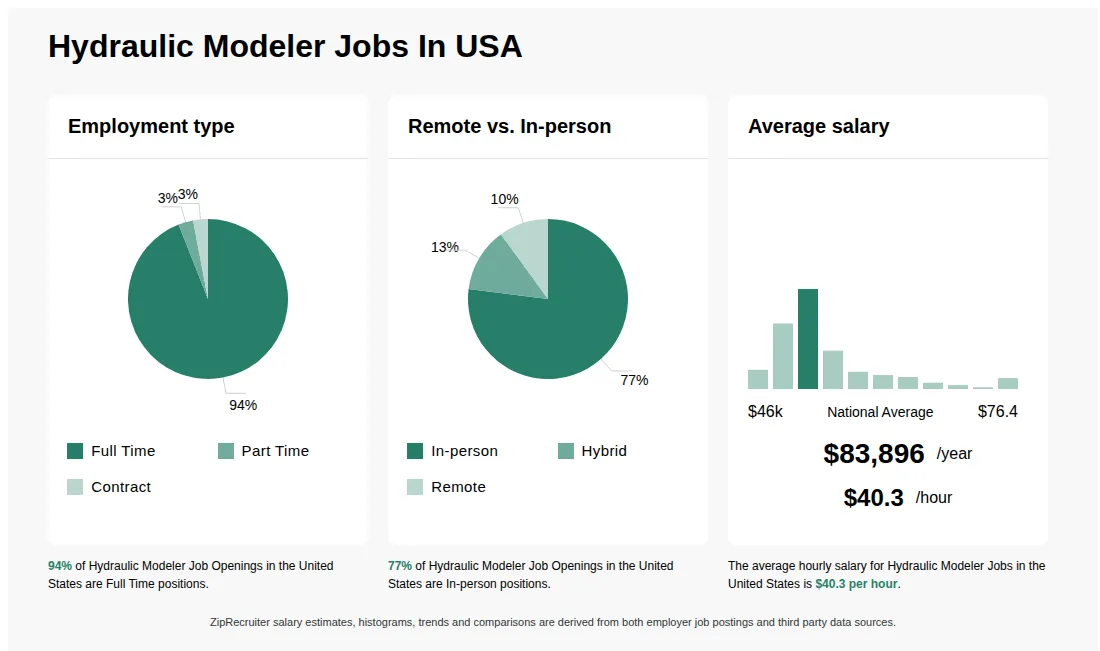
As of Jul 2, 2026, the average hourly pay for hydraulic modeler in the United States is $40.33, according to ZipRecruiter salary data. Most workers in this role earn between $31.25 and $43.51 per hour, depending on experience, location, and employer.

How much do hydraulic modellers make?

Hydraulic modellers typically earn between $60,000 and $90,000 annually, depending on experience, location, and industry. Senior roles or those with specialized skills in modeling software like HEC-RAS or MIKE can earn higher salaries, especially with professional certifications and project management experience.

What is the difference between Hydraulic Modeler vs Civil Engineer?

AspectHydraulic ModelerCivil Engineer
Required CredentialsBachelor's in Civil, Environmental, or Hydraulic Engineering; certifications in hydraulic modeling softwareBachelor's in Civil, Structural, or Environmental Engineering; PE license often preferred
Work EnvironmentDesign firms, consulting agencies, government agencies focused on water resourcesConstruction sites, design firms, infrastructure projects
Industry UsageSpecialized in water flow, flood risk, and hydraulic systemsBroad engineering projects including transportation, structures, water resources

Hydraulic Modelers focus specifically on modeling water systems and hydraulic simulations, while Civil Engineers have a broader scope including infrastructure design and construction. Both roles often collaborate but differ in specialization and project focus.

What are some typical challenges faced by hydraulic modelers when working on large-scale infrastructure projects?

Hydraulic modelers working on large-scale infrastructure projects often encounter challenges such as integrating complex data from multiple sources, ensuring model accuracy with limited field data, and adapting models to reflect real-world changes over time. Collaboration with engineers, planners, and environmental scientists is essential to address these issues and ensure models meet regulatory and client requirements. Staying current with modeling software and industry standards also helps overcome these challenges and deliver reliable results.

What are the key skills and qualifications needed to thrive as a Hydraulic Modeler, and why are they important?

To thrive as a Hydraulic Modeler, you need a solid background in civil or environmental engineering, hydrology, and fluid mechanics, often supported by a relevant degree. Proficiency in modeling software such as HEC-RAS, SWMM, InfoWorks, or MIKE, as well as GIS applications, is typically required. Analytical thinking, attention to detail, and strong communication skills help in interpreting data and conveying complex findings to stakeholders. These skills are crucial for producing accurate models that inform infrastructure planning, flood risk assessment, and water resource management.

How to become a hydraulic modeller?

To become a hydraulic modeller, typically a bachelor's degree in civil engineering, environmental engineering, or a related field is required. Gaining experience with hydraulic modeling software such as HEC-RAS, MIKE, or InfoWorks, along with strong analytical skills and knowledge of fluid mechanics, is essential. Professional certifications and on-the-job training can further enhance qualifications for this role.

What is a Hydraulic Modeler?

A Hydraulic Modeler is a professional who uses mathematical models and computer simulations to analyze and predict the behavior of water flows in natural and engineered systems, such as rivers, stormwater networks, and water treatment facilities. They play a crucial role in designing infrastructure, assessing flood risks, and optimizing water resource management. Hydraulic Modelers often work with specialized software to create accurate models that help inform engineering decisions and environmental planning.

What is hydraulic modeling?

Hydraulic modeling is the process used by hydraulic modelers to simulate the flow of water within a system such as a river, pipe network, or stormwater drainage. It involves creating detailed computer models using specialized software to analyze water movement, pressure, and capacity, which helps in designing, planning, and managing hydraulic infrastructure. Strong skills in hydraulics, fluid mechanics, and software tools like HEC-RAS or MIKE21 are essential for this role.
More about Hydraulic Modeler jobs
What states have the most Hydraulic Modeler jobs? States with the most job openings for Hydraulic Modeler jobs include:
What job categories do people searching Hydraulic Modeler jobs look for? The top searched job categories for Hydraulic Modeler jobs are:
Infographic showing various Hydraulic Modeler job openings in the United States as of June 2026, with employment types broken down into 98% Full Time, and 2% Nights. Highlights an 87% Physical, 4% Hybrid, and 9% Remote job distribution, with an average salary of $83,896 per year, or $40.3 per hour.
Hydraulic Designer

Hydraulic Designer

Larson Design Group

Raleigh, NC • On-site

$59K - $89K/yr

Full-time

Posted 21 days ago


Job description

About Us

Larson Design Group (LDG) is an award-winning, employee-owned Architecture, Engineering, and Consulting Firm. Guided by our core values, we’re expanding our team, opening new offices, and adding new offerings to provide responsive, innovative solutions to clients nationwide.   

Being 100% employee-owned directly impacts our culture: it drives our decision-making, motivates our teams, increases our productivity, improves retention, and contributes to the future success of our company. Our culture is one where we work hard for our clients and for each other – and we have fun collaborating, sharing experience and expertise, and learning along the way. We’re passionate about delivering exceptional quality, elevating client relationships, enriching the careers and lives of our employee owners, and enhancing the communities where we live and serve.     

At LDG, we strive to create an organization where people want to work. We offer a flexible work environment, paid training for required licensures, competitive benefits, bonus plans, and a company-funded Employee Stock Ownership Plan (ESOP) while supporting your professional and personal growth.    

Your Opportunity + Impact

The Hydraulic Designer is an entry‑level technical role on the Professional Engineer licensure track. This position applies basic to intermediate hydraulic engineering principles to support design computations, technical reports, drainage plans, and hydraulic modeling. Under the guidance of senior hydraulic engineers, the associate contributes to NCDOT drainage design, bridge and culvert replacement projects, and hydrologic/hydraulic analyses using CADD and OpenRoads Designer (ORD).

Key Responsibilities

  • Prepares and reviews hydraulic design computations, drainage layouts, and plan drawings.
  • Supports NCDOT bridge and culvert replacement projects, including hydraulic reports, scour analysis, and drainage design tasks.
  • Utilizes CADD and OpenRoads Designer (ORD) to develop drainage models, storm drain systems, and plan sheets.
  • Assists with NCDOT drainage design, including stormwater conveyance systems, ditches, channels, and erosion control features.
  • Reviews submittals and assists with project documentation and submissions.
  • Prepares and reviews specifications, draft letters, and written technical reports.
  • Researches, interprets, and applies NCDOT design standards, codes, and permitting requirements.
  • Maintains accurate documentation of work and project records.
  • Develops technically accurate, clean, and deliverable hydraulic drawings.
  • Promotes and supports quality assurance and quality control processes to reduce design errors and improve deliverable quality.

Education and Experience

  • Education: Bachelor’s or Master’s Degree in Civil Engineering or related field from an ABET‑accredited program.
  • Experience: 0–2 years of relevant experience; prior internships in transportation, hydraulics, or A/E consulting preferred. Experience with CADD / OpenRoads Designer (ORD).
  • Licensure/Certification: Engineer‑in‑Training (EIT) preferred.

Preferred Qualifications

  • Strong desire to expand hydraulic engineering knowledge and take on new responsibilities.
  • Proficient in Microsoft Office Suite (Excel, Word, PowerPoint, Outlook).
  • Excellent organizational and time‑management skills to handle multiple tasks and meet deadlines.
  • Strong oral and written communication skills; able to work independently and collaboratively within a project team.

EEO Statement

Larson Design Group, Inc. is an Affirmative Action and Equal Opportunity Employer (EEO) that is committed to diversity and inclusion in the workplace. We prohibit discrimination and harassment of any kind based on race, color, sex, religion, sexual orientation, national origin, disability, genetic information, pregnancy, or any other protected characteristic as outlined by federal, state, or local laws. This policy applies to all employment practices within our organization.

Powered by JazzHR

10e4FrcJeo