1

Flight Data Monitoring Jobs (NOW HIRING)

Works as a member of the flight crew including monitoring data in real time to assure the safety and proper conduct of flight tests. * Reports on completed tests including reporting any observed ...

Works as a member of the flight crew including monitoring data in real time to assure the safety and proper conduct of flight tests. * Reports on completed tests including reporting any observed ...

Flight Following (FF): Issue information and advisories to arriving, departing, and enroute aircraft; monitor flight progress, receive/post/relay progress reports, and update flight data strips ...

next page

Showing results 1-20

Flight Data Monitoring information

See salary details

$10

$31

$63

How much do flight data monitoring jobs pay per hour?

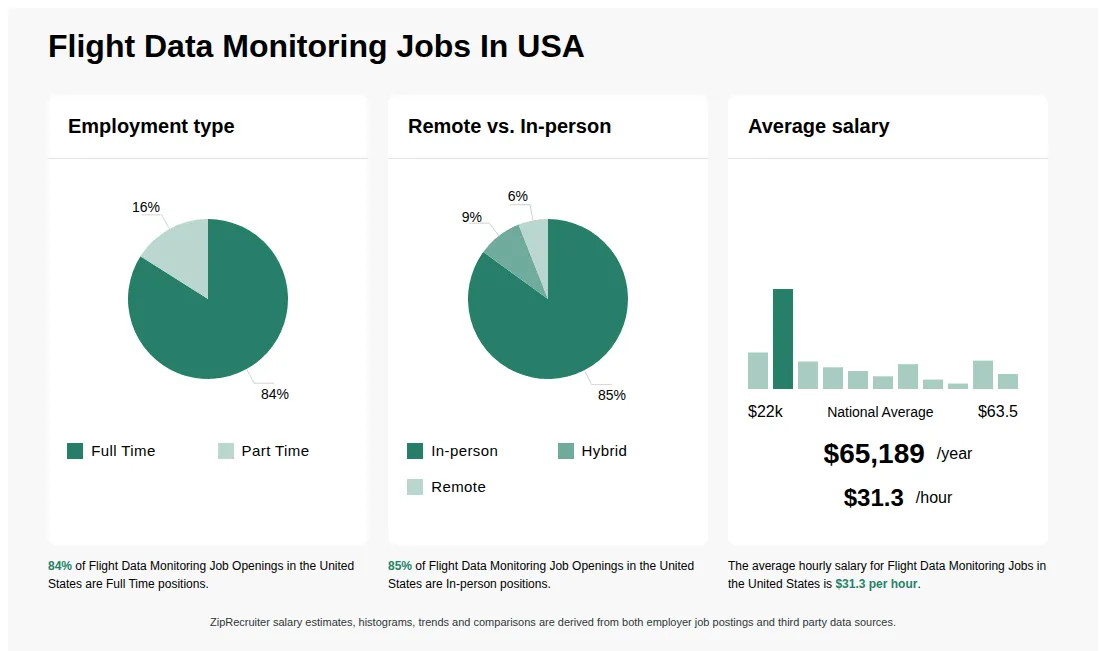
As of Jul 11, 2026, the average hourly pay for flight data monitoring in the United States is $31.34, according to ZipRecruiter salary data. Most workers in this role earn between $16.59 and $43.03 per hour, depending on experience, location, and employer.

What are the key skills and qualifications needed to thrive in the Flight Data Monitoring position, and why are they important?

To thrive in Flight Data Monitoring, you need strong analytical skills, a solid understanding of aviation safety standards, and often a degree in aeronautical engineering, aviation management, or a related field. Familiarity with Flight Data Monitoring (FDM) software, flight data analysis tools, and knowledge of regulatory frameworks such as EASA or FAA requirements are commonly required. Attention to detail, effective communication, and the ability to work collaboratively with pilots and safety teams are essential soft skills. These competencies ensure accurate data interpretation, facilitate proactive safety measures, and foster a culture of continuous safety improvement in aviation operations.

What is the highest paying flight job?

The highest paying flight jobs are typically senior airline pilots, especially captains of large commercial aircraft, with salaries often exceeding $200,000 annually. Factors such as experience, airline size, and type of aircraft influence compensation, and additional certifications like type ratings can enhance earning potential.

How much do flight coordinators get paid?

Flight coordinators typically earn a median annual salary between $40,000 and $60,000, depending on experience, location, and employer. Salaries can vary based on certifications, such as IATA or FAA credentials, and the complexity of the airline or organization they work for.

How much does a flight navigator make?

A flight navigator's salary typically ranges from $70,000 to $120,000 annually, depending on experience, airline, and location. The role requires strong navigation skills, certifications, and often involves working irregular hours and being part of a flight crew.

What is a Flight Data Monitoring job?

A Flight Data Monitoring (FDM) job involves analyzing and interpreting flight data to enhance aviation safety and operational efficiency. FDM professionals collect and process data from flight recorders to identify trends, risks, and potential hazards. They work closely with safety teams, pilots, and engineers to recommend corrective actions and improve training programs. This role helps airlines and aviation organizations comply with regulatory requirements and maintain the highest safety standards.

What are the typical daily responsibilities of a Flight Data Monitoring specialist?

A Flight Data Monitoring specialist is responsible for collecting, processing, and analyzing flight data to identify safety trends and potential risks. Their daily tasks often include reviewing flight records, generating safety reports, and coordinating with flight crews and safety departments to discuss findings and recommend corrective actions. The role may also involve maintaining FDM systems and ensuring compliance with regulatory guidelines. This position requires close collaboration with various teams to support continuous safety enhancement and operational efficiency.

What is flight data monitoring?

Flight data monitoring is the process of collecting, analyzing, and reviewing flight data to ensure safety, compliance, and operational efficiency. It involves using specialized tools and software to detect anomalies, identify safety risks, and support maintenance decisions, often requiring knowledge of aviation regulations and data analysis skills.
More about Flight Data Monitoring jobs
What cities are hiring for Flight Data Monitoring jobs? Cities with the most Flight Data Monitoring job openings:
What are the most commonly searched types of Flight Data Monitoring jobs? The most popular types of Flight Data Monitoring jobs are:
What states have the most Flight Data Monitoring jobs? States with the most job openings for Flight Data Monitoring jobs include:
Infographic showing various Flight Data Monitoring job openings in the United States as of July 2026, with employment types broken down into 83% Full Time, 4% Part Time, and 13% Contract. Highlights an 96% In-person, and 4% Remote job distribution, with an average salary of $65,189 per year, or $31.3 per hour.
Principal Flight Test Engineer

Full-time

Re-posted 5 days ago


Job description

JOB DESCRIPTION: Principal Flight Test Engineer

Orsa Technologies is seeking qualified candidates to provide Principal Engineer Operational Flight Test and Evaluation to Marine Operational Test and Evaluation Squadron One. The Operational Test and Evaluation Engineer will conduct operational tests and evaluations to ensure the effectiveness and suitability of Marine Corps aviation assets, which include UAS, helicopters, and fixed-wing aircraft. The Operational Test Engineer works closely with pilots and other Marine Corps and Navy subject matter experts to plan for test events, collect data, and analyze results. Draft reports to ensure verified and validated operational requirements are met, and capabilities are effective and suitable.

DAILY RESPONSIBILITES MAY INCLUDE:

  • Work closely with active-duty test directors, government civilians and contractor support staff to plan for, execute, collect/analyze data, report on test and evaluation events.
  • Plan and administer performance tests on military aeronautical equipment, controls, systems, and other products and systems.
  • Designs and directs engineering and technical personnel in testing and test-control apparatus and equipment.
  • Coordinate and direct engineering activities concerning the development, procurement, installation, and calibration of instruments, equipment, and control devices required to test, telemeter, record, and reduce test data.
  • Determine conditions under which tests are to be conducted and sequences/phases of test operations. Direct and exercise control over operational, functional, and performance phases of tests.
  • Primarily responsible for the creation and dissemination of test data cards for all test events. At the conclusion of test events, will review all data cards to ensure all data has been captured.
  • Analyzes and interpret test data and prepare technical reports for use by engineering and management personnel.
  • Test planning functions involve determining measures, data requirements, and flight condition requirements to safely provide evaluation, qualification, and certification data. Will have the lead responsibility of preparing for test planning meetings and writing test plans.
  • Test conduct involves briefing flight and ground crews and real-time telemetry monitoring of critical parameters. Large volumes of gathered flight data are processed, analyzed, and reported. Will have the lead responsibility of writing test reports and data analysis summaries.
  • This position also involves significant teamwork and coordination with flight test co-workers in various disciplines (pilots, mechanics, inspectors, instrumentation, and data technicians), qualification or certification authority representatives, and subject matter expert design engineers.
  • Is the primary interface with Operational Test Authorities and the lead expert in the mechanics of their test processes.

MANDATORY REQUIREMENTS:

  • Bachelor of Science (Aerospace, Mechanical, Electrical Engineering or other technical field) degree or equivalent experience and training.
  • At least 8 years of experimental or Operational flight test experience as a Flight Test Engineer.
  • Excellent interpersonal skills to effectively communicate with colleagues across various technical disciplines.
  • Must be capable of completing an NCIC criminal background check to access military installations.
  • Strong technical and analytical skills.
  • Must be able to work independently and on a team and travel as required.
  • Read and speak English proficiently.
  • Must be able to write clear and concise test documents
  • Must be a US citizen.
  • Must have a valid photo ID (driver's license + social security card or birth certificate OR US passport).
  • Must have a valid driver's license/vehicle insurance to drive on U.S. Military Installations.
  • Must be able to travel based on program requirements.

DESIRED REQUIREMENTS:

  • B.S. in Aerospace Engineering or Mechanical Engineering
  • Experimental flight test experience as a Flight Test Engineer, preferably including VTOL or STOVL and fly-by-wire.
  • Aircraft maintenance or pilot experience, preferably from a recognized test pilot school or equivalent on the job experience.
  • Experience with Modeling and Simulation tools such as MATLAB and Simulink
  • General knowledge of aviation rules and procedures
  • Computer skills to include Microsoft Office applications and basic knowledge of analytical software
  • Ability to effectively communicate orally and in written reports
  • Ability to multi-task
  • Strong attention to detail and the ability to assess problems quickly and easily.
  • Ability to work independently as well as in a team environment.
  • Ability to multi-task and employ problem-solving skills
  • Ability to take the initiative in problem-solving and achieve organizational goals with minimal oversight

CLEARANCE REQUIREMENTS: This position requires a government security clearance. Must be a US Citizen for consideration. Must possess a secret clearance or be able to obtain a secret clearance.

EDUCATION REQUIREMENTS: Bachelor's, Master's, or Doctorate of Science degree from an accredited course of study in Aerospace, Mechanical, Electrical Engineering or other technical field.

ORSA Technologies is an Equal Opportunity/Affirmative Action Employer. All qualified applicants will receive consideration for employment without regard to race, color, religion, sex, sexual orientation, gender identity, national origin, disability, veteran status or other characteristics protected by law.