1

Fidelity Jobs (NOW HIRING)

$30 - $50/hr

Become a High Fidelity Wraparound (HFW) Supervisor Lead a Team. Empower Families. Transform Lives. Are you an experienced behavioral health professional with a passion for coaching others and ...

next page

Showing results 1-20

Fidelity information

See salary details

$32K

$65.4K

$147.5K

How much do fidelity jobs pay per year?

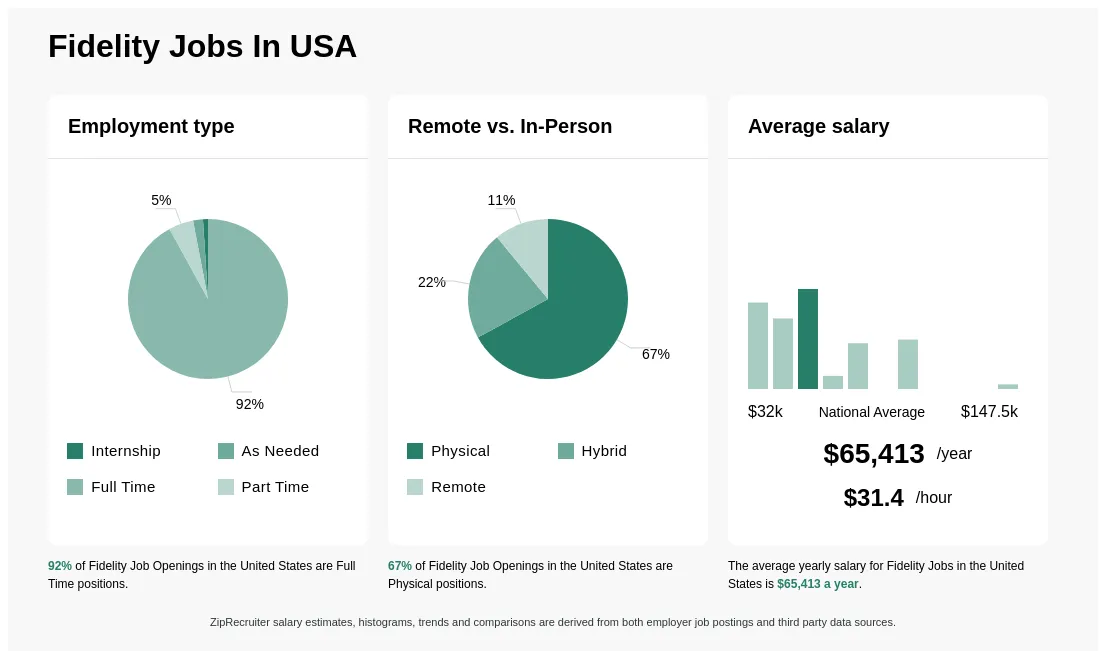
As of Jul 9, 2026, the average yearly pay for fidelity in the United States is $65,413.00, according to ZipRecruiter salary data. Most workers in this role earn between $42,500.00 and $79,000.00 per year, depending on experience, location, and employer.

What are the key skills and qualifications needed to thrive as a Fidelity Analyst, and why are they important?

To thrive as a Fidelity Analyst, you need strong analytical abilities, attention to detail, and a solid understanding of finance or investment principles, often backed by a degree in finance, economics, or a related field. Familiarity with portfolio management software, financial modeling tools, and certifications like CFA or Series 7 are typically advantageous. Excellent communication, problem-solving, and client service skills help build trust and effectively address client needs. These capabilities are critical for ensuring accurate investment analysis, regulatory compliance, and successful client outcomes in financial services.

What are some common challenges faced by Fidelity Analysts when working with sensitive financial data?

Fidelity Analysts often handle sensitive client and transactional data, making data security and accuracy top priorities. Common challenges include ensuring compliance with strict regulatory standards, managing large volumes of confidential information, and maintaining up-to-date knowledge of evolving security protocols. Collaborating closely with compliance officers, IT security teams, and other analysts is essential to effectively mitigate risks and ensure data integrity. Staying organized and detail-oriented helps Fidelity Analysts meet these challenges while supporting the company’s commitment to client trust.

What is an entry-level job at Fidelity?

An entry-level job at Fidelity typically includes roles such as client service associate, operations associate, or financial representative. These positions usually require minimal prior experience, focus on customer service or administrative tasks, and often provide on-the-job training and opportunities for advancement.

What is the starting salary for Fidelity?

The starting salary for a Fidelity employee varies depending on the role, location, and experience level. Entry-level positions typically start around $50,000 to $60,000 annually, with additional benefits and potential bonuses. Salaries may increase with skills, certifications, and performance.

What is the highest paying position at Fidelity?

At Fidelity, the highest paying positions are typically executive roles such as Chief Executive Officer (CEO), Chief Financial Officer (CFO), and other C-suite executives. These roles often have compensation packages that include base salary, bonuses, and stock options, reflecting their leadership responsibilities and experience levels.

What are Fidelity jobs?

Fidelity jobs refer to positions offered by Fidelity Investments, a multinational financial services corporation. These roles span a variety of areas including financial advising, customer service, technology, investment management, and operations. Employees at Fidelity typically help clients with investment choices, retirement planning, and managing financial portfolios. The company is known for offering comprehensive training, growth opportunities, and a strong benefits package. Working at Fidelity can be a good fit for those interested in finance, technology, and customer service.

Is it hard to get hired at Fidelity?

Getting hired at Fidelity can be competitive, as the company seeks candidates with relevant skills, experience, and certifications such as FINRA licenses for certain roles. The hiring process typically involves multiple interviews and assessments to evaluate technical knowledge and cultural fit. Strong communication skills and a good understanding of financial services can improve chances of success.
More about Fidelity jobs
What cities are hiring for Fidelity jobs? Cities with the most Fidelity job openings:
What are the most commonly searched types of Fidelity jobs? The most popular types of Fidelity jobs are:
What states have the most Fidelity jobs? States with the most job openings for Fidelity jobs include:
Infographic showing various Fidelity job openings in the United States as of July 2026, with employment types broken down into 1% As Needed, 85% Full Time, 13% Part Time, and 1% Contract. Highlights an 91% Physical, 2% Hybrid, and 7% Remote job distribution, with an average salary of $65,413 per year, or $31.4 per hour.
Software Engineer - Simulation Fidelity

Software Engineer - Simulation Fidelity

Anduril Industries

Seattle, WA • On-site

Other

Re-posted 13 days ago


Anduril rating

9.4

Company rating: 9.4 out of 10

Based on 7 frontline employees who took The Breakroom Quiz


Job description

ABOUT THE TEAM

Anduril's TRS Simulation team owns the ecosystem, frameworks, and guidance that make simulation possible, repeatable, and scalable across the Tactical Recon & Strike business line. We don't just run sims, we define what it means for a simulation to be trustworthy. Our team operates across four pillars: Sim Infrastructure, Sim Fidelity, Sim Integrations, and Training Simulations, supporting products like Altius, Ghost, Bolt, and Anvil from early development through field deployment. Every fidelity improvement, every validated model, and every simulation environment we deliver directly determines whether autonomous systems are ready to fly real missions.
Our vision is one simulation framework that serves every product and every deployment target, from a developer's laptop through CI pipelines, operator training environments, and large-scale HPC Monte Carlo campaigns. The same declarative workspace definition can be composed, extended, and deployed wherever simulation is needed, so teams spend their time on mission problems instead of reinventing infrastructure.

THE ROLE

This role is for someone who loves going deep on a problem. You'll identify where simulated components diverge from real-world behavior at the system level, work with our functional teams who own those subsystems to understand what a better model looks like, then own the integration, optimization, and validation within our simulation framework. The cycle is: analyze the gap, understand the domain, engineer the solution into the framework, and prove the fidelity improvement with data. The problems are genuinely complex, multi-physics, multi-rate, spanning both real-time and faster-than-real-time execution for large-scale Monte Carlo campaigns, and the feedback loop is measured in months, not years: your improvements are validated against real flight data and deployed to operational systems on a cadence that keeps pace with product development.
You are expected to quickly develop working knowledge of the domains you touch (sensors, comms, navigation, environment, autonomy interfaces) and become an effective partner to our teams that own those subsystems. You'll care about performance characteristics, numerical stability, integration correctness, and building the validation tooling that makes fidelity measurable and repeatable. Whether your background is in industry or academia, what matters is demonstrated depth of ownership over complex software systems and the ability to pick up new domains and deliver reliable, performant software within them. You will own your solutions from design through delivery and long-term maintenance, with the support and collaboration of our team behind you. At the senior level, we expect you to operate across the full breadth of the simulation stack and help shape our team's technical direction.

WHAT YOU'LL DO
  • Analyze simulated subsystems within the framework to identify where system-level behavior diverges from real-world data, quantifying gaps and their downstream impact on simulation trustworthiness.
  • Partner with functional engineering teams (flight dynamics, perception, guidance, comms) who own subsystem models to understand requirements, integrate their higher-fidelity models into the simulation framework, and validate the integration through statistical analysis.
  • Engineer framework-level solutions that enable higher-fidelity models to run efficiently, addressing performance constraints, timing coordination, and numerical integration concerns.
  • Build and maintain validation tooling and benchmarks that make fidelity measurable: automated comparison against real-world data, regression detection, and acceptance threshold enforcement.
  • Design and run Monte Carlo validation campaigns to verify that fidelity improvements hold across parameter sweeps and edge cases, not just nominal conditions.
  • Work across faster-than-real-time simulation and software-in-the-loop (SITL) environments, understanding the performance and fidelity trade-offs at each tier.
  • Identify opportunities where industry-standard or academic approaches could improve our simulation strategy, and coordinate with the appropriate domain teams to evaluate and adopt them.
  • At the senior level: drive cross-cutting fidelity strategy across the simulation stack, mentor other engineers, and represent the fidelity team's technical perspective in cross-functional design reviews.
REQUIRED QUALIFICATIONS
  • Bachelor's degree in Computer Science, Engineering, Physics, Mathematics, or a related field.
  • At least 3+ years of professional software engineering experience with a systems language (C++, Rust) and an analysis/scripting language (Python, MATLAB).
  • Experience with performance analysis and optimization of complex software systems (profiling, bottleneck identification, latency reduction, computational efficiency).
  • Comfort with numerical and scientific computing concepts (integration methods, statistical analysis).
  • Demonstrated ability to take deep ownership of a system end-to-end: understand it, identify problems, design solutions, implement them, and validate the results with data.
  • Experience building or maintaining automated test/validation infrastructure that enforces correctness over time.
  • Track record of working effectively across team boundaries, particularly with domain experts whose systems you need to understand and integrate with.
  • Ability to quickly understand and navigate complex systems and established code bases.
  • A desire to work on critical software that has a real-world impact.
  • Eligible to obtain and maintain an active U.S. Secret security clearance.

Additional for Senior candidates:

  • 5+ years of professional software engineering experience.
  • Experience driving technical strategy and making architectural decisions that affect multiple teams or systems.
  • Track record of mentoring engineers and raising the bar for engineering practices within a team.
PREFERRED QUALIFICATIONS
  • Master's degree or PhD in a relevant field.
  • Experience working with simulation frameworks, game engines, physics engines, or real-time systems.
  • Experience with Monte Carlo methods, parameter sweeps, or statistical validation campaigns.
  • Familiarity with flight dynamics, control systems, sensor modeling, or other aerospace-adjacent domains (even at a high level).
  • Experience with modern build and deployment tooling (Nix, Docker, CI/CD systems).
  • Background in academic research or computational science with a transition (or desire to transition) into applied software engineering.
  • Experience with data pipelines for comparing simulation output against real-world reference data.
  • Familiarity with HPC environments (SLURM, containerized workloads, cluster computing).
  • A bias toward rapid delivery and iteration.

What Anduril employees say

Pay

Benefits

Hours and flexibility

Workplace

Get the full story on Breakroom


Anduril Industries logo

About Anduril Industries

Sourced by ZipRecruiter

Anduril Industries is a trailblazer in the technology industry based in Costa Mesa, CA, US. Founded in 2017 by Palmer Luckey, the creator of Oculus VR, the company focuses on developing innovative technology to equip and empower those in the defense sector. Its primary products include cutting-edge autonomous systems and AI software that assist in combating threats to national and global security. The mission of Anduril Industries is to integrate technology and defense by building transformative, scalable solutions that ensure a safer world.

Industry

Guided missile and space vehicle manufacturing

Company size

501 - 1,000 Employees

Headquarters location

Costa Mesa, CA, US

Year founded

2017

Social media