
POSITION SUMMARY The Exhibition Designer at Lucas Museum of Narrative Art will work collaboratively to create specialized exhibition designs that best support the museum's mission and curatorial ...
POSITION SUMMARY The Exhibition Designer at Lucas Museum of Narrative Art will work collaboratively to create specialized exhibition designs that best support the museum's mission and curatorial ...
Exhibition Designer
Los Angeles, CA · On-site
$119K - $142K/yr
POSITION SUMMARY The Exhibition Designer at Lucas Museum of Narrative Art will work collaboratively to create specialized exhibition designs that best support the museum's mission and curatorial ...
Exhibition Designer
Los Angeles, CA · On-site
$119K - $142K/yr
POSITION SUMMARY The Exhibition Designer at Lucas Museum of Narrative Art will work collaboratively to create specialized exhibition designs that best support the museum's mission and curatorial ...

Exhibition Designer
Cambridge, MA · On-site
$56/hr
Summary: The Exhibition Designer produces unique concepts and plans for gallery installations. Under the supervision of the Assistant Director for Exhibition and their focus on design and ...
Exhibition Designer
Cambridge, MA · On-site
$56/hr
Summary: The Exhibition Designer produces unique concepts and plans for gallery installations. Under the supervision of the Assistant Director for Exhibition and their focus on design and ...
Exhibition Designer
Cambridge, MA · On-site
Summary: The Exhibition Designer produces unique concepts and plans for gallery installations. Under the supervision of the Assistant Director for Exhibition and their focus on design and ...
Exhibition Designer
Cambridge, MA · On-site
Summary: The Exhibition Designer produces unique concepts and plans for gallery installations. Under the supervision of the Assistant Director for Exhibition and their focus on design and ...

Position Information Position Number 004510 Functional Title Exhibition Designer/Preparator Position Type Staff Position Eclass EZ - EHRA Non - Exempt Permanent University Information Located in ...
Position Information Position Number 004510 Functional Title Exhibition Designer/Preparator Position Type Staff Position Eclass EZ - EHRA Non - Exempt Permanent University Information Located in ...

Exhibition Designer/Preparator
Greensboro, NC · On-site
$49K - $55K/yr
Posting Details Position Information Position Number 004510 Functional Title Exhibition Designer/Preparator Position Type Staff Position Eclass EZ - EHRA Non - Exempt Permanent University Information ...
Exhibition Designer/Preparator
Greensboro, NC · On-site
$49K - $55K/yr
Posting Details Position Information Position Number 004510 Functional Title Exhibition Designer/Preparator Position Type Staff Position Eclass EZ - EHRA Non - Exempt Permanent University Information ...

Senior Exhibition Designer
Cambridge, MA · On-site
$120 - $150/hr
The Senior Exhibition Designer oversees all 3D and graphic exhibit design work for the HMSC exhibits department, including supervision of a design team with two direct reports. Responsibilities ...
Senior Exhibition Designer
Cambridge, MA · On-site
$120 - $150/hr
The Senior Exhibition Designer oversees all 3D and graphic exhibit design work for the HMSC exhibits department, including supervision of a design team with two direct reports. Responsibilities ...
Senior Exhibition Designer
Cambridge, MA · On-site
$57/hr
To learn more about HMSC's mission, objectives, and core values, please visit our website The Senior Exhibition Designer oversees all 3D and graphic exhibit design work for the HMSC exhibits ...
Senior Exhibition Designer
Cambridge, MA · On-site
$57/hr
To learn more about HMSC's mission, objectives, and core values, please visit our website The Senior Exhibition Designer oversees all 3D and graphic exhibit design work for the HMSC exhibits ...
Senior Exhibition Designer
Cambridge, MA · On-site
$112K - $120K/yr
To learn more about HMSC's mission, objectives, and core values, please visit our website The Senior Exhibition Designer oversees all 3D and graphic exhibit design work for the HMSC exhibits ...
Senior Exhibition Designer
Cambridge, MA · On-site
$112K - $120K/yr
To learn more about HMSC's mission, objectives, and core values, please visit our website The Senior Exhibition Designer oversees all 3D and graphic exhibit design work for the HMSC exhibits ...

Exhibit Designer
Columbus, OH · On-site
$57K/yr
Oversee all facets of the exhibit development process for exhibits working with collections staff, curators, designers, preparators, education and program staff, audience research staff, and ...
Quick apply
Exhibit Designer
Columbus, OH · On-site
$57K/yr
Oversee all facets of the exhibit development process for exhibits working with collections staff, curators, designers, preparators, education and program staff, audience research staff, and ...
Exhibit Designer
Columbus, OH · On-site
$57K/yr
Oversee all facets of the exhibit development process for exhibits working with collections staff, curators, designers, preparators, education and program staff, audience research staff, and ...
Exhibit Designer
Columbus, OH · On-site
$57K/yr
Oversee all facets of the exhibit development process for exhibits working with collections staff, curators, designers, preparators, education and program staff, audience research staff, and ...
Exhibit Designer
Columbus, OH · On-site
$57K/yr
Oversee all facets of the exhibit development process for exhibits working with collections staff, curators, designers, preparators, education and program staff, audience research staff, and ...
Exhibit Designer
Columbus, OH · On-site
$57K/yr
Oversee all facets of the exhibit development process for exhibits working with collections staff, curators, designers, preparators, education and program staff, audience research staff, and ...

Exhibit Designer
Louisville, KY · On-site
Louisville, KY (In-person) Schedule: Full Time As an Exhibit Designer at Deckel & Moneypenny, you'll be instrumental in bringing brands to life through immersive experiences and captivating exhibits.
Exhibit Designer
Louisville, KY · On-site
Louisville, KY (In-person) Schedule: Full Time As an Exhibit Designer at Deckel & Moneypenny, you'll be instrumental in bringing brands to life through immersive experiences and captivating exhibits.
Senior Manager, Exhibition Interactives
Los Angeles, CA · On-site
$85 - $88/hr
Working closely with curators, exhibition designers, and technical partners, this role defines visitor journeys, interactions, and experiences that bring clarity and delight to every touchpoint. The ...
Senior Manager, Exhibition Interactives
Los Angeles, CA · On-site
$85 - $88/hr
Working closely with curators, exhibition designers, and technical partners, this role defines visitor journeys, interactions, and experiences that bring clarity and delight to every touchpoint. The ...
The New York office of MSF is launching refugee exhibit, "Forced from Home" which is an outdoor, interactive educational exhibition designed to raise public awareness about the plight of the world ...
The New York office of MSF is launching refugee exhibit, "Forced from Home" which is an outdoor, interactive educational exhibition designed to raise public awareness about the plight of the world ...

Exhibitions Manager
Los Angeles, CA · On-site
$72K/yr
This individual works closely with curators, registrars, preparators, and external partners such as exhibition designers and fabricators. They also collaborate with Operations, Communications ...
Exhibitions Manager
Los Angeles, CA · On-site
$72K/yr
This individual works closely with curators, registrars, preparators, and external partners such as exhibition designers and fabricators. They also collaborate with Operations, Communications ...
Exhibitions Manager
Los Angeles, CA · On-site
$62 - $83/hr
This individual works closely with curators, registrars, preparators, and external partners such as exhibition designers and fabricators. They also collaborate with Operations, Communications ...
Exhibitions Manager
Los Angeles, CA · On-site
$62 - $83/hr
This individual works closely with curators, registrars, preparators, and external partners such as exhibition designers and fabricators. They also collaborate with Operations, Communications ...
The New York office of MSF is launching refugee exhibit, "Forced from Home" which is an outdoor, interactive educational exhibition designed to raise public awareness about the plight of the world ...
The New York office of MSF is launching refugee exhibit, "Forced from Home" which is an outdoor, interactive educational exhibition designed to raise public awareness about the plight of the world ...
Exhibitions Manager
Los Angeles, CA · On-site
$65 - $80/hr
This individual works closely with curators, registrars, preparators, and external partners such as exhibition designers and fabricators. They also collaborate with Operations, Communications ...
New
Exhibitions Manager
Los Angeles, CA · On-site
$65 - $80/hr
This individual works closely with curators, registrars, preparators, and external partners such as exhibition designers and fabricators. They also collaborate with Operations, Communications ...
New
Exhibitions Manager
Los Angeles, CA · On-site
$72K/yr
This individual works closely with curators, registrars, preparators, and external partners such as exhibition designers and fabricators. They also collaborate with Operations, Communications ...
Exhibitions Manager
Los Angeles, CA · On-site
$72K/yr
This individual works closely with curators, registrars, preparators, and external partners such as exhibition designers and fabricators. They also collaborate with Operations, Communications ...
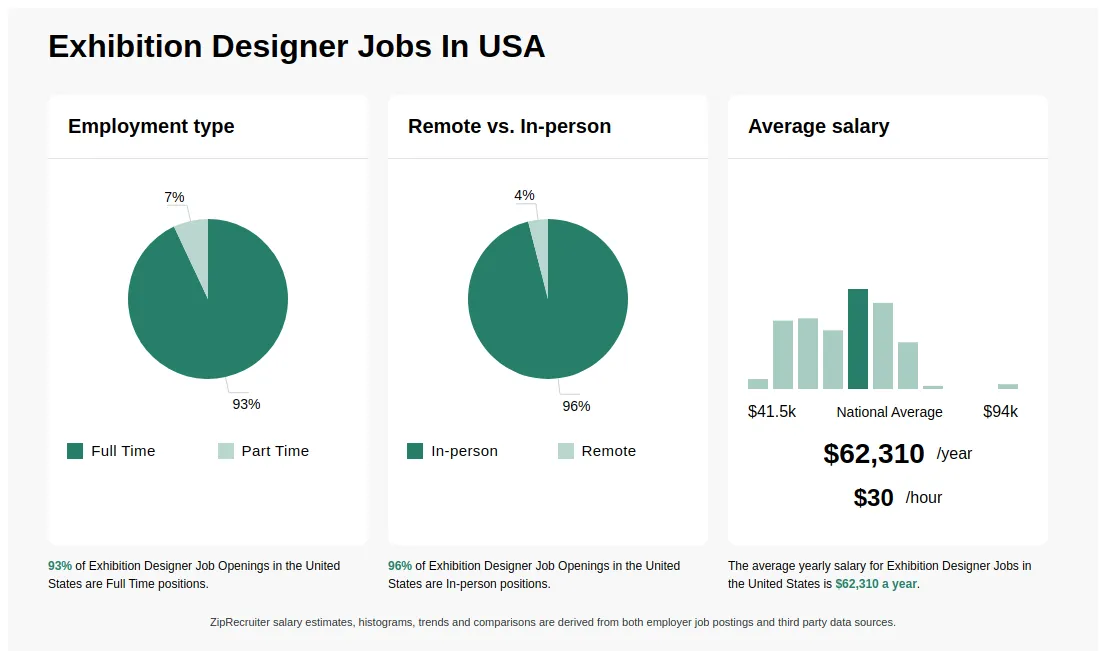
Exhibition Designer information
See salary details
$41.5K - $46.3K
2% of jobs
$46.3K - $51K
15% of jobs
$53.4K is the 25th percentile. Wages below this are outliers.
$51K - $55.8K
15% of jobs
$55.8K - $60.6K
13% of jobs
The median wage is $61.4K / yr.
$60.6K - $65.4K
23% of jobs
$66.8K is the 75th percentile. Wages above this are outliers.
$65.4K - $70.1K
20% of jobs
$70.1K - $74.9K
10% of jobs
$74.9K - $79.7K
0% of jobs
$79.7K - $84.5K
0% of jobs
$84.5K - $89.2K
0% of jobs
$89.2K - $94K
1% of jobs
$41.5K
$62.3K
$94K
How much do exhibition designer jobs pay per year?
As of Sep 5, 2026, the average yearly pay for exhibition designer in the United States is $62,310.00, according to ZipRecruiter salary data. Most workers in this role earn between $52,000.00 and $67,500.00 per year, depending on experience, location, and employer.
What is an exhibition designer?
An exhibition designer plans and lays out exhibits for venues like public and trade shows, conferences, and museum or art gallery installations. As an exhibit designer, you must be able to effectively communicate your client’s message to the exhibit’s audience. Your duties include meeting with clients to determine a theme or review the objects to be displayed, establishing budgets, and scheduling the project to completion. You also interact with clients throughout the design phase to collect feedback, make changes, and design a 3D model in a CAD software program. In some positions, you may supervise the display installation as well.
What does an exhibition designer do?
An Exhibition Designer is responsible for creating engaging and functional layouts for exhibitions, trade shows, museums, and galleries. They develop concepts and designs that effectively showcase objects or information, considering both aesthetics and visitor experience. Their tasks often include planning the spatial arrangement, selecting materials, designing graphics, and collaborating with other professionals such as curators, architects, and lighting specialists. Exhibition Designers ensure that displays are visually appealing, accessible, and communicate the intended message to the audience.
How does an exhibition designer typically collaborate with curators and other stakeholders during a project?
Exhibition Designers work closely with curators, educators, and marketing teams to bring a unified vision to life. Early in the process, designers participate in planning meetings to understand the narrative and educational goals of the exhibition. Throughout the project, they coordinate with fabricators, lighting specialists, and graphic designers to ensure the physical space and displays align with curatorial intent. Frequent communication and iterative feedback are essential, as stakeholders may request adjustments to layout, accessibility, or interpretive elements to enhance visitor engagement.
What is the difference between Exhibition Designer vs Interior Designer?
| Aspect | Exhibition Designer | Interior Designer |
|---|---|---|
| Credentials | Degree in design, architecture, or related field; portfolio | Degree in interior design, architecture, or related field; portfolio |
| Work Environment | Museums, galleries, trade shows, exhibitions | Residential, commercial, hospitality spaces |
| Industry Usage | Event and exhibition industry | Real estate, construction, interior design firms |
| Common Search Intent | Designing temporary displays and exhibits | Designing functional interior spaces |
Exhibition Designers focus on creating engaging displays for museums, galleries, and trade shows, emphasizing visual impact and visitor experience. Interior Designers work on permanent or long-term interior spaces, prioritizing functionality and aesthetics. While both roles require design skills and similar credentials, their work environments and industry applications differ significantly.
How do you become an exhibition designer?
To become an exhibition designer, typically a bachelor's degree in graphic design, interior design, architecture, or a related field is required. Gaining experience through internships or entry-level positions, developing skills in design software like AutoCAD or Adobe Creative Suite, and building a strong portfolio are essential steps in the career path.
How to get a job in exhibition design?
To get a job as an exhibition designer, develop a strong portfolio showcasing your design skills and knowledge of spatial planning, graphics, and lighting. Obtain relevant education such as a degree in interior design, architecture, or a related field, and gain experience through internships or entry-level positions. Proficiency in design software like AutoCAD, SketchUp, or Adobe Creative Suite is also important for success in this field.
Is exhibition design a good career?
Exhibition design is a creative profession that involves planning and creating displays for museums, trade shows, and events. It requires skills in graphic design, spatial planning, and project management, often using tools like CAD software. The field offers opportunities for artistic expression and collaboration but can involve tight deadlines and project-based work.
More about Exhibition Designer jobs
- How can I become an exhibition designer?
- What skills should an exhibition designer have?
- Where can exhibition designers work?
- What is the difference between an exhibition designer and a set and exhibit designer?
- The 10 Top Types Of Exhibition Designer Jobs
- The 7 Best Types of Exhibition Designer in 2026
- What Is an Exhibition Designer and How to Become One
What cities are hiring for Exhibition Designer jobs?
Cities with the most Exhibition Designer job openings:
What are the most commonly searched types of Exhibition Designer jobs?
The most popular types of Exhibition Designer jobs are:
Who are the top companies hiring for Exhibition Designer jobs?
The top employers for Exhibition Designer jobs are:
What states have the most Exhibition Designer jobs?
States with the most job openings for Exhibition Designer jobs include:
What job categories do people searching Exhibition Designer jobs look for?
The top searched job categories for Exhibition Designer jobs are:
What are popular job titles related to Exhibition Designer jobs?
For Exhibition Designer jobs, the most frequently searched job titles are:
Job description
ABOUT THE LUCAS MUSEUM OF NARRATIVE ART
Opening in September 2026, the Lucas Museum of Narrative Art is dedicated to illustrated storytelling. Founded by George Lucas and Mellody Hobson, the museum's collection features works by artists including Norman Rockwell, Kadir Nelson, Jessie Willcox Smith, N. C. Wyeth, Beatrix Potter, Judith F. Baca, Frida Kahlo, and Maxfield Parrish; as well as comic art legends such as Winsor McCay, Jack Kirby, Frank Frazetta, Alison Bechdel, Chris Ware, and R. Crumb; and photographers Gordon Parks, Henri Cartier-Bresson, and Dorothea Lange. The Museum also houses the Lucas Archives, containing models, props, concept art, and costumes from Lucas's filmmaking career.
Designed by Ma Yansong of MAD with a landscape by Mia Lehrer of Studio-MLA, the Museum is in Exposition Park, Los Angeles, on an 11-acre campus that includes new green space and a 300,000-square-foot building with galleries, two theaters, a library, restaurant, cafe, retail store, and community spaces.
POSITION SUMMARY
The Exhibition Designer at Lucas Museum of Narrative Art will work collaboratively to create specialized exhibition designs that best support the museum's mission and curatorial vision, including technical concept design and presentation materials. They will also work closely with internal teams, develop and update specialized documents, record all design-related components of installed exhibitions that best supports the collection and exhibition program. This role will oversee production and execution of art exhibitions, including working with the in-house production team as well as outside contractors for construction, fabrication, digital design and integration, and other vendor services.
RESPONSIBILITIES
Work collaboratively to create specialized exhibition designs that best support the museums mission and curatorial vision, including technical concept design and presentation materials.
Work closely with internal teams, develop and update specialized documents, recording all design-related components of installed exhibitions that best supports the collection and exhibition program.
Oversee production and execution of art exhibitions, including working with the in-house production team as well as outside contractors for construction, fabrication, digital design and integration, and other vendor services.
Responsible for understanding the Museum's base-building conditions and exhibition wall typical construction as it relates to MEP, structural capacities, fire protection, lighting, ceiling and floor components upon which future exhibition rotations and gallery renovations will be developed.
Coordinate with the Buildings Facilities and Operations staff, responsible for understanding the infrastructure parameters and approvals required for outdoor installations within the Park and Garden.
Prepare design document drawings, floor plans, detail drawings, case lists, or schedules for internal museum reviews and construction bid documents to be supplied to outside vendors.
Serve as liaison with external vendors, contractors, and design consultants. Work with external professionals, ensures all physical exhibitions meet all necessary code requirements and achieve accessibility standards set by the museum.
Work with Architect of Record and exhibition fabricators to facilitate and adapt layout configurations and other necessary processes for LADBS submissions and approval.
Manage project schedules, prioritize and coordinate design deliverables.
Work in collaboration with design team to oversee production of graphics from external vendors including printing, silk-screening, and fabrication for exhibitions, and coordinates with Collections Management teams to arrange their installation.
Work with internal teams, manage the process and schedule for exhibition design and fabrication. Collaborate with internal teams, develop and lead the process for determining aesthetic standards for framing, plinths, furniture, and casework.
Oversee selection and procurement of casework and exhibition furniture and will work with the internal team to source appropriate materials to the gallery environment.
Work with collections management team to manage the selection of fabricators and specialty vendors to produce and install custom fabricated elements in the galleries as needed.
Construct architectural models and mockups for design processes and presentation purposes. Prepare all 2D and 3D artwork assets for use in Vectorworks and Rhino models.
Work with the Head of Exhibition Design to manage budgets with regards to in-gallery design, building, and construction (walls, casework, etc.).
CORE COMPETENCIES
Analytical Rigor: Simplifies complex problems by using critical thinking to evaluate problems, gathering information, incorporating multiple perspectives, understanding causes, and identifying best-possible solutions. Invests time in planning, discovery, and reflection to drive better decisions and more efficient implementations. Adopts an audience-centric approach, understanding the needs of the audience and incorporating them, as appropriate, into the decision.
Courageous Communication: Intentionally works well with others both on the team and cross-functionally to achieve individual, team, department, or organizational goals. Values diverse input and working with others as a way to achieve the best output possible.
Collaborative Excellence: Displays courage when handling difficult conversations and genuinely and intentionally communicates. Relays key messages effectively, targeted to specific audiences. Identifies others' communication styles and perspectives, adjusting language and approach accordingly. Employs active listening to understand, rather than reply. Asks for, integrates, and values feedback from team, peers, and leaders.
Adaptive Resilience: Thrives and grows in a rapidly changing and complex environment. Displays flexibility, activates networks, and adopts a continuous growth mindset to learn from mistakes and bounce back from adversity.
Inclusive Interaction: Actively contributes to an environment in which all employees feel a sense of belonging, valued for their differences and empowered to participate and contribute freely.
Building Trust & Relationship Management
- Accountable Ownership and clearly shares information and the "why" behind decisions.
- Asks for and values the opinions of others. Displays empathy when listening.
- Acknowledges when trust has been broken and focuses on rebuilding.
- Relates comfortably with people across levels, functions, cultures, and geographies. Identifies interpersonal and group dynamics and reacts effectively.
Accountable Ownership
- Takes ownership of outcomes, positive or negative, without blaming others within the team or cross-functionally.
- Recognizes when they are not approaching a situation with accountability but instead with a blame mindset.
- Takes accountability for assigned tasks and executes on deliverables in a timely manner.
Strategic Alignment & Execution
- Contributes to the organization by understanding and aligning actions with the organization's goals, core functions, needs, and values.
- Seeks out and incorporates multiple perspectives, experiences, and industry trends to develop a holistic perspective. Operationalizes ideas within the business model.
- Displays critical thinking when faced with a challenge by asking probing questions and looking for connections.
PHYSICAL REQUIREMENTS
The physical demands described below are representative of those required to successfully perform the essential functions of this position. Reasonable accommodations may be made to enable qualified individuals with disabilities to perform the essential functions.
- Ability to stand and walk for extended periods, up to 8 hours per shift.
- Ability to move throughout multiple Museum locations, including galleries, theaters, outdoor spaces, and other public areas.
- Ability to maintain an active and visible presence while providing exceptional guest service.
- Ability to work in a high-volume, public-facing environment with large groups of guests, including school groups, tours, special events, and peak attendance periods, while maintaining professionalism, situational awareness, and composure.
- Ability to frequently bend, reach, stoop, kneel, crouch, and climb stairs as needed.
- Ability to occasionally lift, carry, push, and pull items weighing up to 25 pounds, including wheelchairs, stanchions, signage, guest service equipment, and other operational materials.
- Ability to communicate clearly and effectively with guests and colleagues in person, by telephone, and over two-way radio.
- Ability to work both indoors and outdoors in varying environmental conditions.
- Ability to maintain awareness of guest activity and surrounding conditions while monitoring galleries, queues, and public spaces.
QUALIFICATIONS
Education Requirement:
Bachelor's degree or foreign equivalent in Architecture, Industrial Design, Interior Design, Studio Art or related field.
Three (3) years of experience in the position offered or related occupation.
Must have experience with the following:
- Project Management; formulate budgets and timelines, institute clear workflow processes, managing internal and external partners, and enforcing deadlines
- Architecture and 3D design history and trends
- Creating conceptual solutions to design needs and 3D design experiences
- REVIT, RHINO and VectorWorks
- AutoCAD and Adobe Creative Cloud, and Sketch Up
- Casework platforms, custom object mounts, and framing strategies
- Lighting schemes that meet conservation standards
- Apply ADA (Americans with Disabilities Act) standards to ensure exhibitions are inclusive, navigable, and welcoming to all visitors
- Apply preventive conservation strategies
- Develop and implement light box graphics, photomurals, title walls, and interpretive graphics
$119,500 - $142,900 a year
EQUAL OPPORTUNITY AND OUR COMMITMENT TO DEAIB
The Lucas Museum of Narrative Art embraces diversity and equal opportunity. We are committed to building a team that represents and supports a variety of backgrounds and perspectives. The Lucas Museum fosters a work environment that is free of discrimination and harassment, whether based on race, national origin, gender, gender expression, religion, ethnic background, age, disability, marital status, sexual orientation, or any other criterion prohibited by applicable federal, state, or local laws. We believe that diversity and inclusion among our team is critical to our success, and we seek to recruit, develop, and retain the best qualified people from a diverse candidate pool. Applications from traditionally underrepresented communities are encouraged.
The statements in this description represent typical elements, criteria, and general work performed. They are not intended to be construed as an exhaustive list of all responsibilities, duties, and skills required for the job.
*
MISSION AND VISION
The Lucas Museum of Narrative Art is dedicated to the art of illustrated stories. Our mission is to inspire and connect people through the exploration of visual stories and their influences in society.
VALUES
Our internal and external practices are shaped by the following beliefs and behaviors.
People First: We meet people wherever they are (physically, intellectually, emotionally). Our inclusive practice connects who people are and what they find emotional in works of art.
Inspired: We believe that art can move you to feel, think, reflect, and act.
Collaborative: We believe that nimble thinking and working together yield exponential results.
STRATEGIC PRIORITIES
Narrative Art:
Amplify the social impact of storytelling and illustration.
...
About Lucas Museum of Narrative Art
Sourced by ZipRecruiter
Industry
Museums and historical sites
Company size
11 - 50 Employees
Headquarters location
Los Angeles, CA, US
Year founded
2014