Consulting Practice Leader - Healthcare Provider Data SME Location - Remote-NJ/NY/PA, Boston ... Hands-on familiarity with EHR data models (Epic Clarity/Caboodle, Cerner), Credentialing systems (e ...
Consulting Practice Leader - Healthcare Provider Data SME Location - Remote-NJ/NY/PA, Boston ... Hands-on familiarity with EHR data models (Epic Clarity/Caboodle, Cerner), Credentialing systems (e ...
Consulting Practice Leader - Healthcare Provider Data SME Location - Remote-NJ/NY/PA, Boston ... Hands-on familiarity with EHR data models (Epic Clarity/Caboodle, Cerner), Credentialing systems (e ...
Consulting Practice Leader - Healthcare Provider Data SME Location - Remote-NJ/NY/PA, Boston ... Hands-on familiarity with EHR data models (Epic Clarity/Caboodle, Cerner), Credentialing systems (e ...
Digital Health Analytics Analyst Senior
Danville, PA · On-site +1
$100K - $133K/yr
Work is typically performed in an office or remote environment. Accountable for satisfying all job ... Epic Clarity, Cogito, or Caboodle reporting certification; Professional Scrum Master or equivalent ...
Digital Health Analytics Analyst Senior
Danville, PA · On-site +1
$100K - $133K/yr
Work is typically performed in an office or remote environment. Accountable for satisfying all job ... Epic Clarity, Cogito, or Caboodle reporting certification; Professional Scrum Master or equivalent ...
Hands-on and Certified in Caboodle Development/Caboodle Admin/Cogito Systems, 2+ years working with Epic data model (Clarity and Caboodle), 5+ years working with SQL, Experience working with ETL ...
Hands-on and Certified in Caboodle Development/Caboodle Admin/Cogito Systems, 2+ years working with Epic data model (Clarity and Caboodle), 5+ years working with SQL, Experience working with ETL ...

Sr. Business Intelligence Developer
$122K - $163K/yr
Epic Clarity-Caboodle Development certifications are preferred Additional Information Hours: Must be able to accommodate pacific time zone hours Location: Remote Salary Range (based on years of ...
Sr. Business Intelligence Developer
$122K - $163K/yr
Epic Clarity-Caboodle Development certifications are preferred Additional Information Hours: Must be able to accommodate pacific time zone hours Location: Remote Salary Range (based on years of ...

Sr. Business Intelligence Developer
$122K - $163K/yr
Epic Clarity-Caboodle Development certifications are preferred Additional Information Hours: Must be able to accommodate pacific time zone hours Location: Remote Salary Range (based on years of ...
Sr. Business Intelligence Developer
$122K - $163K/yr
Epic Clarity-Caboodle Development certifications are preferred Additional Information Hours: Must be able to accommodate pacific time zone hours Location: Remote Salary Range (based on years of ...

Epic BI Analyst
Kansas City, MO · Remote
$79K - $109K/yr
Business Intelligence Developer II (Remote) This role is ideal for someone with Epic BI experience ... Working with Epic Cogito, Clarity, and Caboodle data structures * Building reports and dashboards ...
Epic BI Analyst
Kansas City, MO · Remote
$79K - $109K/yr
Business Intelligence Developer II (Remote) This role is ideal for someone with Epic BI experience ... Working with Epic Cogito, Clarity, and Caboodle data structures * Building reports and dashboards ...
Epic Data Acquisition Analyst
Plano, TX · On-site +1
Position Location This is a remote-based position within the Continental US. Who We Are VytlOne is ... Build, configure, and validate Epic reports and extracts using Clarity, Caboodle, Reporting ...
Epic Data Acquisition Analyst
Plano, TX · On-site +1
Position Location This is a remote-based position within the Continental US. Who We Are VytlOne is ... Build, configure, and validate Epic reports and extracts using Clarity, Caboodle, Reporting ...
Position Location This is a remote-based position within the Continental US. Who We Are VytlOne is ... Build, configure, and validate Epic reports and extracts using Clarity, Caboodle, Reporting ...
Position Location This is a remote-based position within the Continental US. Who We Are VytlOne is ... Build, configure, and validate Epic reports and extracts using Clarity, Caboodle, Reporting ...
Position Location This is a remote-based position within the Continental US. Who We Are VytlOne is ... Build, configure, and validate Epic reports and extracts using Clarity, Caboodle, Reporting ...
Position Location This is a remote-based position within the Continental US. Who We Are VytlOne is ... Build, configure, and validate Epic reports and extracts using Clarity, Caboodle, Reporting ...
Epic Data Acquisition Analyst
Plano, TX · On-site +1
Position Location This is a remote-based position within the Continental US. Who We Are VytlOne is ... Build, configure, and validate Epic reports and extracts using Clarity, Caboodle, Reporting ...
Epic Data Acquisition Analyst
Plano, TX · On-site +1
Position Location This is a remote-based position within the Continental US. Who We Are VytlOne is ... Build, configure, and validate Epic reports and extracts using Clarity, Caboodle, Reporting ...
Position Location This is a remote-based position within the Continental US. Who We Are VytlOne is ... Build, configure, and validate Epic reports and extracts using Clarity, Caboodle, Reporting ...
Position Location This is a remote-based position within the Continental US. Who We Are VytlOne is ... Build, configure, and validate Epic reports and extracts using Clarity, Caboodle, Reporting ...
Hands-on and Certified in Caboodle Development/Caboodle Admin/Cogito Systems, 2+ years working with Epic data model (Clarity and Caboodle), 5+ years working with SQL, Experience working with ETL ...
Hands-on and Certified in Caboodle Development/Caboodle Admin/Cogito Systems, 2+ years working with Epic data model (Clarity and Caboodle), 5+ years working with SQL, Experience working with ETL ...
Senior IT Consultant - Epic on Azure Transformation
Delray Beach, FL · Remote
$55 - $60/hr
EpicCare, MyChart, Clarity, Caboodle, Cogito tools, etc. · Support Epic ecosystem modules (system ... remote position.
Quick apply
Senior IT Consultant - Epic on Azure Transformation
Delray Beach, FL · Remote
$55 - $60/hr
EpicCare, MyChart, Clarity, Caboodle, Cogito tools, etc. · Support Epic ecosystem modules (system ... remote position.
Epic Clinical Service Desk Specialist-REMOTE
Lincoln, NE · Remote
$83K - $193K/yr
Prelude, Cadence, HIMS, Resolute HB, Resolute PB, MyChart, EpicLink, EpicWeb, and/or Clarity Basic ... The starting pay range for this remote role is $83,734-$193,829. This range reflects the minimum ...
Epic Clinical Service Desk Specialist-REMOTE
Lincoln, NE · Remote
$83K - $193K/yr
Prelude, Cadence, HIMS, Resolute HB, Resolute PB, MyChart, EpicLink, EpicWeb, and/or Clarity Basic ... The starting pay range for this remote role is $83,734-$193,829. This range reflects the minimum ...
Epic Clinical Service Desk Specialist-REMOTE
Fargo, ND · On-site +1
$83K - $193K/yr
Prelude, Cadence, HIMS, Resolute HB, Resolute PB, MyChart, EpicLink, EpicWeb, and/or Clarity Basic ... The starting pay range for this remote role is $83,734-$193,829. This range reflects the minimum ...
Epic Clinical Service Desk Specialist-REMOTE
Fargo, ND · On-site +1
$83K - $193K/yr
Prelude, Cadence, HIMS, Resolute HB, Resolute PB, MyChart, EpicLink, EpicWeb, and/or Clarity Basic ... The starting pay range for this remote role is $83,734-$193,829. This range reflects the minimum ...
Epic- Clinical Service Desk Specialist-REMOTE
Lincoln, NE · Remote
$68K - $141K/yr
Prelude, Cadence, HIMS, Resolute HB, Resolute PB, MyChart, EpicLink, EpicWeb, and/or Clarity Basic ... The starting pay range for this remote role is $68,076-$141,826. This range reflects the minimum ...
Epic- Clinical Service Desk Specialist-REMOTE
Lincoln, NE · Remote
$68K - $141K/yr
Prelude, Cadence, HIMS, Resolute HB, Resolute PB, MyChart, EpicLink, EpicWeb, and/or Clarity Basic ... The starting pay range for this remote role is $68,076-$141,826. This range reflects the minimum ...
Epic Clinical Service Desk Specialist-REMOTE
Fargo, ND · Remote
$83K - $193K/yr
Prelude, Cadence, HIMS, Resolute HB, Resolute PB, MyChart, EpicLink, EpicWeb, and/or Clarity Basic ... The starting pay range for this remote role is $83,734-$193,829. This range reflects the minimum ...
Epic Clinical Service Desk Specialist-REMOTE
Fargo, ND · Remote
$83K - $193K/yr
Prelude, Cadence, HIMS, Resolute HB, Resolute PB, MyChart, EpicLink, EpicWeb, and/or Clarity Basic ... The starting pay range for this remote role is $83,734-$193,829. This range reflects the minimum ...
Epic Clinical Service Desk Specialist-REMOTE
Lincoln, NE · On-site +1
$83K - $193K/yr
Prelude, Cadence, HIMS, Resolute HB, Resolute PB, MyChart, EpicLink, EpicWeb, and/or Clarity Basic ... The starting pay range for this remote role is $83,734-$193,829. This range reflects the minimum ...
Epic Clinical Service Desk Specialist-REMOTE
Lincoln, NE · On-site +1
$83K - $193K/yr
Prelude, Cadence, HIMS, Resolute HB, Resolute PB, MyChart, EpicLink, EpicWeb, and/or Clarity Basic ... The starting pay range for this remote role is $83,734-$193,829. This range reflects the minimum ...
Epic Clinical Service Desk Specialist-REMOTE
Fargo, ND · Remote
$83K - $193K/yr
Prelude, Cadence, HIMS, Resolute HB, Resolute PB, MyChart, EpicLink, EpicWeb, and/or Clarity Basic ... The starting pay range for this remote role is $83,734-$193,829. This range reflects the minimum ...
Epic Clinical Service Desk Specialist-REMOTE
Fargo, ND · Remote
$83K - $193K/yr
Prelude, Cadence, HIMS, Resolute HB, Resolute PB, MyChart, EpicLink, EpicWeb, and/or Clarity Basic ... The starting pay range for this remote role is $83,734-$193,829. This range reflects the minimum ...
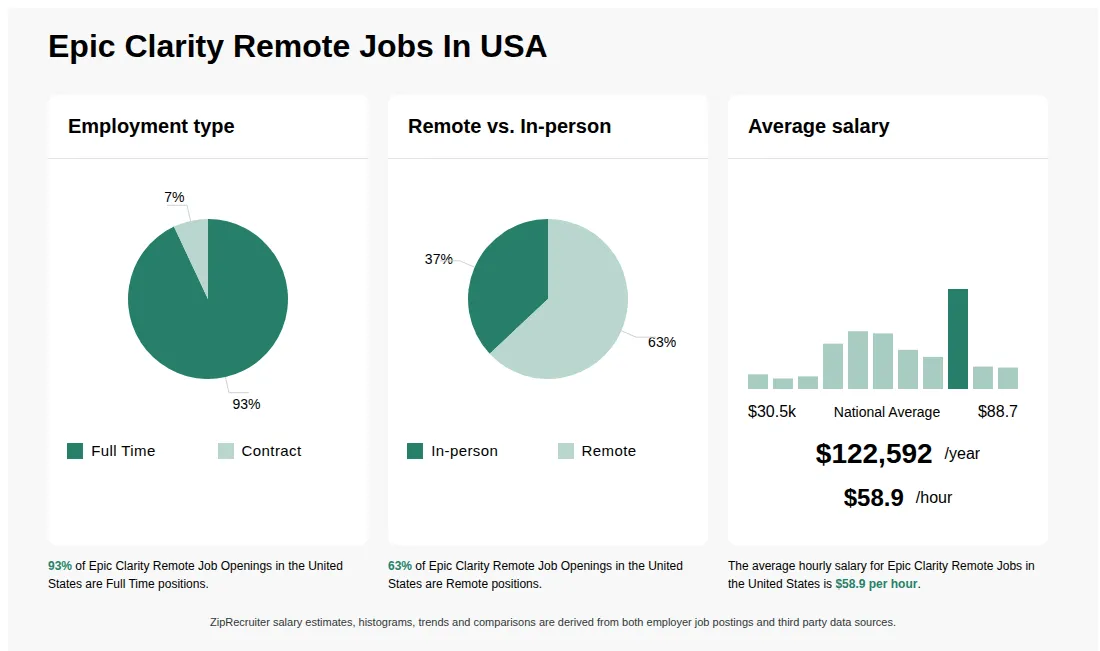
Epic Clarity Remote information
See salary details
$14.66 - $21.39
3% of jobs
$21.39 - $28.13
2% of jobs
$28.13 - $34.86
3% of jobs
$34.86 - $41.59
11% of jobs
$43.99 is the 25th percentile. Wages below this are outliers.
$41.59 - $48.32
15% of jobs
$48.32 - $55.05
14% of jobs
The median wage is $56.54 / hr.
$55.05 - $61.78
9% of jobs
$61.78 - $68.51
7% of jobs
$71.31 is the 75th percentile. Wages above this are outliers.
$68.51 - $75.24
25% of jobs
$75.24 - $81.97
5% of jobs
$81.97 - $88.70
5% of jobs
$14
$58
$88
How much do epic clarity remote jobs pay per hour?
As of Sep 13, 2026, the average hourly pay for epic clarity remote in the United States is $58.94, according to ZipRecruiter salary data. Most workers in this role earn between $44.71 and $72.84 per hour, depending on experience, location, and employer.
What is an Epic Clarity Remote?
An Epic Clarity Remote job involves working with Epic's Clarity database to extract, analyze, and report on healthcare data while performing duties remotely. Clarity is Epic's SQL-based relational database that stores clinical, financial, and operational data for healthcare organizations. Professionals in this role typically have expertise in SQL, reporting tools (such as Crystal Reports or Tableau), and Epic-specific data structures. They collaborate with analysts, administrators, and healthcare stakeholders to support decision-making and compliance requirements. Since the role is remote, strong communication and problem-solving skills are essential for working effectively with dispersed teams.
What are the key skills and qualifications needed to thrive in the Epic Clarity Remote position?
To excel as an Epic Clarity Remote professional, you need in-depth knowledge of Epic Clarity data models, SQL querying, and healthcare analytics, often supported by Epic Clarity certification or relevant experience. Familiarity with Epic Systems software, report development tools like Crystal Reports, and ETL processes is commonly required. Excellent communication, problem-solving skills, and self-motivation are vital for effective remote collaboration and troubleshooting. These abilities are crucial for delivering accurate data reporting and supporting healthcare decision-making in a distributed environment.
What are some common challenges faced by Epic Clarity Remote professionals, and how can they be overcome?
Epic Clarity Remote professionals often encounter challenges related to remote access, troubleshooting complex data issues without on-site support, and aligning with frequently changing organizational reporting needs. Staying proactive in communication, leveraging available collaboration tools, and participating in regular team updates can help mitigate these challenges. Additionally, keeping up-to-date with Epic system upgrades and maintaining strong relationships with hospital IT and analytics staff is essential. By adopting a structured work approach and seeking continuous learning opportunities, remote Epic Clarity specialists can work effectively and provide valuable insights to healthcare organizations.
More about Epic Clarity Remote jobs
What cities are hiring for Epic Clarity Remote jobs?
Cities with the most Epic Clarity Remote job openings:
What are the most commonly searched types of Epic Clarity jobs?
The most popular types of Epic Clarity jobs are:
What states have the most Epic Clarity Remote jobs?
States with the most job openings for Epic Clarity Remote jobs include:
What job categories do people searching Epic Clarity Remote jobs look for?
The top searched job categories for Epic Clarity Remote jobs are:
Consulting Practice Leader & Healthcare Provider Data SME
Remote
Argyle Infotech
Other
Posted 8 days ago
Job description
Consulting Practice Leader – Healthcare Provider Data SME
Location – Remote-NJ/NY/PA, Boston, Philadelphia, or SF Bay Area, CA preferred
SAAMA internal position
About Saama
Saama is an AI and advanced analytics company built for life sciences. Best known for the AI-powered clinical platform that supported the trial behind the world's first COVID-19 vaccine, Saama works with many of the top 20 pharmaceutical companies and a large base of emerging biotech. Alongside our clinical development portfolio, we operate a growing Commercial business — spanning commercial data platforms, master data management, advanced BI, and our Analytics for Commercial Excellence (ACE) solution family — serving marketing, sales, market access, and patient services organizations.
We are hiring a senior leader to own and scale that Commercial business.
The Consulting Practice Leader serves as the primary Subject Matter Expert (SME) and strategic advisor on healthcare provider data for a enterprise-level hospital system client. In this ongoing role, you will bridge the gap between technical data engineering teams, clinical informatics, enterprise analytics, and executive business partners. You will design, govern, and optimize healthcare provider data assets—ensuring data products, reference data models, and Subject Area Data Models align with clinical operations, credentialing, revenue cycle, and digital health initiatives.
Key Responsibilities
1. Enterprise Data Product & Domain Strategy
- Lead the definition, development, and governance of core Provider Data Products (e.g., Provider 360, Master Provider Index/EMPI, Practitioner Directory, Provider Network & Alignment, Provider Roster Management).
- Define domain-specific data architectures and data lifecycle strategies across clinical, administrative, credentialing, and billing domains.
- Establish data product ownership models, domain definitions, and lifecycle management frameworks for provider-centric data assets.
2. Subject Area & Industry Data Modeling
- Architect and refine Provider Subject Area Data Models across key domains: Provider Master Data, Credentialing & Privileging, Network/Payer Contracts, Scheduling/Availability, Provider Attribution, and Clinical Performance.
- Guide the adoption and customization of standard industry data models and frameworks (e.g., HL7 FHIR Practitioner/PractitionerRole resources, OMOP CDM, CAQH standards, and vendor enterprise models such as Epic Clarity/Caboodle provider schemas or Cerner CCL).
- Standardize reference data, taxonomy mappings, and code sets across the health system (e.g., NPI, NUCC Provider Taxonomy, State License IDs, CAQH, Provider Specialty Groups).
3. Client Advisory & Cross-Functional Alignment
- Serve as the trusted advisor to hospital system executives (CDO, CIO, Chief Medical Officer, VP of Revenue Cycle) on provider data strategy and data quality initiatives.
- Drive cross-departmental alignment between Provider Enrollment, Medical Staff Services, Clinical Operations, IT/Data Engineering, and Managed Care Contracting.
- Establish and facilitate data governance bodies specific to Provider Data Quality, Stewardship, and Integration.
4. Data Governance, Quality & Stewardship
- Implement data quality frameworks, stewardship workflows, and automated validation pipelines tailored to complex provider entities (individual vs. organizational providers, affiliations, locations, and panel capacities).
- Establish MDM (Master Data Management) and Identity Resolution protocols to solve multi-source provider duplicate, merge, and alignment issues across disparate systems.
Required Skills & Expertise
Healthcare Provider Data Knowledge
- Provider Data Sub-Domains: Deep expertise in Provider Master Data (MDM), Practitioner vs. Organizational Provider distinction, Medical Staff Credentialing/Privileging, Provider Attribution, Panel Management, and Provider-Location-Specialty relationships.
- Standard Industry Models & Protocols: In-depth knowledge of HL7 FHIR (Practitioner, Practitioner Role, Healthcare Service, Location resources), CAQH, NUCC Taxonomy, and relational/analytical dimensional modeling for healthcare.
- Health System Source Systems: Hands-on familiarity with EHR data models (Epic Clarity/Caboodle, Cerner), Credentialing systems (e.g., Echo, Cactus, Symplr), and Provider Directory / MDM solutions (e.g., Informatica, Reltio, IBM MDM).
- Reference Data & Identifiers: Master-level understanding of NPI (NPPES), DEA, State Licensing, Medicare/Medicaid Enrollment (PECOS), taxonomy codes, and taxonomy crosswalks.
Consulting & Leadership Skills
- Advisory Leadership: Proven experience leading long-term data transformation engagements within large integrated delivery networks (IDNs) or academic medical centers.
- Data Product Management: Ability to manage data assets as products—defining roadmap, user stories, schema specifications, and business value metrics.
- Stakeholder Facilitation: Strong track record of aligning technical teams (ETL, Data Warehousing, Cloud Data Engineers) with business/clinical stakeholders.
Qualifications
- Experience: 8+ years in healthcare data domain consulting or enterprise health system informatics, with a focus on provider data architecture, data governance, and data warehousing.
- Education: Bachelor’s or master’s degree in health informatics, Computer Science, Information Systems, or a related quantitative field.
- Certifications (Preferred): FHIR Certification, Certified Health Data Analyst (CHDA), or Enterprise Data Governance certifications (e.g., CDMP).