The role guides entry level Surgical Technologists, maintains adherence to safety and infection control protocols, and actively contributes to the development of departmental policies and protocols.
The role guides entry level Surgical Technologists, maintains adherence to safety and infection control protocols, and actively contributes to the development of departmental policies and protocols.
The role guides entry level Surgical Technologists, maintains adherence to safety and infection control protocols, and actively contributes to the development of departmental policies and protocols.
The role guides entry level Surgical Technologists, maintains adherence to safety and infection control protocols, and actively contributes to the development of departmental policies and protocols.
The role guides entry level Surgical Technologists, maintains adherence to safety and infection control protocols, and actively contributes to the development of departmental policies and protocols.
The role guides entry level Surgical Technologists, maintains adherence to safety and infection control protocols, and actively contributes to the development of departmental policies and protocols.
Surgical Tech I
Boston, MA · On-site
This entry-level position involves preparing the operating room, handling instruments and supplies ... Certified Surgical Technologist * CPR Preferred Qualifications * Minimum 1 year experience with ...
Surgical Tech I
Boston, MA · On-site
This entry-level position involves preparing the operating room, handling instruments and supplies ... Certified Surgical Technologist * CPR Preferred Qualifications * Minimum 1 year experience with ...

Surgical Tech I
Boston, MA · On-site
This entry-level position involves preparing the operating room, handling instruments and supplies ... Certified Surgical Technologist * CPR Preferred Qualifications * Minimum 1 year experience with ...
Surgical Tech I
Boston, MA · On-site
This entry-level position involves preparing the operating room, handling instruments and supplies ... Certified Surgical Technologist * CPR Preferred Qualifications * Minimum 1 year experience with ...

Surgical Technology Instructor
Morehead City, NC · On-site
$31.79 - $35.85/hr
... entry-level practice as competent, ethical surgical technologists. This is a part-time position ... with the potential to transition to full-time based on performance, organizational needs, and ...
Surgical Technology Instructor
Morehead City, NC · On-site
$31.79 - $35.85/hr
... entry-level practice as competent, ethical surgical technologists. This is a part-time position ... with the potential to transition to full-time based on performance, organizational needs, and ...

Surgical Technologist (Surg Tech)
$23.80 - $41.85/hr
REQUIREMENTS: Entry level knowledge; basic employment skills; High School diploma or GED equivalent ... Accredited Surgical Technology Course Certificate; Surgical Technologist Certification preferred.
Surgical Technologist (Surg Tech)
$23.80 - $41.85/hr
REQUIREMENTS: Entry level knowledge; basic employment skills; High School diploma or GED equivalent ... Accredited Surgical Technology Course Certificate; Surgical Technologist Certification preferred.
Surgical Technologist (Surg Tech)
Randallstown, MD · On-site
$23.80 - $41.85/hr
REQUIREMENTS: Entry level knowledge; basic employment skills; High School diploma or GED equivalent ... Accredited Surgical Technology Course Certificate; Surgical Technologist Certification preferred.
Surgical Technologist (Surg Tech)
Randallstown, MD · On-site
$23.80 - $41.85/hr
REQUIREMENTS: Entry level knowledge; basic employment skills; High School diploma or GED equivalent ... Accredited Surgical Technology Course Certificate; Surgical Technologist Certification preferred.
Surgical Technologist (Surg Tech)
Randallstown, MD · On-site
$23.80 - $41.85/hr
REQUIREMENTS: Entry level knowledge; basic employment skills; High School diploma or GED equivalent ... Accredited Surgical Technology Course Certificate; Surgical Technologist Certification preferred.
Surgical Technologist (Surg Tech)
Randallstown, MD · On-site
$23.80 - $41.85/hr
REQUIREMENTS: Entry level knowledge; basic employment skills; High School diploma or GED equivalent ... Accredited Surgical Technology Course Certificate; Surgical Technologist Certification preferred.
Surgical Technologist (Surg Tech)
Randallstown, MD · On-site
$23.80 - $41.85/hr
REQUIREMENTS: Entry level knowledge; basic employment skills; High School diploma or GED equivalent ... Accredited Surgical Technology Course Certificate; Surgical Technologist Certification preferred.
Surgical Technologist (Surg Tech)
Randallstown, MD · On-site
$23.80 - $41.85/hr
REQUIREMENTS: Entry level knowledge; basic employment skills; High School diploma or GED equivalent ... Accredited Surgical Technology Course Certificate; Surgical Technologist Certification preferred.
Surgical Technologist (Surg Tech)
Randallstown, MD · On-site
$23.80 - $41.85/hr
REQUIREMENTS: Entry level knowledge; basic employment skills; High School diploma or GED equivalent ... Accredited Surgical Technology Course Certificate; Surgical Technologist Certification preferred.
Surgical Technologist (Surg Tech)
Randallstown, MD · On-site
$23.80 - $41.85/hr
REQUIREMENTS: Entry level knowledge; basic employment skills; High School diploma or GED equivalent ... Accredited Surgical Technology Course Certificate; Surgical Technologist Certification preferred.
Pay range shown is for our entry level title, but will be increased based on years of experience ... Staff employed to practice surgical technology by the health care facility on or before the ...
Pay range shown is for our entry level title, but will be increased based on years of experience ... Staff employed to practice surgical technology by the health care facility on or before the ...
$60 - $75/hr
Precepts entry-level staff, students and orients new colleagues as assigned. Other information ... Graduate from a Surgical Technology program * National Board of Surgical Technology and Surgical ...
New
$60 - $75/hr
Precepts entry-level staff, students and orients new colleagues as assigned. Other information ... Graduate from a Surgical Technology program * National Board of Surgical Technology and Surgical ...
New

SURGICAL TECH EXTERN
Thomasville, GA · On-site
Surgical Tech Extern Requirements: BLS current or able to complete soon after hire Pass pre ... Current BLS Experience: Entry level Perks/Benefits: (for eligible employees): Have optimal ...
SURGICAL TECH EXTERN
Thomasville, GA · On-site
Surgical Tech Extern Requirements: BLS current or able to complete soon after hire Pass pre ... Current BLS Experience: Entry level Perks/Benefits: (for eligible employees): Have optimal ...
SURGICAL TECH EXTERN
Thomasville, GA · On-site
Surgical Tech Extern Requirements: BLS current or able to complete soon after hire Pass pre ... Current BLS Experience: Entry level Perks/Benefits: (for eligible employees): Have optimal ...
SURGICAL TECH EXTERN
Thomasville, GA · On-site
Surgical Tech Extern Requirements: BLS current or able to complete soon after hire Pass pre ... Current BLS Experience: Entry level Perks/Benefits: (for eligible employees): Have optimal ...

Surgical Technologist
Pittsburgh, PA · On-site
... * Entry level job 0-2 years' experience. * PA legislature House Bill 81 enacted 10/29/2020 and ... OR was employed as a surg tech in a health care facility on or before effective date of the act (12 ...
Surgical Technologist
Pittsburgh, PA · On-site
... * Entry level job 0-2 years' experience. * PA legislature House Bill 81 enacted 10/29/2020 and ... OR was employed as a surg tech in a health care facility on or before effective date of the act (12 ...

Surgical Technologist
Pittsburgh, PA · On-site
$23.27 - $29.69/hr
Qualifications: * Entry level job 0-2 years' experience. * PA legislature House Bill 81 enacted 10 ... OR was employed as a surg tech in a health care facility on or before effective date of the act (12 ...
Surgical Technologist
Pittsburgh, PA · On-site
$23.27 - $29.69/hr
Qualifications: * Entry level job 0-2 years' experience. * PA legislature House Bill 81 enacted 10 ... OR was employed as a surg tech in a health care facility on or before effective date of the act (12 ...

Surgical Technologist
Atlantic, IA · On-site
$45 - $50/hr
Monday-Friday, 6:45 AM - 3:15 PM; rotating call with 30-minute response time Guaranteed Hours: 40 hours per week Experience: Entry-level accepted; surgical technologist experience preferred About the ...
Quick apply
Surgical Technologist
Atlantic, IA · On-site
$45 - $50/hr
Monday-Friday, 6:45 AM - 3:15 PM; rotating call with 30-minute response time Guaranteed Hours: 40 hours per week Experience: Entry-level accepted; surgical technologist experience preferred About the ...
Surgical Technologist
Farrell, PA · On-site
$25K/yr
The amount of the sign-on bonus is dependent upon your years of Surgical Technology experience. Do ... Entry level job 0-2 years experience.,NY State Law: Public Health Law 2824 Chapter 292 of the Laws ...
Surgical Technologist
Farrell, PA · On-site
$25K/yr
The amount of the sign-on bonus is dependent upon your years of Surgical Technology experience. Do ... Entry level job 0-2 years experience.,NY State Law: Public Health Law 2824 Chapter 292 of the Laws ...
Surgical Technologist
Farrell, PA · On-site
$23.27 - $29.69/hr
The amount of the sign-on bonus is dependent upon your years of Surgical Technology experience. Do ... Entry level job 0-2 years experience.,NY State Law: Public Health Law 2824 Chapter 292 of the Laws ...
Surgical Technologist
Farrell, PA · On-site
$23.27 - $29.69/hr
The amount of the sign-on bonus is dependent upon your years of Surgical Technology experience. Do ... Entry level job 0-2 years experience.,NY State Law: Public Health Law 2824 Chapter 292 of the Laws ...
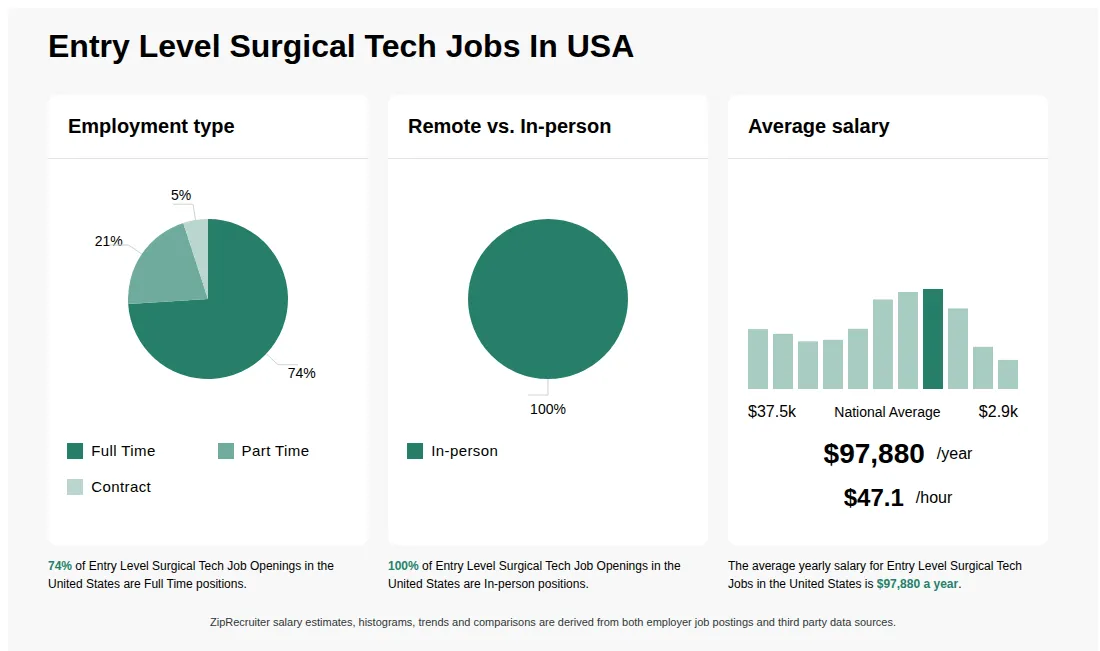
Entry Level Surgical Tech information
See salary details
$721.15 - $918.71
9% of jobs
$918.71 - $1.1K
7% of jobs
$1.1K - $1.3K
6% of jobs
$1.4K is the 25th percentile. Wages below this are outliers.
$1.3K - $1.5K
6% of jobs
$1.5K - $1.7K
9% of jobs
The median wage is $1.9K / yr.
$1.7K - $1.9K
13% of jobs
$1.9K - $2.1K
14% of jobs
$2.3K is the 75th percentile. Wages above this are outliers.
$2.1K - $2.3K
15% of jobs
$2.3K - $2.5K
12% of jobs
$2.5K - $2.7K
5% of jobs
$2.7K - $2.9K
4% of jobs
$721
$1.9K
$2.9K
How much do entry level surgical tech jobs pay per week?
As of Sep 2, 2026, the average weekly pay for entry level surgical tech in the United States is $1,882.31, according to ZipRecruiter salary data. Most workers in this role earn between $1,403.85 and $2,307.69 per week, depending on experience, location, and employer.
What does an entry level surgical tech do?
An entry level surgical tech, also known as a surgical technologist, assists surgeons and medical teams during surgical procedures. Their main responsibilities include preparing operating rooms, sterilizing equipment, ensuring all necessary supplies are ready, and passing instruments to surgeons during operations. They also help with patient preparation and may assist in cleaning up after procedures. This role is crucial for maintaining a sterile environment and supporting the surgical team to ensure patient safety.
What are the key skills and qualifications needed to thrive as an entry level surgical tech?
To thrive as an Entry Level Surgical Tech, you need a solid understanding of sterile techniques, anatomy, and surgical procedures, typically supported by completion of an accredited surgical technology program and certification (such as the CST). Familiarity with surgical instruments, operating room protocols, and electronic medical record systems is crucial. Attention to detail, effective teamwork, and the ability to remain calm under pressure are standout soft skills for this position. These competencies ensure patient safety, efficient surgical procedures, and smooth collaboration with surgical teams in high-stakes environments.
What are some common challenges faced by entry level surgical techs during their first year on the job?
Entry level surgical techs often encounter challenges such as adjusting to the fast-paced and high-pressure operating room environment, learning to anticipate surgeons' needs, and mastering the use of various surgical instruments and sterile techniques. It's also common to feel overwhelmed by the responsibility of maintaining a sterile field and ensuring patient safety. However, with support from experienced team members and ongoing training, new surgical techs quickly build confidence and competency in their role.
What is the difference between Entry Level Surgical Tech vs Certified Surgical Technologist?
| Aspect | Entry Level Surgical Tech | Certified Surgical Technologist |
|---|---|---|
| Credentials | High school diploma or equivalent; on-the-job training | Completion of accredited surgical tech program; certification exam |
| Work Environment | Hospitals, outpatient clinics, surgical centers | Hospitals, outpatient facilities, surgical centers |
| Employer & Industry Usage | Entry-level positions in healthcare facilities | Certified professionals with recognized credentials |
| Search & Comparison Intent | Yes | Yes |
Entry Level Surgical Techs are typically new to the field, often requiring minimal formal education and on-the-job training. Certified Surgical Technologists have completed specialized training and obtained certification, which can enhance job prospects and earning potential. Both roles work in similar environments, such as hospitals and surgical centers, but certification distinguishes more experienced or qualified candidates.
How much does an entry level surgical tech make?
An entry-level surgical tech typically earns between $40,000 and $55,000 annually, depending on location, healthcare facility, and certifications. Starting salaries may be lower in some regions, but with experience and additional skills, pay can increase.
How to get started as an entry level surgical tech?
To start as an entry-level surgical tech, complete a formal surgical technology program accredited by a recognized agency, which typically results in a certificate or associate degree. Obtain certification through the National Surgical Technology Certification Examination, and gain hands-on experience through clinical rotations or internships to develop necessary skills for the operating room environment.
Is it hard to get hired as an entry level surgical tech?
Entry level surgical tech positions can be competitive, but having relevant certifications such as Certified Surgical Technologist (CST) and completing a formal training program can improve hiring prospects. Employers often seek candidates with basic knowledge of sterile techniques, anatomy, and the ability to work in fast-paced surgical environments.
More about Entry Level Surgical Tech jobs
What cities are hiring for Entry Level Surgical Tech jobs?
Cities with the most Entry Level Surgical Tech job openings:
What are the most commonly searched types of Surgical Tech jobs?
The most popular types of Surgical Tech jobs are:
What states have the most Entry Level Surgical Tech jobs?
States with the most job openings for Entry Level Surgical Tech jobs include:
What job categories do people searching Entry Level Surgical Tech jobs look for?
The top searched job categories for Entry Level Surgical Tech jobs are:

Full-time
Medical, Dental, Retirement, PTO
Re-posted 19 days ago
UnityPoint Health rating

7.3
Based on 364 frontline employees who took The Breakroom Quiz
301st of 898 rated healthcare providers
Job description
UnityPoint-St Luke's
Full-Time
M-F 7am-3:30pm plus call
The Surgical Technologist II-Certified is responsible for performing surgical technologist duties, leveraging high proficiency in surgical techniques, and exercising critical thinking to support complex procedures. The role guides entry level Surgical Technologists, maintains adherence to safety and infection control protocols, and actively contributes to the development of departmental policies and protocols. The role also assists with onboarding new surgeons, supports the trialing of new equipment and instruments, and helps manage surgical inventory to align with surgeon preferences.
At UnityPoint Health, you matter. We’re proud to be recognized as a Top 150 Place to Work in Healthcare by Becker's Healthcare several years in a row for our commitment to our team members.
Our competitive Total Rewards program offers benefits options that align with your needs and priorities, no matter what life stage you’re in. Here are just a few:
- Expect paid time off, parental leave, 401K matching and an employee recognition program.
- Dental and health insurance, paid holidays, short and long-term disability and more. We even offer pet insurance for your four-legged family members.
- Early access to earned wages with Daily Pay, tuition reimbursement to help further your career and adoption assistance to help you grow your family.
With a collective goal to champion a culture of belonging where everyone feels valued and respected, we honor the ways people are unique and embrace what brings us together.
And, we believe equipping you with support and development opportunities is a vital part of delivering an exceptional employment experience.
Find a fulfilling career and make a difference with UnityPoint Health.
Clinical Excellence
- Ensures a safe, efficient and surgical environment by assembling and verifying the functionality of necessary instruments, equipment, and supplies according to the surgeon's preference cards. Exercises critical thinking in complex surgeries and performs technologist duties with high proficiency in emergency situations. Prepares patient for surgery by scrubbing, draping, and positioning, and participates in postoperative care by transferring patients to the
recovery room, applying dressings, and ensuring proper documentation. Applies and maintains sterile techniques throughout the procedure, ensuring aseptic conditions and the integrity of the environment. Performs required surgical counts in accordance with the organization’s policy, and handles specimens appropriately for proper preparation, labelling, and transport to the lab. Supports the surgeon by holding retractors, passing instruments,
applying suction, and cutting sutures as directed. Serves as a second circulator under the direction of the Registered Nurse (RN) circulator
Departmental Support
- Assists in cleaning and restocking of operating room between cases and procedures, ensuring all instruments, cleaning supplies, and equipment are ready for the next procedure. Enforces infection control measures and safety protocols while observing and reporting any safety concerns promptly. Adheres to Health Insurance Portability and Accountability Act (HIPAA), Occupational Safety and Health Administration (OSHA), Association of Perioperative Registered Nurses (AORN), Association for the Advancement of Medical Instrumentation (AAMI), and Det Norske Veritas (DNV) guidelines, maintaining safety during each procedure. Participates in departmental meetings and contributes to the
development and implementation of department policies and procedures. Supports trialing and onboarding of new equipment and instruments, maintaining communication with surgeons regarding updates and additions. Assists in managing the inventory of surgical instruments and supplies, ensuring alignment with surgeon preference cards.
Leadership
- Acts as a stand-in for the Surgical Tech Lead and as a preceptor, offering guidance on scrub duties to junior staff, students, surgical technologists, and Registered Nurses (RNs). Assists with onboarding and orientation of new surgeons, ensuring their equipment and instrumentation needs are met.
- Education: High school diploma or GED. Graduate from an accredited education program for Surgical Technology, OR graduate from an appropriate training program in the US Armed Forces OR Medical Certification OR completion of accredited LPN program required.
- Experience: 1 year previous surgical technologist or equivalent experience required.
- License/Certifications: Certified Surgical Technologist obtained within one year through one of the following: National Board of Surgical Technology & Surgical Assisting. National Center for Competency Testing
OR
Current Licensed Practical Nurse in the state(s) of practice, including eligibility under a NLC multistate license required upon hire. - Basic Life Support, American Heart Association. IA Child Abuse Mandatory Reporter Training in state(s) where providing care. IA Adult Dependent Abuse Mandatory Reporter Training in state(s) where providing care.
- Knowledge, Skills and Abilities: Understanding of surgical procedures and protocols, and ability to maintain a sterile field to prevent contamination. Knowledge of preoperative and postoperative care, including patient positioning,
draping, and dressing application. Proficient in handling surgical instruments, operating room equipment, and performing surgical counts. bility to meticulously focus on every aspect of a task or procedure, ensuring accuracy and precision in every action. Adherence to infection control, Health Insurance Portability and Accountability Act (HIPAA), Occupational Safety and Health Administration (OSHA), and other safety standards to ensure a safe surgical environment. Ability to anticipate surgeon’s needs and respond swiftly to changes during procedures, recognize and troubleshoot equipment issues during surgery and adapt quickly to unexpected changes in surgical room. Ability to communicate clearly and effectively with the surgical team, ensuring proper coordination and patient safety. Ability to work seamlessly with surgeons, nurses, and other healthcare
professionals to provide optimal patient care. Knowledge of preoperative and postoperative care, including patient positioning, draping, and dressing application.
What UnityPoint Health employees say
Pay
Benefits
Hours and flexibility
Workplace
Get the full story on Breakroom

About UnityPoint Health
Sourced by ZipRecruiter
At UnityPoint Health, we provide care in nine regions throughout Illinois, Iowa, and Wisconsin. As the nation's fourth largest nondenominational health system in America, UnityPoint Health keeps people at the center of all we do. We are looking for dynamic and talented individuals to join our team. You'll find opportunities for every sized dream.
Industry
Hospitals
Company size
10,000+ Employees
Headquarters location
West Des Moines, IA, US
Year founded
1995