2

Entry Level Robotics Engineer Jobs (NOW HIRING)

Standard Iron is looking for entry-level candidates who share our core values of Safety, Respect ... This individual could be a culmination of a robotically trained welder, or a robotic programmer ...

Field Technician (Oahu, HI)

Mililani, HI ยท Remote

$25 - $50/hr

Our expert team has years of experience in robotics, engineering, software development, operations ... This is an entry-level role that can lead to opportunities in a variety of roles within our ...

Entry-level Electrical Engineer

Irvine, CA ยท On-site

$70K - $85K/yr

Entry Level Electrical Engineer At Salas O'Brien we tell our clients that we're engineered for ... robotics, and more. Our technical expertise is paired with an exceptional team of business ...

next page

Showing results 1-20

Entry Level Robotics Engineer information

See salary details

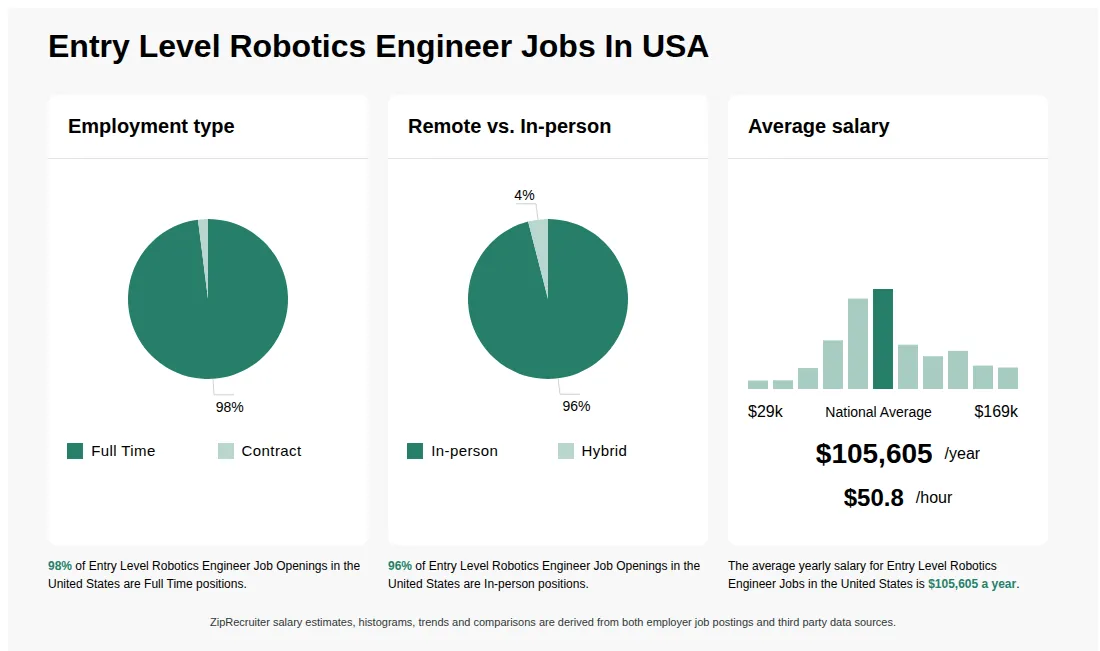
$29K

$105.6K

$169K

How much do entry level robotics engineer jobs pay per year?

As of Jun 4, 2026, the average yearly pay for entry level robotics engineer in the United States is $105,605.00, according to ZipRecruiter salary data. Most workers in this role earn between $83,500.00 and $127,000.00 per year, depending on experience, location, and employer.

What Does an Entry Level Robotics Engineer Do?

An entry-level robotics engineer works with flexible automation, helping design, build, and test robot systems. The responsibilities of an entry-level robotics engineer are to integrate peripherals, such as controllers, welders, and other equipment; create event timing charts or system device lists; design end-of-arm tooling; investigate unexpected maintenance problems, such as mechanical or electrical failures; and evaluate and analyze robotic prototypes or systems. Other duties include researching robotic technology to use for the creation of new systems and system configuration.

What are the key skills and qualifications needed to thrive as an Entry Level Robotics Engineer, and why are they important?

To thrive as an Entry Level Robotics Engineer, you need a solid understanding of robotics fundamentals, programming (such as Python or C++), and a degree in robotics, mechanical, electrical, or computer engineering. Familiarity with CAD software, microcontrollers (like Arduino or Raspberry Pi), and robotics simulation tools (such as ROS or Gazebo) is typically required. Strong problem-solving, teamwork, and effective communication skills help you stand out in collaborative, project-driven environments. These skills and qualities are vital to efficiently design, implement, and troubleshoot robotic systems while contributing to innovative solutions.

What types of projects and technologies do entry level robotics engineers typically work on?

Entry level robotics engineers are often assigned to support the design, assembly, and testing of robotic systems, such as robotic arms, mobile robots, or automated manufacturing lines. They may work with technologies like sensors, actuators, microcontrollers, and programming languages such as Python or C++. Collaboration is common, as they frequently partner with mechanical, electrical, and software engineers to integrate components and troubleshoot issues. This hands-on experience helps new engineers build practical skills and gain exposure to industry-standard tools and processes.

How much do entry-level robotics engineers make in the US?

Entry-level robotics engineers in the US typically earn between $60,000 and $75,000 annually, depending on location, education, and industry. Starting salaries may be higher with relevant internships, certifications, or skills in programming languages like Python or C++ and experience with robotics frameworks such as ROS.

Is robotics a dead field?

Robotics is an active and growing field with ongoing advancements in automation, AI, and sensor technologies. Entry level robotics engineers are in demand in industries such as manufacturing, healthcare, and research, requiring skills in programming, mechanical design, and systems integration.

What is the difference between Entry Level Robotics Engineer vs Robotics Technician?

AspectEntry Level Robotics EngineerRobotics Technician
Required CredentialsBachelor's degree in robotics, mechanical, electrical engineering or related fieldAssociate's degree or technical certification in robotics or automation
Work EnvironmentDesign, develop, and test robotic systems; often in labs or engineering settingsMaintain, troubleshoot, and repair robotic systems; typically in manufacturing or industrial settings
Employer & Industry UsageEngineering firms, tech companies, research labsManufacturing plants, automation companies, industrial facilities

Entry Level Robotics Engineers focus on designing and developing robotic systems, requiring a bachelor's degree, while Robotics Technicians primarily handle maintenance and repairs, often with technical certifications. Both roles are essential in automation industries but differ in responsibilities and educational requirements.

What cities are hiring for Entry Level Robotics Engineer jobs? Cities with the most Entry Level Robotics Engineer job openings:
What are the most commonly searched types of Robotics Engineer jobs? The most popular types of Robotics Engineer jobs are:
What states have the most Entry Level Robotics Engineer jobs? States with the most job openings for Entry Level Robotics Engineer jobs include:
Robotic Welder - All Shifts

Robotic Welder - All Shifts

Standard Iron

Alexandria, MN โ€ข On-site

$24 - $36/hr

Full-time

Medical, Dental, Vision, Life, Retirement, PTO

Posted 13 days ago


Job description

Join Our Team as a Robotic Welder at Standard Iron
Are you ready to start a hands-on career with a company thatโ€™s been setting the standard in contract manufacturing for over 90 years? Standard Iron is looking for entry-level candidates who share our core values of Safety, Respect, Pride in Work, and Continuous Improvement. If you are reliable, hardworking, and eager to learn, we want you to be a part of our team! Standard Iron is seeking someone in the field of Robotic Welding. This individual could be a culmination ofย a robotically trained welder,ย or a robotic programmer with welding capabilities.
Why Standard Iron?
  • Competitive Pay: $24.00 - $36.00 Per Hour (Competitive pay based on experience)
  • Sign-On Bonus -ย $2,500 sign-on bonus for 1st shift Welders and Machine Operators -ย ย $3,000 sign-on bonus for 2ndย shift and weekend shifts Welders and Machine Operators.
  • Outstanding Benefits: Health, dental, vision, and life insurance, plus a 401(k) with employer match.
  • Profit Sharing & More: Take advantage of quarterly profit-sharing, short-term disability, PTO, and paid holidays.
  • Employee Growth: No experience? No problem! We will train the right candidate to succeed.
Available Shifts:
  • 1st Shift: Monday โ€“ Thursday, 6:00 am to 4:30 pm
  • 2nd Shift: Monday - Weds. 4:30pm - 5:00am -ย Employees work three 12-hour shifts (36 hours) and are compensated for a full 40-hour workweek-ย 15% shift differential for 2nd shift
  • Weekend Shift - Friday - Sunday 6:00am - 6:30pm

Key Responsibilities
  • Set up, operate, and monitor robotic welding systems.
  • Familiar with Fanuc robotics is preferred.
  • Program and adjust robotic welding equipment to meet production specifications.
  • Read and interpret blueprints, technical drawings, and welding specifications.
  • Inspect welds to ensure quality, accuracy, and compliance with standards.
  • Perform routine maintenance and troubleshooting on robotic welding systems.
  • Load and unload materials and ensure proper positioning for welding operations.
  • Maintain a clean and safe work environment in accordance with safety guidelines.
  • Collaborate with engineering and production teams to improve processes and efficiency.
  • Document production output and quality checks as required.
  • Establish robotic and automated welding parameters and adjust robotic/welding variables as necessary; oversee improvements to align with safety, delivery, quality, and cost requirements.
  • Balance welding operations to achieve maximum efficiency using offline programming software; analyze cycle time, part dimensional improvements, and ensure part consistency.
  • Assist in the development and implementation of advanced robotic applications and welding automation.
  • Maintain spare parts inventory, oversee routine maintenance for associated equipment.
Qualifications
  • High school diploma or equivalent required; technical training or certification in welding preferred
  • Experience with robotic welding systems in a manufacturing environment
  • Knowledge of welding techniques.
  • Familiar with Fanuc robotics is preferred.
  • Ability to read blueprints and use measuring tools (calipers, gauges, etc.)
  • Basic troubleshooting and mechanical aptitude
  • Strong attention to detail and commitment to quality
  • Ability to work independently and as part of a team.

Apply Today!
If youโ€™re ready to launch your career with a company that values dedication and growth, apply now to join Standard Ironโ€™s team. Start your journey with us and become part of a legacy of excellence.
For a faster experience, please fill out this form when applying
https://surveys.cultureindex.com/s/3B30D30000/12398
We are an Equal Opportunity Employer and consider all qualified applicants without regard to protected characteristics, focusing on skills, safety, and job-related qualifications in our manufacturing operations.

Powered by JazzHR

KGIyeDEiGs