2

Entry Level Robotics Engineer Jobs (NOW HIRING)

... MS entry level with directly applicable degree, otherwise MS plus 1 year or more relevant ... Coding skills in at least two programming languages such as Visual Basic, C, C++, C#, VB, MATLAB ...

New

... MS entry level with directly applicable degree, otherwise MS plus 1 year or more relevant ... Coding skills in at least two programming languages such as Visual Basic, C, C++, C#, VB, MATLAB ...

New

Entry Level Civil Engineer

Birmingham, AL ยท On-site

$65K - $80K/yr

Entry-Level Civil Engineer Launch your career with an engineering team that values innovation ... The firm utilizes modern surveying technologies such as RTK GPS, robotic total stations, and drone ...

Robotic Welder

Sauk Centre, MN ยท On-site

$24 - $36/hr

Standard Iron is looking for entry-level candidates who share our core values of Safety, Respect ... This individual could be a culmination of a robotically trained welder, or a robotic programmer ...

Robotic Welder

Sauk Centre, MN ยท On-site

$24 - $36/hr

Standard Iron is looking for entry-level candidates who share our core values of Safety, Respect ... This individual could be a culmination of a robotically trained welder, or a robotic programmer ...

Be Seen First

Entry Level Manufacturing Engineer

Elgin, IL ยท On-site

$65K - $82K/yr

Position: Entry- Level Manufacturing Engineer Job Type : Direct Hire Pay: $65,000 - $82,000 ... Internship, co-op, lab, shop, automotive, robotics, or other hands-on technical experience.

We are recruiting across a wide range of experience levels from entry level engineers to senior and ... Deployed Robotics: Experience working on robotics deployed in real world settings such as ...

next page

Showing results 1-20

Entry Level Robotics Engineer information

See salary details

$29K

$105.6K

$169K

How much do entry level robotics engineer jobs pay per year?

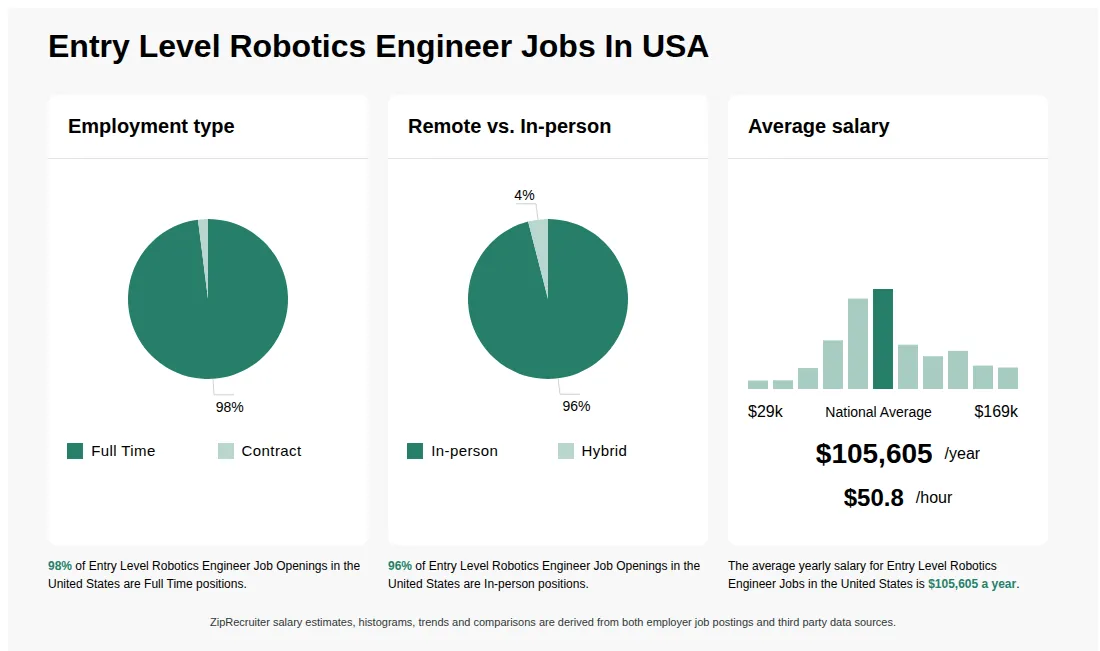
As of Jul 15, 2026, the average yearly pay for entry level robotics engineer in the United States is $105,605.00, according to ZipRecruiter salary data. Most workers in this role earn between $83,500.00 and $127,000.00 per year, depending on experience, location, and employer.

What are the key skills and qualifications needed to thrive as an Entry Level Robotics Engineer, and why are they important?

To thrive as an Entry Level Robotics Engineer, you need a solid understanding of robotics fundamentals, programming (such as Python or C++), and a degree in robotics, mechanical, electrical, or computer engineering. Familiarity with CAD software, microcontrollers (like Arduino or Raspberry Pi), and robotics simulation tools (such as ROS or Gazebo) is typically required. Strong problem-solving, teamwork, and effective communication skills help you stand out in collaborative, project-driven environments. These skills and qualities are vital to efficiently design, implement, and troubleshoot robotic systems while contributing to innovative solutions.

What types of projects and technologies do entry level robotics engineers typically work on?

Entry level robotics engineers are often assigned to support the design, assembly, and testing of robotic systems, such as robotic arms, mobile robots, or automated manufacturing lines. They may work with technologies like sensors, actuators, microcontrollers, and programming languages such as Python or C++. Collaboration is common, as they frequently partner with mechanical, electrical, and software engineers to integrate components and troubleshoot issues. This hands-on experience helps new engineers build practical skills and gain exposure to industry-standard tools and processes.

What is the difference between Entry Level Robotics Engineer vs Robotics Technician?

AspectEntry Level Robotics EngineerRobotics Technician
Required CredentialsBachelor's degree in robotics, mechanical, electrical engineering or related fieldAssociate's degree or technical certification in robotics or automation
Work EnvironmentDesign, develop, and test robotic systems; often in labs or engineering settingsMaintain, troubleshoot, and repair robotic systems; typically in manufacturing or industrial settings
Employer & Industry UsageEngineering firms, tech companies, research labsManufacturing plants, automation companies, industrial facilities

Entry Level Robotics Engineers focus on designing and developing robotic systems, requiring a bachelor's degree, while Robotics Technicians primarily handle maintenance and repairs, often with technical certifications. Both roles are essential in automation industries but differ in responsibilities and educational requirements.

What Does an Entry-Level Robotics Engineer Do?

An entry-level robotics engineer works with flexible automation, helping design, build, and test robot systems. The responsibilities of an entry-level robotics engineer are to integrate peripherals, such as controllers, welders, and other equipment; create event timing charts or system device lists; design end-of-arm tooling; investigate unexpected maintenance problems, such as mechanical or electrical failures; and evaluate and analyze robotic prototypes or systems. Other duties include researching robotic technology to use for the creation of new systems and system configuration.

What does an entry level robotics engineer do?

An entry level robotics engineer is responsible for assisting in the design, development, testing, and implementation of robotic systems and components. They typically work under the guidance of senior engineers, helping to build prototypes, troubleshoot hardware and software issues, and perform routine maintenance. Their tasks can also include programming robots, documenting processes, and collaborating with multidisciplinary teams to improve robotic applications. This role offers hands-on experience and opportunities to learn about cutting-edge robotics technology.
What cities are hiring for Entry Level Robotics Engineer jobs? Cities with the most Entry Level Robotics Engineer job openings:
What are the most commonly searched types of Robotics Engineer jobs? The most popular types of Robotics Engineer jobs are:
What states have the most Entry Level Robotics Engineer jobs? States with the most job openings for Entry Level Robotics Engineer jobs include:
Infographic showing various Entry Level Robotics Engineer job openings in the United States as of July 2026, with employment types broken down into 1% Locum Tenens, 94% Full Time, 2% Part Time, and 3% Contract. Highlights an 87% Physical, 4% Hybrid, and 9% Remote job distribution, with an average salary of $105,605 per year, or $50.8 per hour.
R&D Engineer

Full-time

Posted 6 days ago

New


Job description

Vitro Architectural Glass
Vitro Architectural Glass manufactures a broad range of industry-leading, energy-efficient products such as Solarbanยฎ, Sungateยฎ and Starphire Ultra-Clearยฎ glasses. Throughout our storied history, collaboration and innovation have been central to our advancements. Today, the key to our success continues to lie in the strength of our partnerships. With a foundation formed on trust, teamwork and shared excitement, the possibilities for impactful innovations in glass are truly endless.
With manufacturing facilities throughout the U.S. and Mexico, Vitro Architectural Glass is committed to sustainable manufacturing processes and products. Vitro also operates one of the world's largest glass research and development facilities in Pittsburgh, PA and has four residential glass fabrication plants in Canada.
Website: www.vitroglazings.com
The R&D Engineer's general function is to build, maintain, and improve laboratory and plant-level equipment (including equipment for sample preparation, test, and measurement), and develop new experimental methods, in support of R&D and non-R&D customers. The engineer also own process and product improvement projects that may have visibility beyond R&D (for example HOSHIN-level projects).
Responsibilities:
  • Offers technical information or opinion toward solutions.
  • Coordinates closely with the building and facilities services group to improve and maintain laboratory equipment.
  • Responsible for designing new products and processes involving technology that is largely unknown and/or not practiced within Vitro or elsewhere in industry and improving and maintaining existing products. At times, this work may be completed under supervision from a scientist or higher-level colleagues.
  • Designs and analyze components or assemblies to assist in the development process by ensuring designs are cost efficient, manufacturable, and reliable.
  • Defines process improvements that yield results in safety, quality, cost, and control.
  • Responsible for working independently with known technologies; will further develop new technologies under supervision.
  • Initiates and maintains relationships with vendors and purchase equipment and supplies to ensure efficiency and continuity of laboratory operation.
  • Assists higher level professionals in performing assigned phases of work, ranging from the use of defined methods to exercise of some degree of technical judgement.
  • Provides technical guidance to junior professionals or technicians.
  • Leads and manages HOSHIN level projects focused on product or process improvement.
  • Analyzes and evaluates current equipment and measurement protocols for new products; identifies gaps and areas for improvement; designs and develops instrumentation to meet those needs.
  • Collaborates with other engineers to develop accurate, efficient instrumentation, and data interfaces in accordance with safety and usability standards, customer expectations, and controls methodologies.
  • Designs and tests prototypes of equipment. Develops statistically robust measurement process. Leverage external resources and designs as appropriate.
  • Creates basic schematics and simulated models to test designs; modifies designs to meet specifications and budget requirements.
  • Working with internal and external resources, oversees the implementation of new measuring devices and control systems, ensuring devices are correctly installed and properly tested at the production location. Demonstrate statistically robust measurement process.
  • Drafts and presents formal technical documents, reports, and testing results to manager for approval.
  • Drafts technical and user manuals for instrumentation.
  • Provides training related to devices to employees and/or customers.
  • Works collaboratively with controls, production, and quality engineers to implement process control protocols and tools.

Qualifications:
  • AS/GED plus 14 years relevant experience / AS in technical field plus 10 years relevant experience / BS in technical field plus 3 years relevant experience / MS entry level with directly applicable degree, otherwise MS plus 1 year or more relevant experience.
  • Excellent written and verbal communication skills; ability to plan, organize and share information in interactions with management, peers, associates, and vendors.
  • Ability to troubleshoot, analyze and resolve problems.
  • Must be able to work autonomously as well as in a team setting.
  • Computer knowledge required for use of Microsoft Office products.
  • Working knowledge of computer-aided design equipment and computerized processes preferred.
  • Desired: Coding skills in at least two programming languages such as Visual Basic, C, C++, C#, VB, MATLAB, Python, etc. Fundamental understanding of statistics and process engineering. Technical knowledge and experience in Wonderware InTouch, Allen Bradley PLC, and/or other types of control systems. Experience with SQL, OSISoft-PI, and Azure Platform and familiarity with artificial intelligence and machine learning concepts and implementation. Demonstrated proficiency with two or more programming (e.g., C, C++, Python) languages and SQL. Experience with data interfaces and communication protocols (e.g., TCP/IP) between data acquisition equipment systems.