
July 27, 2026 The City of Waukesha Board of Police and Fire Commissioners is accepting applications for the position of entry level firefighter/paramedic. Individuals who apply should be of excellent ...
July 27, 2026 The City of Waukesha Board of Police and Fire Commissioners is accepting applications for the position of entry level firefighter/paramedic. Individuals who apply should be of excellent ...
Firefighter/Paramedic (Entry-Level)
Perrysburg, OH · On-site
$75K/yr
Division of Fire Opening Date: 06/12/2026 Closing Date: 7/15/2026 11:59 PM Eastern Description ENTRY-LEVEL FIREFIGHTER/PARAMEDIC OPENINGS ALL APPLICANTS MUST TAKE AND PASS THE FOLLOWING NATIONAL ...
Firefighter/Paramedic (Entry-Level)
Perrysburg, OH · On-site
$75K/yr
Division of Fire Opening Date: 06/12/2026 Closing Date: 7/15/2026 11:59 PM Eastern Description ENTRY-LEVEL FIREFIGHTER/PARAMEDIC OPENINGS ALL APPLICANTS MUST TAKE AND PASS THE FOLLOWING NATIONAL ...

FIREFIGHTER/PARAMEDIC RECRUIT
San Marcos, CA · On-site
$108K - $130K/yr
Fire Recruit is an entry-level class in the Firefighter series. The Recruit attends fire department ... Certified EMT/Paramedic license - if issued in a state other than CA - candidate must obtain an EMT ...
FIREFIGHTER/PARAMEDIC RECRUIT
San Marcos, CA · On-site
$108K - $130K/yr
Fire Recruit is an entry-level class in the Firefighter series. The Recruit attends fire department ... Certified EMT/Paramedic license - if issued in a state other than CA - candidate must obtain an EMT ...

Firefighter/Paramedic (Entry-Level)
Albany, CA · On-site
$128K - $172K/yr
Description The City of Albany is accepting applications for Firefighter/Paramedic. Apply Now. Examples of Duties The ideal candidate exemplifies a team-oriented approach, manages challenges with ...
Firefighter/Paramedic (Entry-Level)
Albany, CA · On-site
$128K - $172K/yr
Description The City of Albany is accepting applications for Firefighter/Paramedic. Apply Now. Examples of Duties The ideal candidate exemplifies a team-oriented approach, manages challenges with ...

Firefighter/Paramedic (Entry-Level)
San Pablo, CA · On-site
$128K - $172K/yr
Be a current full-time firefighter/paramedic with at least six months of experience working as a paramedic in a 911 transporting agency is required at time of application * Possession of a California ...
Firefighter/Paramedic (Entry-Level)
San Pablo, CA · On-site
$128K - $172K/yr
Be a current full-time firefighter/paramedic with at least six months of experience working as a paramedic in a 911 transporting agency is required at time of application * Possession of a California ...

Firefighter-Paramedic Recruit
Ventura, CA · On-site
$5.8K - $7.4K/mo
... (entry-level recruit) INTRODUCTION Do you currently have a valid California paramedic license, an interest in a fire service career and a passion to serve your community? Are you an accountable ...
Firefighter-Paramedic Recruit
Ventura, CA · On-site
$5.8K - $7.4K/mo
... (entry-level recruit) INTRODUCTION Do you currently have a valid California paramedic license, an interest in a fire service career and a passion to serve your community? Are you an accountable ...
Firefighter-Paramedic Recruit
Ventura, CA · On-site
$5.8K - $7.4K/mo
... (entry-level recruit) INTRODUCTION Do you currently have a valid California paramedic license, an interest in a fire service career and a passion to serve your community? Are you an accountable ...
Firefighter-Paramedic Recruit
Ventura, CA · On-site
$5.8K - $7.4K/mo
... (entry-level recruit) INTRODUCTION Do you currently have a valid California paramedic license, an interest in a fire service career and a passion to serve your community? Are you an accountable ...

Provides guidance to entry level co-workers. Core Capabilities : Supporting Colleagues : Develops ... LIC-Driver's License - Tennessee, LIC-Emergency Medical Technician - Paramedic - Licensure-Others ...
Provides guidance to entry level co-workers. Core Capabilities : Supporting Colleagues : Develops ... LIC-Driver's License - Tennessee, LIC-Emergency Medical Technician - Paramedic - Licensure-Others ...
Provides guidance to entry level co-workers. Core Capabilities : Supporting Colleagues : Develops ... LIC-Driver's License - Tennessee, LIC-Emergency Medical Technician - Paramedic - Licensure-Others ...
Provides guidance to entry level co-workers. Core Capabilities : Supporting Colleagues : Develops ... LIC-Driver's License - Tennessee, LIC-Emergency Medical Technician - Paramedic - Licensure-Others ...
Provides guidance to entry level co-workers. Core Capabilities : Supporting Colleagues : Develops ... LIC-Emergency Medical Technician - Paramedic - Licensure-Others Work Experience: Relevant Work ...
Provides guidance to entry level co-workers. Core Capabilities : Supporting Colleagues : Develops ... LIC-Emergency Medical Technician - Paramedic - Licensure-Others Work Experience: Relevant Work ...
Provides guidance to entry level co-workers. Core Capabilities : Supporting Colleagues : Develops ... LIC-Emergency Medical Technician - Paramedic - Licensure-Others Work Experience: Relevant Work ...
Provides guidance to entry level co-workers. Core Capabilities : Supporting Colleagues : Develops ... LIC-Emergency Medical Technician - Paramedic - Licensure-Others Work Experience: Relevant Work ...

Firefighter/Paramedic - Entry Level
$144K - $172K/yr
Staffing includes two front line paramedic ambulances, each staffed with two firefighter/paramedics. Novato averages over 7,500 calls for service a year as an all hazard fire agency. Salary range ...
Firefighter/Paramedic - Entry Level
$144K - $172K/yr
Staffing includes two front line paramedic ambulances, each staffed with two firefighter/paramedics. Novato averages over 7,500 calls for service a year as an all hazard fire agency. Salary range ...

Our Paramedics deliver door to door service and provide the highest quality medical care possible ... entry-level position in the City. Essential Duties Please see the online job specification for a ...
Our Paramedics deliver door to door service and provide the highest quality medical care possible ... entry-level position in the City. Essential Duties Please see the online job specification for a ...
FT - Lateral Firefighter/AEMT/Paramedic
$56K - $80K/yr
As an entry-level class, employee may have only limited experience but must have and maintain ... LATERAL FIREFIGHTER/AEMT/PARAMEDIC ESSENTIAL JOB FUNCTIONS * Attendance and punctuality are ...
FT - Lateral Firefighter/AEMT/Paramedic
$56K - $80K/yr
As an entry-level class, employee may have only limited experience but must have and maintain ... LATERAL FIREFIGHTER/AEMT/PARAMEDIC ESSENTIAL JOB FUNCTIONS * Attendance and punctuality are ...
FIREFIGHTER PARAMEDIC
Newport Beach, CA · On-site
$8.0K - $11K/mo
Our Paramedics deliver door to door service and provide the highest quality medical care possible ... an entry-level position in the City. Essential Duties Please see the for a more detailed ...
FIREFIGHTER PARAMEDIC
Newport Beach, CA · On-site
$8.0K - $11K/mo
Our Paramedics deliver door to door service and provide the highest quality medical care possible ... an entry-level position in the City. Essential Duties Please see the for a more detailed ...
FT - Lateral Firefighter/AEMT/Paramedic
Ogden, UT · On-site
$56K - $80K/yr
As an entry-level class, employee may have only limited experience but must have and maintain ... LATERAL FIREFIGHTER/AEMT/PARAMEDIC ESSENTIAL JOB FUNCTIONS * Attendance and punctuality are ...
FT - Lateral Firefighter/AEMT/Paramedic
Ogden, UT · On-site
$56K - $80K/yr
As an entry-level class, employee may have only limited experience but must have and maintain ... LATERAL FIREFIGHTER/AEMT/PARAMEDIC ESSENTIAL JOB FUNCTIONS * Attendance and punctuality are ...
LATERAL Firefighter & Firefighter/Paramedic
University Place, WA · On-site
$8.3K - $11K/mo
If you do not meet the lateral requirements, there is an ENTRY-LEVEL Firefighter & Firefighter/Paramedic job posting on the Employment Opportunities webpage. Lateral Firefighter/EMT 2026 monthly base ...
LATERAL Firefighter & Firefighter/Paramedic
University Place, WA · On-site
$8.3K - $11K/mo
If you do not meet the lateral requirements, there is an ENTRY-LEVEL Firefighter & Firefighter/Paramedic job posting on the Employment Opportunities webpage. Lateral Firefighter/EMT 2026 monthly base ...
LATERAL Firefighter & Firefighter/Paramedic
$8.3K - $11K/mo
If you do not meet the lateral requirements, there is an ENTRY-LEVEL Firefighter & Firefighter/Paramedic job posting on the Employment Opportunities webpage. Lateral Firefighter/EMT 2026 monthly base ...
LATERAL Firefighter & Firefighter/Paramedic
$8.3K - $11K/mo
If you do not meet the lateral requirements, there is an ENTRY-LEVEL Firefighter & Firefighter/Paramedic job posting on the Employment Opportunities webpage. Lateral Firefighter/EMT 2026 monthly base ...

FT - Lateral Firefighter/AEMT/Paramedic
Ogden, UT · On-site
$56K - $80K/yr
As an entry-level class, employee may have only limited experience but must have and maintain ... LATERAL FIREFIGHTER/AEMT/PARAMEDIC ESSENTIAL JOB FUNCTIONS * Attendance and punctuality are ...
Quick apply
FT - Lateral Firefighter/AEMT/Paramedic
Ogden, UT · On-site
$56K - $80K/yr
As an entry-level class, employee may have only limited experience but must have and maintain ... LATERAL FIREFIGHTER/AEMT/PARAMEDIC ESSENTIAL JOB FUNCTIONS * Attendance and punctuality are ...
Firefighter/Paramedic
Sheboygan, WI · On-site
$58K/yr
... paramedic is $58,360.54 ... Candidates with minimum of emergency medical responder and entry-level firefighter certifications ...
Firefighter/Paramedic
Sheboygan, WI · On-site
$58K/yr
... paramedic is $58,360.54 ... Candidates with minimum of emergency medical responder and entry-level firefighter certifications ...
Entry Level Paramedic information
See salary details
$14.42 - $16.56
2% of jobs
$16.56 - $18.71
9% of jobs
$18.71 - $20.85
14% of jobs
$20.92 is the 25th percentile. Wages below this are outliers.
$20.85 - $22.99
15% of jobs
The median wage is $24.64 / hr.
$22.99 - $25.13
14% of jobs
$25.13 - $27.27
11% of jobs
$28.88 is the 75th percentile. Wages above this are outliers.
$27.27 - $29.41
15% of jobs
$29.41 - $31.56
9% of jobs
$31.56 - $33.70
6% of jobs
$33.70 - $35.84
4% of jobs
$35.84 - $37.98
2% of jobs
$14
$26
$37
How much do entry level paramedic jobs pay per hour?
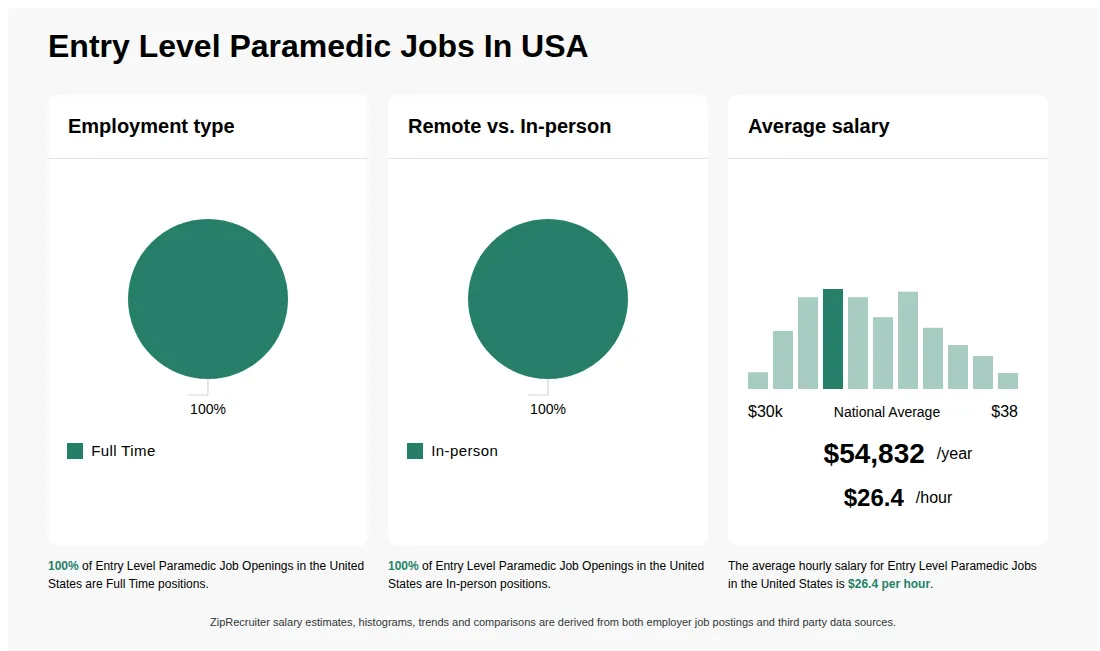
As of Jul 15, 2026, the average hourly pay for entry level paramedic in the United States is $26.36, according to ZipRecruiter salary data. Most workers in this role earn between $21.15 and $29.33 per hour, depending on experience, location, and employer.
What are entry level paramedics?
Entry level paramedics are healthcare professionals who have recently completed their paramedic training and are beginning their careers in emergency medical services. They provide advanced pre-hospital care, including assessing patient conditions, performing life-saving interventions, and safely transporting patients to medical facilities. Entry level paramedics work under protocols and guidance from medical directors, and may collaborate with other emergency responders such as EMTs, firefighters, and police officers. Their responsibilities focus on delivering critical care in urgent situations while gaining experience in the field.
How to get started as a paramedic?
To become an entry-level paramedic, you typically need to complete a state-approved emergency medical technician (EMT) training program, obtain EMT certification, and then enroll in a paramedic training program which includes classroom instruction and clinical experience. After completing the program, you must pass the National Registry of Emergency Medical Technicians (NREMT) exam to become certified and eligible for employment in emergency medical services.
What is the difference between Entry Level Paramedic vs Emergency Medical Technician (EMT)?
| Aspect | Entry Level Paramedic | Emergency Medical Technician (EMT) |
|---|---|---|
| Required Certifications | Paramedic license, advanced certifications | EMT certification, basic life support |
| Work Environment | Ambulances, hospitals, emergency scenes | Ambulances, public safety settings |
| Employer & Industry Usage | Ambulance services, hospitals, EMS agencies | Ambulance services, fire departments, EMS agencies |
Entry Level Paramedics have advanced training and certifications compared to EMTs, allowing them to perform more complex medical procedures. EMTs provide basic emergency care and support. Both roles operate in similar environments but differ in scope of practice and responsibilities.
What are some common challenges faced by entry level paramedics during their first year on the job?
Entry level paramedics often encounter challenges such as adapting to high-pressure situations, managing emotional stress from emergency calls, and gaining confidence in their clinical decision-making skills. Working long shifts, adjusting to irregular hours, and collaborating effectively with more experienced team members can also be demanding. However, most agencies provide mentorship and ongoing training to help new paramedics build resilience and competence as they gain experience in the field.
Is 25 too late to become a paramedic?
Entry-level paramedics can start their careers at age 25 or older, as there is no maximum age limit for training and certification. Many programs accept mature students, and prior life or work experience can be beneficial in emergency medical services. Certification typically requires completing a paramedic training program and passing licensing exams regardless of age.
What are the key skills and qualifications needed to thrive as an Entry Level Paramedic, and why are they important?
To thrive as an Entry Level Paramedic, you need a solid understanding of emergency medical procedures, patient assessment, and life support techniques, generally backed by completion of an accredited paramedic program and state certification. Familiarity with ambulance equipment, cardiac monitors, and electronic patient care reporting systems is typically required. Strong communication, emotional resilience, and teamwork are essential soft skills for interacting with patients and collaborating with other first responders. These skills and qualities ensure effective emergency response, patient safety, and the ability to perform under high-pressure situations.
Can you be a paramedic with no experience?
Entry level paramedics typically need to complete a state-approved EMT or paramedic training program and obtain certification before working. While prior experience is not always required, candidates must demonstrate the necessary skills and pass certification exams to qualify for entry-level positions.
What jobs pay 4000 a week without a degree?
Entry level paramedics typically do not earn $4,000 per week; however, some high-paying jobs without a degree include commercial pilots, sales managers, or skilled trades like electricians and plumbers, especially with experience and certifications. These roles often require specialized training, licenses, or certifications but not necessarily a college degree. Earnings can vary based on location, experience, and industry demand.
More about Entry Level Paramedic jobs
What cities are hiring for Entry Level Paramedic jobs? Cities with the most Entry Level Paramedic job openings:
What are the most commonly searched types of Paramedic jobs? The most popular types of Paramedic jobs are:
What states have the most Entry Level Paramedic jobs? States with the most job openings for Entry Level Paramedic jobs include:
City Of Waukesha rating

8.7
Based on 5 frontline employees who took The Breakroom Quiz
121st of 693 rated public administrative organizations
Job description
Position: Firefighter / Paramedic Salary: 1st Year: $58,625 annually ($61,264 with Paramedic; upon completion of Paramedic Integration); 5th Year: $96,201 annually Location: City of Waukesha - Fire Station 1 Job Type: Full Time Job Number: 26--00798 Department: Fire Department Opening Date: July 10, 2026 Closing Date: July 27, 2026 The City of Waukesha Board of Police and Fire Commissioners is accepting applications for the position of entry level firefighter/paramedic. Individuals who apply should be of excellent moral character and have a commitment to personal integrity and honesty. Minimum requirements to apply include (by date of application): 18 years of age High school graduate or recognized equivalent Valid driver's license State of Wisconsin Firefighter I Certification (Firefighter II preferred)** State of Wisconsin Emergency Medical Technician (EMT) License (Paramedic preferred)** **Reciprocity Conditions - Applicants who are certified Firefighter II bearing the seal of IFSAC (International Fire Service Accreditation Congress)/Pro-Board Equivalent and/or certified Paramedic with the National Registry of Emergency Medical Technicians but are NOT certified and/or licensed by the State of Wisconsin are encouraged to apply.
Offers of employment will be contingent on possessing State of Wisconsin certification and licensure. **Applicants who meet the minimum qualifications of Wisconsin State certified Firefighter I and State of Wisconsin Emergency Medical Technician (EMT) should be advised that offers of employment will include a conditional requirement of attaining State of Wisconsin Firefighter II certification and/or State of Wisconsin Paramedic licensure within 18 months of hire date. An eligibility list will be developed for subsequent employment selection.
As per current collective bargaining agreement (2025 - 2028) starting salary for Firefighter is $58,625. (A higher starting salary may be offered at the sole discretion of the City of Waukesha, depending on candidate qualifications and the recruiting needs of the City. (After five years of employment, with Paramedic license, salary is $96,201.) Application and written test are available at: https://www.publicsafetyanswers.com/waukesha Additional information (Fire Department Overview and Process timeline) can be found at: Department Overview and 2026 Recruitment Timeline.pdf
Explore the City Benefits here: City of Waukesha Benefits Guide 2026 Basic essential job functions of the position: Responds to alarms as a member of firefighting company or EMS unit, and performs a variety of fire ground functions, as situations demand. Operates and performs preventative maintenance and checks on all fire department vehicles and equipment. Responds as a member of a medical team to bring basic or advanced emergency medial care to the citizens of the community.
Prepares written reports and maintains records under supervision of a Company Officer. Participates in daily training exercises and classroom lectures. Performs duties as an Equipment Operator, if qualified, when assigned.
Performs duties as a Fire Lieutenant, if qualified, when assigned. Performs duties as a licensed Paramedic according to criteria and standards set forth by the department, if qualified, when assigned. Perform duties as a Certified Firefighter/EMT-B according to criteria and standards as set forth by department.
Responsible for cleanliness of station and maintenance of apparatus, tools, equipment, and all other fire department property. Conducts demonstrations, tours, and public speeches on fire safety, fire prevention, CPR, fire extinguishers, smoke detectors, first-aid, and other subjects to the public. Performs fire inspections and pre-emergency plans when assigned.
Safely drives emergency vehicles during both day and night, in emergency situations involving speeds more than the posted speed limit, in congested traffic, and during unsafe road conditions. Report to/remain at work during major emergencies and/or disasters without notice. Performs other related duties as assigned.
The City of Waukesha is an Equal Opportunity Employer.