2

Entry Level Epidemiologist Jobs (NOW HIRING)

This entry-level position works under the general direction of the Project Lead or Senior ... Master's degree completed or in progress in Public Health, Epidemiology, Biostatistics, Health ...

$27.16 - $33.78/hr

Provides entry-level nursing functions and services to individuals and families under close ... Conducts nursing assessments and assists with community assessments and epidemiological ...

Public Health Nurse I/II

Mariposa, CA · On-site

$100K - $132K/yr

Public Health Nurse I is the entry-level of this professional series. It provides a full range of ... Participates in epidemiological investigations in the home, school or community, identifying ...

Public Health Nurse I is the entry-level of this professional series. It provides a full range of ... Participates in epidemiological investigations in the home, school or community, identifying ...

The Bachelor of Science in Public Health degree prepares graduates for entry-level careers with social impact, encompassing community-engaged health, environmental health, epidemiology, health ...

The Bachelor of Science in Public Health degree prepares graduates for entry-level careers with social impact, encompassing community-engaged health, environmental health, epidemiology, health ...

next page

Showing results 1-20

Entry Level Epidemiologist information

See salary details

$45K

$85.2K

$133K

How much do entry level epidemiologist jobs pay per year?

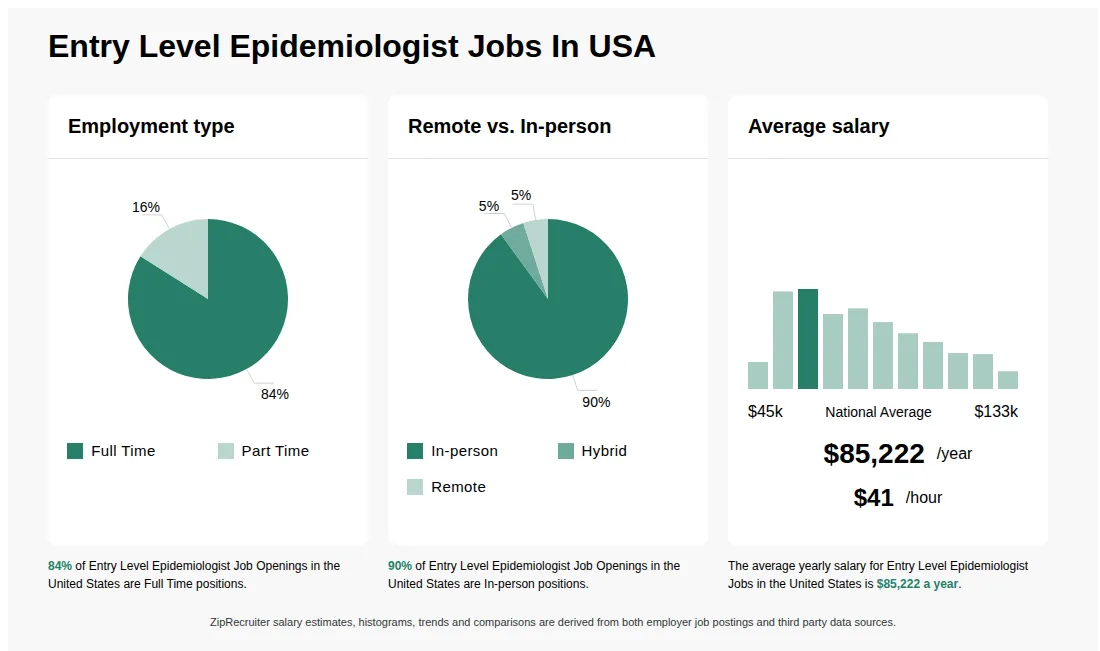
As of Jul 24, 2026, the average yearly pay for entry level epidemiologist in the United States is $85,222.00, according to ZipRecruiter salary data. Most workers in this role earn between $64,000.00 and $101,000.00 per year, depending on experience, location, and employer.

What Does an Entry-Level Epidemiologist Do?

As an entry-level epidemiologist, your responsibilities include conducting research into the spread of disease, treatment of epidemics, and how to prevent epidemics and public health crises. You work under the supervision of a more experienced epidemiologist or a principal investigator who heads a research lab. Your duties depend on whether your office focuses on crafting public policy or conducting research, and they may include planning and conducting studies, collecting data for analysis, writing reports, or developing policy based on research.

What are some common challenges faced by entry level epidemiologists when transitioning from academic study to professional practice?

Entry level epidemiologists often find that applying theoretical knowledge to real-world data and public health issues can be challenging. In the workplace, they must quickly adapt to using specialized software, follow strict protocols, and collaborate with multidisciplinary teams. Balancing multiple projects and deadlines, communicating findings to non-experts, and navigating public health bureaucracy are also common hurdles. However, supportive team environments and mentorship opportunities can help ease this transition and build practical skills.

What are the key skills and qualifications needed to thrive as an Entry Level Epidemiologist, and why are they important?

To thrive as an Entry Level Epidemiologist, you need a solid background in public health, biostatistics, and epidemiological methods, typically backed by a bachelor's or master's degree in public health or a related field. Familiarity with statistical analysis software (such as SAS, SPSS, or R) and data management systems is highly valued. Strong analytical thinking, attention to detail, and effective written and verbal communication skills help you interpret data and collaborate on research teams. These abilities are crucial for accurately analyzing public health data, identifying trends, and supporting evidence-based decision making.

What does an entry level epidemiologist do?

An entry level epidemiologist typically assists in collecting and analyzing data related to disease patterns within populations. Their responsibilities may include conducting surveys, performing statistical analyses, supporting outbreak investigations, and preparing reports under the supervision of senior epidemiologists. They often work in public health departments, research organizations, or hospitals, contributing to efforts that prevent and control health problems. Entry level epidemiologists also help communicate findings to stakeholders and may participate in health education initiatives.

What is the difference between Entry Level Epidemiologist vs Public Health Analyst?

AspectEntry Level EpidemiologistPublic Health Analyst
Required CredentialsBachelor's or Master's in Public Health, Epidemiology, or related fieldBachelor's or Master's in Public Health, Health Policy, or related field
Work EnvironmentResearch settings, healthcare facilities, government agenciesPolicy analysis, program evaluation, government or NGO offices
Employer & Industry UsagePublic health departments, research institutions, hospitalsGovernment agencies, non-profits, consulting firms
Common Search & ComparisonYesYes

Entry Level Epidemiologists and Public Health Analysts often share similar educational backgrounds and work in public health settings. While epidemiologists focus on disease investigation and data analysis, public health analysts tend to concentrate on policy, program evaluation, and health outcomes. Both roles are essential in public health initiatives and frequently overlap in skills and work environments.

What cities are hiring for Entry Level Epidemiologist jobs? Cities with the most Entry Level Epidemiologist job openings:
What are the most commonly searched types of Epidemiologist jobs? The most popular types of Epidemiologist jobs are:
What states have the most Entry Level Epidemiologist jobs? States with the most job openings for Entry Level Epidemiologist jobs include:
Infographic showing various Entry Level Epidemiologist job openings in the United States as of July 2026, with employment types broken down into 80% Full Time, and 20% Part Time. Highlights an 100% In-person job distribution, with an average salary of $85,222 per year, or $41 per hour.
Epi Research Assistant - Phlebotomy/Venipunctureq

Epi Research Assistant - Phlebotomy/Venipunctureq

Rush University Medical Center

Chicago, IL

$17.63 - $24.91/hr

Full-time, Part-time

Posted 10 days ago


Rush University Medical Center rating

8.0

Company rating: 8.0 out of 10

Based on 107 frontline employees who took The Breakroom Quiz

129th of 1,023 rated hospitals


Job description

Location: Chicago, Illinois

Business Unit: Rush Medical Center

Hospital: Rush University Medical Center

Department: IM Community Epi-Res Adm

Work Type: Part Time (Total FTE between 0. 5 and 0. 89)

Shift: Shift 1

Work Schedule: 8 Hr (8:00:00 AM - 4:00:00 PM)

Rush offers exceptional rewards and benefits learn more at our Rush benefits page (https://www.rush.edu/rush-careers/employee-benefits).

Pay Range: $17.63 - $24.91 per hour
Rush salaries are determined by many factors including, but not limited to, education, job-related experience and skills, as well as internal equity and industry specific market data. The pay range for each role reflects Rush’s anticipated wage or salary reasonably expected to be offered for the position. Offers may vary depending on the circumstances of each case.

The Epi Research Assistant will perform venipuncture (phlebotomy) and collect blood samples for the U.S. POINTER study

General Summary:
The Research Assistant is responsible for collecting information from participants according to the established sleep and circadian protocols. Conduct interviews, epidemiological, social or behavioral assessments, and collect data and/or biological samples from research participants and families in studies. Exemplifies the Rush mission, vision and values and acts in accordance with Rush policies and procedures.

Required Job Qualifications:
•Some college with prior data collection experience required.
•Entry level proficiency in Microsoft Office, including Excel spreadsheets and other databases.
•Detail oriented with high attention to accuracy.
•Strong written and verbal communications.
•Ability to develop rapport with a diverse pool of research participants.
•Ability to navigate sensitive topics and maintain confidentiality of participants.
•Ability to collaborate within multi-disciplinary team settings.
•May require 6-8 weeks training depending on study protocols.
•Availability to work evenings, overnight and weekends if called for under the study protocols.
•May require personal transportation to field location.
Preferred Job Qualifications:
•Bachelor’s Degree. If degreed, no prior research experience required.
•Prior work with human subjects research study protocols.
•Fluent in spoken English.
•Must be able to read and write in English.

Responsibilities:
1.Recruit and screen study participants: posting ads, distributing flyers, calling participants, meeting with participants virtually or in person.
2.Administer tests and questionnaires according to research study protocols.
3.Maintain study records and editing for completeness and accuracy.
4.Write, update, and prepare lab instructions and study related materials.
5.Enter and analyze data: data entry of sleep logs and other forms, manipulating spreadsheets, making graphs, etc.
6.Run study participants: preparing equipment and experimental rooms, following checklists, running laboratory sessions, writing accurate chart notes, handling equipment emergencies, monitoring and engaging with research participants, etc.
7.Download study equipment with participants: downloading and interpreting data, writing accurate chart notes, instructing and correcting participants, communicating problems to study coordinator/PI.
8.Utilize approved informed consent and HIPAA procedures.
9.Maintain equipment and computers: caring for equipment, testing equipment, sending equipment for repairs, etc.
10.Maintain supply inventory.
11.Keep lab neat, clean and organized: cleaning up after laboratory sessions with participants, keeping common areas clean and organized, finding new ways to organize.
12.Manage other various smaller lab jobs to ensure the lab runs smoothly.
13.Attend regular team meetings.
14.Troubleshoot field issues when necessary, using discretion to resolve issues when unplanned events arise.
15.May help draft abstracts, manuscripts, or presentations to disseminate study findings.

Rush is an equal opportunity employer. We evaluate qualified applicants without regard to race, color, religion, sex, sexual orientation, gender identity, national origin, disability, veteran status, and other legally protected characteristics.


What Rush University Medical Center employees say

Pay

Benefits

Hours and flexibility

Workplace

Get the full story on Breakroom