2

Entry Level Data Analyst Jobs (NOW HIRING)

DIRECTV Advertising is looking for a data analyst to make an immediate impact by supporting the ... Taking on analytical projects and ad-hoc requests as needed Qualifications: * Entry level ...

Data Entry Clerk / Part Time (Remote)

$17.50 - $23.25/hr

Exciting Opportunity - Remote Entry-Level Data Entry Clerk Are you a detail-oriented, organized ... analysis and contribute to actionable insights that drive business decisions. * Embrace new ...

Data Analyst

Richmond, VA · On-site

$62K/yr

Position Summary The Data Analyst supports the Personal Lines team by analyzing data, creating ... This entry-level role is ideal for a recent graduate with strong technical skills who can ...

Data analyst I

Austin, TX · On-site

$25 - $28/hr

1-3 years' experience in data analysis Strong Microsoft Excel skills (must-have) Experience with Power BI Entry-level knowledge of C++ and CSS (nice-to-have, not core) Engineering Technician I Active ...

Data Analyst

Richmond, VA · On-site

$62K/yr

Position Summary The Data Analyst supports the Personal Lines team by analyzing data, creating ... This entry-level role is ideal for a recent graduate with strong technical skills who can ...

Position Summary The Data Analyst supports the Personal Lines team by analyzing data, creating ... This entry-level role is ideal for a recent graduate with strong technical skills who can ...

next page

Showing results 1-20

Entry Level Data Analyst information

See salary details

$13

$32

$61

How much do entry level data analyst jobs pay per hour?

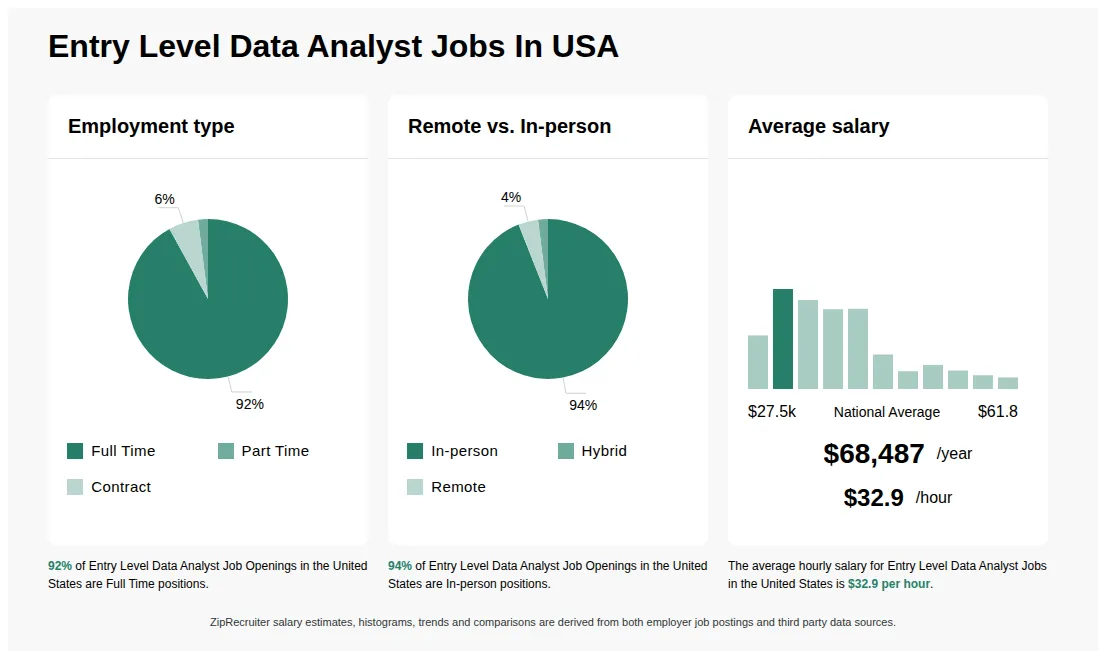
As of Jul 16, 2026, the average hourly pay for entry level data analyst in the United States is $32.93, according to ZipRecruiter salary data. Most workers in this role earn between $21.15 and $36.78 per hour, depending on experience, location, and employer.

Is 40 too late for data science?

Entry level data analysts and data scientists can start at any age, including 40, as long as they develop relevant skills such as programming, statistics, and data visualization. Many professionals successfully transition into data roles later in their careers by gaining certifications and practical experience.

Can you work as a data analyst without experience?

Entry level data analyst positions often do not require prior professional experience, but having skills in Excel, SQL, or data visualization tools can improve your chances. Many employers value relevant coursework, certifications, or internships that demonstrate your ability to analyze data effectively.

What does an Entry Level Data Analyst do?

An Entry Level Data Analyst is responsible for collecting, processing, and analyzing data to help organizations make informed decisions. They often work with spreadsheets, databases, and data visualization tools to identify trends and generate reports. Typical tasks include cleaning data, creating charts or dashboards, and supporting senior analysts or business teams with actionable insights. This role is ideal for individuals with strong analytical skills and a keen attention to detail, even if they have limited professional experience.

What is the difference between Entry Level Data Analyst vs Data Scientist?

AspectEntry Level Data AnalystData Scientist
Required CredentialsBachelor's degree in data-related field; basic knowledge of SQL, Excel, and data visualization toolsBachelor's or master's degree in data science, statistics, or related field; stronger programming and statistical skills
Work EnvironmentEntry-level roles in business, finance, marketing, or healthcare sectors; focus on data reporting and visualizationMore advanced roles often in tech, research, or large organizations; focus on predictive modeling and complex analysis
Employer & Industry UsageCommon in various industries for routine data analysis tasksUsed in industries requiring advanced analytics, machine learning, and predictive insights

While Entry Level Data Analysts focus on basic data collection, cleaning, and reporting, Data Scientists handle complex modeling, machine learning, and predictive analytics. The roles differ mainly in skill level, complexity, and scope of work, but both require a strong foundation in data handling and analysis.

What are some common challenges entry level data analysts face when transitioning from academic projects to real-world business environments?

Entry level data analysts often find that real-world datasets are messier and less structured than those in academic settings, requiring more time spent on data cleaning and preparation. Additionally, business environments may prioritize actionable insights over purely statistical rigor, so learning to communicate findings to non-technical stakeholders is crucial. Collaborating within cross-functional teams and managing multiple deadlines can also be a new challenge, but these experiences help analysts develop strong problem-solving and communication skills that are valuable for career growth.

Can I be a data analyst with no experience?

Entry level data analyst positions often do not require prior professional experience, but having foundational skills in Excel, SQL, or data visualization tools can improve your chances. Many employers value relevant coursework, certifications, or internships that demonstrate your ability to analyze data effectively.

Will AI replace a data analyst?

AI tools can automate routine data processing and basic analysis tasks, but data analysts are essential for interpreting complex data, making strategic decisions, and providing context. The role of a data analyst involves skills like critical thinking, communication, and domain knowledge that AI cannot fully replicate. Therefore, AI is more likely to augment rather than replace entry-level data analysts.

What are the 4 types of data analyst?

Data analysts can be categorized into four main types: business analysts, who focus on understanding business needs; data scientists, who develop advanced models and algorithms; data engineers, who build and maintain data pipelines; and operations analysts, who optimize processes using data insights. Entry-level data analysts often start with business or operations analysis, developing skills in tools like Excel, SQL, and visualization software.

What Does an Entry-Level Data Analyst Do?

The job duties of an entry-level data analyst include working to collect, manage, and analyze data. In this career, your responsibilities often revolve around performing research on business or industry data to define trends or assess performance in a particular sector. As an entry-level data analyst, you usually work as part of a team of analysts and statisticians who analyze data and then create reports to show their findings to relevant executives, stakeholders, and managers. In some situations, this analysis team may recommend actions based on research results.

Can a data analyst be entry-level?

Yes, entry-level data analyst positions are common and typically require basic skills in data analysis tools like Excel, SQL, or Python, along with a relevant degree such as in statistics, mathematics, or computer science. These roles often focus on learning and developing analytical skills under supervision and may require little to no prior professional experience.

What are the key skills and qualifications needed to thrive as an Entry Level Data Analyst, and why are they important?

To thrive as an Entry Level Data Analyst, you need strong analytical thinking, basic statistical knowledge, and proficiency in data management, typically supported by a bachelor’s degree in a quantitative field. Familiarity with tools such as Microsoft Excel, SQL, and data visualization platforms like Tableau or Power BI is commonly required. Attention to detail, effective communication, and a willingness to learn help set candidates apart in this role. These skills are vital for accurately interpreting data, generating actionable insights, and clearly conveying findings to support business decisions.
What cities are hiring for Entry Level Data Analyst jobs? Cities with the most Entry Level Data Analyst job openings:
What are the most commonly searched types of Data Analyst jobs? The most popular types of Data Analyst jobs are:
What states have the most Entry Level Data Analyst jobs? States with the most job openings for Entry Level Data Analyst jobs include:
Infographic showing various Entry Level Data Analyst job openings in the United States as of July 2026, with employment types broken down into 46% Full Time, 8% Part Time, 8% Temporary, and 38% Contract. Highlights an 92% In-person, and 8% Remote job distribution, with an average salary of $68,487 per year, or $32.9 per hour.
Junior Level Data Scientist/java Programmer (Remote)

Junior Level Data Scientist/java Programmer (Remote)

SynergisticIT

Los Angeles, CA • On-site

Other

Posted 4 days ago


Job description

Entry-Level Data Scientist / Java Developer — Choose a Path With Support If you are applying everywhere but not getting responses, it may be time to stop guessing and start building a structured plan. Many candidates are interested in both software and data careers but do not know which path fits their strengths or how to present themselves to employers. SynergisticIT is considering candidates for entry-level Java developer, Python developer, software programmer, data analyst, data engineer, data scientist, and ML/AI programmer paths. This opportunity is ideal for candidates who want guidance, stronger skills, better projects, and a more focused job-search strategy. Since 2010, we’ve helped thousands of candidates land full-time jobs at tech leaders like Google, Apple, PayPal, Visa, Western Union, Wells Fargo, Intel, Paypal, JPMC, Wayfair, BOA, CITI and hundreds more with Job offers of $95k to $154k. Synergisticit focuses on closing the gap between your tech skills and what employers want now. Currently, We are looking for entry-level software programmers, Java Full stack developers, Python/Java developers, Data analysts/Data Engineers/ Data Scientists, Machine Learning engineers for full time positions with clients. We Focus on Java /Full stack/Devops and Data Science /Data Engineers/Data analysts/BI Analysts/ Machine learning/AI candidates Ideal Candidates: Recent grads in CS, Engineering, Math, or Statistics with limited or no job experience Jobseekers who had layoffs due to Downsizing and want to get in demand tech stack Professionals seeking a career switch to tech Candidates with career gaps or lacking real-world experience Individuals looking to boost their skill portfolio for better job prospects Computer Science grads with limited or no job experience Students who recently finished their Bachelor’s or Master’s programs Those struggling to land interviews despite having experience please read our blogs · Why do Tech Companies not Hire recent Computer Science Graduates | https://www.synergisticit.com/why-tech-companies-dont-hire-recent-cs-graduates/ · Technical Skills or Experience? | Which one is important to get a Job? | https://www.synergisticit.com/tech-skill-or-experience-which-one-is-more-important-for-a-jobseeker/ Please check below links: Synergisticit Industry Event videos (OCW, JavaOne, Gartner data Analytics): https://fast.wistia.com/embed/channel/k4mlq69ekl USA Today feature Discover JOPP: https://www.synergisticit.com/jopp/ Contact: https://www.synergisticit.com/contact-us/ SynergisticIT JOPP is good because it helps candidates close the gap between coursework and hiring expectations. Whether your direction is Java, full stack, DevOps, analytics, data science, or AI, the program helps emphasize practical skills, project work, resume preparation, interview readiness, and job-market execution. Choose a career path with structure and support—contact us Please note: Resume databases are shared with clients and interested clients will reach out directly if they find a qualified candidate for their req. Resume submissions may be shared with our JOPP team database also. Please unsubscribe if contacted or if you don’t want to be contacted please don’t submit your resume.