
One Tech Engineering is searching for an Electrical Engineer for a position located in Wallingford, Connecticut; Newton, Massachusetts; Conshohocken, Pennsylvania; or Morristown, New Jersey. The ...
One Tech Engineering is searching for an Electrical Engineer for a position located in Wallingford, Connecticut; Newton, Massachusetts; Conshohocken, Pennsylvania; or Morristown, New Jersey. The ...

Electrical Engineer
Glastonbury, CT · On-site
Electrical Engineer Location: Glastonbury, CT Employment Type: Full-Time, In-person Position Summary: This position entails the electrical project support of multi-million-dollar power generation ...
Quick apply
Electrical Engineer
Glastonbury, CT · On-site
Electrical Engineer Location: Glastonbury, CT Employment Type: Full-Time, In-person Position Summary: This position entails the electrical project support of multi-million-dollar power generation ...
Electrical Engineer
Glastonbury, CT · On-site
Electrical Engineer Location: Glastonbury, CT Employment Type: Full-Time, In-person Position Summary: This position entails the electrical project support of multi-million-dollar power generation ...
Electrical Engineer
Glastonbury, CT · On-site
Electrical Engineer Location: Glastonbury, CT Employment Type: Full-Time, In-person Position Summary: This position entails the electrical project support of multi-million-dollar power generation ...
Electrical Engineer
Glastonbury, CT · On-site
$90 - $130/hr
The Electrical Engineer will also work closely with the project team in proposal development and participate in customer meetings and presentations. Position Description The Electrical Engineer will ...
Electrical Engineer
Glastonbury, CT · On-site
$90 - $130/hr
The Electrical Engineer will also work closely with the project team in proposal development and participate in customer meetings and presentations. Position Description The Electrical Engineer will ...
Electrical Engineer
Glastonbury, CT · On-site
$90 - $130/hr
The Electrical Engineer will also work closely with the project team in proposal development and participate in customer meetings and presentations. Position Description: The Electrical Engineer will ...
Electrical Engineer
Glastonbury, CT · On-site
$90 - $130/hr
The Electrical Engineer will also work closely with the project team in proposal development and participate in customer meetings and presentations. Position Description: The Electrical Engineer will ...

Electrical Engineer
Windsor, CT · On-site
A multi-discipline engineering firm with over 70 years in business is looking for a Senior Electrical Engineer for their Windsor, Connecticut office! Responsibilities: * Design electrical systems ...
Quick apply
Electrical Engineer
Windsor, CT · On-site
A multi-discipline engineering firm with over 70 years in business is looking for a Senior Electrical Engineer for their Windsor, Connecticut office! Responsibilities: * Design electrical systems ...
Electrical Engineer
Windsor, CT · On-site
A multi-discipline engineering firm with over 70 years in business is looking for a Senior Electrical Engineer for their Windsor, Connecticut office! Responsibilities: * Design electrical systems ...
Electrical Engineer
Windsor, CT · On-site
A multi-discipline engineering firm with over 70 years in business is looking for a Senior Electrical Engineer for their Windsor, Connecticut office! Responsibilities: * Design electrical systems ...

Electrical Engineer
Plainville, CT · On-site
Loureiro Engineering Associates has an immediate need for an Electrical Engineer to join our Facility Solutions Division in Plainville Connecticut. We are seeking a candidate who aligns with our ...
Electrical Engineer
Plainville, CT · On-site
Loureiro Engineering Associates has an immediate need for an Electrical Engineer to join our Facility Solutions Division in Plainville Connecticut. We are seeking a candidate who aligns with our ...
Electrical Engineer
Plainville, CT · On-site
Loureiro Engineering Associates has an immediate need for an Electrical Engineer to join our Facility Solutions Division in Plainville Connecticut. We are seeking a candidate who aligns with our ...
Electrical Engineer
Plainville, CT · On-site
Loureiro Engineering Associates has an immediate need for an Electrical Engineer to join our Facility Solutions Division in Plainville Connecticut. We are seeking a candidate who aligns with our ...
Electrical Engineer
Plainville, CT · On-site
Loureiro Engineering Associates has an immediate need for an Electrical Engineer to join our Facility Solutions Division in Plainville Connecticut. We are seeking a candidate who aligns with our ...
Quick apply
Electrical Engineer
Plainville, CT · On-site
Loureiro Engineering Associates has an immediate need for an Electrical Engineer to join our Facility Solutions Division in Plainville Connecticut. We are seeking a candidate who aligns with our ...
Electrical Engineer
Newtown, CT · On-site
We are seeking a highly experienced Electrical Engineer/Manager to join our team in Newtown, CT. Our mission is to deliver high-performance ultrasonic products backed by superior technology and ...
Electrical Engineer
Newtown, CT · On-site
We are seeking a highly experienced Electrical Engineer/Manager to join our team in Newtown, CT. Our mission is to deliver high-performance ultrasonic products backed by superior technology and ...
Electrical Engineer
Newtown, CT · On-site
We are seeking a highly experienced Electrical Engineer/Manager to join our team in Newtown, CT. Our mission is to deliver high-performance ultrasonic products backed by superior technology and ...
Electrical Engineer
Newtown, CT · On-site
We are seeking a highly experienced Electrical Engineer/Manager to join our team in Newtown, CT. Our mission is to deliver high-performance ultrasonic products backed by superior technology and ...

Electrical Engineer
New Haven, CT · On-site
$60 - $120/hr
The ideal Electronic Engineer has an Electrical Engineering background with hands-on circuit simulation experience using tools such as LTspice, PowerSim, or MathWorks. Experience with Altium Designer ...
New
Electrical Engineer
New Haven, CT · On-site
$60 - $120/hr
The ideal Electronic Engineer has an Electrical Engineering background with hands-on circuit simulation experience using tools such as LTspice, PowerSim, or MathWorks. Experience with Altium Designer ...
New
Electrical Engineer
Norwalk, CT · On-site
💼 Electrical Engineer 📍 Norwalk, CT 💰 $110,000 - $130,000 + Profit Sharing Do you like being hands-on with machines as much as you like being at the drawing board? I'm working with an ...
Electrical Engineer
Norwalk, CT · On-site
💼 Electrical Engineer 📍 Norwalk, CT 💰 $110,000 - $130,000 + Profit Sharing Do you like being hands-on with machines as much as you like being at the drawing board? I'm working with an ...

Electrical Engineer
Bloomfield, CT · On-site
$85K - $110K/yr
Job Title: Electrical Engineer Location: Bloomfield, CT * Test Equipment Engineering * Design, build, and commission new electronic test equipment and repair fixtures. * Develop functional ...
Quick apply
Electrical Engineer
Bloomfield, CT · On-site
$85K - $110K/yr
Job Title: Electrical Engineer Location: Bloomfield, CT * Test Equipment Engineering * Design, build, and commission new electronic test equipment and repair fixtures. * Develop functional ...

Electrical Engineer
Danbury, CT · On-site
$75K - $100K/yr
Full Electrical Engineer or Electrical Draftsman for Panel Design Entry to Midlevel Electrical Design Engineer position. Looking for a highly motivated individual with creativity to "get the job done ...
Quick apply
Electrical Engineer
Danbury, CT · On-site
$75K - $100K/yr
Full Electrical Engineer or Electrical Draftsman for Panel Design Entry to Midlevel Electrical Design Engineer position. Looking for a highly motivated individual with creativity to "get the job done ...
Electrical Engineer
Wilton, CT · On-site
$90 - $120/hr
Introduction to the job As an electrical engineer at ASML in Wilton, you will help develop the technologies that make advanced lithography systems possible. You will specify, design, develop, realize ...
Electrical Engineer
Wilton, CT · On-site
$90 - $120/hr
Introduction to the job As an electrical engineer at ASML in Wilton, you will help develop the technologies that make advanced lithography systems possible. You will specify, design, develop, realize ...

Electrical Engineer
Wilton, CT · On-site
Introduction to the job As an electrical engineer at ASML in Wilton, you will help develop the technologies that make advanced lithography systems possible. You will specify, design, develop, realize ...
Electrical Engineer
Wilton, CT · On-site
Introduction to the job As an electrical engineer at ASML in Wilton, you will help develop the technologies that make advanced lithography systems possible. You will specify, design, develop, realize ...

Electrical Engineer
Norwalk, CT · On-site
$100K - $125K/yr
Electrical Engineer Join a Connecticut Top Workplace and industry leader with more than 50 years of innovation in automated packaging equipment. This is an opportunity to make a direct impact ...
Quick apply
Electrical Engineer
Norwalk, CT · On-site
$100K - $125K/yr
Electrical Engineer Join a Connecticut Top Workplace and industry leader with more than 50 years of innovation in automated packaging equipment. This is an opportunity to make a direct impact ...

The Electrical Engineer will be responsible for designing and developing electrical and software systems, performing power system analysis, and evaluating electrical system components. Daily ...
The Electrical Engineer will be responsible for designing and developing electrical and software systems, performing power system analysis, and evaluating electrical system components. Daily ...
Electrical Engineer information
See Connecticut salary details
$48K - $58.2K
2% of jobs
$58.2K - $68.4K
5% of jobs
$68.4K - $78.5K
17% of jobs
$78.9K is the 25th percentile. Wages below this are outliers.
$78.5K - $88.7K
15% of jobs
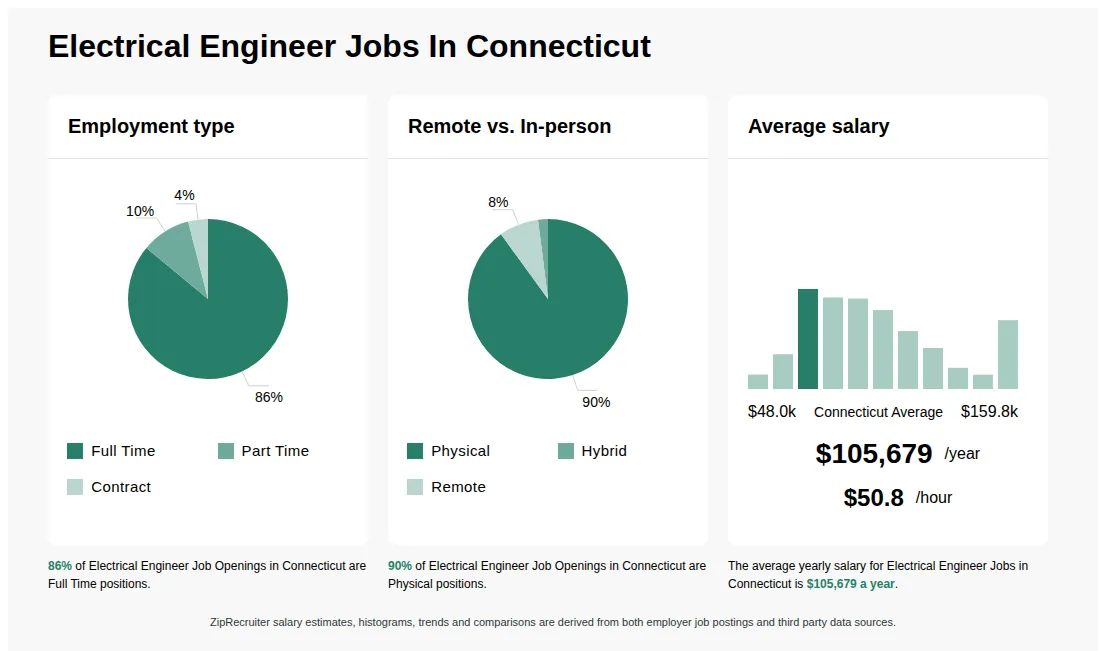
The median wage is $95.9K / yr.
$88.7K - $98.8K
15% of jobs
$98.8K - $109K
13% of jobs
$117.5K is the 75th percentile. Wages above this are outliers.
$109K - $119.2K
10% of jobs
$119.2K - $129.3K
6% of jobs
$129.3K - $139.5K
3% of jobs
$139.5K - $149.7K
2% of jobs
$149.7K - $159.8K
12% of jobs
$48K
$105.7K
$159.8K
How much do electrical engineer jobs pay per year?
As of Sep 5, 2026, the average yearly pay for electrical engineer in Connecticut is $105,679.00, according to ZipRecruiter salary data. Most workers in this role earn between $79,000.00 and $125,600.00 per year, depending on experience, location, and employer.
What does an electrical engineer do?
An Electrical Engineer designs, develops, tests, and supervises the manufacturing of electrical equipment, such as electric motors, radar and navigation systems, communications systems, and power generation equipment. They work in a variety of industries, including energy, manufacturing, telecommunications, and electronics. Their role often involves problem-solving, project management, and ensuring that systems comply with safety and quality standards. Electrical Engineers also collaborate with other engineers and professionals to bring projects from concept to completion.
What are the key skills and qualifications needed to thrive as an electrical engineer, and why are they important?
To thrive as an Electrical Engineer, you need a solid understanding of circuit design, electronics, mathematics, and physics, usually backed by a bachelor's degree in electrical engineering or a related field. Familiarity with CAD software, simulation tools like MATLAB or PSpice, and knowledge of relevant industry standards or certifications (such as a Professional Engineer license) are commonly expected. Strong problem-solving abilities, teamwork, and effective communication skills set outstanding engineers apart. These competencies are critical for designing safe, efficient electrical systems and collaborating effectively on complex engineering projects.
What are some common challenges electrical engineers face when working on multidisciplinary project teams?
Electrical Engineers often collaborate with professionals from mechanical, civil, and software engineering backgrounds. A common challenge is ensuring clear communication and alignment of technical specifications, as each discipline may have different priorities and terminologies. Successfully navigating these challenges requires strong teamwork, adaptability, and the ability to translate complex electrical concepts for diverse audiences. Building mutual understanding helps prevent project delays and ensures seamless integration of electrical systems with other components.
What is the difference between Electrical Engineer vs Electrical Technician?
| Aspect | Electrical Engineer | Electrical Technician |
|---|---|---|
| Required Credentials | Bachelor's degree in electrical engineering or related field | Associate degree or technical diploma in electrical technology |
| Work Environment | Design, development, and testing of electrical systems, often in offices or labs | Installation, maintenance, and troubleshooting of electrical systems, often on-site |
| Employer & Industry Usage | Engineering firms, manufacturing, power generation, and consulting | Construction, maintenance, and manufacturing industries |
Electrical engineers focus on designing and developing electrical systems, requiring a bachelor's degree, while electrical technicians handle installation and maintenance, typically with technical diplomas. Both roles are essential in the electrical industry but differ in responsibilities and educational requirements.
What type of work do electrical engineers do?
Electrical engineers design, develop, and test electrical systems and components used in a variety of industries, including power generation, electronics, telecommunications, and automation. They work on projects such as circuit design, system integration, and troubleshooting, often using tools like CAD software and adhering to safety standards. Their work may involve both research and practical implementation in laboratory or field environments.
More about Electrical Engineer jobs
What are the most commonly searched types of Electrical Engineer jobs in Connecticut?
The most popular types of Electrical Engineer jobs in Connecticut are:
What are popular job titles related to Electrical Engineer jobs in Connecticut?
For Electrical Engineer jobs in Connecticut, the most frequently searched job titles are:
- Electrical Engineer Manager
- Freelance Electrical Engineer Visa Sponsorship Available
- Remote Electrical Power Engineer
- Senior Electrical Engineer Nasa
- Remote Electrical Engineer
- Senior Electrical Engineer
- Startup Electrical Engineer
- No Experience Electrical Engineer
- Junior Electric Vehicle Engineer
- Contract Electrical Engineering
What job categories do people searching Electrical Engineer jobs in Connecticut look for?
The top searched job categories for Electrical Engineer jobs in Connecticut are:
- Taiwan Electrical Engineer
- Hydroelectric Power Generation
- Electrical Engineer Two
- Electrical Engineer In Luxembourg
- Electrical Engineer New Graduate
- Remote Eplan Electrical Design Engineer
- Electrical Engineer In Europe
- Manager Intel Electrical Engineer
- Electrical Engineer Electrical
- Advanced Electrical Engineer
What cities in Connecticut are hiring for Electrical Engineer jobs?
Cities in Connecticut with the most Electrical Engineer job openings:
What are popular job titles related to Electrical Engineer jobs in CT?
For Electrical Engineer jobs in CT, the most frequently searched job titles are:
Job description
Job Description One Tech Engineering is searching for an Electrical Engineer for a position located in Wallingford, Connecticut; Newton, Massachusetts; Conshohocken, Pennsylvania; or Morristown, New Jersey. The Electrical Engineer will responsible for the design of high voltage electrical substations. The candidate must be a US Citizen or a green card holder, the position is not eligible for sponsorship.
The candidate should have a bachelor's degree in electrical engineering or related degree and 3 years of electrical engineering experience. Local candidates preferred or open to relocation. This is not a remote position.
Electrical Engineer Responsibilities: Preparation of proposals and scope development, including conceptual designs and execution plans. Prepare engineering cost and labor estimates and schedules. Physical substation design including yard layouts, plans, sections and details, grounding, lightning protection, control building arrangements, interior and exterior raceways, auxiliary AC/DC power systems, and associated bills of material.
Protection and control design including panel arrangements, one lines/single lines, three lines, AC schematics, DC elementaries, equipment wiring and relay panel wiring. Preparing calculations and reports for engineering studies. (grounding, lightning protection, AC/DC load studies, etc.) Preparing equipment specifications for procurement and/or factory acceptance testing
Coordinating design activities with other departments. (Civil/Structural, Networks, Transmission Line, others.) Providing guidance and mentoring to less experienced team members. Regularly meeting with and corresponding with clients or outside personnel
Performing quality reviews for other engineers and designers. Providing short-term field support during construction. Supporting business development and marketing initiatives.
Other areas of involvement may include relay settings, 3D/intelligent design, or industry/professional technical committee involvement. Performing other duties as assigned. Requirements of the Electrical Engineer: Bachelor's Degree in Electrical Engineering or related degree and 3 years of electrical engineering experience.
Or a Bachelor's Degree in Electrical or related Engineering Technology and successful completion of the Fundamentals of Engineering (FE) exam and 3 years of electrical engineering experience required. Consulting experience preferred. Strong knowledge in standard engineering techniques and procedures.
Excellent written and verbal communication skills. Ability to work methodically and analytically in a quantitative problem-solving environment and demonstrated critical thinking skills. Proficient in standard engineering techniques and procedures.
Strong computer skills (e.g. Microsoft Office Suite) Strong computer skills include AutoCAD, MicroStation, 2D and 3D rendering programs and other analysis programs. Strong attention to detail, facilitation, team building, collaboration, organization and problem-solving skills
Engineers in Training-EIT Certification preferred.