SCOPE OF POSITION The Administrator of Educational Technology provides leadership, administration, support, and strategic planning for the educational technology systems utilized throughout Christ ...
SCOPE OF POSITION The Administrator of Educational Technology provides leadership, administration, support, and strategic planning for the educational technology systems utilized throughout Christ ...

Education Technology Administrator
Jacksonville, FL · On-site
$70 - $110/hr
The Administrator of Educational Technology oversees the administration and support of key educational technology platforms, student information systems, classroom technology resources, and digital ...
Education Technology Administrator
Jacksonville, FL · On-site
$70 - $110/hr
The Administrator of Educational Technology oversees the administration and support of key educational technology platforms, student information systems, classroom technology resources, and digital ...

Florida SouthWestern State College is accepting resumes in search of an Adjunct Professor, of Educational Technology in the School of Education. FSWs' adjunct professors are responsible for providing ...
Florida SouthWestern State College is accepting resumes in search of an Adjunct Professor, of Educational Technology in the School of Education. FSWs' adjunct professors are responsible for providing ...
Florida SouthWestern State College is accepting resumes in search of an Adjunct Professor, of Educational Technology in the School of Education. FSWs' adjunct professors are responsible for providing ...
Florida SouthWestern State College is accepting resumes in search of an Adjunct Professor, of Educational Technology in the School of Education. FSWs' adjunct professors are responsible for providing ...
Florida SouthWestern State College is accepting resumes in search of an Adjunct Professor, of Educational Technology in the School of Education. FSWs' adjunct professors are responsible for providing ...
Florida SouthWestern State College is accepting resumes in search of an Adjunct Professor, of Educational Technology in the School of Education. FSWs' adjunct professors are responsible for providing ...

IBS Registrar and Educational Technology Specialist
Orlando, FL · On-site
$18/hr
Manage the approval workflow and documentation for the Continuing Education and Graduate Study program. * Work with National Seminary Partners to process, document, and verify graduate credit for ...
IBS Registrar and Educational Technology Specialist
Orlando, FL · On-site
$18/hr
Manage the approval workflow and documentation for the Continuing Education and Graduate Study program. * Work with National Seminary Partners to process, document, and verify graduate credit for ...
Manage the approval workflow and documentation for the Continuing Education and Graduate Study program. * Work with National Seminary Partners to process, document, and verify graduate credit for ...
Manage the approval workflow and documentation for the Continuing Education and Graduate Study program. * Work with National Seminary Partners to process, document, and verify graduate credit for ...

The ideal candidate is passionate about technology, business education, and helping middle school students become confident, responsible, and creative digital citizens. The Business Technology ...
Quick apply
The ideal candidate is passionate about technology, business education, and helping middle school students become confident, responsible, and creative digital citizens. The Business Technology ...

Technology Coordinator
Maitland, FL · On-site
$48K - $52K/yr
A career with Park Maitland School offers opportunities in education, summer camps, before and ... Student Tuition Discount About the Role The Technology Coordinator is a vital member of our ...
Technology Coordinator
Maitland, FL · On-site
$48K - $52K/yr
A career with Park Maitland School offers opportunities in education, summer camps, before and ... Student Tuition Discount About the Role The Technology Coordinator is a vital member of our ...

Innovation & Research • Stay current with emerging trends in educational technology and instructional design. • Lead pilot programs for new technologies and share findings and recommendations ...
Innovation & Research • Stay current with emerging trends in educational technology and instructional design. • Lead pilot programs for new technologies and share findings and recommendations ...
Innovation & Research · Stay current with emerging trends in educational technology and ... instructional design. · Lead pilot programs for new technologies and share findings and ...
Quick apply
Innovation & Research · Stay current with emerging trends in educational technology and ... instructional design. · Lead pilot programs for new technologies and share findings and ...
Curriculum & Resource Curation Research, evaluate, and recommend new educational apps, software ... Technology Curriculum Collaboration Collaborate closely with the technology teacher to review ...
Curriculum & Resource Curation Research, evaluate, and recommend new educational apps, software ... Technology Curriculum Collaboration Collaborate closely with the technology teacher to review ...

Specialist, Education Technology Support I
Leesburg, FL · On-site
$42K/yr
... educational technology implementation. In addition, the Education Technician manages and delivers technology services district-wide. Responsible for demonstrating LSSC's core values of Caring ...
Specialist, Education Technology Support I
Leesburg, FL · On-site
$42K/yr
... educational technology implementation. In addition, the Education Technician manages and delivers technology services district-wide. Responsible for demonstrating LSSC's core values of Caring ...
Instructional Technology Spec
Venice, FL · On-site
$70 - $90/hr
CSUSA provides an academically rigorous education to students equipping them with real world ... As an Instructional Technology Specialist (ITS), you will facilitate the integration of technology ...
Instructional Technology Spec
Venice, FL · On-site
$70 - $90/hr
CSUSA provides an academically rigorous education to students equipping them with real world ... As an Instructional Technology Specialist (ITS), you will facilitate the integration of technology ...
Instructional Technology Spec
Venice, FL · On-site
CSUSA provides an academically rigorous education to students equipping them with real world ... As an Instructional Technology Specialist (ITS), you will facilitate the integration of technology ...
Instructional Technology Spec
Venice, FL · On-site
CSUSA provides an academically rigorous education to students equipping them with real world ... As an Instructional Technology Specialist (ITS), you will facilitate the integration of technology ...
Director of Education
Delray Beach, FL · On-site
Oversee curriculum implementation, materials, scheduling, and use of educational technology. * Conduct regular site visits to evaluate program delivery, strengthen instructional consistency, and ...
Quick apply
Director of Education
Delray Beach, FL · On-site
Oversee curriculum implementation, materials, scheduling, and use of educational technology. * Conduct regular site visits to evaluate program delivery, strengthen instructional consistency, and ...

Curriculum & Academic Success Specialist
Miramar, FL · On-site
$60K/yr
Research and recommend curriculum resources, instructional strategies, educational technology, and best practices. * Collaborate with leadership, Site Managers, teachers, school partners, and other ...
Curriculum & Academic Success Specialist
Miramar, FL · On-site
$60K/yr
Research and recommend curriculum resources, instructional strategies, educational technology, and best practices. * Collaborate with leadership, Site Managers, teachers, school partners, and other ...
Research and recommend curriculum resources, instructional strategies, educational technology, and best practices. * Collaborate with leadership, Site Managers, teachers, school partners, and other ...
Research and recommend curriculum resources, instructional strategies, educational technology, and best practices. * Collaborate with leadership, Site Managers, teachers, school partners, and other ...
Curriculum & Academic Success Specialist
Miramar, FL · On-site
$60K/yr
Research and recommend curriculum resources, instructional strategies, educational technology, and best practices. * Collaborate with leadership, Site Managers, teachers, school partners, and other ...
Quick apply
Curriculum & Academic Success Specialist
Miramar, FL · On-site
$60K/yr
Research and recommend curriculum resources, instructional strategies, educational technology, and best practices. * Collaborate with leadership, Site Managers, teachers, school partners, and other ...
Educator / Governess
Lake Worth, FL · On-site
Heart-centered approach - Tech-forward yet grounded - AI enthusiast and educational technology geek who remains humble and connected to nature Partnership Commitment Complete dedication to academic ...
Quick apply
Educator / Governess
Lake Worth, FL · On-site
Heart-centered approach - Tech-forward yet grounded - AI enthusiast and educational technology geek who remains humble and connected to nature Partnership Commitment Complete dedication to academic ...
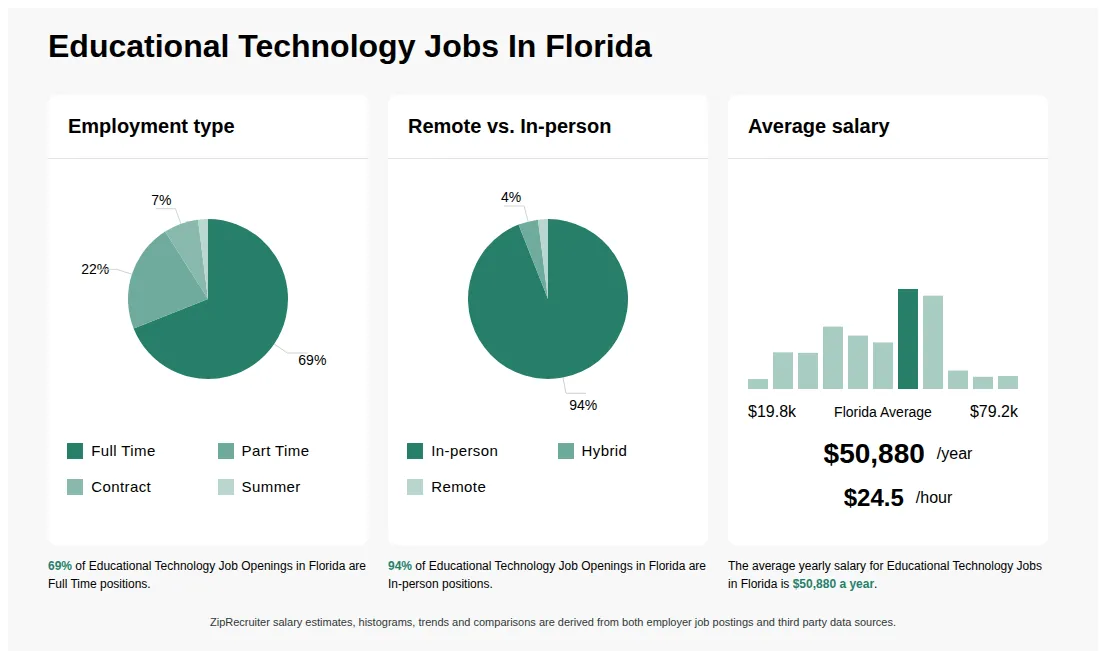
Educational Technology information
See Florida salary details
$19.8K - $25.2K
2% of jobs
$25.2K - $30.6K
7% of jobs
$30.6K - $36K
7% of jobs
$39.4K is the 25th percentile. Wages below this are outliers.
$36K - $41.4K
13% of jobs
$41.4K - $46.8K
12% of jobs
The median wage is $51.6K / yr.
$46.8K - $52.2K
10% of jobs
$52.2K - $57.6K
21% of jobs
$58.3K is the 75th percentile. Wages above this are outliers.
$57.6K - $63K
20% of jobs
$63K - $68.4K
3% of jobs
$68.4K - $73.8K
2% of jobs
$73.8K - $79.2K
2% of jobs
$19.8K
$50.9K
$79.2K
How much do educational technology jobs pay per year?
As of Sep 5, 2026, the average yearly pay for educational technology in Florida is $50,880.00, according to ZipRecruiter salary data. Most workers in this role earn between $38,500.00 and $59,000.00 per year, depending on experience, location, and employer.
What is educational technology?
Educational technology refers to the use of digital tools, resources, and processes to enhance teaching, learning, and educational management. It includes everything from online learning platforms and educational software to interactive whiteboards and virtual reality applications. Professionals in this field design, implement, and evaluate technology-driven solutions to improve educational outcomes. Educational technology aims to make learning more engaging, accessible, and effective for students and educators alike.
What are the key skills and qualifications needed to thrive in educational technology, and why are they important?
To thrive in Educational Technology, you need a solid understanding of instructional design, curriculum development, and a background in education or a related field. Familiarity with Learning Management Systems (LMS), authoring tools like Articulate or Adobe Captivate, and relevant certifications such as ISTE or Google Certified Educator are highly valued. Strong communication, collaboration, and problem-solving skills help professionals effectively support educators and drive technology integration. These skills ensure that technology enhances learning experiences and meets the evolving needs of students and teachers.
What are some common challenges faced by professionals working in educational technology, and how can they be addressed?
Professionals in Educational Technology often encounter challenges such as keeping up with rapidly evolving digital tools, ensuring effective technology integration in diverse classroom settings, and addressing varying levels of tech proficiency among educators and students. Staying current through professional development, collaborating closely with teachers to tailor solutions, and providing ongoing training are effective strategies to overcome these hurdles. Additionally, working in cross-functional teams with IT, curriculum designers, and faculty helps facilitate smoother implementation and promotes a supportive environment for innovation.
What is the difference between Educational Technology vs Instructional Designer?
| Aspect | Educational Technology | Instructional Designer |
|---|---|---|
| Required Credentials | Bachelor's or Master's in Education, Educational Technology, or related fields | Bachelor's or Master's in Education, Instructional Design, or related fields |
| Work Environment | Schools, universities, corporate training, e-learning companies | Educational institutions, corporate training departments, e-learning firms |
| Employer & Industry Usage | Focuses on integrating technology into teaching and learning processes | Designs instructional materials and experiences using technology |
Educational Technology professionals focus on integrating technology into educational settings, enhancing teaching and learning through tools and systems. Instructional Designers create effective instructional materials and experiences, often utilizing technology but with a broader focus on curriculum development. Both roles overlap in tech use but differ in primary objectives and scope.
How to get a job in educational technology?
To get a job in educational technology, candidates typically need a bachelor's degree in education, technology, or a related field, along with experience in instructional design, software tools, or e-learning platforms. Developing skills in curriculum development, familiarity with learning management systems, and obtaining certifications like ISTE or CompTIA can improve employability. Gaining practical experience through internships or projects is also beneficial for entering this field.
What can I do with a degree in educational technology?
A degree in educational technology prepares individuals for roles such as instructional designer, e-learning developer, or educational technologist. These professionals create digital learning materials, implement educational software, and support technology integration in schools or organizations, often requiring skills in software tools, curriculum development, and sometimes certifications in specific platforms.
What does an educational technology do?
An educational technology professional designs, implements, and manages digital tools and systems to enhance teaching and learning. They often work with learning management systems, multimedia resources, and instructional software, requiring skills in technology integration and educational principles.
What educational technology jobs have the highest salaries?
Educational technology roles with the highest salaries typically include Chief Learning Officer, Director of Educational Technology, and Learning Experience Designer, often requiring advanced degrees and expertise in instructional design, data analysis, or software development. These positions usually involve leadership responsibilities and specialized skills in tools like Learning Management Systems (LMS) and multimedia development.
What are the most commonly searched types of Educational Technology jobs in Florida?
The most popular types of Educational Technology jobs in Florida are:
What are popular job titles related to Educational Technology jobs in Florida?
For Educational Technology jobs in Florida, the most frequently searched job titles are:
What job categories do people searching Educational Technology jobs in Florida look for?
The top searched job categories for Educational Technology jobs in Florida are:
What cities in Florida are hiring for Educational Technology jobs?
Cities in Florida with the most Educational Technology job openings:

Full-time
Re-posted 2 days ago
Job description
SCOPE OF POSITION
The Administrator of Educational Technology provides leadership, administration, support, and strategic planning for the educational technology systems utilized throughout Christ's Church Academy. This role serves as the primary resource for faculty and administrative staff in the effective use of technology to enhance teaching, learning, communication, operational efficiency, and student success.
The Administrator of Educational Technology oversees the administration and support of key educational technology platforms, student information systems, classroom technology resources, and digital learning environments. This position works closely with Academy leadership, teachers, administrative staff, students, and parents to ensure technology resources effectively support the mission and educational objectives of Christ's Church Academy.
As part of the broader Information Technology team, this role collaborates with internal technology staff and external service providers to ensure a secure, reliable, and innovative technology environment.
RELATIONSHIPS
- Be a Disciple Maker: Foster a Christ-centered culture by modeling servant leadership, integrity, excellence, and stewardship in all interactions.
- Align with Strategic Direction: Execute the technology priorities established by Academy Leadership and the Director of Information Technology while supporting the mission and vision of Christ's Church Academy.
- Support Faculty and Staff: Serve as the primary educational technology resource for teachers and administrative personnel, providing training, guidance, troubleshooting, and strategic consultation.
- Partner with Academic Leadership: Collaborate with Principals, Admissions, Student Services, and Operations personnel to ensure educational technology systems effectively support Academy objectives.
- Support Students and Families: Provide support and guidance related to student technology resources, digital learning platforms, device management, and educational applications.
- Collaborate with Technology Partners: Work closely with internal IT staff, Managed Service Providers, software vendors, and educational technology partners to ensure effective technology operations and continuous improvement.
- Manage Vendor Relationships: Establish and maintain productive relationships with educational software providers, technology vendors, and support partners.
PRIORITIES
- Lead Educational Technology Systems: Serve as the primary administrator and support resource for:
- FACTS Student Information System (SIS)
- FACTS Admissions and Enrollment
- FACTS Scheduling and Classroom Management
- Clever Single Sign-On (SSO) and roster synchronization
- Microsoft 365 and Teams for Education
- Raptor Technologies Emergency Management
- PikMyKid dismissal management
- Verkada late arrival and early dismissal systems
- Mosyle Mobile Device Management (MDM)
- PaperCut print management
- Algo paging and bell scheduling systems
- Support Faculty Technology Integration: Train and equip teachers to effectively utilize educational technology tools, digital curriculum resources, and instructional applications.
- Support Student Devices and Learning Resources: Provide administration and support for student and staff devices, including:
- iPadOS devices
- Windows-based computers
- Apple Mac computers
- Classroom technology resources
- Promote Student Digital Safety: Support initiatives that foster responsible technology usage, student online safety, cybersecurity awareness, and digital citizenship.
- Support Academic Testing Platforms: Coordinate technology readiness and support for online testing platforms including:
- College Board Bluebook Testing
- AP Testing
- PSAT Testing
- Other digital assessment platforms
- Technology Planning and Innovation: Evaluate emerging educational technologies and curriculum resources, providing recommendations that enhance student learning and operational effectiveness.
- Proactively Engage in School Activities: Participate in faculty meetings, staff development opportunities, and Academy events as needed.
PROCESS & SYSTEMS:
- Educational Systems Administration: Maintain configuration, user accounts, permissions, integrations, workflows, and reporting for Academy educational technology systems.
- Device Management: Administer Mosyle and related tools to deploy, manage, secure, and support student and staff devices.
- Training and Professional Development: Develop and deliver technology training for faculty, staff, students, and parents.
- Help Desk Support: Provide first and second-level support for educational technology issues while coordinating escalation when necessary.
- Data Integrity and Reporting: Maintain accurate student, staff, and course data within FACTS and related systems.
- Evaluate and Improve Technology Resources: Continuously assess educational technology effectiveness and identify opportunities for enhancement.
- Administration: Utilize FACTS, Clever, Microsoft 365, Teams, SharePoint, OneDrive, and other approved Academy systems.
- Provide Metrics and Reporting: Complete required reporting, technology inventories, licensing records, and system documentation in a timely manner.
- Collaborate with Infrastructure Teams: Work alongside the Information Technology team and Managed Service Providers supporting:
- Network infrastructure
- Wireless connectivity
- Security cameras
- Access control systems
- Emergency notification systems
- Vape detection systems
- Core cybersecurity initiatives
ENVIRONMENTAL CONDITIONS
- Practice a strict policy of confidentiality when dealing with student, parent, employee, and Academy information.
- Office and classroom environment with frequent interaction with faculty, students, and staff.
- Requires routine movement throughout campus facilities to provide support and training.
- May require lifting and transporting technology equipment up to 25 pounds.
- Occasional evening, weekend, or summer support may be required for projects, upgrades, training, and Academy events.
- Occasional travel for professional development, conferences, or vendor meetings may be required.
KEY OUTCOMES
- Faculty Technology Effectiveness: Teachers are confident, equipped, and supported in leveraging technology to enhance instruction and student engagement.
- Reliable Educational Systems: Academy technology platforms operate efficiently, securely, and effectively with minimal disruption.
- Student Technology Success: Students have access to reliable technology resources that support learning, collaboration, creativity, and academic achievement.
- Data Integrity & System Excellence: Student information, schedules, enrollment data, and educational records are maintained accurately and securely.
- Technology Adoption & Innovation: New educational technologies are evaluated thoughtfully and implemented successfully to advance Academy objectives.
- Collaborative Technology Support: Faculty, staff, students, and families experience responsive, professional, and effective technology support.
Summary
The Administrator of Educational Technology serves as the primary steward of Christ's Church Academy's educational technology ecosystem. Through effective system administration, faculty support, student technology management, strategic planning, and continuous improvement, this role ensures that technology resources are reliable, secure, and aligned to support exceptional teaching, learning, and operational excellence throughout the Academy.
Previous K -12 scholastic technology support preferred.