Familiarity with Chromebooks, tablets, web-based coding platforms, educational technology, or related STEM instructional tools. Preferred backgrounds may include educators, computer science students ...
Quick apply
Familiarity with Chromebooks, tablets, web-based coding platforms, educational technology, or related STEM instructional tools. Preferred backgrounds may include educators, computer science students ...
Quick apply
Familiarity with Chromebooks, tablets, web-based coding platforms, educational technology, or related STEM instructional tools. Preferred backgrounds may include educators, computer science students ...
Tampa, FL · On-site
$80 - $120/hr
A graduate degree in instructional technology, educational leadership, higher education administration, curriculum and instruction, information systems, information technology, educational media ...
Tampa, FL · On-site
$80 - $120/hr
A graduate degree in instructional technology, educational leadership, higher education administration, curriculum and instruction, information systems, information technology, educational media ...
Melbourne, FL · On-site
$20/hr
Utilize educational technology tools to enhance learning experiences and adapt lessons for different learning styles. * Manage classroom behavior effectively while promoting a respectful and ...
Quick apply
Melbourne, FL · On-site
$20/hr
Utilize educational technology tools to enhance learning experiences and adapt lessons for different learning styles. * Manage classroom behavior effectively while promoting a respectful and ...
Melbourne, FL · On-site
$20/hr
Utilize educational technology tools to enhance learning experiences and adapt lessons for different learning styles. * Manage classroom behavior effectively while promoting a respectful and ...
Melbourne, FL · On-site
$20/hr
Utilize educational technology tools to enhance learning experiences and adapt lessons for different learning styles. * Manage classroom behavior effectively while promoting a respectful and ...
Aventura, FL · On-site
CSUSA provides an academically rigorous education to students equipping them with real world ... As a Senior Instructional Technology Specialist supports the integration of instructional ...
Aventura, FL · On-site
CSUSA provides an academically rigorous education to students equipping them with real world ... As a Senior Instructional Technology Specialist supports the integration of instructional ...
Jacksonville, FL · On-site
CSUSA provides an academically rigorous education to students equipping them with real world ... The Instructional Technology Specialist -State (ITS-S) supports the integration of instructional ...
Jacksonville, FL · On-site
CSUSA provides an academically rigorous education to students equipping them with real world ... The Instructional Technology Specialist -State (ITS-S) supports the integration of instructional ...
Melbourne, FL · On-site
$20/hr
Utilize educational technology tools to enhance learning experiences and adapt lessons for different learning styles. * Manage classroom behavior effectively while promoting a respectful and ...
Melbourne, FL · On-site
$20/hr
Utilize educational technology tools to enhance learning experiences and adapt lessons for different learning styles. * Manage classroom behavior effectively while promoting a respectful and ...
Aventura, FL · On-site
CSUSA provides an academically rigorous education to students equipping them with real world ... As a Senior Instructional Technology Specialist supports the integration of instructional ...
Aventura, FL · On-site
CSUSA provides an academically rigorous education to students equipping them with real world ... As a Senior Instructional Technology Specialist supports the integration of instructional ...
Saint Augustine, FL · On-site
CSUSA provides an academically rigorous education to students equipping them with real world ... The Instructional Technology Specialist -State (ITS-S) supports the integration of instructional ...
Saint Augustine, FL · On-site
CSUSA provides an academically rigorous education to students equipping them with real world ... The Instructional Technology Specialist -State (ITS-S) supports the integration of instructional ...
Fort Lauderdale, FL · On-site
$55K - $75K/yr
Associate or bachelor's degree in computer science, information systems, educational technology, communications, or related field * 2-5 years of experience in IT support, IT management, or a related ...
Fort Lauderdale, FL · On-site
$55K - $75K/yr
Associate or bachelor's degree in computer science, information systems, educational technology, communications, or related field * 2-5 years of experience in IT support, IT management, or a related ...
Fort Lauderdale, FL · On-site
$55K - $75K/yr
Associate or bachelor's degree in computer science, information systems, educational technology, communications, or related field * 2-5 years of experience in IT support, IT management, or a related ...
Quick apply
Fort Lauderdale, FL · On-site
$55K - $75K/yr
Associate or bachelor's degree in computer science, information systems, educational technology, communications, or related field * 2-5 years of experience in IT support, IT management, or a related ...
Fort Lauderdale, FL · On-site
$55 - $75/hr
Associate or bachelor's degree in computer science, information systems, educational technology, communications, or related field * 2-5 years of experience in IT support, IT management, or a related ...
Fort Lauderdale, FL · On-site
$55 - $75/hr
Associate or bachelor's degree in computer science, information systems, educational technology, communications, or related field * 2-5 years of experience in IT support, IT management, or a related ...
... Educational Technology, Information Security Management, Information Systems, Information Technology, Programming and Analysis, Security Informatics, Security Management, Technology Management ...
... Educational Technology, Information Security Management, Information Systems, Information Technology, Programming and Analysis, Security Informatics, Security Management, Technology Management ...
$85K - $139K/yr
A graduate degree in one of the following: instructional technology, educational leadership, higher education administration, curriculum and instruction, information systems, information technology ...
$85K - $139K/yr
A graduate degree in one of the following: instructional technology, educational leadership, higher education administration, curriculum and instruction, information systems, information technology ...
Tampa, FL · On-site
$85K - $139K/yr
A graduate degree in one of the following: instructional technology, educational leadership, higher education administration, curriculum and instruction, information systems, information technology ...
Tampa, FL · On-site
$85K - $139K/yr
A graduate degree in one of the following: instructional technology, educational leadership, higher education administration, curriculum and instruction, information systems, information technology ...
Gainesville, FL · On-site
$12.75 - $16/hr
Summary The Educational Aide will provide administrative support to faculty, staff and students within Information Technology Education at the Blount Center. This position is responsible for ...
Gainesville, FL · On-site
$12.75 - $16/hr
Summary The Educational Aide will provide administrative support to faculty, staff and students within Information Technology Education at the Blount Center. This position is responsible for ...
Gainesville, FL · On-site
$55K - $65K/yr
Our team of instructional designers, graphic designers, videographers, educational technologists, and multimedia specialists works together to produce high-quality courses for university stakeholders ...
Gainesville, FL · On-site
$55K - $65K/yr
Our team of instructional designers, graphic designers, videographers, educational technologists, and multimedia specialists works together to produce high-quality courses for university stakeholders ...
Leesburg, FL · On-site
$45K/yr
Proficiency with educational technology and digital learning platforms. * Experience using educational technology, interactive simulations, and AI tools in the classroom. We Are Looking for Someone ...
Quick apply
Leesburg, FL · On-site
$45K/yr
Proficiency with educational technology and digital learning platforms. * Experience using educational technology, interactive simulations, and AI tools in the classroom. We Are Looking for Someone ...
Leesburg, FL · On-site
$45K/yr
Proficiency with educational technology and digital learning platforms. * Experience using educational technology, interactive simulations, and AI tools in the classroom. We Are Looking for Someone ...
Quick apply
Leesburg, FL · On-site
$45K/yr
Proficiency with educational technology and digital learning platforms. * Experience using educational technology, interactive simulations, and AI tools in the classroom. We Are Looking for Someone ...
Gainesville, FL · On-site
$52 - $72/hr
Our team of instructional designers, graphic designers, videographers, educational technologists, and multimedia specialists works together to produce high-quality courses for university stakeholders ...
Gainesville, FL · On-site
$52 - $72/hr
Our team of instructional designers, graphic designers, videographers, educational technologists, and multimedia specialists works together to produce high-quality courses for university stakeholders ...
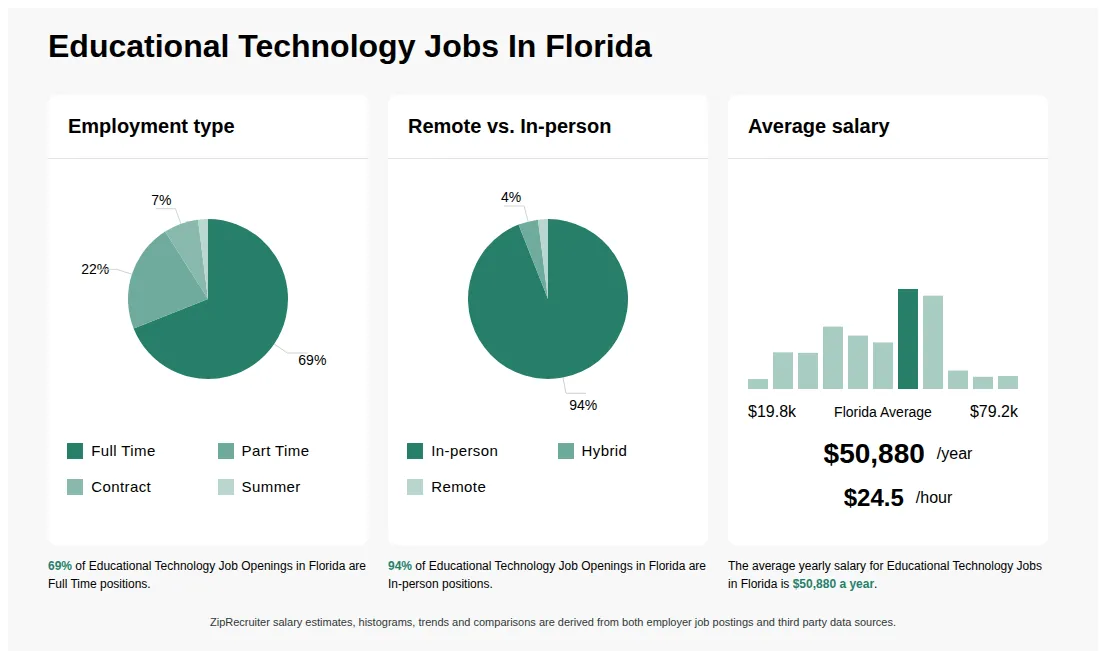
$19.8K - $25.2K
2% of jobs
$25.2K - $30.6K
7% of jobs
$30.6K - $36K
7% of jobs
$39.4K is the 25th percentile. Wages below this are outliers.
$36K - $41.4K
13% of jobs
$41.4K - $46.8K
12% of jobs
The median wage is $51.6K / yr.
$46.8K - $52.2K
10% of jobs
$52.2K - $57.6K
21% of jobs
$58.3K is the 75th percentile. Wages above this are outliers.
$57.6K - $63K
20% of jobs
$63K - $68.4K
3% of jobs
$68.4K - $73.8K
2% of jobs
$73.8K - $79.2K
2% of jobs
$19.8K
$50.9K
$79.2K
| Aspect | Educational Technology | Instructional Designer |
|---|---|---|
| Required Credentials | Bachelor's or Master's in Education, Educational Technology, or related fields | Bachelor's or Master's in Education, Instructional Design, or related fields |
| Work Environment | Schools, universities, corporate training, e-learning companies | Educational institutions, corporate training departments, e-learning firms |
| Employer & Industry Usage | Focuses on integrating technology into teaching and learning processes | Designs instructional materials and experiences using technology |
Educational Technology professionals focus on integrating technology into educational settings, enhancing teaching and learning through tools and systems. Instructional Designers create effective instructional materials and experiences, often utilizing technology but with a broader focus on curriculum development. Both roles overlap in tech use but differ in primary objectives and scope.
The most popular types of Educational Technology jobs in Florida are:
For Educational Technology jobs in Florida, the most frequently searched job titles are:
The top searched job categories for Educational Technology jobs in Florida are:
Cities in Florida with the most Educational Technology job openings:

$50/hr
Contractor
Posted 14 days ago
POTENTIAL INDEPENDENT CONTRACTOR INSTRUCTIONAL ASSIGNMENTS
Program: Robotics Coding Instructor Opportunities
Location: On-site at partner schools; varies by assignment
Teaching Mode: In Person
Grade Levels: Elementary, Middle, and High School; varies by assignment
Schedule: Typically 1–4 instructional service hours per week after school
Program Length: Commonly approximately 10 weeks per assignment
Start Dates: Opportunities become available throughout the school year
Compensation: Typical compensation of $50+ per completed instructional service hour, depending on assignment scope, experience, location, schedule, and agreed compensation
ABOUT THE OPPORTUNITY
Concorde Education is seeking independent instructional contractors to provide robotics coding enrichment services for K–12 students.
This is a potential independent contractor assignment, not an employee position. Contractors may choose whether to apply for, accept, decline, or ignore available opportunities.
Assignments vary by school, grade level, schedule, curriculum, available robotics kits, technology resources, and program objectives.
Concorde may provide curriculum guidance, lesson-plan suggestions, coding challenges, instructional resources, or program objectives. Contractors may use their professional judgment to adapt instruction within the assignment scope and applicable site requirements.
ASSIGNMENT SCOPE
Depending on the accepted assignment, contractors may:
• Plan and facilitate engaging, age-appropriate robotics coding sessions;
• Introduce students to foundational programming and robotics concepts through project-based, hands-on learning;
• Adapt instruction based on student experience levels, site requirements, available robotics kits, technology resources, and program objectives;
• Guide students through coding, testing, debugging, engineering challenges, and collaborative problem-solving activities;
• Maintain a safe, respectful, inclusive, and age-appropriate learning environment;
• Communicate assignment-related needs or significant concerns with Concorde and school staff, as appropriate;
• Complete a brief session completion form after each scheduled session; and
• Follow applicable site safety, visitor, technology, equipment, emergency, and student-protection procedures.
EXAMPLE PROGRAM TOPICS
Assignments may include topics such as:
• Robotics safety, equipment care, and responsible technology use;
• Block-based programming using age-appropriate coding platforms;
• Sequencing, algorithms, and logical problem-solving;
• Loops, conditionals, and introductory programming concepts;
• Debugging techniques and iterative testing;
• Sensors, inputs, outputs, and basic robotics interactions, where applicable;
• Engineering design, prototyping, testing, and continuous improvement;
• Collaborative robotics challenges using LEGO® Education, Sphero, Ozobot, VEX, or similar educational robotics platforms; and
• Creativity, computational thinking, teamwork, and STEM problem-solving.
Specific robotics platforms, coding software, curriculum requirements, and available equipment vary by assignment.
QUALIFICATIONS
Preferred qualifications include:
• At least 60 college credits, where required by the applicable assignment or site;
• Experience with educational robotics platforms such as LEGO® Education, Sphero, Ozobot, VEX, or similar robotics and coding tools;
• Experience teaching, tutoring, coaching, mentoring, or leading activities with school-age students;
• Strong communication, organization, and classroom facilitation skills;
• Availability to provide services for the accepted assignment schedule and communicate schedule issues as soon as reasonably practicable; and
• Familiarity with Chromebooks, tablets, web-based coding platforms, educational technology, or related STEM instructional tools.
Preferred backgrounds may include educators, computer science students, engineering students, robotics coaches, STEM instructors, makerspace facilitators, programmers, technology specialists, and others with relevant instructional or technical experience.
MATERIALS AND RESOURCES
Assignments may utilize school-provided robotics kits, Chromebooks, tablets, coding software, educational technology platforms, curriculum resources, lesson plans, engineering challenges, and other instructional materials, where available.
Contractors may use their own instructional methods and materials when appropriate, safe, age-appropriate, lawful, and consistent with the assignment scope and site requirements.
Purchases requiring reimbursement must be approved in writing by Concorde before they are incurred.
COMPENSATION
Compensation varies by assignment and agreed contractor terms. Many opportunities pay $50+ per completed instructional service hour with students.
Contractors may propose their desired compensation rate when applying. When proposing a rate, contractors should consider the overall assignment scope, including anticipated preparation, planning, commute, materials, schedule, and other business considerations.
Concorde may accept the proposed rate, decline the application, or provide a counteroffer based on the budget for the specific assignment.
Unless otherwise approved in writing, compensation is based on completed instructional service hours with students.
Payment for completed services is generally made by direct deposit on the fifteenth day of the month following the month in which services were completed, unless otherwise stated in the accepted assignment terms or required by applicable law.
APPLICATION AND ONBOARDING
Applicants selected to move forward may be invited to create a contractor profile and complete any required onboarding steps.
Applying, interviewing, receiving an invitation to create a profile, creating a profile, or completing onboarding does not guarantee selection, placement, or future assignment opportunities.
Potential assignments are subject to assignment fit, agreed compensation, completion of required onboarding, applicable background-check review, Fair Chance or pre-adverse action procedures where required, site-specific clearance requirements, and final written confirmation from Concorde Education.
Some assignments may require background-check authorization, fingerprinting, agency clearance, site-specific documentation, identification badges, or other compliance steps before services may begin.
Applicants should not provide criminal-history information unless and until requested through the appropriate legally compliant process.
EQUAL OPPORTUNITY
Concorde Education considers contractor applicants without regard to any status protected by applicable federal, state, or local law and is committed to respectful, inclusive, and student-centered programming.

Sourced by ZipRecruiter
Education programs administration and recruiting and staffing services
11 - 50 Employees
New York, NY, US