Description The Vice President of Economic Development & Government Affairs is responsible for bridging private development initiatives and public sector entities. This position is responsible for ...
Description The Vice President of Economic Development & Government Affairs is responsible for bridging private development initiatives and public sector entities. This position is responsible for ...

Director Corporate Economic Development - Customer Strategy
Amarillo, TX · On-site
$148K - $210K/yr
Director Corporate Economic Development - Customer Strategy Position Summary Responsible for identifying and developing new and significant/large-scale retail energy business opportunities across all ...
Director Corporate Economic Development - Customer Strategy
Amarillo, TX · On-site
$148K - $210K/yr
Director Corporate Economic Development - Customer Strategy Position Summary Responsible for identifying and developing new and significant/large-scale retail energy business opportunities across all ...
Description The Vice President of Economic Development & Government Affairs is responsible for bridging private development initiatives and public sector entities. This position is responsible for ...
Description The Vice President of Economic Development & Government Affairs is responsible for bridging private development initiatives and public sector entities. This position is responsible for ...
Salary: $76,765.31 to $102,872.86 The Manager of Economic Development and Marketing serves as an important part of the City of Benbrooks Economic Development team. The teams objectives are to drive ...
Quick apply
Salary: $76,765.31 to $102,872.86 The Manager of Economic Development and Marketing serves as an important part of the City of Benbrooks Economic Development team. The teams objectives are to drive ...
This position leads the efforts of the Liberty Hill Economic Development Corporation (EDC), implements economic development strategies aligned with the City's Strategic Action Plan and Comprehensive ...
This position leads the efforts of the Liberty Hill Economic Development Corporation (EDC), implements economic development strategies aligned with the City's Strategic Action Plan and Comprehensive ...
Manager of Economic Development and Marketing
Benbrook, TX · On-site
$76K - $102K/yr
The Manager of Economic Development and Marketing serves as an important part of the City of Benbrook's Economic Development team. The team's objectives are to drive economic growth and ...
Manager of Economic Development and Marketing
Benbrook, TX · On-site
$76K - $102K/yr
The Manager of Economic Development and Marketing serves as an important part of the City of Benbrook's Economic Development team. The team's objectives are to drive economic growth and ...
The Manager of Economic Development and Marketing serves as an important part of the City of Benbrook's Economic Development team. The team's objectives are to drive economic growth and ...
The Manager of Economic Development and Marketing serves as an important part of the City of Benbrook's Economic Development team. The team's objectives are to drive economic growth and ...

Assistant Director of Economic Development
Cedar Hill, TX · On-site
$115K/yr
Economic Development Opening Date: 06/30/2026 Closing Date: 7/22/2026 5:00 PM Central Why This Role is Valuable Nestled in the heart of the DFW Metroplex, Cedar Hill offers the rare combination of ...
Assistant Director of Economic Development
Cedar Hill, TX · On-site
$115K/yr
Economic Development Opening Date: 06/30/2026 Closing Date: 7/22/2026 5:00 PM Central Why This Role is Valuable Nestled in the heart of the DFW Metroplex, Cedar Hill offers the rare combination of ...
Assistant Director of Economic Development
$1.0K - $120K/yr
We are seeking an innovative, strategic, and forward-thinking Assistant Director of Economic Development to help lead transformative projects, attract new investment, support redevelopment, and ...
Assistant Director of Economic Development
$1.0K - $120K/yr
We are seeking an innovative, strategic, and forward-thinking Assistant Director of Economic Development to help lead transformative projects, attract new investment, support redevelopment, and ...
Job Type Full-time Description The Vice President of Economic Development & Government Affairs is responsible for bridging private development initiatives and public sector entities. This position is ...
Job Type Full-time Description The Vice President of Economic Development & Government Affairs is responsible for bridging private development initiatives and public sector entities. This position is ...

Economic Community Development Program Manager
Bryan, TX · On-site
$63K - $70K/yr
GENERAL Performs various planning and research work for the Economic and Community Development Planning Program. Planning may involve activities related to job growth/retention, data collection ...
Quick apply
Economic Community Development Program Manager
Bryan, TX · On-site
$63K - $70K/yr
GENERAL Performs various planning and research work for the Economic and Community Development Planning Program. Planning may involve activities related to job growth/retention, data collection ...
Director Corporate Economic Development - Transmission Solutions
Amarillo, TX · On-site
$148K - $210K/yr
Director Corporate Economic Development - Transmission Solutions Position Summary Responsible for developing transmission solutions for transmission and interconnection of data center and large ...
Director Corporate Economic Development - Transmission Solutions
Amarillo, TX · On-site
$148K - $210K/yr
Director Corporate Economic Development - Transmission Solutions Position Summary Responsible for developing transmission solutions for transmission and interconnection of data center and large ...
The Deputy Director of Economic Development is a visionary leadership role responsible for amplifying the economic, demographic, and social context of Downtown Houston. This position serves as the ...
The Deputy Director of Economic Development is a visionary leadership role responsible for amplifying the economic, demographic, and social context of Downtown Houston. This position serves as the ...

Position Information Job Title PT COUNSELOR-BUSINESS & ECONOMIC DEVELOPMENT CENTER (Pool) Position Status Part Time Classification Title Part-Time Hourly-Up to 19 hpw Work Location Main Campus-3600 N.
Position Information Job Title PT COUNSELOR-BUSINESS & ECONOMIC DEVELOPMENT CENTER (Pool) Position Status Part Time Classification Title Part-Time Hourly-Up to 19 hpw Work Location Main Campus-3600 N.
Posting Details Position Information Job Title PT COUNSELOR-BUSINESS & ECONOMIC DEVELOPMENT CENTER (Pool) Position Status Part Time Classification Title Part-Time Hourly-Up to 19 hpw Work Location ...
Posting Details Position Information Job Title PT COUNSELOR-BUSINESS & ECONOMIC DEVELOPMENT CENTER (Pool) Position Status Part Time Classification Title Part-Time Hourly-Up to 19 hpw Work Location ...

Academic Affairs and Economic Development General Statement of Job Directs the development of content and production of materials for both existing and emerging programs. Leads the creation and ...
Academic Affairs and Economic Development General Statement of Job Directs the development of content and production of materials for both existing and emerging programs. Leads the creation and ...

Identifying and securing economic development incentive programs for Newmark's corporate clients. Assists clients in every stage of a transaction; from inception and initial due diligence, to ...
Identifying and securing economic development incentive programs for Newmark's corporate clients. Assists clients in every stage of a transaction; from inception and initial due diligence, to ...
Identifying and securing economic development incentive programs for Newmark's corporate clients. Assists clients in every stage of a transaction; from inception and initial due diligence, to ...
Identifying and securing economic development incentive programs for Newmark's corporate clients. Assists clients in every stage of a transaction; from inception and initial due diligence, to ...
Open to undergraduate students at Texas universities --- Who We Are Govuni Collective is a workforce empowerment and economic development organization dedicated to job training, business growth ...
Open to undergraduate students at Texas universities --- Who We Are Govuni Collective is a workforce empowerment and economic development organization dedicated to job training, business growth ...

Fort Worth is one of the most dynamic economic development markets in the country, and the Fort Worth Economic Development Partnership is helping lead that momentum. In just its first three years ...
Fort Worth is one of the most dynamic economic development markets in the country, and the Fort Worth Economic Development Partnership is helping lead that momentum. In just its first three years ...
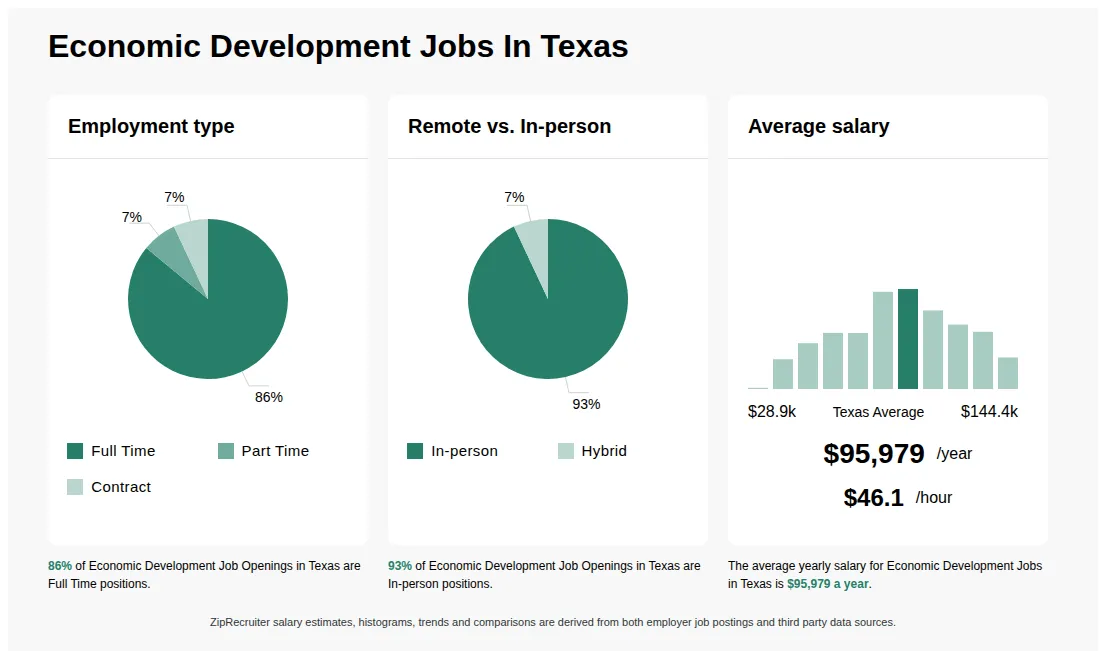
Economic Development information
See Texas salary details
$28.9K - $39.4K
0% of jobs
$39.4K - $49.9K
4% of jobs
$49.9K - $60.4K
7% of jobs
$60.4K - $70.9K
9% of jobs
$75.6K is the 25th percentile. Wages below this are outliers.
$70.9K - $81.4K
9% of jobs
$81.4K - $91.9K
16% of jobs
The median wage is $94.5K / yr.
$91.9K - $102.4K
17% of jobs
$112.9K is the 75th percentile. Wages above this are outliers.
$102.4K - $112.9K
13% of jobs
$112.9K - $123.4K
10% of jobs
$123.4K - $133.9K
9% of jobs
$133.9K - $144.4K
5% of jobs
$28.9K
$96K
$144.4K
How much do economic development jobs pay per year?
As of Jul 18, 2026, the average yearly pay for economic development in Texas is $95,979.00, according to ZipRecruiter salary data. Most workers in this role earn between $75,900.00 and $116,000.00 per year, depending on experience, location, and employer.
What is economic development?
Economic development refers to the process by which the economic well-being and quality of life of a region, community, or country are improved. This typically involves efforts to create jobs, attract investment, support businesses, enhance infrastructure, and promote sustainable growth. Professionals in economic development work with government agencies, private sector partners, and community organizations to create strategies that foster economic opportunities and address local challenges. Their goal is to build resilient economies that benefit all residents.
What is the difference between Economic Development vs Urban Planner?
| Aspect | Economic Development | Urban Planner |
|---|---|---|
| Required Credentials | Bachelor's degree in economics, public policy, or related field; often certifications in economic development | Bachelor's or master's in urban planning, geography, or related field; licensure may be required |
| Work Environment | Government agencies, economic development organizations, consulting firms | Municipalities, government agencies, private planning firms |
| Industry Usage | Focuses on economic growth, business attraction, and community development | Focuses on land use, zoning, and urban design |
While both roles aim to improve communities, economic development professionals focus on boosting local economies and attracting businesses, whereas urban planners concentrate on land use, zoning, and urban design to shape city landscapes.
What are some common challenges faced by professionals in Economic Development roles, and how can they be addressed?
Economic Development professionals often encounter challenges such as balancing the needs of diverse stakeholders, navigating complex regulatory environments, and securing funding for projects. Success in this field requires strong communication and negotiation skills to build consensus among government officials, business leaders, and community members. Proactively staying updated on policy changes, leveraging data-driven approaches, and building strong partnerships can help address these challenges and drive impactful outcomes.
What professions make $500,000 a year?
In economic development and related fields, high-paying roles such as senior economic consultants, chief development officers, and executive-level positions in large organizations can earn $500,000 or more annually. These roles typically require extensive experience, advanced degrees, and strong leadership skills, often involving strategic planning and stakeholder management.
What profession makes $400,000 a year?
In the field of economic development, senior roles such as Chief Economic Development Officer or high-level consultants can earn $400,000 or more annually, especially with extensive experience, advanced degrees, and leadership responsibilities. These positions often require strong analytical skills, strategic planning, and a deep understanding of regional or national economic policies.
What is a career in economic development?
A career in economic development involves working to improve the economic well-being of communities by attracting new businesses, supporting existing industries, and creating jobs. Professionals in this field often analyze economic data, develop strategic plans, and collaborate with government agencies, requiring skills in research, communication, and project management.
What are the key skills and qualifications needed to thrive as an Economic Development professional, and why are they important?
To thrive as an Economic Development professional, you need a background in economics, public administration, or urban planning, often supported by a bachelor’s or master’s degree in a related field. Familiarity with data analysis tools, GIS software, project management platforms, and knowledge of relevant regulations or certifications like CEcD are essential. Strong communication, relationship-building, and problem-solving skills distinguish top performers in this role. These skills are vital for successfully attracting investment, fostering sustainable growth, and collaborating with stakeholders to drive community prosperity.
What are the different types of economic development jobs?
Economic development jobs include roles such as economic development director, business development specialist, project manager, and urban planner. These positions often involve tasks like attracting investment, planning community projects, and analyzing economic data, requiring skills in research, communication, and policy analysis.
What are the most commonly searched types of Economic Development jobs in Texas? The most popular types of Economic Development jobs in Texas are:
What are popular job titles related to Economic Development jobs in Texas? For Economic Development jobs in Texas, the most frequently searched job titles are:
What job categories do people searching Economic Development jobs in Texas look for? The top searched job categories for Economic Development jobs in Texas are:
What cities in Texas are hiring for Economic Development jobs? Cities in Texas with the most Economic Development job openings:

Vice President of Economic Development & Government Affairs
Laredo, TX • On-site
Other
Re-posted 5 days ago
Job description
Description
The Vice President of Economic Development & Government Affairs is responsible for bridging private development initiatives and public sector entities. This position is responsible for securing financial incentives, navigating local, state, and federal regulations, and building partnerships with community leaders to maximize project feasibility, long-term value, and community alignment while supporting the company's growth and development objectives.
Requirements
ESSENTIAL DUTIES:
- Develops, assists, and helps with negotiating long-term strategies for deploying economic development tools to assist with development and construction growth plans
- Identifying, evaluating, and securing economic development tools, such as tax abatements, and grants for projects.
- Partner with real estate teams to attract high-quality tenants, retailers, and developers to company-owned properties.
- Lead business recruitment and development efforts for the company across different industry sectors.
- Identify existing industries with expansion efforts and manage relationships with local businesses.
- Research community impact on development efforts to ensure business goals are accomplished.
- Support economic research to advance business growth.
- Negotiate business development grants, loans, and investment packages with local, state, or federal government.
- Engage with stakeholders, including government officials, educators, and community leaders to align regional interests.
- Build and maintain relationships with governmental, community, and business leaders to facilitate development projects.
- Utilize economic data, GIS mapping, and market trends to identify prime locations and economic opportunities.
- Oversee, direct, and monitor real estate and site development programs to ensure compliance with company goals.
- Collaborate with internal departments on economic development projects.
- Manage current and future Tax Increment Reinvestment Zone (TIRZ) agreements.
- Lead Municipal Management Districts (MMD) partnerships and Municipal Utility Districts (MUD) and any other special districts or economic development tools
- Actively seek new business opportunities through networking and outreach.
- Participate in town hall meetings, City Council, Planning and Zoning, MPO, State and Federal meetings, non-profits, conferences, workshops and community development events to establish and build business networks.
- Other Duties as Assigned.
EDUCATION:
Bachelor's degree required, with master's degree (MBA, Economics, Public Policy) preferred. Certified Economic Developer (CEcD) preferred.
EXPERIENCE:
Must have over ten (10) years in economic development, corporate real estate, business finance, or related roles.
SKILLS:
Must have the following skills and/or abilities:
- Proficient in Windows operating systems and associated software
- High level negotiation skills
- Ability to lead, present to executives or public boards, and manage complex projects
- Experience working with city, county, state, and federal agencies
- Strong oral and written communication skills
- Ability to work with community and governmental leaders effectively
- Knowledge of trends, developments, and techniques in the field of economic development
LICENSES/CERTIFICATIONS:
Must have a current driver's license and a satisfactory driving record.
PHYSICAL REQUIREMENTS:
Must be able to perform the following physical activity on a frequent to constant basis:
- Sit for long periods of time while gathering, updating, and validating vendor or supplier cost information or performing other related activities.
- Lift 10-20 lbs. of files, plans, office supplies, or similar items.
- Constantly uses fingers and hands when dialing/answering the telephone and operating a computer or other office machinery, such as a copy machine, scanner, and computer printer.
- Ability to hear average or normal conversations and receive ordinary information through verbal communications in person or detect objects in and around job site over the telephone.
- Average, ordinary visual acuity necessary to prepare or inspect documents; operate a computer or other office machinery; or.
- Walk short distances on slippery, even, and/or uneven surfaces.
- Stand, bend, stoop, kneel, crouch, twist, turn, or crawl.
WORKING CONDITIONS:
- Majority of work is performed in an office atmosphere located inside a building, with building inspections as needed.
- May require infrequent job site visits involve performing work in outdoor weather conditions with exposure to extreme cold, heat, and noise depending upon project site.
- Travel locally and between cities where development is in progress will be expected.
OTHER REQUIREMENTS:
Must be able to:
- Adhere to the highest standards of ethics, integrity, professionalism, and discretion.
- Project a courteous, professional and positive approach with clients, subcontractors, employees, and authorizing agencies while providing prompt, efficient, and accurate assistance.
- Follow and exchange basic instructions, information, and guidelines.
- Direct and instructs Sub-Contractors effectively with a leadership style that is firm, fair, consistent, and goal oriented.
- Nurture a working environment which encourages employee loyalty, longevity, and satisfaction.
- Creates a culture of customer satisfaction.
- Make independent decisions based on experience or knowledge with minimal supervision.
- Participate in training and development opportunities offered to maintain construction-related software and safety knowledge.
- Communicate and comprehend instructions/directions in accordance with safety requirements, which necessitate no language barriers exist between employees and supervisors.
- Adhere to and perform functions according to company and OSHA safety guidelines.
- Wear personal protective equipment as required such as steel toed shoes, gloves, safety glasses, hearing protection, hard hat, vest, and the like while conducting job site visits.
- Maintain regular, timely, and predictable attendance.

About Killam Development
Sourced by ZipRecruiter
Industry
Real estate
Company size
51 - 200 Employees
Headquarters location
Laredo, TX, US
Year founded
1988