1

Die Cast Operator Jobs (NOW HIRING)

Job Objective To set up and operate a trim press, helps the A operator with die set ups on the die cast machine, and has the ability to run production of parts consistent with established quality ...

Die Cast Set-Up Operator

Elgin, IL · On-site

$25 - $34.50/hr

Dynacast, LLC, a Form Technologies Company, is currently looking for hard-working and reliable Die Cast Set-Up Operators for all 3 shifts. Come join a global leader in precision die-casting; be part ...

Die Cast Set-Up Operator

Elgin, IL · On-site

$25 - $34.50/hr

Dynacast, LLC, a Form Technologies Company, is currently looking for hard-working and reliable Die Cast Set-Up Operators for all 3 shifts. Come join a global leader in precision die-casting; be part ...

Die Cast Set-Up Operator

Elgin, IL · On-site

$28.75 - $34.50/hr

Dynacast, LLC, a Form Technologies Company, is currently looking for hard-working and reliable Die Cast Set-Up Operators for all 3 shifts. Come join a global leader in precision die-casting; be part ...

next page

Showing results 1-20

Die Cast Operator information

See salary details

$7

$17

$21

How much do die cast operator jobs pay per hour?

As of Jun 12, 2026, the average hourly pay for die cast operator in the United States is $17.66, according to ZipRecruiter salary data. Most workers in this role earn between $16.35 and $19.23 per hour, depending on experience, location, and employer.

How much do you get paid as a machine operator?

Die cast operators typically earn an average hourly wage between $15 and $20, depending on experience, location, and the complexity of the machinery. Many positions also offer overtime pay and benefits, with some earning annual salaries around $30,000 to $50,000. Skills in machine operation and safety protocols can influence pay rates.

What does a casting operator do?

A casting operator operates machinery to produce metal or plastic parts through the casting process. They set up molds, control pouring and cooling, and monitor equipment to ensure quality and safety standards are met. Attention to detail and knowledge of safety procedures are essential in this role.

What are Die Cast Operators?

Die Cast Operators are skilled workers responsible for operating die casting machines, which produce metal parts by injecting molten metal into a mold. Their duties include setting up machines, monitoring production, inspecting finished products for quality, and performing routine maintenance. Die Cast Operators play a crucial role in manufacturing industries, especially in automotive and consumer goods sectors, ensuring consistent and high-quality output. They must follow safety protocols and often work in environments with high temperatures and heavy machinery.

What Is a Die Cast Operator?

A die cast operator operates a die casting machinery, pouring molten metal into a mold to create specific parts for machines, such as carburetors or engine blocks. Your job duties are to calibrate, operate, and maintain the die casting equipment. A career as a die cast operating does not require you have a college degree, but you should have a high school diploma or GED certificate, and employers strongly prefer candidates with vocational training. Important skills include a strong eye for detail, mechanical aptitude, and computer proficiency.

What jobs pay 2000 a day?

Die Cast Operators typically do not earn $2000 a day; such high daily wages are usually associated with specialized roles like senior executives, highly experienced consultants, or certain medical and legal professionals. Some high-paying jobs in niche industries or with significant overtime and bonuses can reach that level, but they are uncommon for standard manufacturing roles. Skills, certifications, and experience levels significantly influence earning potential.

What are the key skills and qualifications needed to thrive as a Die Cast Operator, and why are they important?

To thrive as a Die Cast Operator, you need mechanical aptitude, attention to detail, and familiarity with manufacturing processes, typically supported by a high school diploma or equivalent. Experience with die casting machines, basic measuring tools, and safety certifications such as OSHA training are often required. Strong problem-solving skills, teamwork, and effective communication help operators quickly address issues and maintain production quality. These abilities are essential for producing precise components efficiently and ensuring a safe, high-quality manufacturing environment.

What are the typical challenges faced by a Die Cast Operator, and how can they be managed effectively?

Die Cast Operators often work in fast-paced manufacturing environments where maintaining consistent product quality and minimizing machine downtime are key challenges. Operators must pay close attention to detail when monitoring machinery, adjusting settings, and troubleshooting minor equipment issues to ensure that castings meet specifications. Effective communication with team members, routine maintenance, and ongoing training in safety and process improvements help manage these challenges and contribute to operational efficiency. Being proactive in identifying potential problems and reporting them promptly also enhances workflow and safety.

What is a die cut operator job description?

A die cast operator is responsible for operating and maintaining die casting machines to produce metal parts by injecting molten metal into molds. They set up equipment, monitor the casting process, perform quality checks, and ensure safety procedures are followed. Attention to detail and knowledge of machinery are essential for this role.

What is the difference between Die Cast Operator vs Mold Maker?

AspectDie Cast OperatorMold Maker
CredentialsHigh school diploma or equivalent; on-the-job trainingHigh school diploma; technical training or apprenticeship
Work EnvironmentManufacturing plant, operating die casting machinesMachine shops or manufacturing facilities, building and repairing molds
Industry UsageAutomotive, aerospace, consumer goods manufacturingTool and die industry, custom mold fabrication
Primary FocusOperating die casting equipment to produce metal partsDesigning, building, and maintaining molds for casting or molding processes

The main difference between a Die Cast Operator and a Mold Maker is their focus within the manufacturing process. Die Cast Operators operate machines to produce metal parts using pre-made molds, while Mold Makers create and repair those molds. Both roles are essential in casting industries, often working closely but with distinct skill sets and responsibilities.

What cities are hiring for Die Cast Operator jobs? Cities with the most Die Cast Operator job openings:
Who are the top companies hiring for Die Cast Operator jobs? The top employers for Die Cast Operator jobs are:
What states have the most Die Cast Operator jobs? States with the most job openings for Die Cast Operator jobs include:
What are popular job titles related to Die Cast Operator jobs? For Die Cast Operator jobs, the most frequently searched job titles are:
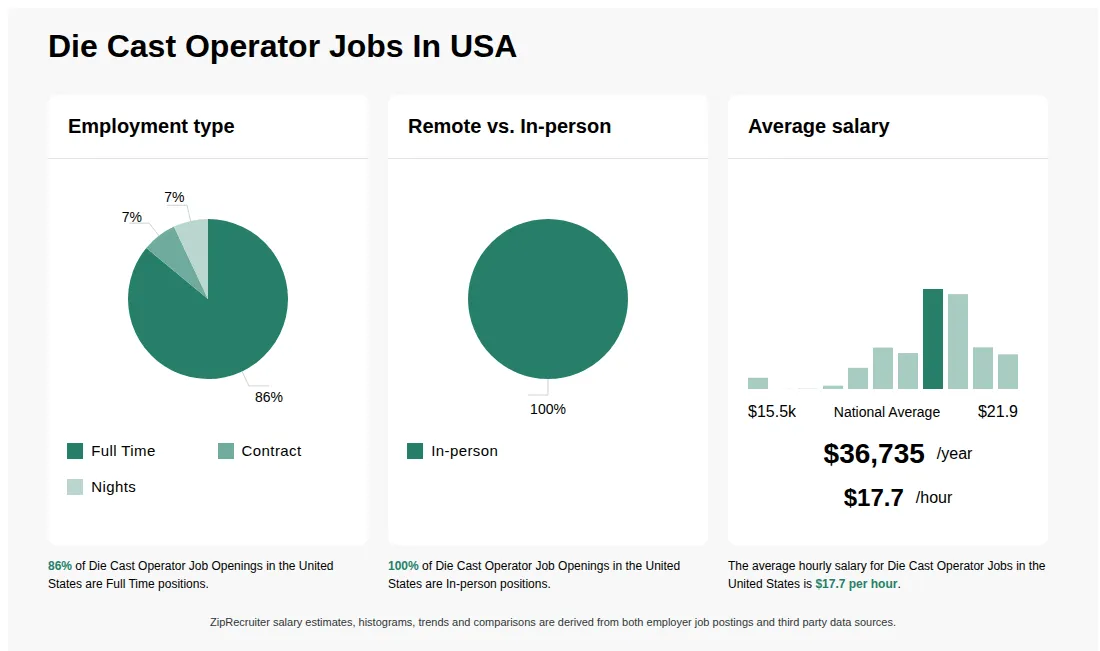
Infographic showing various Die Cast Operator job openings in the United States as of June 2026, with employment types broken down into 95% Full Time, 2% Part Time, 1% Temporary, and 2% Contract. Highlights an 98% Physical, 1% Hybrid, and 1% Remote job distribution, with an average salary of $36,735 per year, or $17.7 per hour.
Die Cast B Operator- 1st Shift

Die Cast B Operator- 1st Shift

trimark

New Hampton, IA

$21.93/hr

Other

Posted yesterday


Job description

Starting Wage: $21.93/hr. 

Job Objective

To set up and operate a trim press, helps the A operator with die set ups on the die cast machine, and has the ability to run production of parts consistent with established quality standards and plant schedules.

Duties and Responsibilities

  • Receives work assignment and clarifies any uncertainty about what is to be done.
  • Sets up the trim press and makes adjustments to minimize safety hazards and help achieve highest level of quality production possible. Assists with the set up of the die cast machine as needed.
  • Operates the trim press to produce quality- finished parts, which meet established standards.
  • Check first few pieces for general quality and monitors quality of parts regularly to minimize time consuming sorting, waste, and/or remelt.
  • Notifies lead-person and/or other qualified person of machine problems or recurring difficulties promptly.
  • Provides information to maintenance and the tool room to assist in diagnosing equipment or tooling problems.
  • Keeps accurate time and job records.
  • Maintains work area in a clean and orderly condition using 5S principles to minimize safety hazards and lost time accidents.
  • Follows established safety procedures and policies at all times.
  • Maintains a good attendance record.
  • Performs other duties as assigned.
  • This position supports the continual improvement and compliance of QMS and EMS.
  • Responsible to perform his or her job functions in a manner that supports TriMark's mission, vision and values in order for the company to attain its strategic and growth goals.

Skills, Abilities and Experience Required

Skill to set up and operate hydraulic trim presses which can be learned on the job.

Ability to follow verbal and written instructions or special instructions related to changes in procedures for die cast.

Ability to work cooperatively with other employees.

Ability to stay positive with a good attitude and values Trimark’s Core Values.

Judgment Required

To determine general quality of finished die cast products.

To perform basic machine setup and adjustments as required.

To operate a forklift and other machinery in a safe manner.

To provide assistance to new personnel as requested.

Core Competencies

  • Perform Startup and Shutdown procedures
  • Ensure that they can shut down or startup equipment with good manufacturing practices, operating procedures and safety procedures.
  • Read and Understand Work Instructions
  • Ensure that all work instructions are understood before performing the tasks.
  • Communication
  • Conveying information to others effectively.
  • Quality Standards
  • Troubleshooting
  • Determine causes of operating errors and finding a solution on how to address.
  • Determine root cause of quality issues & determine solutions or steps to fix.
  • Determine safety issues as well as safety improvements.

Working Conditions

Must be available to work overtime and weekends as required to meet the company’s business demands.

 Exposure to hazards of machine operation and molten zinc.  Some contact with oils, lubricants and coolant necessary for the operation of the die cast machines.  The work area is damp and the temperature is above normal.  The noise level exceeds 95db.

Uniform safety practices consist of pull on safety shoes, safety glasses, hearing protection, gloves, and other devices as required.  This area requires normal or corrected vision, normal depth perception and peripheral vision of 180 degrees, and no color deficiency.

Physical Effort

Bending -

Knee level

Stooping -

5% of time

Squatting -

None

Twisting -

90 degrees

Turning -

180 degrees

Reaching -

Full reach

Lifting -

50# or less

Pushing/Pulling -

 50# or more

Standing -

75% or more

Sitting -

5% or less

Walking -

20% or less

Climbing -

2 - 3 steps

Grasping -

Moderate  dexterity