Perform material reconciliation, paperwork review and assist with pulling of data for ... Strong analytical and comprehension skills, with the ability to verbally communicate ideas and ...
Perform material reconciliation, paperwork review and assist with pulling of data for ... Strong analytical and comprehension skills, with the ability to verbally communicate ideas and ...

Be Seen First
Assistant Operations & Warehouse Manager
Denver, CO · On-site
$50K - $55K/yr
Provide insights and recommendations through data analysis and reporting. * Coordinate across ... Company Description American Textile Recycling Service provides donation bins for gently used ...
Quick apply
Be Seen First
Assistant Operations & Warehouse Manager
Denver, CO · On-site
$50K - $55K/yr
Provide insights and recommendations through data analysis and reporting. * Coordinate across ... Company Description American Textile Recycling Service provides donation bins for gently used ...

At Standard Textile, we're dedicated to providing comfort and care across generations. Guided by ... This role helps ensure product data is accurate and robust, in-market presentation aligns to ...
At Standard Textile, we're dedicated to providing comfort and care across generations. Guided by ... This role helps ensure product data is accurate and robust, in-market presentation aligns to ...

Payroll & People Systems Specialist
Burlington, VT · On-site +1
$23.50 - $32/hr
People & Culture Lead Remote - USA About Us Textile Exchange is a global non-profit driving ... S. payroll, HR systems, employee data management, compliance, and reporting. This role serves as ...
Payroll & People Systems Specialist
Burlington, VT · On-site +1
$23.50 - $32/hr
People & Culture Lead Remote - USA About Us Textile Exchange is a global non-profit driving ... S. payroll, HR systems, employee data management, compliance, and reporting. This role serves as ...
Perform material reconciliation, paperwork review and assist with pulling of data for ... Strong analytical and comprehension skills, with the ability to verbally communicate ideas and ...
Perform material reconciliation, paperwork review and assist with pulling of data for ... Strong analytical and comprehension skills, with the ability to verbally communicate ideas and ...
Supply Planner / Buyer
Cincinnati, OH · On-site
$28.25 - $38.50/hr
At Standard Textile, we're dedicated to providing comfort and care across generations. Guided by ... Apply data insights and scenario analysis to support informed decision-making Qualifications ...
Supply Planner / Buyer
Cincinnati, OH · On-site
$28.25 - $38.50/hr
At Standard Textile, we're dedicated to providing comfort and care across generations. Guided by ... Apply data insights and scenario analysis to support informed decision-making Qualifications ...
At Standard Textile, we're dedicated to providing comfort and care across generations. Guided by ... Analyze quality data and translate findings into actionable insights * Lead or support continuous ...
At Standard Textile, we're dedicated to providing comfort and care across generations. Guided by ... Analyze quality data and translate findings into actionable insights * Lead or support continuous ...
... multi-vertical focus on textile, engineering, healthcare, finance, IT & ITES services ... The Data Warehouse Developer-Analyst will be supporting a new area of analysis involving User ...
... multi-vertical focus on textile, engineering, healthcare, finance, IT & ITES services ... The Data Warehouse Developer-Analyst will be supporting a new area of analysis involving User ...
At Standard Textile, we're dedicated to providing comfort and care across generations. Guided by ... Analyze sales data and business reports to inform strategy * Partner closely with a dedicated ...
At Standard Textile, we're dedicated to providing comfort and care across generations. Guided by ... Analyze sales data and business reports to inform strategy * Partner closely with a dedicated ...
Manufacturing Assistant
Thomaston, GA · On-site
$13.50 - $17.50/hr
At Standard Textile, we're dedicated to providing comfort and care across generations. Guided by ... Compile and record production data and generates various reports * Maintain files of documents used ...
Manufacturing Assistant
Thomaston, GA · On-site
$13.50 - $17.50/hr
At Standard Textile, we're dedicated to providing comfort and care across generations. Guided by ... Compile and record production data and generates various reports * Maintain files of documents used ...
At Standard Textile, we're dedicated to providing comfort and care across generations. Guided by ... Analyze sales data and business reports to inform strategy * Partner closely with a dedicated ...
At Standard Textile, we're dedicated to providing comfort and care across generations. Guided by ... Analyze sales data and business reports to inform strategy * Partner closely with a dedicated ...

Category Expertise & Data Analysis • Utilizes syndicated data, consumer research, and industry ... for Home & Textiles Market in March and September, in collaboration with Product Development ...
Category Expertise & Data Analysis • Utilizes syndicated data, consumer research, and industry ... for Home & Textiles Market in March and September, in collaboration with Product Development ...
Elevate Textiles is a leading global manufacturer of fabric and thread solutions focused on ... Data & Continuous Improvement * Utilize CMMS and other systems to track and analyze maintenance ...
Elevate Textiles is a leading global manufacturer of fabric and thread solutions focused on ... Data & Continuous Improvement * Utilize CMMS and other systems to track and analyze maintenance ...
At Standard Textile, we're dedicated to providing comfort and care across generations. Guided by ... This role helps ensure product data is accurate and robust, in-market presentation aligns to ...
At Standard Textile, we're dedicated to providing comfort and care across generations. Guided by ... This role helps ensure product data is accurate and robust, in-market presentation aligns to ...

Senior Textile Quality Assurance Associate
Los Angeles, CA · On-site
$67K - $95K/yr
Analyze new materials, test results, & risk, and provide recommendations to the cross-functional ... Everlane is deeply committed to respecting and protecting your data privacy. For information on our ...
Senior Textile Quality Assurance Associate
Los Angeles, CA · On-site
$67K - $95K/yr
Analyze new materials, test results, & risk, and provide recommendations to the cross-functional ... Everlane is deeply committed to respecting and protecting your data privacy. For information on our ...
Senior Textile Quality Assurance Associate
Los Angeles, CA · Hybrid
$67K - $95K/yr
Analyze new materials, test results, & risk, and provide recommendations to the cross-functional ... Everlane is deeply committed to respecting and protecting your data privacy. For information on our ...
Senior Textile Quality Assurance Associate
Los Angeles, CA · Hybrid
$67K - $95K/yr
Analyze new materials, test results, & risk, and provide recommendations to the cross-functional ... Everlane is deeply committed to respecting and protecting your data privacy. For information on our ...

Quality Manager
Raeford, NC · On-site
... at our textile yarn manufacturing facility. This individual will play a pivotal role in ensuring ... Data Analysis & Reporting: * Analyze data from production, testing, and quality reports to identify ...
Quality Manager
Raeford, NC · On-site
... at our textile yarn manufacturing facility. This individual will play a pivotal role in ensuring ... Data Analysis & Reporting: * Analyze data from production, testing, and quality reports to identify ...
Quality Engineer - Rotational Development Program
Cincinnati, OH · On-site
$69K - $89K/yr
At Standard Textile, we're dedicated to providing comfort and care across generations. Guided by ... Analyze quality data and translate findings into actionable insights * Lead or support continuous ...
Quality Engineer - Rotational Development Program
Cincinnati, OH · On-site
$69K - $89K/yr
At Standard Textile, we're dedicated to providing comfort and care across generations. Guided by ... Analyze quality data and translate findings into actionable insights * Lead or support continuous ...

Understand industrial manufacturing processes in technical textiles * Learn basic process control and data analysis techniques * Participate in troubleshooting and continuous improvement activities
Quick apply
Understand industrial manufacturing processes in technical textiles * Learn basic process control and data analysis techniques * Participate in troubleshooting and continuous improvement activities
At Standard Textile, we're dedicated to providing comfort and care across generations. Guided by ... Analyze sales data and business reports to inform strategy * Partner closely with a dedicated ...
At Standard Textile, we're dedicated to providing comfort and care across generations. Guided by ... Analyze sales data and business reports to inform strategy * Partner closely with a dedicated ...
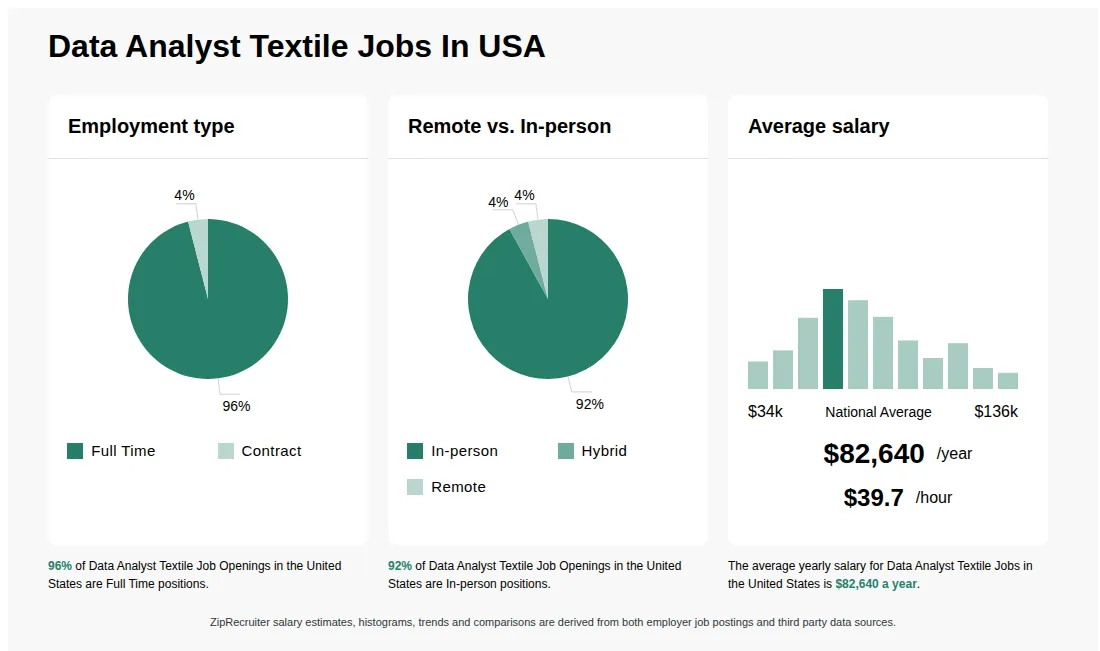
Data Analyst Textile information
See salary details
$34K - $43.3K
4% of jobs
$43.3K - $52.5K
7% of jobs
$52.5K - $61.8K
13% of jobs
$62.4K is the 25th percentile. Wages below this are outliers.
$61.8K - $71.1K
18% of jobs
The median wage is $75.4K / yr.
$71.1K - $80.4K
16% of jobs
$80.4K - $89.6K
13% of jobs
$93.1K is the 75th percentile. Wages above this are outliers.
$89.6K - $98.9K
9% of jobs
$98.9K - $108.2K
5% of jobs
$108.2K - $117.5K
9% of jobs
$117.5K - $126.7K
3% of jobs
$126.7K - $136K
2% of jobs
$34K
$82.6K
$136K
How much do data analyst textile jobs pay per year?
As of Jul 22, 2026, the average yearly pay for data analyst textile in the United States is $82,640.00, according to ZipRecruiter salary data. Most workers in this role earn between $62,500.00 and $97,000.00 per year, depending on experience, location, and employer.
How does a Data Analyst in the textile industry typically collaborate with production and design teams?
As a Data Analyst in the textile industry, you will frequently work alongside production and design teams to translate raw data into actionable insights. This collaboration often involves analyzing trends in material usage, production efficiency, and customer preferences, then sharing findings through reports or presentations. Your analyses help inform decisions on inventory management, product development, and process optimization, making clear communication and teamwork essential. Regular meetings with cross-functional teams are common, ensuring that data-driven recommendations align with both operational goals and creative directions.
Will AI replace data analyst?
AI is transforming the role of data analysts by automating routine tasks such as data cleaning and basic analysis, but it is unlikely to fully replace the need for human analysts. Data analysts in the textile industry will continue to be essential for interpreting complex data, making strategic decisions, and applying domain expertise that AI cannot replicate. Skills in data visualization, statistical analysis, and tools like SQL and Python remain valuable in this evolving environment.
What does a Data Analyst in the textile industry do?
A Data Analyst in the textile industry is responsible for collecting, processing, and interpreting data related to textile production, sales, supply chain, or quality control. They use statistical tools and analytical techniques to identify trends, forecast demand, and help optimize manufacturing processes. Their insights help companies improve efficiency, reduce costs, and make informed business decisions. Additionally, they often collaborate with other departments such as production, sales, and marketing to provide data-driven recommendations.
What field is the highest paid data analyst?
Data analysts working in finance, technology, and consulting tend to have the highest salaries, especially those with expertise in advanced analytics, machine learning, and programming tools like Python or R. Specializing in industries with high revenue potential and acquiring certifications such as CFA or SAS can also increase earning potential.
Is 40 too late for data science?
For a Data Analyst in the textile industry, starting a career in data science at age 40 is feasible, as many skills such as statistical analysis, programming, and data visualization can be learned at any age. Experience in the textile sector can also provide valuable domain knowledge that complements data science skills, and continuous learning through online courses or certifications can help transition into more advanced roles regardless of age.
Are textile jobs in demand?
Textile jobs, including roles like data analysts in the textile industry, are generally in demand due to ongoing manufacturing needs and technological advancements such as automation and data management tools. Employment opportunities depend on regional industry growth and the ability to analyze production data effectively.
What is the difference between Data Analyst Textile vs Textile Quality Analyst?
| Aspect | Data Analyst Textile | Textile Quality Analyst |
|---|---|---|
| Required Credentials | Bachelor's in Data Science, Statistics, or related field | Bachelor's in Textile Engineering, Quality Management, or related field |
| Work Environment | Data analysis teams, offices, manufacturing plants | Quality control labs, manufacturing facilities, textile mills |
| Employer & Industry Usage | Fashion brands, textile manufacturers, data firms | Textile mills, apparel companies, quality assurance firms |
| Common Search & Comparison | Yes | Yes |
The Data Analyst Textile focuses on analyzing data related to textile production, sales, and market trends, while the Textile Quality Analyst concentrates on inspecting and ensuring the quality of textile products. Both roles require industry-specific knowledge but differ in their core responsibilities and skill sets.
What are the key skills and qualifications needed to thrive as a Data Analyst in the textile industry, and why are they important?
To thrive as a Data Analyst in the textile industry, you need strong analytical skills, proficiency in statistics, and a relevant degree in data science, mathematics, or a related field. Familiarity with tools like Excel, SQL, Python, and data visualization platforms such as Tableau or Power BI is essential, along with knowledge of textile production systems. Exceptional attention to detail, problem-solving abilities, and effective communication skills help translate complex data insights for diverse stakeholders. These competencies are critical for optimizing production processes, improving quality, and driving data-driven decisions in a competitive textile market.
More about Data Analyst Textile jobs
What cities are hiring for Data Analyst Textile jobs? Cities with the most Data Analyst Textile job openings:
What states have the most Data Analyst Textile jobs? States with the most job openings for Data Analyst Textile jobs include:
What job categories do people searching Data Analyst Textile jobs look for? The top searched job categories for Data Analyst Textile jobs are:

Full-time
Medical, Dental, Vision, Life, Retirement, PTO
Re-posted 26 days ago
Job description
Requisition ID: 66213 Title:Textile Manufacturing Lead
Arthrex, Inc. is a global medical device company and a leader in new product development and medical education. Arthrex Manufacturing is actively searching for Textile Manufacturing Lead. The person in this position will lead manufacturing teams to produce Quality Medical Instruments in accordance with Arthrex Manufacturing Inc. procedures in a safe and effective manner to meet and exceed the customer's needs. Join our talented team at a global medical device company focused on Helping Surgeons Treat Their Patients Better™.
The 3rd Shift hours for this position is Sunday through Thursday from 10:30PM-7:00AM.
Essential Duties and Responsibilities:
Education and Experience:
Knowledge and Skill Requirements/Specialized Courses and/or Training:
Machine, Tools, and/or Equipment Skills:
The technology and the frequency of the technology required to perform this job are as follows; the operation of textile equipment and support equipment including weigh scales, measurement devices, and general test equipment.
Language and Communication Skills:
Strong analytical and comprehension skills, with the ability to verbally communicate ideas and issues effectively to other team members and management. Ability to write and record data and information as required by procedures.
Physical Demands:
The physical demands described here are representative of those that must be met by an employee to successfully perform the essential functions of the job. Reasonable accommodations may be made to enable individuals with disabilities to perform the essential functions. While performing the duties of this job, the employee is regularly required to talk or hear. The employee is frequently required to sit and stand, use hands and fingers to handle and feel, and reach with hands and arms. The employee must lift and/or move up to 20 lbs. on a regular basis. The employee must also be able to bend frequently and lift 30-50lbs occasionally.
Work Environment:
The work environment characteristics described here are representative of those an employee encounters while performing the essential functions of this job. Reasonable accommodations may be made to enable individuals with disabilities to perform the essential functions. Work is primarily performed in a general manufacturing area as well as in a cleanroom/controlled environment. A cleanroom is a controlled environment where products are manufactured, in which the concentration of airborne particles is controlled to specified limits. These contaminants are generated by people, processes, facilities, and equipment and must be continually removed from the air. Strict rules and procedures are followed to prevent contamination of the product. The only way to control contamination is to control the total environment- air flow rates and direction, pressurization, temperature, humidity, specialized filtration and the sources of these particles all need to be tightly controlled. Temperature ranges from 69F-73F. Hearing protection may be required.
Arthrex Benefits
All qualified applicants will receive consideration for employment without regard to race, color, religion, age, sex, sexual orientation, gender identity, national origin, disability, protected veteran status, or any other status protected by law.
Making People Better at Arthrex
Lorem ipsum dolor sit amet consectetur. Cras fringilla elementum odio velit.
Job Details
Date: Jul 17, 2026
Requisition ID: 66213
Salary Range:
Job title: Textile Manufacturing Lead - 3rd Shift
Arthrex
Location:
Arthrex, Inc. is a global medical device company and a leader in new product development and medical education. Arthrex Manufacturing is actively searching for Textile Manufacturing Lead. The person in this position will lead manufacturing teams to produce Quality Medical Instruments in accordance with Arthrex Manufacturing Inc. procedures in a safe and effective manner to meet and exceed the customer's needs. Join our talented team at a global medical device company focused on Helping Surgeons Treat Their Patients Better™.
The 3rd Shift hours for this position is Sunday through Thursday from 10:30PM-7:00AM.
Essential Duties and Responsibilities:
- Set-up and operate a variety of hand tools and light duty textile machines to manufacture products specified on work order using engineering prints, standard work instructions and inspection procedures
- Identify in-process defects and troubleshoot related equipment to ensure quality of material produced, while ensuring proper adherence to GMP and GDP during the manufacturing process.
- Handle and measure appropriate chemical quantities using graduated cylinders and digital scales, track usage for accurate inventory issuance
- Optimize machine run times and drive execution and efficiency through proper time-management techniques and accurate product setups within the manufacturing factory
- Follow company Quality System Requirements to ensure Quality is at the forefront of the manufacturing of sutures for patient use
- Function as primary point of contact for the braiding department in absence of braiding manufacturing supervisor
- Assist with the training, mentoring, onboarding, and certification of new textile technicians
- Promote a culture of safety and attention to detail, encouraging employees use correct PPE for tasks and follow all applicable cleanroom WI
- Apply continuous improvement principles to the manufacturing process and proactively identify potential issues, and work with stakeholders to implement fixes and eliminate process errors
- Foster a cohesive culture of teamwork and respect by encouraging employee engagement and feedback
- Promote an atmosphere of consistent audit readiness by driving accountability and process adherence within textile manufacturing
- Consistently interface with support groups such as engineering, quality, planning, maintenance, facilities, and other stakeholders to ensure timely flow of production relevant information.
- Perform material reconciliation, paperwork review and assist with pulling of data for investigations or downstream customer requests.
- Work inside a controlled clean room environment for material finishing, including wearing clean room attire in accordance with ISO Class 7 controlled environment requirements
- Ensure that all Arthrex policies and procedures are being followed within the area of responsibility.
Education and Experience:
- High School Diploma or equivalent required
- 4 years of manufacturing experience required
- Textile processing experience is required
- Medical device manufacturing experience strongly preferred
- Experience in Lean manufacturing environment is desirable
Knowledge and Skill Requirements/Specialized Courses and/or Training:
- Elevated understanding of textile processes including twisting, winding, braiding, coating and dyeing, and able to communicate with suppliers as it relates to quality issues and process improvements.
- Self-starter with the ability to work independently, but also works effectively with internal and external customers under general direction and supervision
- Ability to determine materials and tools required to perform the operation.
- Excellent interpersonal and collaboration skills
- Demonstrates an elevated level of attention to detail and accuracy.
- High level of planning and organization skills, and the proven ability to meet deadlines are required
- Strong proficiency in administrative procedures and computer systems such as word processing, managing files and records, Excel, Power Point, Documentum, SAP, and Microsoft Outlook is preferred.
Machine, Tools, and/or Equipment Skills:
The technology and the frequency of the technology required to perform this job are as follows; the operation of textile equipment and support equipment including weigh scales, measurement devices, and general test equipment.
Language and Communication Skills:
Strong analytical and comprehension skills, with the ability to verbally communicate ideas and issues effectively to other team members and management. Ability to write and record data and information as required by procedures.
Physical Demands:
The physical demands described here are representative of those that must be met by an employee to successfully perform the essential functions of the job. Reasonable accommodations may be made to enable individuals with disabilities to perform the essential functions. While performing the duties of this job, the employee is regularly required to talk or hear. The employee is frequently required to sit and stand, use hands and fingers to handle and feel, and reach with hands and arms. The employee must lift and/or move up to 20 lbs. on a regular basis. The employee must also be able to bend frequently and lift 30-50lbs occasionally.
Work Environment:
The work environment characteristics described here are representative of those an employee encounters while performing the essential functions of this job. Reasonable accommodations may be made to enable individuals with disabilities to perform the essential functions. Work is primarily performed in a general manufacturing area as well as in a cleanroom/controlled environment. A cleanroom is a controlled environment where products are manufactured, in which the concentration of airborne particles is controlled to specified limits. These contaminants are generated by people, processes, facilities, and equipment and must be continually removed from the air. Strict rules and procedures are followed to prevent contamination of the product. The only way to control contamination is to control the total environment- air flow rates and direction, pressurization, temperature, humidity, specialized filtration and the sources of these particles all need to be tightly controlled. Temperature ranges from 69F-73F. Hearing protection may be required.
Arthrex Benefits
- Medical, Dental and Vision Insurance
- Company-Provided Life Insurance
- Voluntary Life Insurance
- Flexible Spending Account (FSA)
- Supplemental Insurance Plans (Accident, Cancer, Hospital, Critical Illness)
- Matching 401(k) Retirement Plan
- Annual Bonus
- Wellness Incentive Program
- Free Onsite Medical Clinics
- Free Onsite Lunch
- Tuition Reimbursement Program
- Trip of a Lifetime
- Paid Parental Leave
- Paid Time Off
- Volunteer PTO
- Employee Assistance Provider (EAP)
All qualified applicants will receive consideration for employment without regard to race, color, religion, age, sex, sexual orientation, gender identity, national origin, disability, protected veteran status, or any other status protected by law.
Making People Better at Arthrex
Lorem ipsum dolor sit amet consectetur. Cras fringilla elementum odio velit.
Job Details
Date: Jul 17, 2026
Requisition ID: 66213
Salary Range:
Job title: Textile Manufacturing Lead - 3rd Shift
Arthrex
Location:

About Arthrex
Sourced by ZipRecruiter
Industry
Medical equipment and supplies manufacturing
Company size
5,001 - 10,000 Employees
Headquarters location
Naples, FL, US
Year founded
1981