Description Job title: CRNA-Certified Registered Nurse Anesthetist Location: Hickory, North Carolina - Frye Regional Medical Center Status: Full-time, Exempt Department: Clinical Reports to:
Description Job title: CRNA-Certified Registered Nurse Anesthetist Location: Hickory, North Carolina - Frye Regional Medical Center Status: Full-time, Exempt Department: Clinical Reports to:
Job title: CRNA-Certified Registered Nurse Anesthetist Location: Hickory, North Carolina - Frye Regional Medical Center Status: Full-time, Exempt Department: Clinical Reports to: Assistant Chief ...
Job title: CRNA-Certified Registered Nurse Anesthetist Location: Hickory, North Carolina - Frye Regional Medical Center Status: Full-time, Exempt Department: Clinical Reports to: Assistant Chief ...
Certified Registered Nurse Anesthetist (CRNA)
Edenton, NC · On-site
$300K/yr
Certified Registered Nurse Anesthetist (CRNA) Location: ECU Health Chowan (Edenton, NC) and ECU Health Bertie (Windsor, NC) Hospitals Status: Full-time (exempt) Salary: High starting base of $300,000 ...
Quick apply
Certified Registered Nurse Anesthetist (CRNA)
Edenton, NC · On-site
$300K/yr
Certified Registered Nurse Anesthetist (CRNA) Location: ECU Health Chowan (Edenton, NC) and ECU Health Bertie (Windsor, NC) Hospitals Status: Full-time (exempt) Salary: High starting base of $300,000 ...
Certified Registered Nurse Anesthetist (CRNA)
Edenton, NC · On-site
$300K/yr
Certified Registered Nurse Anesthetist (CRNA) Location: ECU Health Chowan (Edenton, NC) and ECU Health Bertie (Windsor, NC) Hospitals Status: Full-time (exempt) Salary: High starting base of $300,000 ...
Certified Registered Nurse Anesthetist (CRNA)
Edenton, NC · On-site
$300K/yr
Certified Registered Nurse Anesthetist (CRNA) Location: ECU Health Chowan (Edenton, NC) and ECU Health Bertie (Windsor, NC) Hospitals Status: Full-time (exempt) Salary: High starting base of $300,000 ...
Certified Registered Nurse Anesthetist (CRNA)
Windsor, NC · On-site
$300K/yr
Certified Registered Nurse Anesthetist (CRNA) Location: ECU Health Chowan (Edenton, NC) and ECU Health Bertie (Windsor, NC) Hospitals Status: Full-time (exempt) Salary: High starting base of $300,000 ...
Quick apply
Certified Registered Nurse Anesthetist (CRNA)
Windsor, NC · On-site
$300K/yr
Certified Registered Nurse Anesthetist (CRNA) Location: ECU Health Chowan (Edenton, NC) and ECU Health Bertie (Windsor, NC) Hospitals Status: Full-time (exempt) Salary: High starting base of $300,000 ...
Certified Registered Nurse Anesthetist (CRNA) Location: ECU Health Chowan (Edenton, NC) and ECU Health Bertie (Windsor, NC) Hospitals Status: Full-time (exempt) Salary: High starting base of $300,000 ...
Quick apply
Certified Registered Nurse Anesthetist (CRNA) Location: ECU Health Chowan (Edenton, NC) and ECU Health Bertie (Windsor, NC) Hospitals Status: Full-time (exempt) Salary: High starting base of $300,000 ...

The Certified Registered Nurse Anesthetist (CRNA) Opportunity: * Full-time, permanent position * Varied shifts * Great leadership and administration team! * Work independently to provide anesthesia ...
The Certified Registered Nurse Anesthetist (CRNA) Opportunity: * Full-time, permanent position * Varied shifts * Great leadership and administration team! * Work independently to provide anesthesia ...
Certified Registered Nurse Anesthetist (CRNA) The Certified Registered Nurse Anesthetist (CRNA) delivers comprehensive anesthesia care that supports the VA mission through quality and timely service.
Certified Registered Nurse Anesthetist (CRNA) The Certified Registered Nurse Anesthetist (CRNA) delivers comprehensive anesthesia care that supports the VA mission through quality and timely service.

HCA Kansas City is looking for skilled and flexible Certified Registered Nurse Anesthetists (CRNAs) to join our team. Due to the nature of the position, candidates must live beyond a 90-mile radius ...
HCA Kansas City is looking for skilled and flexible Certified Registered Nurse Anesthetists (CRNAs) to join our team. Due to the nature of the position, candidates must live beyond a 90-mile radius ...
Certified Registered Nurse Anesthetist (CRNA)
Windsor, NC · On-site
$300K/yr
Certified Registered Nurse Anesthetist (CRNA) Location: ECU Health Chowan (Edenton, NC) and ECU Health Bertie (Windsor, NC) Hospitals Status: Full-time (exempt) Salary: High starting base of $300,000 ...
Certified Registered Nurse Anesthetist (CRNA)
Windsor, NC · On-site
$300K/yr
Certified Registered Nurse Anesthetist (CRNA) Location: ECU Health Chowan (Edenton, NC) and ECU Health Bertie (Windsor, NC) Hospitals Status: Full-time (exempt) Salary: High starting base of $300,000 ...

Certified Registered Nurse Anesthetist (CRNA)
Van Wert, OH · On-site
$210 - $220/hr
Certified Registered Nurse Anesthetist (CRNA) * Start Date: 11-09-26 * Length: 26 weeks Schedule and Coverage: * Shift Coverage: Scheduled + On Call required * Shift Schedule: Standard 5, 8-Hour 07 ...
Certified Registered Nurse Anesthetist (CRNA)
Van Wert, OH · On-site
$210 - $220/hr
Certified Registered Nurse Anesthetist (CRNA) * Start Date: 11-09-26 * Length: 26 weeks Schedule and Coverage: * Shift Coverage: Scheduled + On Call required * Shift Schedule: Standard 5, 8-Hour 07 ...
Certified Registered Nurse Anesthetist (CRNA)
Detroit, MI · On-site
$170 - $180/hr
Certified Registered Nurse Anesthetist (CRNA) * Start Date: 01-01-27 * Length: 13 weeks Schedule and Coverage: * Shift Coverage: Scheduled + No Call * Shift Schedule: Standard 5, 8-Hour 19:00 - 07:00 ...
Certified Registered Nurse Anesthetist (CRNA)
Detroit, MI · On-site
$170 - $180/hr
Certified Registered Nurse Anesthetist (CRNA) * Start Date: 01-01-27 * Length: 13 weeks Schedule and Coverage: * Shift Coverage: Scheduled + No Call * Shift Schedule: Standard 5, 8-Hour 19:00 - 07:00 ...
Certified Registered Nurse Anesthetist (CRNA)
Winona, MN · On-site
$210 - $220/hr
Certified Registered Nurse Anesthetist (CRNA) * Start Date: 10-05-26 * Length: 13 weeks Schedule and Coverage: * Shift Coverage: Scheduled + On Call required * Shift Schedule: Standard 5, 8-Hour 07 ...
Certified Registered Nurse Anesthetist (CRNA)
Winona, MN · On-site
$210 - $220/hr
Certified Registered Nurse Anesthetist (CRNA) * Start Date: 10-05-26 * Length: 13 weeks Schedule and Coverage: * Shift Coverage: Scheduled + On Call required * Shift Schedule: Standard 5, 8-Hour 07 ...
Certified Registered Nurse Anesthetist (CRNA)
East Stroudsburg, PA · On-site
$210 - $220/hr
Certified Registered Nurse Anesthetist (CRNA) * Start Date: 12-05-26 * Length: 13 weeks Schedule and Coverage: * Shift Coverage: Scheduled + On Call required * Shift Schedule: Standard 5, 8-Hour 07 ...
Certified Registered Nurse Anesthetist (CRNA)
East Stroudsburg, PA · On-site
$210 - $220/hr
Certified Registered Nurse Anesthetist (CRNA) * Start Date: 12-05-26 * Length: 13 weeks Schedule and Coverage: * Shift Coverage: Scheduled + On Call required * Shift Schedule: Standard 5, 8-Hour 07 ...
Certified Registered Nurse Anesthetist (CRNA)
New Martinsville, WV · On-site
$200 - $210/hr
Certified Registered Nurse Anesthetist (CRNA) * Start Date: 12-21-26 * Length: 1 week Schedule and Coverage: * Shift Coverage: Scheduled + No Call * Shift Schedule: Standard 3, 8-Hour 07:00 - 15:00 ...
Certified Registered Nurse Anesthetist (CRNA)
New Martinsville, WV · On-site
$200 - $210/hr
Certified Registered Nurse Anesthetist (CRNA) * Start Date: 12-21-26 * Length: 1 week Schedule and Coverage: * Shift Coverage: Scheduled + No Call * Shift Schedule: Standard 3, 8-Hour 07:00 - 15:00 ...

Certified Registered Nurse Anesthetist (CRNA) opening Location: Denver, ColoradoEmployment Type: 1099 ContractPosition Overview:We are looking for a dedicated and experienced Certified Registered ...
Certified Registered Nurse Anesthetist (CRNA) opening Location: Denver, ColoradoEmployment Type: 1099 ContractPosition Overview:We are looking for a dedicated and experienced Certified Registered ...
Certified Registered Nurse Anesthetist (CRNA)
Washington, NC · On-site
$275K/yr
Certified Registered Nurse Anesthetist (CRNA) Location: ECU Health Beaufort Hospital Status: Full-time, $275,000 base, $20,000 annual retention bonus + shift differentials and call pay Department:
Certified Registered Nurse Anesthetist (CRNA)
Washington, NC · On-site
$275K/yr
Certified Registered Nurse Anesthetist (CRNA) Location: ECU Health Beaufort Hospital Status: Full-time, $275,000 base, $20,000 annual retention bonus + shift differentials and call pay Department:
Certified Registered Nurse Anesthetist (CRNA)
Spokane, WA · On-site
$1.2K - $1.6K/day
Certified Registered Nurse Anesthetist (CRNA) * Start Date: 10-26-26 * Length: 13 weeks Schedule and Coverage: * Shift Coverage: Scheduled + No Call * Shift Schedule: Standard 2, 8-Hour 07:30 - 16:30 ...
Certified Registered Nurse Anesthetist (CRNA)
Spokane, WA · On-site
$1.2K - $1.6K/day
Certified Registered Nurse Anesthetist (CRNA) * Start Date: 10-26-26 * Length: 13 weeks Schedule and Coverage: * Shift Coverage: Scheduled + No Call * Shift Schedule: Standard 2, 8-Hour 07:30 - 16:30 ...
Certified Registered Nurse Anesthetist (CRNA)
Shakopee, MN · On-site
$240 - $250/hr
Certified Registered Nurse Anesthetist (CRNA) * Start Date: 11-16-26 * Length: 26 weeks Schedule and Coverage: * Shift Coverage: Scheduled + No Call * Shift Schedule: Standard 4, 10-Hour 06:45 ...
Certified Registered Nurse Anesthetist (CRNA)
Shakopee, MN · On-site
$240 - $250/hr
Certified Registered Nurse Anesthetist (CRNA) * Start Date: 11-16-26 * Length: 26 weeks Schedule and Coverage: * Shift Coverage: Scheduled + No Call * Shift Schedule: Standard 4, 10-Hour 06:45 ...
Certified Registered Nurse Anesthetist (CRNA)
Kirksville, MO · On-site
$205 - $215/hr
Certified Registered Nurse Anesthetist (CRNA) * Start Date: 10-05-26 * Length: 13 weeks Schedule and Coverage: * Shift Coverage: Scheduled + On Call required * Shift Schedule: Standard 5, 8-Hour 06 ...
Certified Registered Nurse Anesthetist (CRNA)
Kirksville, MO · On-site
$205 - $215/hr
Certified Registered Nurse Anesthetist (CRNA) * Start Date: 10-05-26 * Length: 13 weeks Schedule and Coverage: * Shift Coverage: Scheduled + On Call required * Shift Schedule: Standard 5, 8-Hour 06 ...
Crna information
See salary details
$14.90 - $30.99
1% of jobs
$30.99 - $47.07
1% of jobs
$47.07 - $63.16
2% of jobs
$63.16 - $79.24
11% of jobs
$90.15 is the 25th percentile. Wages below this are outliers.
$79.24 - $95.32
15% of jobs
$95.32 - $111.41
19% of jobs
The median wage is $113.02 / hr.
$111.41 - $127.49
11% of jobs
$127.49 - $143.58
7% of jobs
$154.54 is the 75th percentile. Wages above this are outliers.
$143.58 - $159.66
12% of jobs
$159.66 - $175.74
10% of jobs
$175.74 - $191.83
12% of jobs
$14
$124
$191
How much do crna jobs pay per hour?
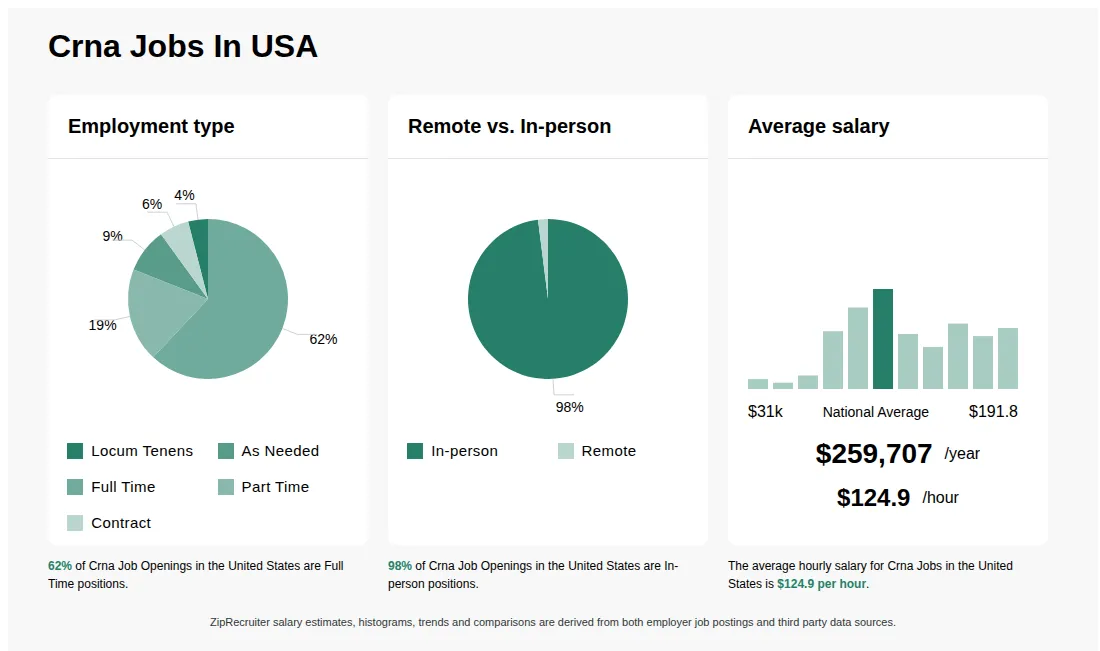
As of Sep 13, 2026, the average hourly pay for crna in the United States is $124.86, according to ZipRecruiter salary data. Most workers in this role earn between $91.59 and $167.31 per hour, depending on experience, location, and employer.
What is a CRNA?
CRNAs, or Certified Registered Nurse Anesthetists, are advanced practice registered nurses who are trained and certified to administer anesthesia and provide care before, during, and after surgical, therapeutic, diagnostic, and obstetrical procedures. They play a critical role in ensuring patient safety and comfort during anesthesia. CRNAs work in a variety of healthcare settings, including hospitals, surgical centers, and pain management clinics, often collaborating with surgeons, anesthesiologists, and other healthcare professionals.
How does a CRNA typically collaborate with surgeons and other healthcare professionals during surgical procedures?
Certified Registered Nurse Anesthetists (CRNAs) work closely with surgeons, anesthesiologists, and operating room staff to ensure patient safety and optimal outcomes during surgery. Collaboration involves preoperative assessments, developing anesthesia plans, monitoring vital signs, and adjusting anesthesia levels as needed. CRNAs also communicate regularly with the surgical team to respond quickly to any changes in a patient’s condition, making teamwork and clear communication essential parts of the role.
What is the difference between Crna vs Nurse Anesthetist?
| Aspect | Crna | Nurse Anesthetist |
|---|---|---|
| Credentials | Registered Nurse (RN) + Certified Registered Nurse Anesthetist (CRNA) certification | Same as Crna: RN license + CRNA certification |
| Work Environment | Hospitals, surgical centers, clinics, dental offices | Same as Crna: hospitals, surgical centers, clinics |
| Industry Usage | Commonly used in healthcare and anesthesia contexts | Same as Crna: used interchangeably in industry |
| Job Role | Administers anesthesia, monitors patients, collaborates with surgical teams | Same as Crna: responsible for anesthesia care before, during, and after procedures |
The terms Crna and Nurse Anesthetist are often used interchangeably, both referring to advanced practice registered nurses who administer anesthesia. They share the same credentials, work environments, and job responsibilities, making them essentially the same role in the healthcare industry.
Is CRNA still in demand?
Certified Registered Nurse Anesthetists (CRNAs) are in high demand due to ongoing shortages of anesthesia providers and the increasing need for anesthesia services in hospitals, surgical centers, and rural areas. The profession offers strong job stability, competitive salaries, and requires advanced education and certification, making it a consistently sought-after role in healthcare.
What does a CRNA do?
A Certified Registered Nurse Anesthetist (CRNA) administers anesthesia to patients undergoing surgery or procedures, monitors vital signs, and manages pain control before, during, and after anesthesia. They work independently or with anesthesiologists in various healthcare settings, requiring advanced training and certification in anesthesia practice.
More about Crna jobs
What cities are hiring for Crna jobs?
Cities with the most Crna job openings:
What are the most commonly searched types of Crna jobs?
The most popular types of Crna jobs are:
What states have the most Crna jobs?
States with the most job openings for Crna jobs include:
What are popular job titles related to Crna jobs?
For Crna jobs, the most frequently searched job titles are:
CRNA-Certified Registered Nurse Anesthetist
Hickory, NC • On-site
ECAA Anesthesia Specialists
Full-time
Re-posted 9 days ago
Job description
Description
Job title: CRNA-Certified Registered Nurse Anesthetist
Location: Hickory, North Carolina - Frye Regional Medical Center
Status: Full-time, Exempt
Department: Clinical
Reports to: Assistant Chief CRNA - Hickory Division
Job Supervisory Responsibilities: None
Job Summary:
The CRNA-Certified Registered Nurse Anesthetist for Frye Regional Medical Center in our Hickory division manages all anesthetics with encouraged and supported autonomy, while practicing in an ACT setting. Frye Regional Medical Center includes a 355-bed acute care hospital, as well as Frye Brain Center, Frye Heart Center, Cancer Center, General and Bariatric surgery, Emergency Services, Advanced Orthopedics, Neurosciences, Women’s Birthing Center, and Inpatient Rehabilitation. The CRNA will cover daytime ORs at FRMC and three ambulatory surgery centers. This position offers a varying case mix including general, orthopedics, plastics, pediatrics, dental, bariatrics, and minimal neurosurgery and obstetrics. Cardiac cases are negotiable and there is no trauma. The CRNA will use high patient acuity allowing the new and/or experienced CRNA to fully implement their clinical skills and education, and continue to expand within any area of expertise that may be desired.
Duties/Responsibilities:
● Examine patients’ history for allergies or illnesses that would affect anesthesia.
● Evaluate and prepare patients, provide education about surgeries/procedures and recovery, and discuss possible side effects.
● Liaise with other members of the healthcare team such as MDs, nurses, and other healthcare workers.
● Determine appropriate amount, type, and method of anesthesia administration.
● Perform anesthetics; administer medication to patients for pain relief.
● Supervise and assist other CRNAs/SRNAs.
● Oversee recovery and pain management of patients.
● Inform patients of post-surgical and pain management procedures.
● Assist in patient procedure preparation.
● Provide support to other healthcare teams.
● Advise patients on medication type and dosage.
● Performs other duties as assigned.
Education and Experience:
● Must be a Certified Registered Nurse Anesthetist, or in the process of completing the certification through an accredited CRNA program.
● Current or compact RN license in the state of North Carolina, or able to obtain NC licensure.
● BLS, ACLS, and PALS certifications required.
Required Skills/Abilities:
● Ability to provide safe pre-and post-anesthetic care using innovative and proven techniques.
● Ability to assess patients’ medical history and plan anesthesia administration for the best outcome.
● High patient acuity with the ability to provide compassionate care to every patient.
● Ability to work in a team, but also autonomously when needed.
● Strong written and oral skills with the ability to communicate clearly under pressure.
● Proficient with technology including medical equipment and computers.
● Maintain a friendly, collaborative attitude and professional demeanor at all times.
Work Environment/Physical Requirements:
● Must have the ability to stand for longer periods of time and be accustomed to frequent and prolonged movement.
● Involves frequent contact with patients, physicians, leadership, facility, and medical office staff.
● Ability to perform work in a hospital where the environment may be stressful and often disruptive.
ECAA is an equal opportunity employer and does not discriminate against any applicant or employee on the basis of age, race, color, religion, sex, national origin, genetic information, disability, or other legally protected status. This policy extends to all terms, conditions, and privileges of employment, as well as the use of the Company's facilities and participation in all activities sponsored by the Company.