Exceptions are authorized by the COR or Chief of Biomedical Engineering/HTM Manager of WRNMMC through a review of a bona fide occupational qualification (BFOQ). Work Environment: The work requires ...
Exceptions are authorized by the COR or Chief of Biomedical Engineering/HTM Manager of WRNMMC through a review of a bona fide occupational qualification (BFOQ). Work Environment: The work requires ...
Founding Manufacturing Engineer - Medical Devices
Los Angeles, CA · On-site
$140 - $190/hr
Founder & CEO Equity Eligible: Yes - Eligible to participate in the Company's Equity Incentive Plan ... Working closely with the Biomedical Engineer, Software Engineer, ML Engineer, FDA Regulatory ...
Founding Manufacturing Engineer - Medical Devices
Los Angeles, CA · On-site
$140 - $190/hr
Founder & CEO Equity Eligible: Yes - Eligible to participate in the Company's Equity Incentive Plan ... Working closely with the Biomedical Engineer, Software Engineer, ML Engineer, FDA Regulatory ...

$140 - $210/hr
## Chief Engineer, SoftwareApplylocations: Warner Robins, GA 31088-7810time type: Full timeposted on ... biomedical, mechanical, and systems engineering • Knowledge of engineering principles (e.g ...
$140 - $210/hr
## Chief Engineer, SoftwareApplylocations: Warner Robins, GA 31088-7810time type: Full timeposted on ... biomedical, mechanical, and systems engineering • Knowledge of engineering principles (e.g ...
Chief Engineer, Software
Warner Robins, GA · On-site
$120 - $160/hr
## Chief Engineer, SoftwareApplylocations: Warner Robins, GA 31088-7810time type: Full timeposted on ... biomedical, mechanical, and systems engineering • Knowledge of engineering principles (e.g ...
Chief Engineer, Software
Warner Robins, GA · On-site
$120 - $160/hr
## Chief Engineer, SoftwareApplylocations: Warner Robins, GA 31088-7810time type: Full timeposted on ... biomedical, mechanical, and systems engineering • Knowledge of engineering principles (e.g ...
Chief Engineer, Software
Warner Robins, GA · On-site
$140 - $210/hr
## Chief Engineer, SoftwareApplylocations: Warner Robins, GA 31088-7810time type: Full timeposted on ... biomedical, mechanical, and systems engineering • Knowledge of engineering principles (e.g ...
Chief Engineer, Software
Warner Robins, GA · On-site
$140 - $210/hr
## Chief Engineer, SoftwareApplylocations: Warner Robins, GA 31088-7810time type: Full timeposted on ... biomedical, mechanical, and systems engineering • Knowledge of engineering principles (e.g ...
Applied Clinical Informatics Branch Chief (NIH NLM)
Bethesda, MD · On-site
$150 - $190/hr
... Biomedical Engineering and Biophysics,Computational Biology,Clinical Research The NIH National Library of Medicine's Lister Hill National Center for Biomedical Communications is now seeking a Chief ...
New
Applied Clinical Informatics Branch Chief (NIH NLM)
Bethesda, MD · On-site
$150 - $190/hr
... Biomedical Engineering and Biophysics,Computational Biology,Clinical Research The NIH National Library of Medicine's Lister Hill National Center for Biomedical Communications is now seeking a Chief ...
New

Chief Engineer, Software Department: MERC College/Division: Mercer Engineering Research Center ... biomedical, mechanical, and systems engineering Knowledge of engineering principles (e.g. analysis ...
Chief Engineer, Software Department: MERC College/Division: Mercer Engineering Research Center ... biomedical, mechanical, and systems engineering Knowledge of engineering principles (e.g. analysis ...

They support the Chief of M3D by conducting research, providing analysis, and offering ... Use various programming languages to perform data management and transformation. Programming ...
New
They support the Chief of M3D by conducting research, providing analysis, and offering ... Use various programming languages to perform data management and transformation. Programming ...
New
Chief Engineer, Software Department: MERC College/Division: Mercer Engineering Research Center ... biomedical, mechanical, and systems engineering • Knowledge of engineering principles (e.g ...
Chief Engineer, Software Department: MERC College/Division: Mercer Engineering Research Center ... biomedical, mechanical, and systems engineering • Knowledge of engineering principles (e.g ...
Chief Engineer, Software Department: MERC College/Division: Mercer Engineering Research Center ... biomedical, mechanical, and systems engineering • Knowledge of engineering principles (e.g ...
Chief Engineer, Software Department: MERC College/Division: Mercer Engineering Research Center ... biomedical, mechanical, and systems engineering • Knowledge of engineering principles (e.g ...
Supervisory Healthcare Engineer (Deputy Chief)
Hampton, VA · On-site
$128K/yr
Electrical Engineering, Mechanical Engineering, Biomedical Engineering, Civil Engineering ... The Chief Engineer must also work outdoors in all types of weather. There may be occasional ...
Supervisory Healthcare Engineer (Deputy Chief)
Hampton, VA · On-site
$128K/yr
Electrical Engineering, Mechanical Engineering, Biomedical Engineering, Civil Engineering ... The Chief Engineer must also work outdoors in all types of weather. There may be occasional ...

Supervisory Healthcare Engineer (Deputy Chief)
Hampton, VA · On-site +1
$128K - $166K/yr
Electrical Engineering, Mechanical Engineering, Biomedical Engineering, Civil Engineering ... The Chief Engineer must also work outdoors in all types of weather. There may be occasional ...
Supervisory Healthcare Engineer (Deputy Chief)
Hampton, VA · On-site +1
$128K - $166K/yr
Electrical Engineering, Mechanical Engineering, Biomedical Engineering, Civil Engineering ... The Chief Engineer must also work outdoors in all types of weather. There may be occasional ...

Biomedical Elec Technician (40 hrs/days)(Temple University Hospital)
Philadelphia, PA · On-site
$25.50 - $33.75/hr
Education High School Diploma or Equivalent Required Associate's Degree in Biomedical Engineering ... As the chief clinical training site for the Lewis Katz School of Medicine at Temple University, the ...
Biomedical Elec Technician (40 hrs/days)(Temple University Hospital)
Philadelphia, PA · On-site
$25.50 - $33.75/hr
Education High School Diploma or Equivalent Required Associate's Degree in Biomedical Engineering ... As the chief clinical training site for the Lewis Katz School of Medicine at Temple University, the ...

You will partner closely with the Chief of Staff and CTO to ensure smooth operations, effective ... Academic fields could include Electrical or Mechanical Engineering, Neuroscience, Biomedical ...
You will partner closely with the Chief of Staff and CTO to ensure smooth operations, effective ... Academic fields could include Electrical or Mechanical Engineering, Neuroscience, Biomedical ...
Founding Chief Technology Officer (Builder CTO) | MyDentalWig
Los Angeles, CA · On-site
$220 - $300/hr
Founder & CEO Executive Leadership: Yes - Member of the Executive Leadership Team Equity Eligible ... By integrating biomedical sensing, machine learning, software engineering, and intelligent cloud ...
Founding Chief Technology Officer (Builder CTO) | MyDentalWig
Los Angeles, CA · On-site
$220 - $300/hr
Founder & CEO Executive Leadership: Yes - Member of the Executive Leadership Team Equity Eligible ... By integrating biomedical sensing, machine learning, software engineering, and intelligent cloud ...

Aerospace Medicine Specialist
El Paso, TX · On-site
Areas of responsibility spanAerospace Medicine, Biomedical Engineering, Flight Control Operations ... Support Blue Origin's Chief Medical Officer and engineering teams in the development of health ...
Aerospace Medicine Specialist
El Paso, TX · On-site
Areas of responsibility spanAerospace Medicine, Biomedical Engineering, Flight Control Operations ... Support Blue Origin's Chief Medical Officer and engineering teams in the development of health ...
Aerospace Medicine Specialist
Phoenix, AZ · On-site
Areas of responsibility spanAerospace Medicine, Biomedical Engineering, Flight Control Operations ... Support Blue Origin's Chief Medical Officer and engineering teams in the development of health ...
Aerospace Medicine Specialist
Phoenix, AZ · On-site
Areas of responsibility spanAerospace Medicine, Biomedical Engineering, Flight Control Operations ... Support Blue Origin's Chief Medical Officer and engineering teams in the development of health ...
Areas of responsibility spanAerospace Medicine, Biomedical Engineering, Flight Control Operations ... Support Blue Origin's Chief Medical Officer and engineering teams in the development of health ...
Areas of responsibility spanAerospace Medicine, Biomedical Engineering, Flight Control Operations ... Support Blue Origin's Chief Medical Officer and engineering teams in the development of health ...
Aerospace Medicine Specialist
Denver, CO · On-site
Areas of responsibility spanAerospace Medicine, Biomedical Engineering, Flight Control Operations ... Support Blue Origin's Chief Medical Officer and engineering teams in the development of health ...
Aerospace Medicine Specialist
Denver, CO · On-site
Areas of responsibility spanAerospace Medicine, Biomedical Engineering, Flight Control Operations ... Support Blue Origin's Chief Medical Officer and engineering teams in the development of health ...
Aerospace Medicine Specialist
El Paso, TX · On-site
Areas of responsibility span Aerospace Medicine, Biomedical Engineering, Flight Control Operations ... Support Blue Origin's Chief Medical Officer and engineering teams in the development of health ...
Aerospace Medicine Specialist
El Paso, TX · On-site
Areas of responsibility span Aerospace Medicine, Biomedical Engineering, Flight Control Operations ... Support Blue Origin's Chief Medical Officer and engineering teams in the development of health ...
Chief Biomedical Engineer information
See salary details
$32.5K - $46K
9% of jobs
$59.1K is the 25th percentile. Wages below this are outliers.
$46K - $59.5K
17% of jobs
$59.5K - $73K
15% of jobs
The median wage is $81.1K / yr.
$73K - $86.5K
16% of jobs
$86.5K - $100K
11% of jobs
$112.7K is the 75th percentile. Wages above this are outliers.
$100K - $113.5K
9% of jobs
$113.5K - $127K
10% of jobs
$127K - $140.5K
7% of jobs
$140.5K - $154K
3% of jobs
$154K - $167.5K
2% of jobs
$167.5K - $181K
2% of jobs
$32.5K
$92.9K
$181K
How much do chief biomedical engineer jobs pay per year?
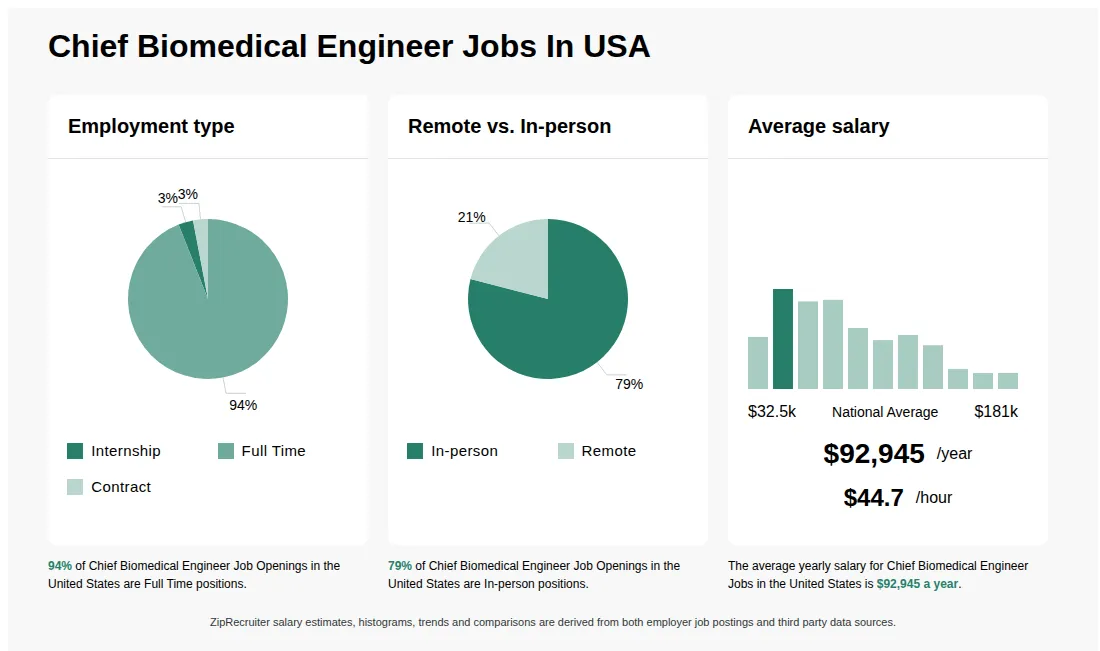
As of Sep 4, 2026, the average yearly pay for chief biomedical engineer in the United States is $92,945.00, according to ZipRecruiter salary data. Most workers in this role earn between $59,000.00 and $120,000.00 per year, depending on experience, location, and employer.
What does a chief biomedical engineer do?
A Chief Biomedical Engineer oversees the design, development, and maintenance of medical equipment and technology within healthcare organizations. They manage teams of biomedical engineers, ensure compliance with safety standards, and collaborate with medical staff to implement new technologies. Additionally, they are responsible for budgeting, equipment procurement, and ensuring that all devices operate efficiently and safely. Their expertise helps improve patient care by making sure medical technology is reliable and up to date.
What are the key skills and qualifications needed to thrive as a chief biomedical engineer?
To thrive as a Chief Biomedical Engineer, you need advanced knowledge of biomedical engineering principles, a relevant engineering degree, and extensive experience in healthcare technology management. Familiarity with medical device regulations, asset management systems, and certifications such as CBET (Certified Biomedical Equipment Technician) are typically required. Leadership, problem-solving, and strong communication skills help you manage teams and collaborate effectively with clinical staff and vendors. These competencies ensure the safe, efficient operation of medical equipment and support high standards of patient care in healthcare organizations.
What are some common challenges faced by a chief biomedical engineer in managing a multidisciplinary team?
A Chief Biomedical Engineer often leads teams composed of engineers, technicians, and clinical staff, each with different expertise and priorities. One common challenge is ensuring seamless communication and collaboration among these diverse groups to meet both technical and patient care objectives. Balancing resource allocation, managing project timelines, and staying compliant with healthcare regulations also present ongoing challenges. Effective leadership, clear communication, and proactive conflict resolution are key to successfully navigating these complexities.
What is the difference between Chief Biomedical Engineer vs Biomedical Engineer?
| Aspect | Chief Biomedical Engineer | Biomedical Engineer |
|---|---|---|
| Credentials | Bachelor's or Master's in Biomedical Engineering; often requires experience and certifications | Bachelor's degree in Biomedical Engineering or related field |
| Work Environment | Leadership role overseeing teams, strategic planning, and project management | Design, develop, and test medical devices; work in labs or hospitals |
| Employer & Industry Usage | Hospitals, medical device companies, research institutions | Medical device manufacturers, healthcare facilities, research labs |
The main difference is that the Chief Biomedical Engineer holds a leadership position responsible for overseeing biomedical engineering projects and teams, while the Biomedical Engineer focuses on designing and testing medical devices. The Chief role involves strategic decision-making, whereas the Biomedical Engineer is more hands-on with technical tasks.
More about Chief Biomedical Engineer jobs
What cities are hiring for Chief Biomedical Engineer jobs?
Cities with the most Chief Biomedical Engineer job openings:
What are the most commonly searched types of Chief Biomedical Engineer jobs?
The most popular types of Chief Biomedical Engineer jobs are:
What states have the most Chief Biomedical Engineer jobs?
States with the most job openings for Chief Biomedical Engineer jobs include:
What job categories do people searching Chief Biomedical Engineer jobs look for?
The top searched job categories for Chief Biomedical Engineer jobs are:

Contractor
Posted 9 days ago
Job description
Work Shifts-Monday-Friday- 6:45am – 5:00pm and 2:30pm – 11:30pm Biomedical Equipment Technicians Biomedical Equipment Technician works in various departments of the medical treatment facility or logical extensions of the facility (i.e., satellite clinic, health and wellness centers). Contract personnel shall evaluate, install, maintain, diagnose, repair, calibrate, and test MDE, including high risk and life support MDE. The Contractor shall ensure that all contract personnel maintain necessary sustainment training and/or certifications and are at the expense of the Contractor or contract personnel. Advanced, specialty, and manufacturer specific training may be provided, as written in the contract. Qualifications: Mandatory knowledge and skills: * Strong knowledge and ability in applying electronic circuitry and technical aspects of the operation, repair and maintenance of electronic equipment. * Repair electronic, pneumatic, electro-mechanical and mechanical medical to include troubleshooting, identifying source of problem(s), replacement of defective printed circuit board(s), discrete component(s), or other parts as appropriate. * Extensive knowledge of solid state, digital and integrated circuits (microprocessors) to isolate and resolve the complex relationship between electrical, electronic, computer operating systems, mechanical, physical and chemical components of the equipment and system and changes in circuitry when the patient and respective Environment of Care (EOC) become part of the system is required. * The ability to understand in-depth knowledge to diagnose problems with the quality of images and signals as required by medical professionals based on the equipment, network, and medical procedure being performed. * Understands the physiological parameters associated with a patient when diagnosing and troubleshooting MDE and deals effectively with patients. * Considerable knowledge of analysis techniques to be able to devise recovery plans for system failure situations. * Considerable knowledge and skill in using standard Microsoft operating systems, Microsoft Office suite of products for Office Automation, and administrative and clinical software products currently in use at WRNMMC. * Considerable knowledge of current regulatory requirements. * Substantial knowledge of basic anatomy, physiology, and medical terminology. * Ability to interpret schematics, wiring diagrams, and illustrated parts drawings of biomedical instrumentation. Knowledge of color code conventions used in component and wiring marking. * Ability to document investigation of equipment hazard alerts, recalls, updates, and incidents. * Ability to analyze, repair, and test electronic and electromechanical MDE. * Ability to perform preventive maintenance inspections. * Ability to run diagnostic programs. * Ability to maintain accurate records of repairs, calibration, and tests. * Contract personnel shall understand and comply with TJC and other applicable standards and regulations. * Skill in testing electronic equipment. * Skill in manual dexterity, hand-to-eye coordination, and color vision. * Skilled in effective communications, verbally and in writing, accurately and completely document MDE SPM and unscheduled services. * Able to communicate with clinical staff and provide assistance in service training. Education/Certification: * Graduate of a military BMET Course or a higher education degree from an accredited college in Biomedical Technology or Engineering. * Minimum of four (4) years’ experience in the repair and maintenance of Medical Devices & Equipment (MDE) * Association for the Advancement of Medical Instrumentation (AAMI) Certification (Preferred but not required) * Exceptions are authorized by the COR or Chief of Biomedical Engineering/HTM Manager of WRNMMC through a review of a bona fide occupational qualification (BFOQ). Work Environment: The work requires regular and recurring physical exertion such as long periods of standing, bending, stooping, stretching, reaching, or similar activities. The incumbent works primarily in an office setting. However, the work at times involves moderate risks or discomforts that require special safety precautions (e.g., working around moving parts, carts, or machines; exposure to contagious diseases or irritant chemicals). Employees may be required to use protective clothing or gear such as masks, gowns, coats, boots, goggles, gloves, or shields within the hospital. Exposure to patient care areas will be required periodically. Physical Requirements. The nature of the work requires moderate physical effort. The biomedical equipment technician frequently is required to lift, carry or otherwise, handle, items weighing up to 50 pounds with occasional encounters involving items greater than 18 kilograms. Frequent standing, walking, bending, crouching, reaching, stooping and working in cramped and awkward positions for prolonged periods is required. In addition to health requirements in the contract, the individual must pass color vision test. In addition to the ability to lift up to 50 pounds of MDE and TMDE, contract personnel shall be able to push/pull equipment carts; to kneel, stand, bend, and reach during MDE repair and SPM.

About RWD Consulting
Sourced by ZipRecruiter
Industry
Public administration
Company size
11 - 50 Employees
Headquarters location
Washington, DC, US
Year founded
2004