1

Chief Biomedical Engineer Jobs (NOW HIRING)

Biomedical Engineer

Tulsa, OK · On-site

$90 - $120/hr

Serves as a staff advisor to the Biomedical Engineering Supervisor/ Chief in Biomedical Engineering as well as engineering principles and practices, which relate to the area of specialization and ...

Biomedical Engineer ID: 2233 Location: Bethesda Openings: 1 Status: Full-Time Description ... Keeps the service chiefs informed of progress and potentially controversial findings or problems ...

Biomedical Engineer

Bethesda, MD · On-site

$90 - $115/hr

Bachelor of Science in Biomedical Engineering. * Five (5) years' experience in working with ... chiefs informed of progress and potential impact issues. * Assist with resolving technical issues ...

Biomedical Engineer

Bethesda, MD · On-site

$90K - $115K/yr

BIOMEDICAL ENGINEER Salary Requirement: $90,000-$115,000 Must Live in the DMV area onsite only ... Keeps the service chiefs informed of progress and potentially controversial findings or problems ...

NY · On-site

$120 - $160/hr

As Chief Engineer, you will provide technical leadership and hands-on ownership of sensor ... Bachelor's or advanced degree in Electrical Engineering, Computer Engineering, Biomedical ...

Role : Chief Editor, BMC Biomedical Technologies Location : New York or Shanghai- Hybrid, Permanent Closing date: September 25, 2026 About Springer Nature Springer Nature is one of the leading ...

next page

Showing results 1-20

Chief Biomedical Engineer information

See salary details

$32.5K

$92.9K

$181K

How much do chief biomedical engineer jobs pay per year?

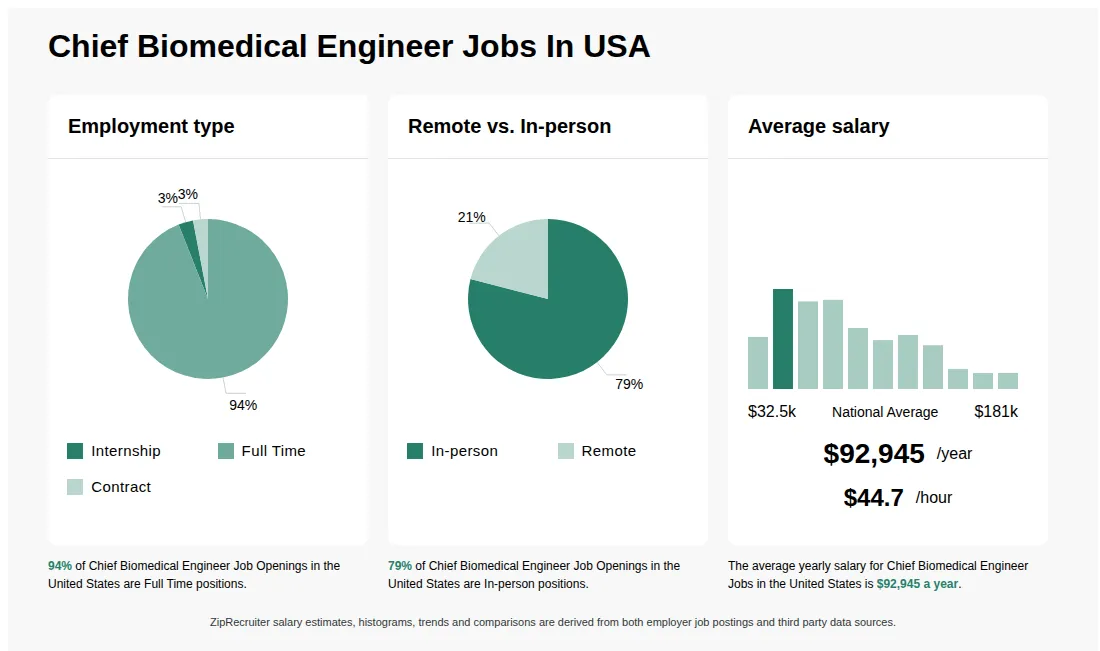
As of Sep 4, 2026, the average yearly pay for chief biomedical engineer in the United States is $92,945.00, according to ZipRecruiter salary data. Most workers in this role earn between $59,000.00 and $120,000.00 per year, depending on experience, location, and employer.

What does a chief biomedical engineer do?

A Chief Biomedical Engineer oversees the design, development, and maintenance of medical equipment and technology within healthcare organizations. They manage teams of biomedical engineers, ensure compliance with safety standards, and collaborate with medical staff to implement new technologies. Additionally, they are responsible for budgeting, equipment procurement, and ensuring that all devices operate efficiently and safely. Their expertise helps improve patient care by making sure medical technology is reliable and up to date.

What are the key skills and qualifications needed to thrive as a chief biomedical engineer?

To thrive as a Chief Biomedical Engineer, you need advanced knowledge of biomedical engineering principles, a relevant engineering degree, and extensive experience in healthcare technology management. Familiarity with medical device regulations, asset management systems, and certifications such as CBET (Certified Biomedical Equipment Technician) are typically required. Leadership, problem-solving, and strong communication skills help you manage teams and collaborate effectively with clinical staff and vendors. These competencies ensure the safe, efficient operation of medical equipment and support high standards of patient care in healthcare organizations.

What are some common challenges faced by a chief biomedical engineer in managing a multidisciplinary team?

A Chief Biomedical Engineer often leads teams composed of engineers, technicians, and clinical staff, each with different expertise and priorities. One common challenge is ensuring seamless communication and collaboration among these diverse groups to meet both technical and patient care objectives. Balancing resource allocation, managing project timelines, and staying compliant with healthcare regulations also present ongoing challenges. Effective leadership, clear communication, and proactive conflict resolution are key to successfully navigating these complexities.

What is the difference between Chief Biomedical Engineer vs Biomedical Engineer?

AspectChief Biomedical EngineerBiomedical Engineer
CredentialsBachelor's or Master's in Biomedical Engineering; often requires experience and certificationsBachelor's degree in Biomedical Engineering or related field
Work EnvironmentLeadership role overseeing teams, strategic planning, and project managementDesign, develop, and test medical devices; work in labs or hospitals
Employer & Industry UsageHospitals, medical device companies, research institutionsMedical device manufacturers, healthcare facilities, research labs

The main difference is that the Chief Biomedical Engineer holds a leadership position responsible for overseeing biomedical engineering projects and teams, while the Biomedical Engineer focuses on designing and testing medical devices. The Chief role involves strategic decision-making, whereas the Biomedical Engineer is more hands-on with technical tasks.

More about Chief Biomedical Engineer jobs

What cities are hiring for Chief Biomedical Engineer jobs?

Cities with the most Chief Biomedical Engineer job openings:

What are the most commonly searched types of Chief Biomedical Engineer jobs?

The most popular types of Chief Biomedical Engineer jobs are:

What states have the most Chief Biomedical Engineer jobs?

States with the most job openings for Chief Biomedical Engineer jobs include:

Infographic showing various Chief Biomedical Engineer job openings in the United States as of August 2026, with employment types broken down into 93% Full Time, 3% Part Time, and 4% Contract. Highlights an 86% Physical, 5% Hybrid, and 9% Remote job distribution, with an average salary of $92,945 per year, or $44.7 per hour.

Supervisory Biomedical Engineer (Clinical)

Stryker Corporation

Montgomery, AL • On-site

$95 - $140/hr

Other

Posted 3 days ago

New


Key responsibilities

  • Serves as the Chief of Healthcare Technology Management Service and is responsible for the Healthcare Technology Program at the Central Alabama Health Care System.

  • Supervises technical staff and manages the financial resources allocated to support quality assurance and maintenance activities for medical equipment.

  • Coordinates the purchase, planning, installation, and in-service training of major medical equipment and develops long-range plans for new and complex programs.


Stryker rating

8.2

Company rating: 8.2 out of 10

Based on 112 frontline employees who took The Breakroom Quiz

133rd of 496 rated machine equipment manufacturers


Job description

OPENING DATE: 06/17/2026

CLOSING DATE: 09/30/2026

DUTIES:

The Supervisory Biomedical Engineer (Healthcare Technology Manager) serves as the Chief of Healthcare Technology Management (HTM) Service and is responsible for the HTM Program at the Central Alabama Health Care System (CAVHCS). CAVHCS is currently a level 2 complexity that has affiliations with and joint operations with nearby DoD installations. The incumbent is vested with complete responsibility and authority to implement the HTM program under the direction of the Deputy Director.

  • Serves as Chief Biomedical Engineer (Healthcare Technology Manager) of Healthcare Technology Management Service and is responsible for the Healthcare Technology Program at the Central Alabama Health Care System (CAVHCS)
  • Provides management support and technical expert consultation to Executive Leadership for all issues relative to the areas listed above. He/she has final decision-making authority, responsibility and accountability on issues affecting the Healthcare Technology Management Service
  • Determines organizational changes in key positions within the Service
  • Uses leadership to draft new policies and procedures to guide activities
  • Responsible for supervising technical staff including engineers, biomedical engineers, biomedical equipment support specialist and administrative staff.
  • Responsible for financial management of budget resources allocated to support quality assurance and maintenance activities necessary to assure the facility medical equipment inventory is available for patient care activities
  • Administrative and managerial responsibilities for planning, staffing, budgeting, developing, and effectively managing the total Healthcare Technology Management Service and Medical Equipment Management Program.
  • Supporting the VISN 7 Healthcare Technology Management Program, including, but not limited to hosting VISN systems, participating in the VISN trainee program and the development of VISN policy and guidance
  • Knowledgeable of overall VISN and Facility goals, missions, and priorities to assure a positive impact on other programs and resources
  • Acts as a consultant to the Facility regarding Healthcare Technology Management
  • Develops new innovative strategies to complete assignments as required
  • Serves on standing committees of the facility as assigned by the Leadership team
  • Develops long-range plans for new and complex programs; works with top management to develop long-range management plans
  • Plans and/or accomplishes special projects; manages special projects for major office or program issues of broad impact; conceives and implements new initiatives and projects to strengthen, facilitate, and integrate programs
  • Conducts an equipment management program that meets current requirements from The Joint Commission (TJC) and NFPA, including planning, selection, consultation, installation, application, and maintenance
  • Assesses situations that are complicated by conflicting or insufficient data that must be analyzed to determine the applicability, efficiency, and effectiveness of established and/or innovative methods
  • Serves as the point of contact for High Cost/High Tech Equipment purchases and provides the Facility with guidance regarding Technology Purchases and acts as a resource for Technology related issues
  • Lead role in the coordination of purchase, planning, construction, installation, and in-service training stages of major Medical Equipment acquisitions.

Work Schedule: Monday-Friday 8:00am-4:30pm, work schedule subject to change based on agency needs.
Telework: Ad-hoc
Virtual: This is not a virtual position.
Functional Statement #: 52492F
Relocation/Recruitment Incentives: Authorized
Permanent Change of Station (PCS): Authorized
PCS Appraised Value Offer (AVO): Authorized

Conditions of Employment
  • You must be a U.S. Citizen to apply for this job.
  • All applicants tentatively selected for VA employment in a testing designated position are subject to urinalysis to screen for illegal drug use prior to appointment. Applicants who refuse to be tested will be denied employment with VA.
  • Selective Service Registration is required for males born after 12/31/1959.
  • Must be proficient in written and spoken English.
  • Subject to background/security investigation.
  • Selected applicants will be required to complete an online onboarding process. Acceptable form(s) of identification will be required to complete pre-employment requirements (https://www.uscis.gov/i-9-central/form-i-9-acceptable-documents). Effective May 7, 2025, driver's licenses or state-issued identification cards that are not REAL ID compliant cannot be utilized as an acceptable form of identification for employment.
  • Must pass pre-employment physical examination.
  • Participation in the seasonal influenza vaccination program is a requirement for all Department of Veterans Affairs Health Care Personnel (HCP).
  • Complete all application requirements detailed in the "Required Documents" section of this announcement.

As a condition of employment for accepting this position, you will be required to serve a 1 or 2-year trial period during which we will evaluate your fitness and whether your continued employment advances the public interest. In determining if your employment advances the public interest, we may consider:

  • Your performance and conduct;
  • The needs and interests of the agency;
  • Whether your continued employment would advance organizational goals of the agency or the Government; and
  • Whether your continued employment would advance the efficiency of the Federal service.

Upon completion of your trial period, your employment will be terminated unless you receive certification, in writing, that your continued employment advances the public interest.

Qualifications Basic Requirements

Citizenship. Be a citizen of the United States. (Non-citizens may be appointed when it is not possible to recruit qualified citizens in accordance with VA Handbook 5005, Part II,] chapter 3, section A, paragraph 3.g.)

English Language Proficiency. Biomedical Engineers must be proficient in spoken and written English in accordance with chapter 2, section D, paragraph 5a, this part.

Education and/or Experience. The individual must meet either item (1) or (2) below to meet this requirement:

(1). Bachelor's Degree or Higher in Engineering. To be creditable, the curriculum must be from a school of engineering with at least one curriculum accredited by the Accreditation Board for Engineering and Technology (ABET), as a professional engineering curriculum. Examples of acceptable engineering degrees include: Biomedical Engineering, Clinical Engineering, Bioengineering, Biomechanical Engineering, Electrical Engineering, Mechanical Engineering, and Biochemical Engineering. Titles may vary from educational institutions and change over time.
OR
(2). Certification as a Certified Clinical Engineer (CCE) and a bachelor's degree not listed in item 3.b.(1) above.

GRADE REQUIREMENTS

Grade Determinations. In addition to the basic requirements for employment listed in paragraph 3 above, the following education and experience criteria must be met when determining the grade of candidates:

Supervisory Biomedical Engineer (Clinical), GS-14

(a) Experience. Completion of at least one year of experience equivalent to the next lower level, and must fully meet the KSAs at that level.

(b) Demonstrated Knowledge, Skills, and Abilities. In addition to the experience above, the biomedical engineer (clinical) must demonstrate all of the following KSAs:

i. Ability to manage overall department resources, i.e., finance, space, equipment, supplies, and staffing at a highly complex medical center or at the VISN level.

ii. Ability to develop local or VISN policies and/or draft directives related to healthcare technology management.

iii. Skill in balancing multiple responsibilities, setting priorities, delegating tasks and projects, meeting multiple deadlines, analyzing organizational problems, and developing and implementing effective solutions.

iv. Ability to analyze complex organizational and operational problems to develop and implement solutions that result in efficient operations, and use data effectively to manage workload, quality, performance, and productivity within the area of responsibility.

v. Skill in interpersonal relationships leading and dealing with employees, team leaders, and managers, within and outside the biomedical engineering program, to include conflict management, dispute resolution, mediation, or reasonable accommodations

Preferred Experience: Creditable Professional Engineering Experience. To be creditable, experience must have been accomplished after receipt of the bachelor's degree, and/or CCE certification, and requires the possession and use of knowledge, skills, and abilities associated within the scope of the biomedical engineering profession. Additionally, the experience must have been attained in a healthcare setting for Biomedical Engineer (Clinical) positions, or a research setting for Biomedical Engineer (Research) positions, and be directly applicable to the assignment.

Reference: For more information on this qualification standard, please visit https://www.va.gov/ohrm/QualificationStandards/.

#J-18808-Ljbffr

What Stryker employees say

Pay

Benefits

Hours and flexibility

Workplace

Get the full story on Breakroom