Certified Risk Adjustment Coder
Hialeah, FL · On-site
$20.50 - $27.75/hr
Demonstrates knowledge of coding and documentation standards as well as CMS risk adjustment ... Certification:
Hialeah, FL · On-site
$20.50 - $27.75/hr
Demonstrates knowledge of coding and documentation standards as well as CMS risk adjustment ... Certification:
Hialeah, FL · On-site
$20.50 - $27.75/hr
Demonstrates knowledge of coding and documentation standards as well as CMS risk adjustment ... Certification:
Hialeah, FL · On-site
$20.50 - $27.75/hr
Demonstrates knowledge of coding and documentation standards as well as CMS risk adjustment ... Certification:
Hialeah, FL · On-site
$20.50 - $27.75/hr
Demonstrates knowledge of coding and documentation standards as well as CMS risk adjustment ... Certification:
Virginia Beach, VA · On-site
$16.50 - $22/hr
Certified Professional Coder (CPC), Certified Outpatient Coder (COC), Certified Inpatient Coder ... Must obtain Certified Risk Adjustment Coder (CRC) certification within two years of employment.
Virginia Beach, VA · On-site
$16.50 - $22/hr
Certified Professional Coder (CPC), Certified Outpatient Coder (COC), Certified Inpatient Coder ... Must obtain Certified Risk Adjustment Coder (CRC) certification within two years of employment.
Miami, FL · On-site
$18 - $24/hr
Certified Professional Coder (CPC) or Certified Coding Specialist (CCS) required. * Certified Risk Adjustment Coder (CRC) preferred. * 5 years of experience in medical coding with a focus on risk ...
New
Miami, FL · On-site
$18 - $24/hr
Certified Professional Coder (CPC) or Certified Coding Specialist (CCS) required. * Certified Risk Adjustment Coder (CRC) preferred. * 5 years of experience in medical coding with a focus on risk ...
New
Franklin, TN · Remote
$18 - $24/hr
Certified Professional Coder (CPC) - AAPC * Certified Risk Adjustment Coder (CRC) - AAPC * Certified Coding Specialist (CCS) - AHIMA * Registered Health Information Technician (RHIT) - AHIMA
Franklin, TN · Remote
$18 - $24/hr
Certified Professional Coder (CPC) - AAPC * Certified Risk Adjustment Coder (CRC) - AAPC * Certified Coding Specialist (CCS) - AHIMA * Registered Health Information Technician (RHIT) - AHIMA
Albany, NY · Remote
$30 - $35/hr
... Certified Professional Coder) certification Active CRC (Certified Risk Adjustment Coder ... certification Proficiency in Microsoft Office Suite (Excel, Word, Outlook) This is a remote ...
Quick apply
Albany, NY · Remote
$30 - $35/hr
... Certified Professional Coder) certification Active CRC (Certified Risk Adjustment Coder ... certification Proficiency in Microsoft Office Suite (Excel, Word, Outlook) This is a remote ...
Albany, NY · Remote
$27 - $30.75/hr
... Certified Professional Coder) certification Active CRC (Certified Risk Adjustment Coder ... certification Proficiency in Microsoft Office Suite (Excel, Word, Outlook) This is a remote ...
Albany, NY · Remote
$27 - $30.75/hr
... Certified Professional Coder) certification Active CRC (Certified Risk Adjustment Coder ... certification Proficiency in Microsoft Office Suite (Excel, Word, Outlook) This is a remote ...
Albany, NY · Remote
$27 - $30.75/hr
... Certified Professional Coder) certification Active CRC (Certified Risk Adjustment Coder ... certification Proficiency in Microsoft Office Suite (Excel, Word, Outlook) This is a remote ...
Albany, NY · Remote
$27 - $30.75/hr
... Certified Professional Coder) certification Active CRC (Certified Risk Adjustment Coder ... certification Proficiency in Microsoft Office Suite (Excel, Word, Outlook) This is a remote ...
Prosper, TX · On-site
$25 - $28.50/hr
This role will be occupied by a certified risk adjustment coder to support first and second pass auditing for CMS RADV's. Required skillset: MS Suite CPC certified CRC certified 5+ years of risk ...
Quick apply
Prosper, TX · On-site
$25 - $28.50/hr
This role will be occupied by a certified risk adjustment coder to support first and second pass auditing for CMS RADV's. Required skillset: MS Suite CPC certified CRC certified 5+ years of risk ...
Miami, FL · On-site
$18 - $24/hr
Certified Professional Coder (CPC) or Certified Coding Specialist (CCS) required. * Certified Risk Adjustment Coder (CRC) preferred. * 5 years of experience in medical coding with a focus on risk ...
New
Miami, FL · On-site
$18 - $24/hr
Certified Professional Coder (CPC) or Certified Coding Specialist (CCS) required. * Certified Risk Adjustment Coder (CRC) preferred. * 5 years of experience in medical coding with a focus on risk ...
New
Miami, FL · On-site
$18 - $24/hr
Certified Professional Coder (CPC) or Certified Coding Specialist (CCS) required. * Certified Risk Adjustment Coder (CRC) preferred. * 5 years of experience in medical coding with a focus on risk ...
Miami, FL · On-site
$18 - $24/hr
Certified Professional Coder (CPC) or Certified Coding Specialist (CCS) required. * Certified Risk Adjustment Coder (CRC) preferred. * 5 years of experience in medical coding with a focus on risk ...
Prosper, TX · On-site
$25 - $28.50/hr
This role will be occupied by a certified risk adjustment coder to support first and second pass auditing for CMS RADV's. Required skillset: MS Suite CPC certified CRC certified 5+ years of risk ...
Prosper, TX · On-site
$25 - $28.50/hr
This role will be occupied by a certified risk adjustment coder to support first and second pass auditing for CMS RADV's. Required skillset: MS Suite CPC certified CRC certified 5+ years of risk ...
Albany, NY · On-site
$27 - $30.75/hr
... Certified Professional Coder) certification Active CRC (Certified Risk Adjustment Coder ... certification Proficiency in Microsoft Office Suite (Excel, Word, Outlook) This is a remote ...
Albany, NY · On-site
$27 - $30.75/hr
... Certified Professional Coder) certification Active CRC (Certified Risk Adjustment Coder ... certification Proficiency in Microsoft Office Suite (Excel, Word, Outlook) This is a remote ...
Miami, FL · On-site
$18 - $24/hr
Certified Professional Coder (CPC) or Certified Coding Specialist (CCS) required. * Certified Risk Adjustment Coder (CRC) preferred. * 5 years of experience in medical coding with a focus on risk ...
Miami, FL · On-site
$18 - $24/hr
Certified Professional Coder (CPC) or Certified Coding Specialist (CCS) required. * Certified Risk Adjustment Coder (CRC) preferred. * 5 years of experience in medical coding with a focus on risk ...
Miami, FL · On-site
$18 - $24/hr
Certified Professional Coder (CPC) or Certified Coding Specialist (CCS) required. * Certified Risk Adjustment Coder (CRC) preferred. * 5 years of experience in medical coding with a focus on risk ...
New
Miami, FL · On-site
$18 - $24/hr
Certified Professional Coder (CPC) or Certified Coding Specialist (CCS) required. * Certified Risk Adjustment Coder (CRC) preferred. * 5 years of experience in medical coding with a focus on risk ...
New
Tampa, FL · On-site
$20.50 - $28/hr
Certified coder (CPC, CCS, CRC, CCA, or equivalent certification) * Strong ICD-10-CM coding experience and medical record review background * Knowledge of Risk Adjustment and HCC coding methodologies
Tampa, FL · On-site
$20.50 - $28/hr
Certified coder (CPC, CCS, CRC, CCA, or equivalent certification) * Strong ICD-10-CM coding experience and medical record review background * Knowledge of Risk Adjustment and HCC coding methodologies
$56K - $85K/yr
Quality - Risk Adjustment Employment Type: Full Time Location: 1600 Corporate Center Dr., Monterey Park, CA 91754 Compensation: $56,000 - $85,000 / year Description The Certified Risk Coder plays a ...
New
$56K - $85K/yr
Quality - Risk Adjustment Employment Type: Full Time Location: 1600 Corporate Center Dr., Monterey Park, CA 91754 Compensation: $56,000 - $85,000 / year Description The Certified Risk Coder plays a ...
New
Dallas, TX · On-site
$27 - $30.75/hr
This role will be occupied by a certified risk adjustment coder to support first and second pass auditing for CMS RADV's. Required Skills * MS Suite * CPC certified * CRC certified * 5+ years of risk ...
Dallas, TX · On-site
$27 - $30.75/hr
This role will be occupied by a certified risk adjustment coder to support first and second pass auditing for CMS RADV's. Required Skills * MS Suite * CPC certified * CRC certified * 5+ years of risk ...
Virginia Beach, VA · On-site
$10K/mo
Education/Certification/Experience Associate degree required in healthcare administration, nursing ... Must obtain Certified Risk Adjustment Coder (CRC) certification within two years of employment.
Virginia Beach, VA · On-site
$10K/mo
Education/Certification/Experience Associate degree required in healthcare administration, nursing ... Must obtain Certified Risk Adjustment Coder (CRC) certification within two years of employment.
Monterey Park, CA · On-site
$56K - $85K/yr
Quality - Risk Adjustment Employment Type: Full Time Location: 1600 Corporate Center Dr., Monterey Park, CA 91754 Compensation: $56,000 - $85,000 / year Description The Certified Risk Coder plays a ...
Monterey Park, CA · On-site
$56K - $85K/yr
Quality - Risk Adjustment Employment Type: Full Time Location: 1600 Corporate Center Dr., Monterey Park, CA 91754 Compensation: $56,000 - $85,000 / year Description The Certified Risk Coder plays a ...
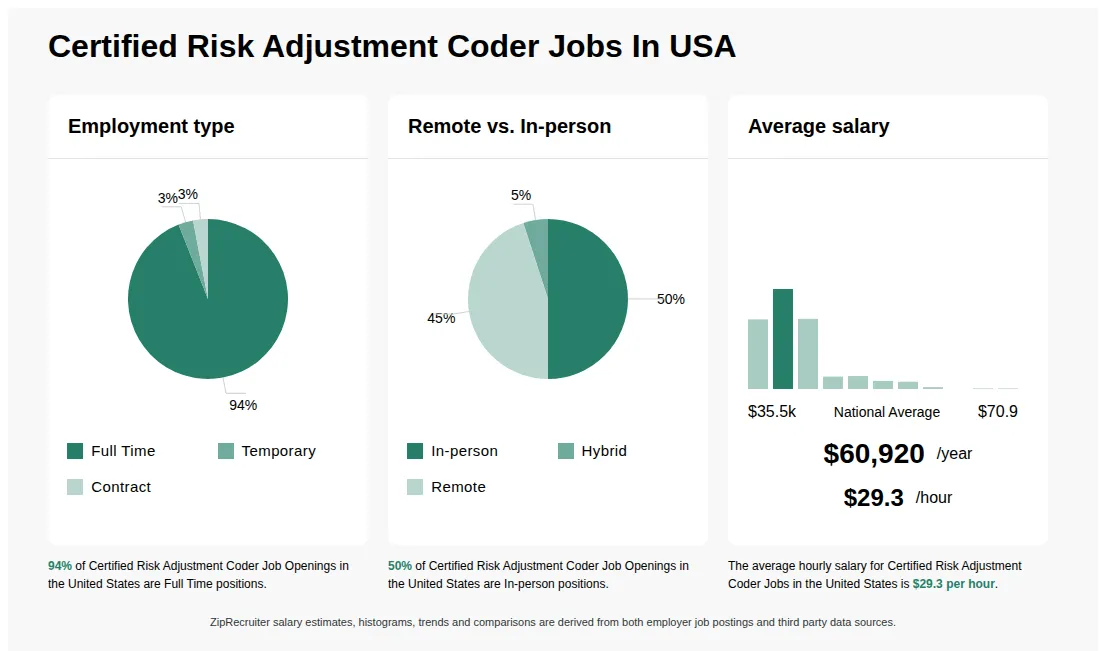
$21.91 is the 25th percentile. Wages below this are outliers.
$17.07 - $21.96
25% of jobs
The median wage is $25.25 / hr.
$21.96 - $26.86
37% of jobs
$29.36 is the 75th percentile. Wages above this are outliers.
$26.86 - $31.75
25% of jobs
$31.75 - $36.65
4% of jobs
$36.65 - $41.54
4% of jobs
$41.54 - $46.44
2% of jobs
$46.44 - $51.33
2% of jobs
$51.33 - $56.23
0% of jobs
$56.23 - $61.12
0% of jobs
$61.12 - $66.02
0% of jobs
$66.02 - $70.91
0% of jobs
$17
$29
$70
| Aspect | Certified Risk Adjustment Coder | Certified Medical Coder |
|---|---|---|
| Certifications | Requires risk adjustment-specific credentials like RAC, CRC, or CPC-R | Requires CPC or CCS certifications |
| Work Environment | Primarily in health insurance, risk adjustment, and payer settings | Hospitals, clinics, physician offices, and outpatient facilities |
| Industry Usage | Used mainly in health insurance and risk adjustment programs | Used across healthcare providers for medical coding and billing |
The Certified Risk Adjustment Coder specializes in coding for risk adjustment programs within health insurance, focusing on accurate documentation for reimbursement. In contrast, the Certified Medical Coder works across various healthcare settings, primarily coding diagnoses and procedures for billing. While both roles require coding certifications, their focus areas and work environments differ significantly.
Cities with the most Certified Risk Adjustment Coder job openings:
The top employers for Certified Risk Adjustment Coder jobs are:
States with the most job openings for Certified Risk Adjustment Coder jobs include:
For Certified Risk Adjustment Coder jobs, the most frequently searched job titles are:

Hialeah, FL • On-site
$20.50 - $27.75/hr
Full-time
Medical, Life, Retirement, PTO
Re-posted 2 days ago
Reviews medical records to ensure diagnosis codes are documented for accurate HCC assignment.
Queries physicians and provides feedback to improve documentation accuracy for risk adjustment coding.
Completes patient medical chart reviews within 24-48 hours of visit completion.

Sourced by ZipRecruiter
Hospitals
1,001 - 5,000 Employees
Miami Beach, FL, US
1949