Company Description Neurable is a funded brain-computer interface (BCI) startup spun out of the University of Michigan's Direct to Brain Interface Laboratory (UM-DBI); our technology, an artificial ...
Company Description Neurable is a funded brain-computer interface (BCI) startup spun out of the University of Michigan's Direct to Brain Interface Laboratory (UM-DBI); our technology, an artificial ...

Software Engineer Intern, BCI Applications
Austin, TX · On-site
$35/hr
The Brain Computer Interface (BCI) Applications Team is responsible for delivering a product that gives people with paralysis the ability to control computers, phones, gaming consoles, and robotic ...
Software Engineer Intern, BCI Applications
Austin, TX · On-site
$35/hr
The Brain Computer Interface (BCI) Applications Team is responsible for delivering a product that gives people with paralysis the ability to control computers, phones, gaming consoles, and robotic ...

Senior Director, Regulatory Affairs -- BCI Medical Devices
San Diego, CA · On-site
$159K - $210K/yr
This position involves overseeing regulatory strategies for new brain-computer interface (BCI) platform development and managing submissions to regulatory bodies. The ideal candidate will have at ...
Senior Director, Regulatory Affairs -- BCI Medical Devices
San Diego, CA · On-site
$159K - $210K/yr
This position involves overseeing regulatory strategies for new brain-computer interface (BCI) platform development and managing submissions to regulatory bodies. The ideal candidate will have at ...
Software Engineer, BCI Applications
Austin, TX · On-site
$150K - $281K/yr
The Brain Computer Interface (BCI) Applications Team is responsible for delivering a product that gives people with paralysis the ability to control computers, phones, and robotic arms with their ...
Software Engineer, BCI Applications
Austin, TX · On-site
$150K - $281K/yr
The Brain Computer Interface (BCI) Applications Team is responsible for delivering a product that gives people with paralysis the ability to control computers, phones, and robotic arms with their ...
Software Engineer, BCI Applications
Austin, TX · On-site
$150K - $281K/yr
The Brain Computer Interface (BCI) Applications Team is responsible for delivering a product that gives people with paralysis the ability to control computers, phones, and robotic arms with their ...
Software Engineer, BCI Applications
Austin, TX · On-site
$150K - $281K/yr
The Brain Computer Interface (BCI) Applications Team is responsible for delivering a product that gives people with paralysis the ability to control computers, phones, and robotic arms with their ...
Company Description Neurable is a funded brain-computer interface (BCI) startup spun out of the University of Michigan's Direct to Brain Interface Laboratory (UM-DBI); our technology, an artificial ...
Company Description Neurable is a funded brain-computer interface (BCI) startup spun out of the University of Michigan's Direct to Brain Interface Laboratory (UM-DBI); our technology, an artificial ...
Machine Learning
Cambridge, MA · On-site
Company Description Neurable is a funded brain-computer interface (BCI) startup spun out of the University of Michigan's Direct to Brain Interface Laboratory (UM-DBI); our technology, an artificial ...
Machine Learning
Cambridge, MA · On-site
Company Description Neurable is a funded brain-computer interface (BCI) startup spun out of the University of Michigan's Direct to Brain Interface Laboratory (UM-DBI); our technology, an artificial ...
Scientist - Translational Immunology
San Francisco, CA · On-site
$120K - $215K/yr
We're pursuing this goal by developingfundamentally new approaches to brain-computer interfaces that interact with the brain at high bandwidth, integrate with advanced AI, and are ultimately safe and ...
Scientist - Translational Immunology
San Francisco, CA · On-site
$120K - $215K/yr
We're pursuing this goal by developingfundamentally new approaches to brain-computer interfaces that interact with the brain at high bandwidth, integrate with advanced AI, and are ultimately safe and ...
Internship Program
New York, NY · On-site
$18.25 - $23.75/hr
Synaptrix is on a mission to revolutionize brain-computer interfaces through non-invasive approaches. We believe that the power to diagnose and treat neurological conditions safely, and to expand ...
Quick apply
Internship Program
New York, NY · On-site
$18.25 - $23.75/hr
Synaptrix is on a mission to revolutionize brain-computer interfaces through non-invasive approaches. We believe that the power to diagnose and treat neurological conditions safely, and to expand ...
Internship Program
New York, NY · On-site
$18.25 - $23.75/hr
Synaptrix is on a mission to revolutionize brain-computer interfaces through non-invasive approaches. We believe that the power to diagnose and treat neurological conditions safely, and to expand ...
Internship Program
New York, NY · On-site
$18.25 - $23.75/hr
Synaptrix is on a mission to revolutionize brain-computer interfaces through non-invasive approaches. We believe that the power to diagnose and treat neurological conditions safely, and to expand ...
Internship Program
$18.25 - $23.75/hr
Synaptrix is on a mission to revolutionize brain-computer interfaces through non-invasive approaches. We believe that the power to diagnose and treat neurological conditions safely, and to expand ...
Internship Program
$18.25 - $23.75/hr
Synaptrix is on a mission to revolutionize brain-computer interfaces through non-invasive approaches. We believe that the power to diagnose and treat neurological conditions safely, and to expand ...
Senior Quality Reliability Engineer
Addison, TX · On-site
$85K - $116K/yr
As a Precision employee, you'll join one of the fastest‑moving and best‑capitalized companies in the emerging field of brain-computer interfaces. Since our founding in 2021, we have raised more ...
Senior Quality Reliability Engineer
Addison, TX · On-site
$85K - $116K/yr
As a Precision employee, you'll join one of the fastest‑moving and best‑capitalized companies in the emerging field of brain-computer interfaces. Since our founding in 2021, we have raised more ...
Founding Machine Learning Engineer
San Francisco, CA · On-site
$225K - $275K/yr
Our translational brain computer interface and pioneering models decode emotion, putting experience and wellbeing at the center of every interaction. Our wearable BCI achieves fMRI-comparable ...
Founding Machine Learning Engineer
San Francisco, CA · On-site
$225K - $275K/yr
Our translational brain computer interface and pioneering models decode emotion, putting experience and wellbeing at the center of every interaction. Our wearable BCI achieves fMRI-comparable ...
$85K/yr
We are currently seeking a postdoctoral researcher to lead studies using brain-computer interface (BCI) tasks to study neural coding in the rodent cortex. This project is highly interdisciplinary and ...
$85K/yr
We are currently seeking a postdoctoral researcher to lead studies using brain-computer interface (BCI) tasks to study neural coding in the rodent cortex. This project is highly interdisciplinary and ...
Field Clinical Specialist
Manhattan, NY · On-site
$86K - $93K/yr
Hybrid · USD 140,000-160,000 / year New York, New York, United States Precision Neuroscience is building a next-generation brain-computer interface (BCI) to heal and empower millions of people ...
Field Clinical Specialist
Manhattan, NY · On-site
$86K - $93K/yr
Hybrid · USD 140,000-160,000 / year New York, New York, United States Precision Neuroscience is building a next-generation brain-computer interface (BCI) to heal and empower millions of people ...
Postdoctoral Researcher - Gonzales Lab
Nashville, TN · On-site
$112K/yr
We are currently seeking a postdoctoral researcher to lead studies using brain-computer interface (BCI) tasks to study neural coding in the rodent cortex. This project is highly interdisciplinary and ...
Postdoctoral Researcher - Gonzales Lab
Nashville, TN · On-site
$112K/yr
We are currently seeking a postdoctoral researcher to lead studies using brain-computer interface (BCI) tasks to study neural coding in the rodent cortex. This project is highly interdisciplinary and ...
Neuroengineer, Next Gen
South San Francisco, CA · On-site
$122K - $226K/yr
The Next Gen team at Neuralink is developing the next generation of brain-computer interfaces. We are laying the groundwork for intuitive, high-dimensional, and bidirectional interfaces between ...
Neuroengineer, Next Gen
South San Francisco, CA · On-site
$122K - $226K/yr
The Next Gen team at Neuralink is developing the next generation of brain-computer interfaces. We are laying the groundwork for intuitive, high-dimensional, and bidirectional interfaces between ...
Neuroengineer, Next Gen
Austin, TX · On-site
$122K - $226K/yr
The Next Gen team at Neuralink is developing the next generation of brain-computer interfaces. We are laying the groundwork for intuitive, high-dimensional, and bidirectional interfaces between ...
Neuroengineer, Next Gen
Austin, TX · On-site
$122K - $226K/yr
The Next Gen team at Neuralink is developing the next generation of brain-computer interfaces. We are laying the groundwork for intuitive, high-dimensional, and bidirectional interfaces between ...
Neuroengineer, Next Gen
Austin, TX · On-site
$122K - $226K/yr
The Next Gen team at Neuralink is developing the next generation of brain-computer interfaces. We are laying the groundwork for intuitive, high-dimensional, and bidirectional interfaces between ...
Neuroengineer, Next Gen
Austin, TX · On-site
$122K - $226K/yr
The Next Gen team at Neuralink is developing the next generation of brain-computer interfaces. We are laying the groundwork for intuitive, high-dimensional, and bidirectional interfaces between ...
The Brain Interfaces Soc Department delivers chip architecture and silicon implementation of neural recording and stimulation system-on-chip (SoC) for high-bandwidth brain-computer interfaces. We ...
The Brain Interfaces Soc Department delivers chip architecture and silicon implementation of neural recording and stimulation system-on-chip (SoC) for high-bandwidth brain-computer interfaces. We ...
Brain Computer Interface information
See salary details
$11.54 - $17.57
2% of jobs
$17.57 - $23.60
0% of jobs
$23.60 - $29.63
0% of jobs
$29.63 - $35.66
3% of jobs
$35.66 - $41.70
5% of jobs
$41.70 - $47.73
14% of jobs
$47.89 is the 25th percentile. Wages below this are outliers.
$47.73 - $53.76
28% of jobs
$53.76 - $59.79
18% of jobs
$61.76 is the 75th percentile. Wages above this are outliers.
$59.79 - $65.82
14% of jobs
$65.82 - $71.85
11% of jobs
$71.85 - $77.88
5% of jobs
$11
$54
$77
How much do brain computer interface jobs pay per hour?
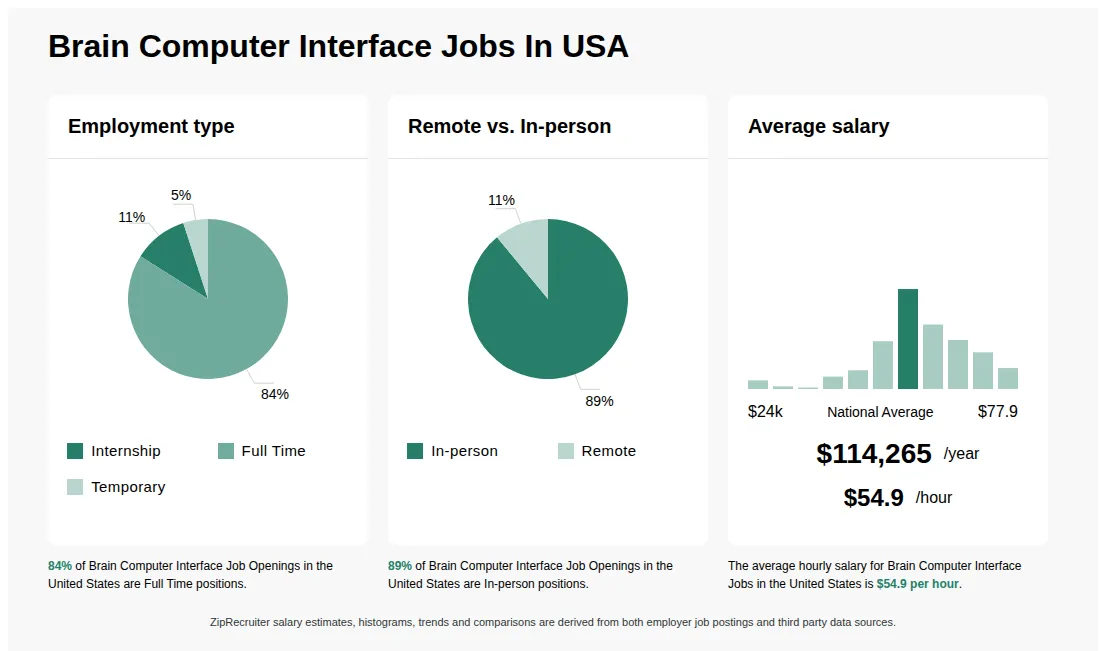
As of Sep 13, 2026, the average hourly pay for brain computer interface in the United States is $54.94, according to ZipRecruiter salary data. Most workers in this role earn between $48.08 and $62.50 per hour, depending on experience, location, and employer.
What is a brain computer interface?
A Brain-Computer Interface (BCI) job involves developing systems that enable direct communication between the brain and external devices. Professionals in this field work on hardware and software to interpret neural signals, often for medical, assistive, or neurotechnology applications. Roles can include research, software engineering, signal processing, and machine learning to improve BCIs' accuracy and functionality. These jobs are common in healthcare, neuroscience, gaming, and AI-driven human augmentation industries.
What are the key skills and qualifications needed to thrive in the brain computer interface position?
To thrive in a Brain Computer Interface role, you typically need a strong background in neuroscience, biomedical engineering, or computer science, coupled with experience in signal processing and neural data analysis. Familiarity with tools such as MATLAB, Python, EEG/MEG systems, and relevant certifications in neurotechnology are highly valuable. Strong problem-solving abilities, collaboration, and effective communication skills are essential for working on multidisciplinary teams and translating research into practical applications. These skills ensure that you can design, develop, and refine advanced BCI systems that meet both technical and user needs in this rapidly evolving field.
What are some common challenges faced by professionals working in brain computer interface roles?
Professionals in Brain Computer Interface roles often face challenges related to accurately interpreting complex neural signals, minimizing noise in data, and ensuring that BCI systems are intuitive for end-users. They frequently collaborate with neuroscientists, engineers, software developers, and clinicians to overcome technical and usability barriers. Balancing research innovation with real-world applicability can be demanding, and staying current with rapidly advancing technology is essential. These challenges make the field dynamic and rewarding for those passionate about shaping the future of human-computer interaction.
More about Brain Computer Interface jobs
What cities are hiring for Brain Computer Interface jobs?
Cities with the most Brain Computer Interface job openings:
What are the most commonly searched types of Brain Computer Interface jobs?
The most popular types of Brain Computer Interface jobs are:
What states have the most Brain Computer Interface jobs?
States with the most job openings for Brain Computer Interface jobs include:
What are popular job titles for Brain Computer Interface?
Popular job titles for Brain Computer Interface:

Software Developer
Cambridge, MA
Neurable, INC
• Computer and Electronic Product Manufacturing • 1 - 10 employees1 - 10 employees
Full-time
Re-posted 5 days ago
Job description
Company Description
Neurable is a funded brain-computer interface (BCI) startup spun out of the University of Michigan's Direct to Brain Interface Laboratory (UM-DBI); our technology, an artificial intelligence developed by our CEO Ramses Alcaide, BCI expert and PhD neuroscience, enables people to control hardware and software in real-time with their brain via a non-invasive cap. We have enabled users to control remote control cars, computer programs, wheelchairs, and more. Currently we are directing Neurable for virtual and augmented reality applications.
Job Description
Our ideal candidate is someone who likes to think outside of the box. Here we try to encourage as much creative thought and innovative thinking possible. We are working in a field and creating a technology with functionalities that have never existed before. If you like tinkering, are curious by nature, consider yourself a technologist or someone who thinks several steps ahead...we would like you to join us, or at least meet us, or come to our office and play some video games (we have all the latest VR/AR technology). We are a small group adding to the banality of "work hard, play hard" but only because it is true.
Duties:
Your main responsibility will be to translate python code to C++ for inclusion into our API, parsing brain data, and you will be working on research and development (i.e. testing and tweaking our Unity demo applications).
Company aside, we thoroughly enjoy:
- Fine food and beverages
- Movies and shows (during Game of Thrones season, our CEO Ramses, also a near chef, cooks everyone dinner while we watch on his 12' by 21' projector screen)
- Video games (we own every console from the ColecoVision, 1982, to the latest in virtual reality systems)
- Adventures (ask us about what happened one fateful night on Mt. Nacheesmo)
- Dogs (we have two in our office)
Qualifications
- Design, build, test, and maintain efficient, reusable, and reliable C++ code
- Help maintain code quality, organization, and automatization
- Fluency in: C/C++, Python, C#/Unity, Matlab (preferred)
- Familiarity with developing apps in Unity and Qt
- Python with numpy and pandas libraries
- Strong written communication and documentation abilities
- Comfortable in a small, intense, and high-growth environment
- Ability to rapidly prototype real features in a startup environment
- You know and can admit when something is not great. You can recognize that something needs improvement
- Creativity and desire to push boundaries
- Desire to create a positive change in the world
- Experience with Machine Learning, Computer Vision, Signals Processing preferred
- Experience with startups, brain-computer interface, and AR/VR applications are preferred
- Must be authorized to work in the United States
Additional Information
All your information will be kept confidential according to EEO guidelines.

About Neurable
Sourced by ZipRecruiter
Industry
Computer and electronic product manufacturing
Company size
1 - 10 Employees
Headquarters location
Cambridge, MA, US
Year founded
2015