As a Research Engineer - Brain Computer Interface Models , you will be a core contributor to Zyphra's BCI work, building the next generation of open-source EEG and brain-computer interface models.
Quick apply
As a Research Engineer - Brain Computer Interface Models , you will be a core contributor to Zyphra's BCI work, building the next generation of open-source EEG and brain-computer interface models.
Quick apply
As a Research Engineer - Brain Computer Interface Models , you will be a core contributor to Zyphra's BCI work, building the next generation of open-source EEG and brain-computer interface models.
As a Research Engineer - Brain Computer Interface Models , you will be a core contributor to Zyphra's BCI work, building the next generation of open-source EEG and brain-computer interface models.
As a Research Engineer - Brain Computer Interface Models , you will be a core contributor to Zyphra's BCI work, building the next generation of open-source EEG and brain-computer interface models.
Austin, TX · On-site
$35/hr
As a Mechanical Engineering Intern, you will support the design and production of hardware solutions for our brain-computer interface devices, including components for surgical robotics, automation ...
Austin, TX · On-site
$35/hr
As a Mechanical Engineering Intern, you will support the design and production of hardware solutions for our brain-computer interface devices, including components for surgical robotics, automation ...
Austin, TX · On-site
$35/hr
As a Mechanical Engineering Intern, you will support the design and production of hardware solutions for our brain-computer interface devices, including components for surgical robotics, automation ...
Austin, TX · On-site
$35/hr
As a Mechanical Engineering Intern, you will support the design and production of hardware solutions for our brain-computer interface devices, including components for surgical robotics, automation ...
Austin, TX · On-site
$47K/yr
Design and independently conduct brain-computer interface (BCI) experiments. * Collect electroencephalogram (EEG) and other physiological data. * Maintain accurate records of experimental procedures ...
Austin, TX · On-site
$47K/yr
Design and independently conduct brain-computer interface (BCI) experiments. * Collect electroencephalogram (EEG) and other physiological data. * Maintain accurate records of experimental procedures ...
Salt Lake City, UT · On-site
$100 - $125/hr
This role involves leadership in areas like Brain-Computer Interfaces and Bionics and includes diverse departmental collaboration. Candidates will need a Ph.D., Sc.D., or M.D., with a robust research ...
Salt Lake City, UT · On-site
$100 - $125/hr
This role involves leadership in areas like Brain-Computer Interfaces and Bionics and includes diverse departmental collaboration. Candidates will need a Ph.D., Sc.D., or M.D., with a robust research ...
Los Angeles, CA · On-site
$68K/yr
Projects may include developing and testing novel brain-computer interface (BCI) systems, conducting neuroimaging analyses (MRI, EEG, fNIRS), and designing experimental and clinical studies to ...
Los Angeles, CA · On-site
$68K/yr
Projects may include developing and testing novel brain-computer interface (BCI) systems, conducting neuroimaging analyses (MRI, EEG, fNIRS), and designing experimental and clinical studies to ...
Projects may include developing and testing novel brain-computer interface (BCI) systems, conducting neuroimaging analyses (MRI, EEG, fNIRS), and designing experimental and clinical studies to ...
Projects may include developing and testing novel brain-computer interface (BCI) systems, conducting neuroimaging analyses (MRI, EEG, fNIRS), and designing experimental and clinical studies to ...
Projects may include developing and testing novel brain-computer interface (BCI) systems, conducting neuroimaging analyses (MRI, EEG, fNIRS), and designing experimental and clinical studies to ...
Projects may include developing and testing novel brain-computer interface (BCI) systems, conducting neuroimaging analyses (MRI, EEG, fNIRS), and designing experimental and clinical studies to ...
Los Angeles, CA · On-site
$68K/yr
Projects may include developing and testing novel brain-computer interface (BCI) systems, conducting neuroimaging analyses (MRI, EEG, fNIRS), and designing experimental and clinical studies to ...
Los Angeles, CA · On-site
$68K/yr
Projects may include developing and testing novel brain-computer interface (BCI) systems, conducting neuroimaging analyses (MRI, EEG, fNIRS), and designing experimental and clinical studies to ...
San Francisco, CA · On-site
Our translational brain computer interface and pioneering models decode emotion, putting experience and wellbeing at the center of every interaction. Our wearable BCI achieves fMRI-comparable ...
San Francisco, CA · On-site
Our translational brain computer interface and pioneering models decode emotion, putting experience and wellbeing at the center of every interaction. Our wearable BCI achieves fMRI-comparable ...
South San Francisco, CA · On-site
$35/hr
The Brain Computer Interface (BCI) Applications Team is responsible for delivering a product that gives people with paralysis the ability to control computers, phones, gaming consoles, and robotic ...
South San Francisco, CA · On-site
$35/hr
The Brain Computer Interface (BCI) Applications Team is responsible for delivering a product that gives people with paralysis the ability to control computers, phones, gaming consoles, and robotic ...
Austin, TX · On-site
$35/hr
The Brain Computer Interface (BCI) Applications Team is responsible for delivering a product that gives people with paralysis the ability to control computers, phones, gaming consoles, and robotic ...
Austin, TX · On-site
$35/hr
The Brain Computer Interface (BCI) Applications Team is responsible for delivering a product that gives people with paralysis the ability to control computers, phones, gaming consoles, and robotic ...
The Brain Computer Interface (BCI) Applications Team is responsible for delivering a product that gives people with paralysis the ability to control computers, phones, and robotic arms with their ...
The Brain Computer Interface (BCI) Applications Team is responsible for delivering a product that gives people with paralysis the ability to control computers, phones, and robotic arms with their ...
Cambridge, MA · On-site
Company Description Neurable is a funded brain-computer interface (BCI) startup spun out of the University of Michigan's Direct to Brain Interface Laboratory (UM-DBI); our technology, an artificial ...
Cambridge, MA · On-site
Company Description Neurable is a funded brain-computer interface (BCI) startup spun out of the University of Michigan's Direct to Brain Interface Laboratory (UM-DBI); our technology, an artificial ...
South San Francisco, CA · On-site
$35/hr
The Brain Computer Interface (BCI) Applications Team is responsible for delivering a product that gives people with paralysis the ability to control computers, phones, gaming consoles, and robotic ...
South San Francisco, CA · On-site
$35/hr
The Brain Computer Interface (BCI) Applications Team is responsible for delivering a product that gives people with paralysis the ability to control computers, phones, gaming consoles, and robotic ...
San Francisco, CA · On-site
$100 - $125/hr
We're pursuing this goal by developing fundamentally new approaches to brain-computer interfaces that interact with the brain at high bandwidth, integrate with advanced AI, and are ultimately safe ...
San Francisco, CA · On-site
$100 - $125/hr
We're pursuing this goal by developing fundamentally new approaches to brain-computer interfaces that interact with the brain at high bandwidth, integrate with advanced AI, and are ultimately safe ...
Cambridge, MA · On-site
Company Description Neurable is a funded brain-computer interface (BCI) startup spun out of the University of Michigan's Direct to Brain Interface Laboratory (UM-DBI); our technology, an artificial ...
Cambridge, MA · On-site
Company Description Neurable is a funded brain-computer interface (BCI) startup spun out of the University of Michigan's Direct to Brain Interface Laboratory (UM-DBI); our technology, an artificial ...
Austin, TX · On-site
$35/hr
The Brain Computer Interface (BCI) Applications Team is responsible for delivering a product that gives people with paralysis the ability to control computers, phones, gaming consoles, and robotic ...
Austin, TX · On-site
$35/hr
The Brain Computer Interface (BCI) Applications Team is responsible for delivering a product that gives people with paralysis the ability to control computers, phones, gaming consoles, and robotic ...
Austin, TX · On-site
$150K - $281K/yr
The Brain Computer Interface (BCI) Applications Team is responsible for delivering a product that gives people with paralysis the ability to control computers, phones, and robotic arms with their ...
Austin, TX · On-site
$150K - $281K/yr
The Brain Computer Interface (BCI) Applications Team is responsible for delivering a product that gives people with paralysis the ability to control computers, phones, and robotic arms with their ...
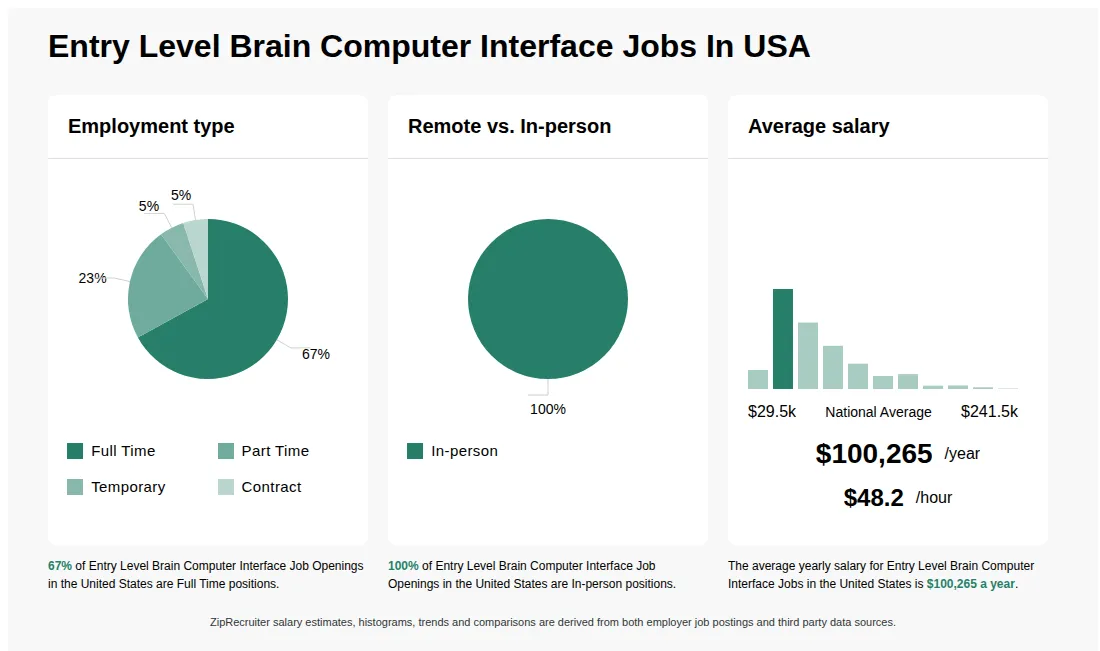
$29.5K - $48.8K
6% of jobs
$58.8K is the 25th percentile. Wages below this are outliers.
$48.8K - $68K
36% of jobs
The median wage is $74.6K / yr.
$68K - $87.3K
23% of jobs
$100.1K is the 75th percentile. Wages above this are outliers.
$87.3K - $106.6K
15% of jobs
$106.6K - $125.9K
8% of jobs
$125.9K - $145.1K
4% of jobs
$145.1K - $164.4K
5% of jobs
$164.4K - $183.7K
1% of jobs
$183.7K - $203K
1% of jobs
$203K - $222.2K
0% of jobs
$222.2K - $241.5K
0% of jobs
$29.5K
$100.3K
$241.5K
| Aspect | Entry Level Brain Computer Interface | Entry Level Neural Engineer |
|---|---|---|
| Required Credentials | Bachelor's in neuroscience, engineering, or related field; basic understanding of signal processing | Bachelor's in biomedical engineering, neuroscience, or related; knowledge of neural systems and data analysis |
| Work Environment | Research labs, tech companies, healthcare settings | Research institutions, biotech firms, medical device companies |
| Industry Usage | Developing BCI devices, signal acquisition, and processing | Designing neural interfaces, analyzing neural data, device integration |
While both roles involve working with neural data and require backgrounds in neuroscience or engineering, Entry Level Brain Computer Interface positions focus on developing and implementing BCI technologies, whereas Entry Level Neural Engineers typically work on designing neural systems and analyzing neural signals. Both roles are essential in advancing neurotechnology and often overlap in skills and work environments.
Cities with the most Entry Level Brain Computer Interface job openings:
The most popular types of Brain Computer Interface jobs are:
States with the most job openings for Entry Level Brain Computer Interface jobs include:
The top searched job categories for Entry Level Brain Computer Interface jobs are:
San Francisco, CA • On-site
Full-time
Medical, Dental, Vision, Retirement, PTO
Re-posted 26 days ago
As a Research Engineer - Brain Computer Interface Models, you will be a core contributor to Zyphra’s BCI work, building the next generation of open-source EEG and brain–computer interface models. You will be involved across the full model lifecycle, from data collection and preprocessing to designing novel architectures and training methodologies.
You’ll Work Across:Large-scale EEG model training runs and evaluation
Architecture and training methodology ablations and innovations
Dataset collection and preprocessing for EEG and other BCI modalities
Performance optimization of the training stack
Integration of models into real-world BCI applications
Organized, methodical researcher who can take ownership of a project component, communicate their process clearly, and deliver a working module
Excellent communication and collaboration skills, with clean and concise coding practices
Strong implementation and prototyping skills, with comfort working across both research and engineering at scale
Ability to learn new domains quickly, orient oneself in the academic literature, and implement new ideas, creatively borrowing concepts from other modalities and applying them to EEG domain
Interest in neural data such as EEG, MEG, fMRI as well as building foundation models in a much less explored space
Proficiency with PyTorch and Python
Experience with VAEs, GANs, diffusion models, and contrastive learning
Familiarity with signal processing (especially for EEG) and time-series analysis
Experience training on large-scale (multi-node) GPU clusters
Experience contributing to large existing codebases and ramping up quickly
Previously published machine learning research in well-respected venues
Our research methodology is grounded in methodical, step-by-step approaches to ambitious goals. Both deep research and engineering excellence are equally valued
We strongly value new and crazy ideas and are very willing to bet big on new ideas
We move as quickly as we can; we aim to minimize the bar to impact as low as possible
We all enjoy what we do and love discussing AI
Comprehensive medical, dental, vision, and FSA plans
Competitive compensation and 401(k) plan
Relocation and immigration support on a case-by-case basis
In-office snacks and meals provided
Unlimited PTO and company holidays
In-person team in San Francisco with a collaborative, high-energy environment