Engineering Co-op: MuReva
$97K - $128K/yr
Must be a Sophomore, Junior, or Senior engineering student pursuing a degree in Mechanical or Biomedical Engineering. * Available for either the Spring 2026, Summer 2026, Fall 2026 semester and be ...
$97K - $128K/yr
Must be a Sophomore, Junior, or Senior engineering student pursuing a degree in Mechanical or Biomedical Engineering. * Available for either the Spring 2026, Summer 2026, Fall 2026 semester and be ...
$97K - $128K/yr
Must be a Sophomore, Junior, or Senior engineering student pursuing a degree in Mechanical or Biomedical Engineering. * Available for either the Spring 2026, Summer 2026, Fall 2026 semester and be ...
Sunnyvale, CA · On-site
$20 - $25/hr
Semester or Summer Internship (12-16 weeks, flexible) Hours: 10-30 hours/week Compensation: Paid or ... Biomedical Engineering * Bioinformatics * Health Informatics * Cognitive Science * Human Biology ...
Quick apply
Sunnyvale, CA · On-site
$20 - $25/hr
Semester or Summer Internship (12-16 weeks, flexible) Hours: 10-30 hours/week Compensation: Paid or ... Biomedical Engineering * Bioinformatics * Health Informatics * Cognitive Science * Human Biology ...
... Begin Summer/Fall 2026 Details Assistant/Associate Professor or Professor Department of ... The Department of Biomedical Engineering is among the nation's most established programs and ...
... Begin Summer/Fall 2026 Details Assistant/Associate Professor or Professor Department of ... The Department of Biomedical Engineering is among the nation's most established programs and ...
... Begin Summer/Fall 2026 Details Assistant/Associate Professor or Professor Department of ... The Department of Biomedical Engineering is among the nation's most established programs and ...
... Begin Summer/Fall 2026 Details Assistant/Associate Professor or Professor Department of ... The Department of Biomedical Engineering is among the nation's most established programs and ...
Brecksville, OH · On-site
Must be a Sophomore, Junior, or Senior engineering student pursuing a degree in Mechanical or Biomedical Engineering. * Available for either the Spring 2026, Summer 2026, Fall 2026 semester and be ...
Brecksville, OH · On-site
Must be a Sophomore, Junior, or Senior engineering student pursuing a degree in Mechanical or Biomedical Engineering. * Available for either the Spring 2026, Summer 2026, Fall 2026 semester and be ...
Villanova, PA · On-site
$105K/yr
The position starts as early as Summer 2023. Minimum Qualifications: * Ph.D. in biomedical engineering, chemical engineering, chemistry, or similar field required. * Expertise in polymers from a ...
Villanova, PA · On-site
$105K/yr
The position starts as early as Summer 2023. Minimum Qualifications: * Ph.D. in biomedical engineering, chemical engineering, chemistry, or similar field required. * Expertise in polymers from a ...
... of Biomedical Engineering (BME). The expected start date is the Fall 2026 semester. The position is a calendar year appointment and can include teaching responsibilities during the summer.
... of Biomedical Engineering (BME). The expected start date is the Fall 2026 semester. The position is a calendar year appointment and can include teaching responsibilities during the summer.
Glassboro, NJ · On-site
... Science programming at Rowan University. The Department of Biological & Biomedical Sciences is ... year and summer term; the balance of workload credits, including teaching and program-related ...
Glassboro, NJ · On-site
... Science programming at Rowan University. The Department of Biological & Biomedical Sciences is ... year and summer term; the balance of workload credits, including teaching and program-related ...
Houston, TX · On-site
$3.4K - $4.3K/wk
Our Summer Associate Program is designed to give law students a full picture of the firm. As a ... Biomedical Engineering, Computer Science, Engineering, Pharmacy, etc.) * Superior academic ...
Houston, TX · On-site
$3.4K - $4.3K/wk
Our Summer Associate Program is designed to give law students a full picture of the firm. As a ... Biomedical Engineering, Computer Science, Engineering, Pharmacy, etc.) * Superior academic ...
Currently enrolled in an undergraduate or graduate Engineering program with at least two years completed; preferably in Biomedical Engineering * Ability to work at least 15 hours per week in the lab ...
Currently enrolled in an undergraduate or graduate Engineering program with at least two years completed; preferably in Biomedical Engineering * Ability to work at least 15 hours per week in the lab ...
Glassboro, NJ · On-site
... Science programming at Rowan University. The Department of Biological & Biomedical Sciences is ... year and summer term; the balance of workload credits, including teaching and program-related ...
Glassboro, NJ · On-site
... Science programming at Rowan University. The Department of Biological & Biomedical Sciences is ... year and summer term; the balance of workload credits, including teaching and program-related ...
We are seeking a Summer Intern who will support project-based analytical work for executive ... Background in life sciences, biology, biochemistry, biomedical engineering, pharmacy, or a related ...
We are seeking a Summer Intern who will support project-based analytical work for executive ... Background in life sciences, biology, biochemistry, biomedical engineering, pharmacy, or a related ...
We are seeking a Summer Intern who will support project-based analytical work for executive ... Background in life sciences, biology, biochemistry, biomedical engineering, pharmacy, or a related ...
We are seeking a Summer Intern who will support project-based analytical work for executive ... Background in life sciences, biology, biochemistry, biomedical engineering, pharmacy, or a related ...
New York, NY · On-site
$135K - $175K/yr
S.) or Masters Degree in Mechanical or Biomedical Engineering NICE TO HAVES: * Solidworks CAD ... Year round early "summer Fridays" * WiFi enabled rooftop
New York, NY · On-site
$135K - $175K/yr
S.) or Masters Degree in Mechanical or Biomedical Engineering NICE TO HAVES: * Solidworks CAD ... Year round early "summer Fridays" * WiFi enabled rooftop
New York, NY · On-site
$135K - $175K/yr
S.) or Masters Degree in Mechanical or Biomedical Engineering NICE TO HAVES: * Solidworks CAD ... Year round early "summer Fridays" * WiFi enabled rooftop
New York, NY · On-site
$135K - $175K/yr
S.) or Masters Degree in Mechanical or Biomedical Engineering NICE TO HAVES: * Solidworks CAD ... Year round early "summer Fridays" * WiFi enabled rooftop
Austin, TX · On-site
$13/hr
... Biomedical Engineering major for at least six (6) credit hours or more in the long semester/term employed and zero (0) credit hours in summer if enrolled in six or more in the prior spring * Good ...
Austin, TX · On-site
$13/hr
... Biomedical Engineering major for at least six (6) credit hours or more in the long semester/term employed and zero (0) credit hours in summer if enrolled in six or more in the prior spring * Good ...
Piscataway, NJ · On-site
$14.25 - $18/hr
Employee discount programs Posting Summary Freeman Lab is seeking for a summer assistant to aid with laboratory-based engineering and biomedical engineering research activities related to virtual ...
Piscataway, NJ · On-site
$14.25 - $18/hr
Employee discount programs Posting Summary Freeman Lab is seeking for a summer assistant to aid with laboratory-based engineering and biomedical engineering research activities related to virtual ...
... technologies, biomedical systems and devices, wireless and telephonic communications ... Patent bar eligible with a bachelor's degree in electrical engineering, physics, computer ...
... technologies, biomedical systems and devices, wireless and telephonic communications ... Patent bar eligible with a bachelor's degree in electrical engineering, physics, computer ...
... technologies, biomedical systems and devices, wireless and telephonic communications ... Patent bar eligible with a bachelor's degree in electrical engineering, physics, computer ...
... technologies, biomedical systems and devices, wireless and telephonic communications ... Patent bar eligible with a bachelor's degree in electrical engineering, physics, computer ...
Applications are being accepted for two Research Assistant positions beginning Summer 2026, working ... BA, BS, or Master's degree in neuroscience, engineering, psychology, cognitive science, biomedical ...
Applications are being accepted for two Research Assistant positions beginning Summer 2026, working ... BA, BS, or Master's degree in neuroscience, engineering, psychology, cognitive science, biomedical ...
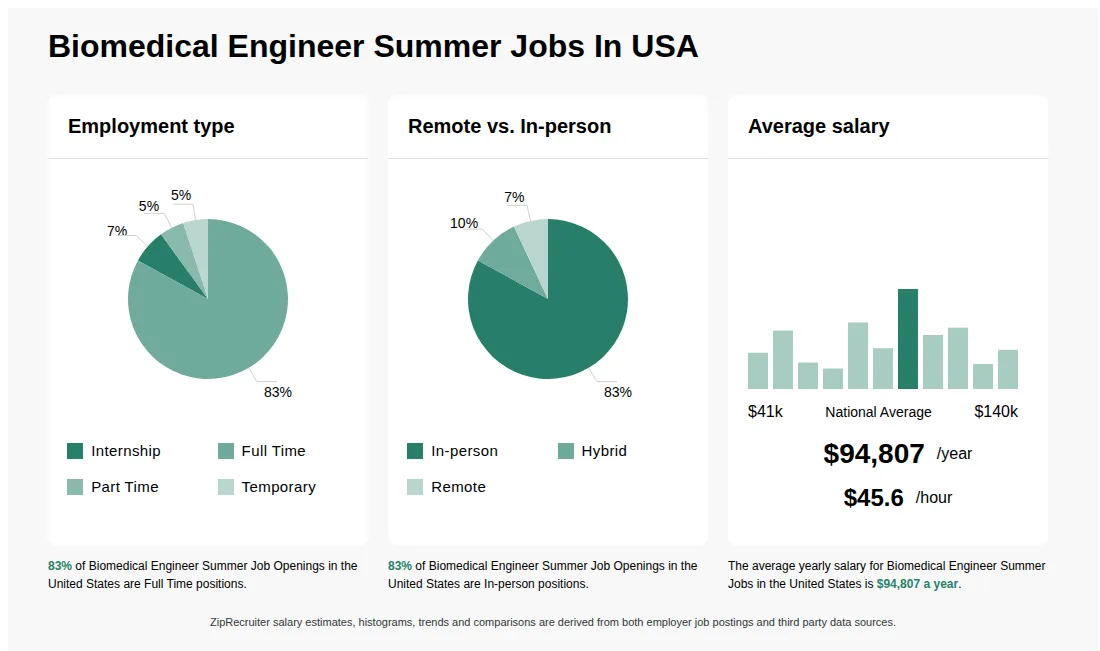
$41K - $50K
6% of jobs
$50K - $59K
12% of jobs
$59K - $68K
5% of jobs
$72.5K is the 25th percentile. Wages below this are outliers.
$68K - $77K
3% of jobs
$77K - $86K
13% of jobs
$86K - $95K
7% of jobs
The median wage is $96.5K / yr.
$95K - $104K
19% of jobs
$111.7K is the 75th percentile. Wages above this are outliers.
$104K - $113K
11% of jobs
$113K - $122K
12% of jobs
$122K - $131K
4% of jobs
$131K - $140K
7% of jobs
$41K
$94.8K
$140K
| Aspect | Biomedical Engineer Summer | Biomedical Technician |
|---|---|---|
| Required Credentials | Typically pursuing or holding a bachelor's degree in biomedical engineering or related field | Usually holds an associate degree or certification in biomedical technology or related area |
| Work Environment | Research labs, hospitals, or industry settings during summer internships | Hospitals, clinics, or repair facilities for medical equipment maintenance |
| Employer & Industry Usage | Internship programs, research projects, or industry training | Medical device companies, hospitals, or clinics for equipment servicing |
Biomedical Engineer Summer roles focus on gaining experience in research, design, and development of medical devices, often as internships. Biomedical Technicians primarily maintain, repair, and troubleshoot medical equipment. Both roles are essential in healthcare but differ in responsibilities, credentials, and work settings.
The qualifications you need to get a biomedical engineer summer job vary. A summer internship is typically geared specifically toward students who are actively enrolled as an undergraduate in a biology, medical, or biomedical engineering department. Other roles are for master’s or Ph.D. students who are completing their studies and need more experience or want to investigate industry operations before applying for full-time positions. You should have excellent research and analytical skills, and be able to provide a copy of your student transcript as well as letters of recommendation.
Description
MuReva Phototherapy was established in 2018 and is committed to changing the way physicians approach cancer treatment by addressing key dose limiting side-effects for which there are currently only palliative solutions such as opioids. MuReva aims to not only improve patient outcomes, but also significantly increase patient quality of life while saving healthcare costs. MuReva Phototherapy spun-off from its parent company, Lumitex, a leader in fiber-optic lighting technologies, to focus on developing a patient-friendly approach for delivering phototherapy treatment. With the assistance of $1.7M in grant funding from the National Institutes of Health and an additional $5M+ in private funding, MuReva Phototherapy has developed a new light transmission modality to overcome the current barriers that have prevented its mainstream adoption.
At MuReva Phototherapy, we are looking for passionate, flexible, action orientated, and collaborative engineering students that are looking for an exciting and diversified co-op experience!
Under the direction of an experience Engineer, our Co-ops will be provided with exposure to multiple areas of engineering including design, manufacturing, testing, and prototyping. They will be challenged and trusted to manage projects as they assist our Engineering Team.
The Co-op experience with MuReva Phototherapy includes:
You will work with our Engineering Team to develop traits and skills that are essential for every engineer, such as attention to details, accountability, risk management, test planning, data analysis, technical writing, and effective presentation skills.
Requirements
For more information, please visit us at www.murevapt.com

Sourced by ZipRecruiter
Electrical equipment, appliance, and component manufacturing
51 - 200 Employees
Strongsville, OH, US
1985