1

Autopsy Assistant Jobs (NOW HIRING)

Summary The Autopsy Technician will assist the Forensic Pathologist in the performance of autopsies, including preparation of the body for autopsy, photography, directly supervised dissections ...

Autopsy Pathologist The Department of Pathology and Laboratory Medicine at Emory University School of Medicine is seeking a full-time non-tenure track Autopsy Pathologist at the rank of Assistant ...

... of Assistant, Associate, or Full Professor to provide autopsy coverage, as Director of the Autopsy Service, at Emory University Hospital and Emory University Hospital Midtown, a large academic ...

Showing results 21-40

Autopsy Assistant information

See salary details

$12

$19

$26

How much do autopsy assistant jobs pay per hour?

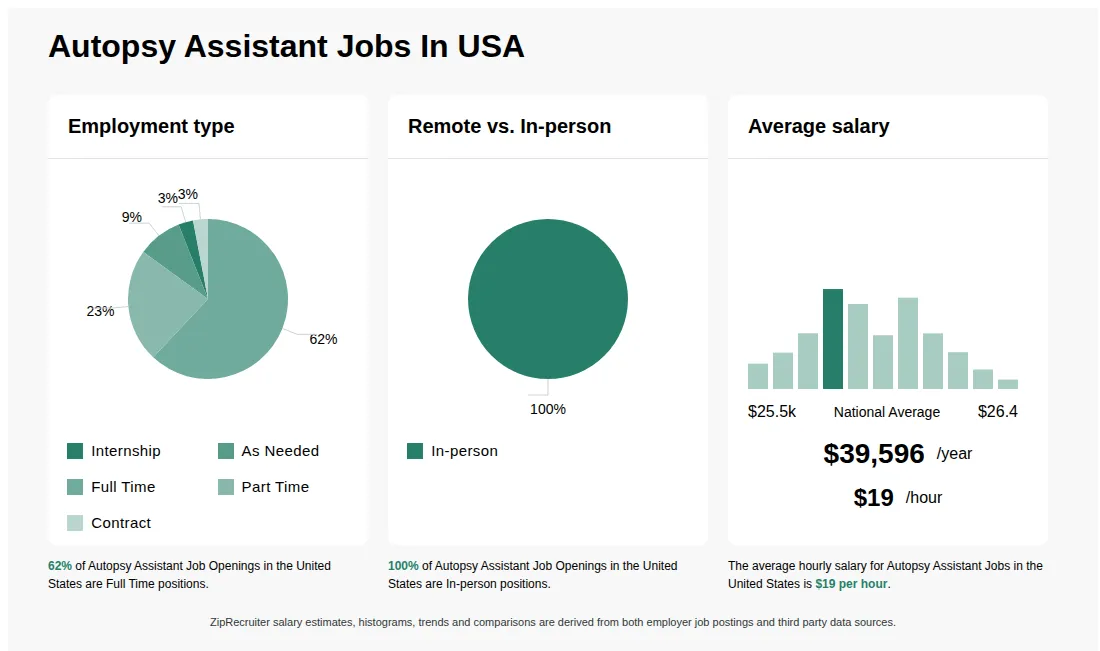
As of Sep 14, 2026, the average hourly pay for autopsy assistant in the United States is $19.04, according to ZipRecruiter salary data. Most workers in this role earn between $16.35 and $21.15 per hour, depending on experience, location, and employer.

What is an autopsy assistant?

An Autopsy Assistant helps forensic pathologists by preparing bodies, collecting specimens, and maintaining the morgue. They assist in examinations, document findings, and ensure proper handling of remains. This role requires attention to detail, knowledge of anatomy, and the ability to work in a clinical or forensic setting.

What does an autopsy assistant do?

A typical day for an Autopsy Assistant involves preparing the autopsy suite, assisting the pathologist during examinations, and handling specimens for lab analysis. You may be responsible for maintaining detailed records, cleaning and sterilizing equipment, and ensuring chain-of-custody protocols are followed. The role often requires collaboration with medical examiners, law enforcement, and laboratory staff. Due to the sensitive nature of the work, maintaining professionalism and discretion is essential throughout all responsibilities. Work schedules can vary, including on-call or weekend shifts depending on the facility.

What are the key skills and qualifications needed to thrive as an autopsy assistant?

To thrive as an Autopsy Assistant, you need foundational knowledge in anatomy, pathology, and safe laboratory practices, usually supported by an associate degree or relevant certification in mortuary science or a related field. Familiarity with autopsy instruments, evidence-handling protocols, and digital recordkeeping systems is often required. Exceptional attention to detail, communication skills, and emotional resilience help individuals excel in this role. These skills are crucial for maintaining accuracy, ensuring legal compliance, and working smoothly within multidisciplinary forensic or pathology teams.


How do I become an autopsy assistant?

To become an autopsy assistant, candidates typically need a high school diploma or equivalent, with some positions preferring post-secondary education in biology or a related field. Relevant skills include attention to detail, knowledge of anatomy, and familiarity with autopsy procedures; certification or training in forensic or medical assisting can also be beneficial. Experience working in a medical or laboratory environment may improve job prospects.

How long does it take to be an autopsy assistant?

Becoming an autopsy assistant typically requires completing a high school diploma or equivalent, followed by relevant post-secondary education such as a certificate or associate degree in mortuary science, forensic science, or a related field. Gaining experience through internships or on-the-job training is common, and the total time can range from several months to a few years depending on educational pathways and certification requirements.

What qualifications do you need to be an autopsy assistant?

Autopsy assistants typically need a high school diploma or equivalent, with some positions preferring post-secondary education in biology, anatomy, or forensic science. Relevant skills include attention to detail, familiarity with medical terminology, and the ability to work in a morgue environment; certification is not usually required but can enhance job prospects.
More about Autopsy Assistant jobs

What cities are hiring for Autopsy Assistant jobs?

Cities with the most Autopsy Assistant job openings:

What are the most commonly searched types of Autopsy jobs?

The most popular types of Autopsy jobs are:

What states have the most Autopsy Assistant jobs?

States with the most job openings for Autopsy Assistant jobs include:

What are popular job titles related to Autopsy Assistant jobs?

For Autopsy Assistant jobs, the most frequently searched job titles are:

Infographic showing various Autopsy Assistant job openings in the United States as of September 2026, with employment types broken down into 2% As Needed, 75% Full Time, 21% Part Time, and 2% Contract. Highlights an 97% Physical, 1% Hybrid, and 2% Remote job distribution, with an average salary of $39,596 per year, or $19 per hour.

Autopsy Technician

Lubbock, TX

$55K - $65K/yr

Full-time

Re-posted 15 days ago


Key responsibilities

  • Assist the Forensic Pathologist in performing autopsies, including body preparation, dissection, and cleaning.

  • Create labels, document evidence and property, and maintain chain of custody for all evidence, belongings, and biological specimens.

  • Support evidence collection, documentation, photography, and transfer of specimens or evidence as directed by the Forensic Pathologist.


Job description

Summary The Autopsy Technician will assist the Forensic Pathologist in the performance of autopsies, including preparation of the body for autopsy, photography, directly supervised dissections, cleaning and necessary paperwork. Essential Duties Must be able to create labels with appropriate case numbers as well as set up all necessary forms and materials as directed by the Forensic Pathologist. Appropriately document evidence/property to include change of custody form.

Proper knowledge of photography of human remains, personal belongings and evidence using appropriate labels as directed by the Forensic Pathologist. Assist Forensic Pathologist with evidence/property identification, documentation, transfer, and retention. Communicate professionally as a representative of Lubbock County Medical Examiner (LCME) with officials from all agencies, as well as any individuals involved in each investigation as directed by LCME.

Create a chain of custody and obtain transfer signatures for all evidence, personal belongings and biological specimens as directed by the Forensic Pathologist. Create and maintain necessary paperwork, scene photographs and evidence/personal belongings, Chain of Custody information for all deaths reported to LCME where such requirements are mandated by policy. Take and process X-Rays as directed by the Forensic Pathologist.

Assist with evisceration and specialized dissections, and other autopsy needs, as directed by the Forensic Pathologist. Close postmortem incisions, clean human remains and return to cooler as directed by the Forensic Pathologist. Secure remains for transport.

Meet mortuary transport at LCME and document arrival and identification of remains and evidence/belongings in the appropriate required fashion. Prepare autopsy forms and/or requisitions for specimen/evidence submission for testing/analysis. Facilitate transfer/submission of specimens/evidence using proper chain of custody transfer forms, as directed by the Forensic Pathologist.

Must be available for release and acceptance of bodies and comply with all necessary documentation and verification. Prepare and mail letters to the decedent's next of kin regarding property in the custody of the medical examiner's office and how they may obtain it. Perform Duties as they are assigned.

Position Requirements QUALIFICATION REQUIREMENTS: Associate degree with emphasis on the medical sciences such as chemistry or biology AND at least five (5) years of practical dissection experience in a medical or laboratory environment. Knowledge of: Medical terminology and human anatomy as related to morgue activities. Autopsy procedures and practices.

Safety procedures and practices in a morgue setting. Modern office/clerical practices, procedures and methods. Principle and procedures of record keeping.

Computer equipment to include word processing, databases, and a variety of software packages. English, spelling, and arithmetic. Unit's Standard Operating Procedure (SOP).

Department's casework software. Evidence collection and proper chain-of-custody techniques. Departmental policies and procedures.

Skill in: Autopsy procedures and practices, including evisceration. Using and caring of autopsy room equipment. Maintaining morgue cleanliness, inventory and equipment preventive maintenance with little or no supervision.

Recording and compiling material for reports. Effective verbal and written communication. Ability to: Work in morgue environment with daily contact with decedents, including those in a decomposed state.

Handle the psychological effects of death. Work effectively with pathologists in the conduction of autopsies and demonstrate lead responsibilities as necessary. Follow written directions and instructions and carry out departmental instructions.

Operate x-ray, dental x-ray, photographic, and fingerprinting equipment. Perform in a stressful environment, while maintaining a professional manner. Establish and maintain effective working relationships with departmental clientele, representatives of outside agencies, other County employees and officials, and the general public.

Supplemental Information PHYSICAL DEMANDS: Ability to lift/carry up to 75-100 pounds and maneuvering cadavers unassisted in excess of 200 pounds. Requires visual acuity, speech and hearing, hand and eye coordination, and manual dexterity necessary to operate laboratory equipment and basic office equipment and computer. Subject to standing, walking, sitting, repetitive motion, reaching, climbing stairs, bending, stooping, kneeling, crouching, crawling, pushing, pulling, balancing, client/customer contact, squatting to perform the essential functions.

At times requires driving and exposure to outdoor conditions. Subject to various biological/infectious, chemical, mechanical, electrical, explosive and radiation hazards in indoors/outdoors work, and exposure to fumes, noxious odors and toxic wastes. Daily contact with biohazardous materials.

Some exposure to high job stress. Must possess sufficient physical strength and emotional stability to work under adverse conditions. This job description is intended to be generic in nature.

It is not necessarily an exhaustive list of all duties and responsibilities. The essential duties, functions and responsibilities and overtime eligibility may vary based on the specific tasks assigned to the position. DISCLAIMER: The above description reflects the details considered necessary to describe the standard functions of this position and should not be constructed as a thorough description of all work requirements.

The characteristics of the work environment described are representative of those that an employee encounters while performing the essential functions of this job. Reasonable accommodations may be made to enable individuals with disabilities to perform the essential functions. Equal Employment Employer: Lubbock County will not discriminate in our employment practices based on an applicant's race, ethnicity, color, religion, sex, sexual orientation, gender identity, national origin, age, disability, genetic information or status as a protected veteran.