1

Autopsy Assistant Jobs (NOW HIRING)

The work is distinguished from the Autopsy Assistant by the additional core duties of field investigation, data collection, report writing, and interaction with witnesses and families. The Death ...

Pathologists' Assistant

Washington, DC · On-site

$80K - $120K/yr

Description Autopsy & Anatomic Pathology Services | Travel Opportunities | Growing Private Practice This is not a typical hospital Pathologists' Assistant role. If you enjoy working closely with ...

next page

Showing results 1-20

Autopsy Assistant information

See salary details

$12

$19

$26

How much do autopsy assistant jobs pay per hour?

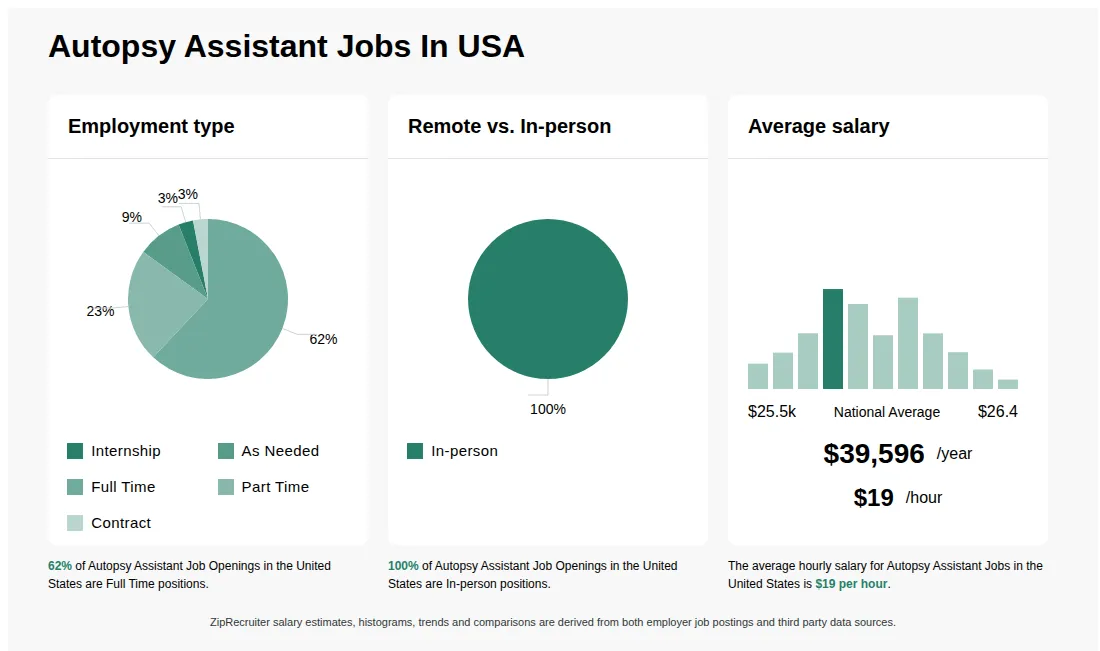
As of Jun 22, 2026, the average hourly pay for autopsy assistant in the United States is $19.04, according to ZipRecruiter salary data. Most workers in this role earn between $16.35 and $21.15 per hour, depending on experience, location, and employer.

What does an autopsy attendant do?

An autopsy attendant assists with the preparation and handling of bodies, setting up autopsy rooms, and supporting pathologists during examinations. They may also clean equipment, document procedures, and ensure the autopsy environment remains sterile and organized. This role often requires attention to detail, knowledge of safety protocols, and sometimes certification or training in mortuary practices.

How long does it take to be an autopsy assistant?

Becoming an autopsy assistant typically requires completing a high school diploma or equivalent, followed by relevant post-secondary education such as a certificate or associate degree in mortuary science, anatomy, or a related field. Gaining experience through internships or on-the-job training can take several months to a year, and some positions may require certification or licensure depending on the state or employer.

What is an Autopsy Assistant job?

An Autopsy Assistant helps forensic pathologists by preparing bodies, collecting specimens, and maintaining the morgue. They assist in examinations, document findings, and ensure proper handling of remains. This role requires attention to detail, knowledge of anatomy, and the ability to work in a clinical or forensic setting.

What does a typical workday look like for an Autopsy Assistant?

A typical day for an Autopsy Assistant involves preparing the autopsy suite, assisting the pathologist during examinations, and handling specimens for lab analysis. You may be responsible for maintaining detailed records, cleaning and sterilizing equipment, and ensuring chain-of-custody protocols are followed. The role often requires collaboration with medical examiners, law enforcement, and laboratory staff. Due to the sensitive nature of the work, maintaining professionalism and discretion is essential throughout all responsibilities. Work schedules can vary, including on-call or weekend shifts depending on the facility.

What are the key skills and qualifications needed to thrive in the Autopsy Assistant position, and why are they important?

To thrive as an Autopsy Assistant, you need foundational knowledge in anatomy, pathology, and safe laboratory practices, usually supported by an associate degree or relevant certification in mortuary science or a related field. Familiarity with autopsy instruments, evidence-handling protocols, and digital recordkeeping systems is often required. Exceptional attention to detail, communication skills, and emotional resilience help individuals excel in this role. These skills are crucial for maintaining accuracy, ensuring legal compliance, and working smoothly within multidisciplinary forensic or pathology teams.


How to become a coroner assistant with no experience?

To become a coroner assistant, relevant education such as a high school diploma or equivalent is typically required, along with strong organizational and communication skills. Gaining experience in medical or forensic environments, possibly through volunteering or internships, can improve prospects; some positions may require certification or training in death investigation procedures. Entry-level roles often involve assisting with administrative tasks and supporting forensic staff.

What qualifications do you need to be an autopsy assistant?

Autopsy assistants typically need a high school diploma or equivalent, with some positions preferring post-secondary education in biology, anatomy, or forensic science. Relevant skills include attention to detail, familiarity with medical terminology, and the ability to work in a morgue environment; certification is not usually required but can enhance job prospects.
More about Autopsy Assistant jobs
What cities are hiring for Autopsy Assistant jobs? Cities with the most Autopsy Assistant job openings:
What are the most commonly searched types of Autopsy jobs? The most popular types of Autopsy jobs are:
What states have the most Autopsy Assistant jobs? States with the most job openings for Autopsy Assistant jobs include:
Infographic showing various Autopsy Assistant job openings in the United States as of June 2026, with employment types broken down into 100% As Needed. Highlights an 98% Physical, 1% Hybrid, and 1% Remote job distribution, with an average salary of $39,596 per year, or $19 per hour.

Death Investigator

Clark County

Vancouver, WA • On-site

Full-time

Medical, Dental, Vision, Life, Retirement, PTO

Posted 10 days ago


Clark County (Nevada) rating

7.6

Company rating: 7.6 out of 10

Based on 37 frontline employees who took The Breakroom Quiz

387th of 659 rated public administrative organizations


Job description

Job Summary
The Death Investigator is responsible for the objective investigation of the circumstances of unnatural and/or unattended deaths. The work includes observing, evaluating, and documenting death scenes.
The work of the Death Investigator includes but is not limited to the use of digital photography; scene description (written summary and diagram); interviewing witnesses and others persons; collecting and summarizing information regarding the decedent from a variety of sources; lifting, loading, and transportation of human remains; and notification of next of kin. Death Investigators may be the first official to contact the family of the decedent and as such, are required to be sensitive and exhibit an understanding of the initial grieving process. The Death Investigator compiles the investigative information regarding the death and prepares an investigative report for review and approval by the Medical Examiner.
CLASSIFICATION DISTINCTIONS
This is a single level classification within the Medical Examiner's Office. The work supports the efforts of the Medical Examiner by assisting the Medical Examiner in death investigations and preparing investigative reports. The work is distinguished from the Autopsy Assistant by the additional core duties of field investigation, data collection, report writing, and interaction with witnesses and families. The Death Investigator, on an as needed basis rather than as a routine component of the work, provides assistance with autopsies.
Our department values our community's diversity and seeks ways to promote equity and inclusion within the organization and with the public. We also encourage applications from candidates with knowledge, ability and experience working with a broad range of individuals and communities with diverse racial, ethnic, and socio-economic backgrounds.
This is a full-time represented position represented by Local 8.
Qualifications
Experience and Training:
An Associate's Degree is required with work experience performing criminal, civil, and/or death investigations. A Bachelor's Degree is preferred with work experience performing criminal, civil, and/or death investigations. Any equivalent combination of education or experience in medical, criminal justice, or related fields that would demonstrate the ability to perform the requirements of the position will be considered.
Special Requirements:
Possession of a valid driver's license unrestricted except as to vision from state of residence and evidence of a safe driving record.
Successfully pass a background investigation (including a criminal records check and fingerprinting), drug screen, physical abilities test, and psychological examination.
Carry an employer-issued cell phone and pager while on shift.
Work as a team member and independently utilize strong decision making and critical thinking skills that are within the scope of this position.
Work variable shifts to include: nights, afternoons, days, holidays, weekends, and emergency situations. May be on on-call status 24 hours a day, 7 days a week.
Must possess or attain American Board of Medicolegal Death Investigator (ABMDI) Registry Certification within 24 months of date of appointment to position.
Knowledge of: interviewing, criminal investigation and identification procedures and techniques; methods, practices, equipment and procedures involved in handling human remains; human anatomy and physiological functions of the human body; data collection, report writing principles; procedures necessary to prepare a body for autopsy and to assist during an autopsy; pertinent federal, state and local laws, codes, and regulations.
Ability to: communicate clearly and effectively both orally and in writing; prepare clear, concise but thorough, grammatically correct written reports; work in an unpredictable environment that may be at times stressful and exhibit appropriate sensitivity in situations involving relatives and friends of decedents; gather, verify, compile and evaluate information and other data; evaluate and preserve evidence that would assist the Medical Examiner in providing an opinion concerning the cause and manner of death; provide effective and credible courtroom testimony; appropriately manage the emotional burden of repetitive exposure to death and human remains in various stages of decomposition, disease, and trauma; maintain the confidentiality and integrity of information; establish and maintain effective working relationships with those contacted in the course of work; proficiently keyboard and use computer software applications including Microsoft Word, Outlook, Internet Explorer, and various search engines; operate other related office equipment.
Selection Process:
Resumes and other documents must be attached together in the 'Resume Upload' section of the application. Multiple files are allowed, but all applicant attachments must be uploaded simultaneously, as there is no way to edit or append uploaded materials after submitting the application.
Application Review (Pass/ Fail) - An online application is required. Attaching a resume does not substitute for a completed application; incomplete applications will not pass the application review. Candidates deemed most qualified will be invited to participate in the remainder of the selection process.
Practical Exam (Pass/Fail) - This recruitment may require a practical exam which will be job related and may include, but not limited to, the qualifications outlined in the job announcement. Candidates deemed most qualified will be invited to participate in the remainder of the selection process.
Oral Interview - The interview will be job related and may include, not limited to, the qualifications outlined in the job announcement. Top candidate(s) will continue in the process.
Employment references will be conducted for the final candidates and may include verification of education.
Examples of Duties
KEY OR TYPICAL TASKS OR RESPONSIBILITES (including but not limited to the following):
  • Receives notification of deaths, determines jurisdiction within the Medical Examiner's Office standard guidelines.
  • Responds to investigate death; drives to death scenes to perform initial on-scene examination of remains; takes digital images; records scene observations (written summary and diagram); interviews witnesses; collects, preserves and transports evidence; and obtains demographic information that is pertinent to the cause and manner of death and death certificate completion.
  • Interacts with healthcare practitioners to obtain confidential medical history and records of the decedent. Reviews medical records of the decedent.
  • Interacts with law enforcement officials in the appropriate exchange of investigative information related to death investigations.
  • Lifts and loads human remains onto a gurney for transport from death scenes, hospitals, and other care facilities and transports remains to the Medical Examiner's Office. Lift and remove loaded gurney from transport vehicle.
  • Identifies and locates next of kin or legal representative of the decedent and makes death notifications; removes personal items from body, catalogues and secures personal items for later release to family or appropriate representative of the decedent.
  • Performs thorough investigations and prepares clear, concise, and comprehensive investigative reports of the circumstances of the death, social and medical history, and other information relevant to the death; and performs follow-up investigations to obtain additional information needed for finalization of investigative reports.
  • Answers telephones within the Medical Examiner's Office responding to questions from the public, medical professionals, law enforcement, and families.
  • Impartially facilitates disposition of remains through consultation with families, funeral homes, and others.
  • Provides pre-trial interviews, depositions, and court testimony.
  • Assists in autopsies on an as needed basis.

Salary Grade
Local 8.8
Salary Range
$34.25 - $48.89- per hour
Close Date
Open Until FilledRecruiter
Irene Catherine Chrest
Email:
Irene.Chrest@clark.wa.gov
Equal Opportunity Employer
Clark County is an equal opportunity employer committed to providing equal opportunity in employment, access, and delivery of all county services. Clark County's Equal Employment Opportunity Plan is available at http://www.clark.wa.gov/human-resources/documents.
Employee Benefits and additional compensation
Clark County provides regular full-time and part-time employees with a comprehensive benefits package which includes medical, vision and dental insurance, paid leave, flexible spending accounts, life insurance and long-term disability, retirement, and deferred compensation. Some types of employees in some positions and bargaining units might have different benefits and additional compensation. More specific benefit information for the different bargaining units can be found at https://clark.wa.gov/human-resources/employee-benefits. Also please refer to the specific bargaining unit contract for additional compensation at https://clark.wa.gov/human-resources/documents.
Retirement Information
All Clark County employees must participate in a WASHINGTON STATE RETIREMENT SYSTEM PLAN (PERS, PSERS or LEOFF).Employee contributions begin the first day of work. Current contribution rates vary by plan but could range from 5% to 15% of gross pay, depending on the plan choice.
For additional information, check out the Department of Retirement Systems' web site here: http://www.drs.wa.gov/
If you are in need of ADA/Section 504 assistance for accommodations, please contact Human Resources at (564) 397-2456; Relay (800) 833-6388.

What Clark County (Nevada) employees say

Pay

Benefits

Hours and flexibility

Workplace

Get the full story on Breakroom