
Aerospace Engineer
Houghton, MI · On-site
Description The Aerospace Engineer will join Orbion's world class team to lead and execute projects dedicated toward R&D, testing, and mass production of spacecraft electric propulsion systems.
Houghton, MI · On-site
Description The Aerospace Engineer will join Orbion's world class team to lead and execute projects dedicated toward R&D, testing, and mass production of spacecraft electric propulsion systems.
Houghton, MI · On-site
Description The Aerospace Engineer will join Orbion's world class team to lead and execute projects dedicated toward R&D, testing, and mass production of spacecraft electric propulsion systems.
AEROSPACE ENGINEER III DEPARTMENT: AEROSPACE ENGINEERING REPORTS TO: SENIOR AEROSPACE ENGINEERING CLASSIFICATION: EXEMPT PRIMARY FUNCTION We are seeking a highly skilled and experienced Senior ...
AEROSPACE ENGINEER III DEPARTMENT: AEROSPACE ENGINEERING REPORTS TO: SENIOR AEROSPACE ENGINEERING CLASSIFICATION: EXEMPT PRIMARY FUNCTION We are seeking a highly skilled and experienced Senior ...
Houghton, MI · On-site
Job Type Full-time Description The Aerospace Engineer will join Orbion's world class team to lead and execute projects dedicated toward R&D, testing, and mass production of spacecraft electric ...
Houghton, MI · On-site
Job Type Full-time Description The Aerospace Engineer will join Orbion's world class team to lead and execute projects dedicated toward R&D, testing, and mass production of spacecraft electric ...
Houghton, MI · On-site
The Aerospace Engineer will join Orbion's world class team to lead and execute projects dedicated toward R&D, testing, and mass production of spacecraft electric propulsion systems. RESPONSIBILITES
Quick apply
Houghton, MI · On-site
The Aerospace Engineer will join Orbion's world class team to lead and execute projects dedicated toward R&D, testing, and mass production of spacecraft electric propulsion systems. RESPONSIBILITES
Niceville, FL · On-site
Overview The Aerospace Engineer II position is a full-time exempt position early career or having completed a relevant M.S. or PhD program. The successful candidate will support engineering ...
Quick apply
Niceville, FL · On-site
Overview The Aerospace Engineer II position is a full-time exempt position early career or having completed a relevant M.S. or PhD program. The successful candidate will support engineering ...
$69K - $158K/yr
Aerospace Engineer The Opportunity: As an Aerospace Engineer at Booz Allen, you will be at the tip of the spear in developing new technologies, concepts, and methodologies for the future of air and ...
$69K - $158K/yr
Aerospace Engineer The Opportunity: As an Aerospace Engineer at Booz Allen, you will be at the tip of the spear in developing new technologies, concepts, and methodologies for the future of air and ...
Beavercreek, OH · On-site
$69K - $158K/yr
Aerospace Engineer The Opportunity: As an Aerospace Engineer at Booz Allen, you will be at the tip of the spear in developing new technologies, concepts, and methodologies for the future of air and ...
Beavercreek, OH · On-site
$69K - $158K/yr
Aerospace Engineer The Opportunity: As an Aerospace Engineer at Booz Allen, you will be at the tip of the spear in developing new technologies, concepts, and methodologies for the future of air and ...
Beavercreek, OH · On-site
$69K - $158K/yr
Aerospace Engineer The Opportunity: As an Aerospace Engineer at Booz Allen, you will be at the tip of the spear in developing new technologies, concepts, and methodologies for the future of air and ...
Beavercreek, OH · On-site
$69K - $158K/yr
Aerospace Engineer The Opportunity: As an Aerospace Engineer at Booz Allen, you will be at the tip of the spear in developing new technologies, concepts, and methodologies for the future of air and ...
$69K - $158K/yr
Aerospace Engineer The Opportunity: As an Aerospace Engineer at Booz Allen, you will be at the tip of the spear in developing new technologies, concepts, and methodologies for the future of air and ...
$69K - $158K/yr
Aerospace Engineer The Opportunity: As an Aerospace Engineer at Booz Allen, you will be at the tip of the spear in developing new technologies, concepts, and methodologies for the future of air and ...
Beavercreek, OH · On-site
$69K - $158K/yr
Share Aerospace Engineer The Opportunity: As an Aerospace Engineer at Booz Allen, you will be at the tip of the spear in developing new technologies, concepts, and methodologies for the future of air ...
Beavercreek, OH · On-site
$69K - $158K/yr
Share Aerospace Engineer The Opportunity: As an Aerospace Engineer at Booz Allen, you will be at the tip of the spear in developing new technologies, concepts, and methodologies for the future of air ...
Mesa, AZ · On-site
The Aerospace Engineer provides technical/engineering expertise on F-16 aircraft, including but not limited to, structures, avionics, flight controls, engine, air conditioning and pressurization ...
Quick apply
Mesa, AZ · On-site
The Aerospace Engineer provides technical/engineering expertise on F-16 aircraft, including but not limited to, structures, avionics, flight controls, engine, air conditioning and pressurization ...
Houston, TX · On-site
$86K - $198K/yr
Aerospace Engineer The Opportunity: We're looking for someone to join the Booz Allen Space Environments Modeling and Simulation (M&S) Team. The team supports clients by tackling the challenges of ...
Houston, TX · On-site
$86K - $198K/yr
Aerospace Engineer The Opportunity: We're looking for someone to join the Booz Allen Space Environments Modeling and Simulation (M&S) Team. The team supports clients by tackling the challenges of ...
Beavercreek, OH · On-site
$69K - $158K/yr
Aerospace Engineer The Opportunity: As an Aerospace Engineer at Booz Allen, you will be at the tip of the spear in developing new technologies, concepts, and methodologies for the future of air and ...
Beavercreek, OH · On-site
$69K - $158K/yr
Aerospace Engineer The Opportunity: As an Aerospace Engineer at Booz Allen, you will be at the tip of the spear in developing new technologies, concepts, and methodologies for the future of air and ...
Beavercreek, OH · On-site
$69K - $158K/yr
Aerospace Engineer The Opportunity: As an Aerospace Engineer at Booz Allen, you will be at the tip of the spear in developing new technologies, concepts, and methodologies for the future of air and ...
Beavercreek, OH · On-site
$69K - $158K/yr
Aerospace Engineer The Opportunity: As an Aerospace Engineer at Booz Allen, you will be at the tip of the spear in developing new technologies, concepts, and methodologies for the future of air and ...
$86K - $198K/yr
Aerospace Engineer The Opportunity: As an aerospace engineer, you know leading-edge technology, systems, and tools are critical to national defense. At Booz Allen, you can use your engineering ...
$86K - $198K/yr
Aerospace Engineer The Opportunity: As an aerospace engineer, you know leading-edge technology, systems, and tools are critical to national defense. At Booz Allen, you can use your engineering ...
Boston, MA · On-site
Role Summary Specter Aerospace is seeking an Aerospace Engineer III-IV to support the design and analysis of high-speed airbreathing testbed vehicles. A successful candidate will have prior ...
Quick apply
Boston, MA · On-site
Role Summary Specter Aerospace is seeking an Aerospace Engineer III-IV to support the design and analysis of high-speed airbreathing testbed vehicles. A successful candidate will have prior ...
Nellis Air Force Base, NV · Remote
$84K - $137K/yr
The Aerospace Engineer (Subject Matter Expert) serves as a recognized technical authority providing expert-level aerospace engineering support to operational test and evaluation (OT&E) of fighter ...
Quick apply
Nellis Air Force Base, NV · Remote
$84K - $137K/yr
The Aerospace Engineer (Subject Matter Expert) serves as a recognized technical authority providing expert-level aerospace engineering support to operational test and evaluation (OT&E) of fighter ...
Houston, TX · On-site
Key Responsibilities The Aerospace Engineer will be responsible for: • Interpreting mechanical hardware requirement specifications from interfacing systems. • Developing and documenting ...
Houston, TX · On-site
Key Responsibilities The Aerospace Engineer will be responsible for: • Interpreting mechanical hardware requirement specifications from interfacing systems. • Developing and documenting ...
$69K - $158K/yr
Share Aerospace Engineer The Opportunity: As an Aerospace Engineer at Booz Allen, you will be at the tip of the spear in developing new technologies, concepts, and methodologies for the future of air ...
$69K - $158K/yr
Share Aerospace Engineer The Opportunity: As an Aerospace Engineer at Booz Allen, you will be at the tip of the spear in developing new technologies, concepts, and methodologies for the future of air ...
$69K - $158K/yr
Share Aerospace Engineer The Opportunity: As an Aerospace Engineer at Booz Allen, you will be at the tip of the spear in developing new technologies, concepts, and methodologies for the future of air ...
$69K - $158K/yr
Share Aerospace Engineer The Opportunity: As an Aerospace Engineer at Booz Allen, you will be at the tip of the spear in developing new technologies, concepts, and methodologies for the future of air ...
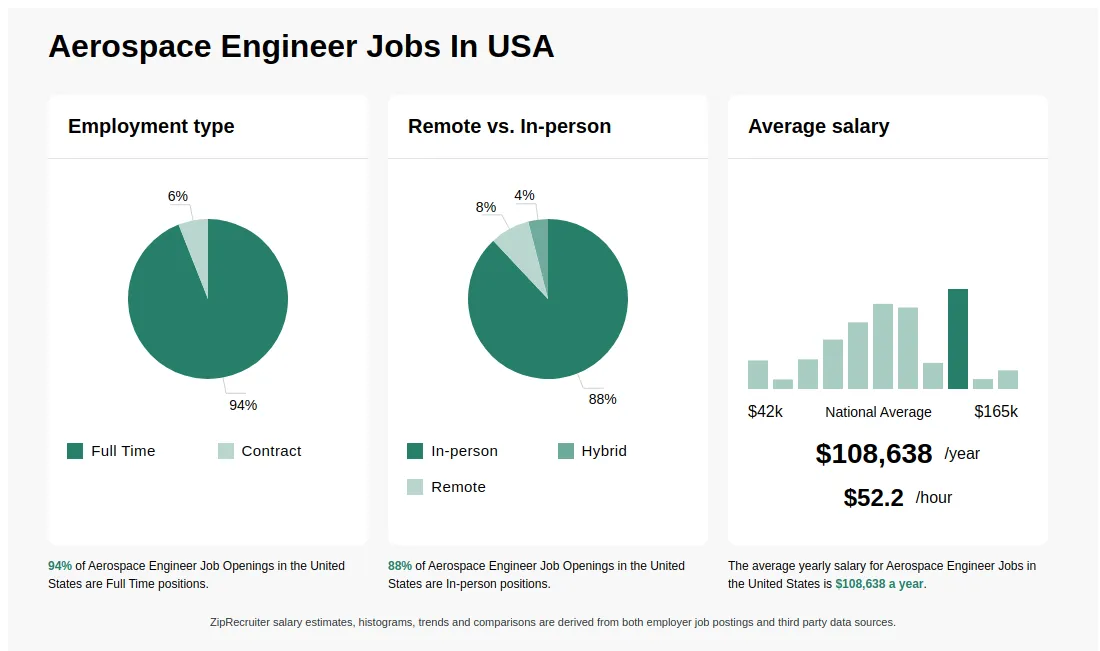
$42K - $53.2K
5% of jobs
$53.2K - $64.4K
1% of jobs
$64.4K - $75.5K
5% of jobs
$75.5K - $86.7K
10% of jobs
$89.5K is the 25th percentile. Wages below this are outliers.
$86.7K - $97.9K
14% of jobs
The median wage is $107.3K / yr.
$97.9K - $109.1K
17% of jobs
$109.1K - $120.3K
17% of jobs
$130.9K is the 75th percentile. Wages above this are outliers.
$120.3K - $131.5K
5% of jobs
$131.5K - $142.6K
20% of jobs
$142.6K - $153.8K
1% of jobs
$153.8K - $165K
3% of jobs
$42K
$108.6K
$165K
Aerospace Engineers manufacture and design aircraft, satellites, missiles, aeronautical and astronautical products and technologies for development, research, defense, and commercial use. They document and evaluate the production of aircraft and aircraft technologies, including commercial and military airplanes, propulsion systems, navigation systems, instrumentation, communication, and thermodynamic and aerodynamic materials used in flight. Aerospace Engineers use highly complex computer systems and software to model, design, evaluate, and simulate parts, products, and vehicles in order to determine if proposals are financially feasible and whether designs will meet regulatory and safety standards. They confer with each other on large-scale projects that require group input, completing a multitude of tasks on a single project through the shared duties of many engineers.
| Aspect | Aerospace Engineer | Mechanical Engineer |
|---|---|---|
| Required Credentials | Bachelor's in aerospace or aeronautical engineering; often a Professional Engineer (PE) license | Bachelor's in mechanical engineering; PE license optional |
| Work Environment | Designing aircraft, spacecraft, satellites; working in labs, design offices, and manufacturing | Designing machinery, engines, HVAC systems; working in factories, labs, and offices |
| Industry Usage | Aerospace, defense, space exploration | Automotive, manufacturing, energy, robotics |
| Common Search/Comparison | Yes | No |
In summary, aerospace engineers specialize in designing and developing aircraft and spacecraft, often requiring specific aerospace credentials and working in specialized environments. Mechanical engineers have a broader focus on machinery and systems across various industries, with more general credentials. The key difference lies in their industry focus and the types of projects they handle.
Cities with the most Aerospace Engineer job openings:
The most popular types of Aerospace Engineer jobs are:
The top employers for Aerospace Engineer jobs are:
States with the most job openings for Aerospace Engineer jobs include:
The top searched job categories for Aerospace Engineer jobs are:
For Aerospace Engineer jobs, the most frequently searched job titles are:
Description
The Aerospace Engineer will join Orbion's world class team to lead and execute projects dedicated toward R&D, testing, and mass production of spacecraft electric propulsion systems.
RESPONSIBILITES
MINIMUM REQUIREMENTS
PREFERRED QUALIFICATIONS
PHYSICAL REQUIREMENTS
All qualified applicants will receive consideration for employment without regard to sex, gender identity, sexual orientation, race, color, religion, national origin, disability, protected veteran status, age, or any other characteristic protected by state or local law.

Sourced by ZipRecruiter
Guided missile and space vehicle manufacturing
11 - 50 Employees
Houghton, MI, US
2016



