
As a senior developer, you will work across the full stack - .NET Core, Angular, Azure, data ... COMPANY PowerPlan develops enterprisegrade tax, accounting, reporting, and workflow automation ...
As a senior developer, you will work across the full stack - .NET Core, Angular, Azure, data ... COMPANY PowerPlan develops enterprisegrade tax, accounting, reporting, and workflow automation ...
Principal Software Developer
Atlanta, GA · On-site
As a senior developer, you will work across the full stack - .NET Core, Angular, Azure, data ... COMPANY PowerPlan develops enterprisegrade tax, accounting, reporting, and workflow automation ...
Principal Software Developer
Atlanta, GA · On-site
As a senior developer, you will work across the full stack - .NET Core, Angular, Azure, data ... COMPANY PowerPlan develops enterprisegrade tax, accounting, reporting, and workflow automation ...
As a senior developer, you will work across the full stack -- .NET Core, Angular, Azure, data ... COMPANY PowerPlan develops enterprisegrade tax, accounting, reporting, and workflow automation ...
New
As a senior developer, you will work across the full stack -- .NET Core, Angular, Azure, data ... COMPANY PowerPlan develops enterprisegrade tax, accounting, reporting, and workflow automation ...
New
Principal Software Developer
Atlanta, GA · On-site
As a senior developer, you will work across the full stack - .NET Core, Angular, Azure, data ... COMPANY PowerPlan develops enterprise-grade tax, accounting, reporting, and workflow automation ...
New
Principal Software Developer
Atlanta, GA · On-site
As a senior developer, you will work across the full stack - .NET Core, Angular, Azure, data ... COMPANY PowerPlan develops enterprise-grade tax, accounting, reporting, and workflow automation ...
New
Software Developer Location: Mount Weather, VA Work Schedule: Full-Time Security Clearance: Top ... Modernize & migrate current application to new COST Accounting, Reporting, and Distribution System ...
Software Developer Location: Mount Weather, VA Work Schedule: Full-Time Security Clearance: Top ... Modernize & migrate current application to new COST Accounting, Reporting, and Distribution System ...

Accounting Assistant
$23 - $26/hr
We serve a client base of real estate developers and construction companies, as well as ... Enter invoices into accounting software with correct coding * Prepare and process vendor payments.
Accounting Assistant
$23 - $26/hr
We serve a client base of real estate developers and construction companies, as well as ... Enter invoices into accounting software with correct coding * Prepare and process vendor payments.
Accounting Assistant
Charlotte, NC · On-site
We serve a client base of real estate developers and construction companies, as well as ... Enter invoices into accounting software with correct coding * Prepare and process vendor payments.
Quick apply
Accounting Assistant
Charlotte, NC · On-site
We serve a client base of real estate developers and construction companies, as well as ... Enter invoices into accounting software with correct coding * Prepare and process vendor payments.

Software Developer III
Austin, TX · On-site
... accountancy and consulting firms, and other financial institutions. We help them to identify ... to manage software development cycle Participate and help lead UI/UX efforts to advance our ...
Software Developer III
Austin, TX · On-site
... accountancy and consulting firms, and other financial institutions. We help them to identify ... to manage software development cycle Participate and help lead UI/UX efforts to advance our ...
Accounting Assistant
Charlotte, NC · On-site
$23/hr
We serve a client base of real estate developers and construction companies, as well as ... Enter invoices into accounting software with correct coding * Prepare and process vendor payments.
Quick apply
Accounting Assistant
Charlotte, NC · On-site
$23/hr
We serve a client base of real estate developers and construction companies, as well as ... Enter invoices into accounting software with correct coding * Prepare and process vendor payments.
Accounting Assistant
Charlotte, NC · On-site
$23 - $26/hr
We serve a client base of real estate developers and construction companies, as well as ... Enter invoices into accounting software with correct coding * Prepare and process vendor payments.
Accounting Assistant
Charlotte, NC · On-site
$23 - $26/hr
We serve a client base of real estate developers and construction companies, as well as ... Enter invoices into accounting software with correct coding * Prepare and process vendor payments.

Accounting Manager
Sedro Woolley, WA · On-site +1
Across every role, from engineers and technicians to operations and support teams, our people help ... Oversee the implementation and management of various accounting software systems such as SAP, S4 ...
Quick apply
Accounting Manager
Sedro Woolley, WA · On-site +1
Across every role, from engineers and technicians to operations and support teams, our people help ... Oversee the implementation and management of various accounting software systems such as SAP, S4 ...
Software Developer III
Austin, TX · On-site
... accountancy and consulting firms, and other financial institutions. We help them to identify ... manage software development cycle • Participate and help lead UI/UX efforts to advance our ...
Software Developer III
Austin, TX · On-site
... accountancy and consulting firms, and other financial institutions. We help them to identify ... manage software development cycle • Participate and help lead UI/UX efforts to advance our ...
Accounting Manager
Sedro Woolley, WA · On-site
Across every role, from engineers and technicians to operations and support teams, our people help ... Oversee the implementation and management of various accounting software systems such as SAP, S4 ...
Accounting Manager
Sedro Woolley, WA · On-site
Across every role, from engineers and technicians to operations and support teams, our people help ... Oversee the implementation and management of various accounting software systems such as SAP, S4 ...

Director of Accounting
Omaha, NE · On-site
$90K - $150K/yr
Project management for the implementation of new accounting software. Communication between developers, IT department, auditors and accounting department of a group of companies in the USA.
Quick apply
Director of Accounting
Omaha, NE · On-site
$90K - $150K/yr
Project management for the implementation of new accounting software. Communication between developers, IT department, auditors and accounting department of a group of companies in the USA.
Full Stack Engineer
San Francisco, CA · On-site
$150K - $220K/yr
About Us Campfire is on a mission to redefine the accounting software landscape by taking on giants ... About the Role Join our engineering team as a full-stack or back-end developers at Campfire, you'll ...
Full Stack Engineer
San Francisco, CA · On-site
$150K - $220K/yr
About Us Campfire is on a mission to redefine the accounting software landscape by taking on giants ... About the Role Join our engineering team as a full-stack or back-end developers at Campfire, you'll ...
Director of Accounting
Miami, FL · On-site
$90K - $150K/yr
Project management for the implementation of new accounting software. Communication between developers, IT department, auditors and accounting department of a group of companies in the USA.
Quick apply
Director of Accounting
Miami, FL · On-site
$90K - $150K/yr
Project management for the implementation of new accounting software. Communication between developers, IT department, auditors and accounting department of a group of companies in the USA.
Director of Accounting
Miami, FL · On-site
$90K - $150K/yr
Project management for the implementation of new accounting software. Communication between developers, IT department, auditors and accounting department of a group of companies in the USA.
Quick apply
Director of Accounting
Miami, FL · On-site
$90K - $150K/yr
Project management for the implementation of new accounting software. Communication between developers, IT department, auditors and accounting department of a group of companies in the USA.
Director of Accounting
Omaha, NE · On-site
$90K - $150K/yr
Project management for the implementation of new accounting software. Communication between developers, IT department, auditors and accounting department of a group of companies in the USA.
Quick apply
Director of Accounting
Omaha, NE · On-site
$90K - $150K/yr
Project management for the implementation of new accounting software. Communication between developers, IT department, auditors and accounting department of a group of companies in the USA.

Overview Susquehanna is seeking talented software engineers to join our Trade Finance and Internal ... Build and support tools to meet Financial, Regulatory, Accounting as well as Audit reporting ...
Overview Susquehanna is seeking talented software engineers to join our Trade Finance and Internal ... Build and support tools to meet Financial, Regulatory, Accounting as well as Audit reporting ...

Software Developer ll
Hamtramck, MI · Hybrid
We are looking for a Software Developer II to help support and grow that platform ... Today it includes 250+ web parts, 100+ business reports (accounting, inventory, production), and ...
Software Developer ll
Hamtramck, MI · Hybrid
We are looking for a Software Developer II to help support and grow that platform ... Today it includes 250+ web parts, 100+ business reports (accounting, inventory, production), and ...
Accounting Software Developer information
See salary details
$48K - $58.7K
1% of jobs
$58.7K - $69.5K
4% of jobs
$69.5K - $80.2K
9% of jobs
$90.2K is the 25th percentile. Wages below this are outliers.
$80.2K - $90.9K
12% of jobs
$90.9K - $101.6K
15% of jobs
The median wage is $108.7K / yr.
$101.6K - $112.4K
14% of jobs
$112.4K - $123.1K
15% of jobs
$127.3K is the 75th percentile. Wages above this are outliers.
$123.1K - $133.8K
13% of jobs
$133.8K - $144.5K
9% of jobs
$144.5K - $155.3K
5% of jobs
$155.3K - $166K
3% of jobs
$48K
$111.8K
$166K
How much do accounting software developer jobs pay per year?
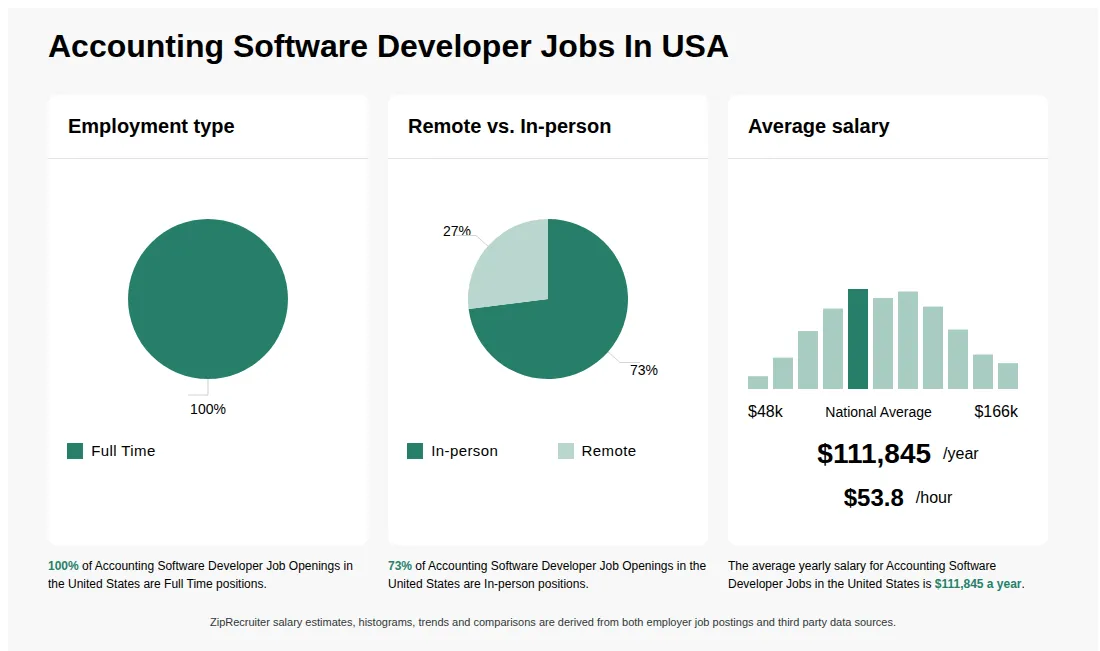
As of Jul 26, 2026, the average yearly pay for accounting software developer in the United States is $111,845.00, according to ZipRecruiter salary data. Most workers in this role earn between $90,000.00 and $130,000.00 per year, depending on experience, location, and employer.
What does an Accounting Software Developer do?
An Accounting Software Developer designs, builds, and maintains software applications that help individuals and businesses manage their financial data and accounting processes. Their work involves understanding accounting principles and requirements to create tools for tasks like invoicing, payroll, expense tracking, and financial reporting. They often collaborate with accountants and end-users to ensure the software is user-friendly, secure, and compliant with financial regulations. These developers may work for software companies, accounting firms, or as independent consultants.
Can you make $500,000 a year as an accountant?
Accounting software developers typically do not earn $500,000 annually; their salaries vary based on experience, location, and company size. Senior developers with specialized skills or leadership roles in large firms may reach high six-figure incomes, but such earnings are uncommon for most accountants or developers in the field.
What is an accounting software developer?
An accounting software developer designs, develops, and maintains software applications used for financial management and accounting tasks. They typically have skills in programming languages like Java, C#, or Python, and may work with accounting principles and software tools such as QuickBooks or SAP. Their role involves creating solutions that improve financial data processing, reporting, and compliance.
What are the key skills and qualifications needed to thrive as an Accounting Software Developer, and why are they important?
To thrive as an Accounting Software Developer, you need strong proficiency in programming languages (such as Java, C#, or Python), a solid understanding of accounting principles, and often a degree in computer science or a related field. Familiarity with accounting software platforms (like QuickBooks or SAP), database systems, and version control tools is typically required, along with knowledge of industry-standard APIs. Excellent problem-solving, communication skills, and attention to detail help developers collaborate with stakeholders and create user-friendly, reliable software. These competencies ensure the creation of effective, compliant, and high-quality accounting solutions that meet business needs.
Can I make 100k as a software developer?
Accounting software developers can potentially earn $100,000 or more annually, especially with experience, specialized skills, and working in high-demand regions or companies. Salaries vary based on location, education, certifications, and the complexity of the software developed.
What engineer makes $500,000 a year?
Highly experienced software engineers, especially those in specialized fields like machine learning, AI, or working at top tech companies, can earn $500,000 or more annually. Senior roles often include bonuses, stock options, and other compensation components that contribute to this level of income.
What are some common challenges Accounting Software Developers face when integrating new features with existing financial systems?
Accounting Software Developers often encounter challenges when integrating new features, such as ensuring compatibility with legacy financial systems and maintaining data integrity across different modules. They must carefully manage version control, adhere to strict security protocols, and thoroughly test to prevent disruptions to critical accounting processes. Collaboration with finance professionals and IT teams is vital to understand business requirements and regulatory compliance, making strong communication skills important for success in this role.
What Does an Accounting Software Developer Do?
Accounting software developers help create and support applications used for accounting purposes. In this role, you may ensure the software correctly manages each account and transaction, verify that the system can adequately handle any unusual entries that accountants need to make, and run reports to evaluate the current financial situation of your clients. Accounting software developers usually work in teams; because much of the data entered into the system concerns monetary transactions, the primary function of the software focuses on accurate calculations. Software precision and avoiding bugs is even more critical than in other types of programs because of the serious impact that errors could have on customers.
What is the difference between Accounting Software Developer vs Bookkeeper?
| Aspect | Accounting Software Developer | Bookkeeper |
|---|---|---|
| Primary Role | Designing, developing, and maintaining accounting software applications | Recording and managing financial transactions manually or with basic software |
| Required Skills | Programming, software development, understanding of accounting processes | Basic accounting knowledge, data entry, attention to detail |
| Work Environment | Tech companies, software firms, finance departments | Small businesses, accounting firms, small offices |
| Certifications | Possibly relevant IT or accounting certifications | Bookkeeping certifications or basic accounting courses |
While an Accounting Software Developer focuses on creating and improving accounting software tools, a Bookkeeper manages day-to-day financial records manually or with simple software. Both roles require understanding of accounting principles, but their skills and work environments differ significantly.
More about Accounting Software Developer jobs
What cities are hiring for Accounting Software Developer jobs? Cities with the most Accounting Software Developer job openings:
What are the most commonly searched types of Accounting Software Developer jobs? The most popular types of Accounting Software Developer jobs are:
What states have the most Accounting Software Developer jobs? States with the most job openings for Accounting Software Developer jobs include:
What job categories do people searching Accounting Software Developer jobs look for? The top searched job categories for Accounting Software Developer jobs are:
Job description
Overview
This role offers the chance to design and build modern, cloud-native enterprise software that directly supports mission-critical tax, accounting, and operational workflows for the energy industry. As a senior developer, you will work across the full stack - .NET Core, Angular, Azure, data services, and workflow systems - contributing to complex architecture, scalable services, and modernized user experiences.
You will collaborate closely with architects, SMEs, users, and cross-functional teams while helping evolve engineering practices, tooling, and development methodologies. This is an opportunity to make a clear, measurable impact on large enterprise systems in a high-trust, high-accountability engineering organization.
COMPANY
PowerPlan develops enterprisegrade tax, accounting, reporting, and workflow automation solutions tailored specifically for energy industry organizations. We serve customers whose operational, financial, and regulatory processes depend on accuracy, reliability, and scalability. With a culture focused on teamwork, quality, continuous improvement, and modern engineering, we create technology that solves highvalue industry problems while providing a supportive, collaborative environment where talented developers can grow and lead.
ResponsibilitiesKEY PERFORMANCE OBJECTIVES (First 12 Months)
OBJECTIVE 1: Master Project Domain, Architecture & User Workflows (First 4 Weeks)
Outcome:Within the first 4 weeks, develop a complete understanding of the assigned systems, including architecture, business workflows, module responsibilities, dependencies, data flows, customer use cases, and integration points. Deliver a 10-15 minute presentation to the development leaders demonstrating technical fluency, an understanding of user needs, and clarity on how your work contributes to business value.
Impact:Rapid mastery of the domain enables earlier meaningful contributions, reduces rework due to misunderstanding, and strengthens alignment between engineering decisions, customer workflows, and architectural direction.
How:Meet with architects, team leads, SMEs, end users, and crossfunctional partners to map requirements and workflows. Review architecture diagrams, repositories, backlog items, and sprint history. Walk through real user scenarios to understand functional expectations. Consolidate findings into diagrams, notes, and a concise leadership presentation.
OBJECTIVE 2: Build a Professional Development & Agile Contribution Plan (First 6 Weeks)
Outcome:Within the first 6 weeks, create a structured personal development and contribution plan detailing technical upskilling goals, storypoint velocity expectations, testing and automation commitments, code review responsibilities, and specific recommendations for improving team processes and methodologies. Review the plan with the hiring manager and finalize it with feedback incorporated.
Impact:A targeted growth and contribution plan accelerates the path to full productivity, strengthens sprint predictability, and supports ongoing improvement of engineering quality and Agile execution.
How:Assess skill gaps, analyze sprint history, review engineering standards, and gather feedback from senior developers and the Scrum Master. Convert insights into measurable objectives, commitments, and process improvement recommendations aligned with team needs.
OBJECTIVE 3: Build, Optimize & Maintain CloudNative Enterprise Solutions (Ongoing)
Outcome
Design, build, and maintain production-ready features and enhancements for cloud-native enterprise tax, accounting, reporting, and workflow applications. Deliver high-quality code using:
- Modern .NET (C#, ASP.NET Core with async/await, performance tuning, REST/GraphQL APIs)
- Angular with TypeScript (component architecture, lazy loading, module design)
- Reactive programming with RxJS and NgRx
- Relational database engineering (schema design, SQL optimization, Azure SQL/SQL Server)
- Azure cloud services (App Services, AKS, Service Bus, API Management)
- Achieve consistent sprint throughput, stable production performance, and low defect escape rates.
Impact:
Highquality, scalable code enhances system reliability, customer satisfaction, and product competitiveness. Strong engineering practices reduce operational risk and support ongoing modernization efforts in a missioncritical enterprise platform.
How:Implement features, refactor legacy areas, optimize backend APIs, build Angular components with clean state management, design and tune SQL structures, and deploy/operate solutions on Azure. Use CI/CD pipelines, test automation, code reviews, performance diagnostics, and structured AIassisted development (BMAD) to deliver predictable, highquality increments.
OBJECTIVE 4: Operate as a HighTrust, HighAccountability Scrum Team Member (Ongoing)
Outcome:Contribute consistently and transparently to Agile ceremonies-standups, refinement, planning, reviews, and retrospectives-while delivering committed work with high quality and predictable velocity. Engage in accurate estimation, clear communication, constructive code reviews, and proactive risk identification. Model behaviors aligned with The Five Dysfunctions of a Team: trust, healthy conflict, commitment, accountability, and focus on results.
Impact:Strong collaboration and accountability reduce rework, improve sprint flow, and strengthen team delivery. Hightrust team behavior directly increases quality, velocity, and customer impact.
How:Provide clear updates, surface blockers early, refine stories with product and SMEs, share knowledge, pair with teammates, and contribute to continuous improvement. Engage openly in retrospectives, adopt agreed changes quickly, and support a culture of healthy debate and shared success.
QualificationsWHAT YOU BRING
- .NET & C# - Deep expertise in modern .NET (C#, ASP.NET Core), async/await patterns, performance optimization, and API design (REST required; GraphQL a plus).
- Angular & TypeScript - Strong front-end engineering skills using TypeScript, Angular, RxJS, and NgRx or equivalent state management patterns.
- SQL & Data Modeling - Hands-on experience designing relational schemas and optimizing SQL queries in Azure SQL or SQL Server.
- Azure Cloud - Experience operating cloud-hosted systems on Azure (App Services, AKS, Service Bus, API Management) with an understanding of scalability, resiliency, and cost/performance tradeoffs.
- Enterprise Application Experience - Track record building enterprise-grade or SaaS applications with complex workflows, integrations, or financial/accounting/tax domains.
- Agile Execution - Strong Scrum/Agile habits with an emphasis on communication, collaboration, accountability, and continuous improvement.
"PowerPlan is an EOE"
https://info.powerplan.com/ApplicantPrivacyNotice
Please note that this is a hybrid role that involves a combination of onsite work from our corporate office as well as work from home. While we strive to accommodate flexible working arrangements when sensible, there will be times when onsite work is required. This could include scheduled office days, team meetings, client meetings, or special events.
Employment Type: OTHER

About Powerplan
Sourced by ZipRecruiter
Industry
Software development
Company size
201 - 500 Employees
Headquarters location
Atlanta, GA, US
Year founded
1994