Synaptrix is building non-invasive brain-computer interfaces by treating neural decoding as a fundamental machine learning problem. The brain produces extraordinarily high-dimensional, noisy, non ...
Synaptrix is building non-invasive brain-computer interfaces by treating neural decoding as a fundamental machine learning problem. The brain produces extraordinarily high-dimensional, noisy, non ...

Your responsibilities may also include working on our brain-computer interface devices, surgical robotics, automation, microfabrication, and more. You will have the opportunity to own projects from ...
Your responsibilities may also include working on our brain-computer interface devices, surgical robotics, automation, microfabrication, and more. You will have the opportunity to own projects from ...
Neuroengineer Intern
South San Francisco, CA · On-site
$35/hr
The Next Gen team at Neuralink is developing the next generation of brain-computer interfaces. We are laying the groundwork for intuitive, high-dimensional, and bidirectional interfaces between ...
Neuroengineer Intern
South San Francisco, CA · On-site
$35/hr
The Next Gen team at Neuralink is developing the next generation of brain-computer interfaces. We are laying the groundwork for intuitive, high-dimensional, and bidirectional interfaces between ...
Synaptrix is building non-invasive brain-computer interfaces by treating neural decoding as a fundamental machine learning problem. The brain produces extraordinarily high-dimensional, noisy, non ...
Synaptrix is building non-invasive brain-computer interfaces by treating neural decoding as a fundamental machine learning problem. The brain produces extraordinarily high-dimensional, noisy, non ...

We're pursuing this goal by developing fundamentally new approaches to brain-computer interfaces that interact with the brain at high bandwidth, integrate with advanced AI, and are ultimately safe ...
We're pursuing this goal by developing fundamentally new approaches to brain-computer interfaces that interact with the brain at high bandwidth, integrate with advanced AI, and are ultimately safe ...
Precision Neuroscience is building a next‑generation brain-computer interface (BCI) to heal and empower millions of people living with neurological conditions. Our first product, Layer 7, is ...
Precision Neuroscience is building a next‑generation brain-computer interface (BCI) to heal and empower millions of people living with neurological conditions. Our first product, Layer 7, is ...
Biomedical Engineer Intern
South San Francisco, CA · On-site
$35/hr
The Next Gen team at Neuralink is developing the next generation of brain-computer interfaces. We are laying the groundwork for intuitive, high-dimensional, and bidirectional interfaces between ...
Biomedical Engineer Intern
South San Francisco, CA · On-site
$35/hr
The Next Gen team at Neuralink is developing the next generation of brain-computer interfaces. We are laying the groundwork for intuitive, high-dimensional, and bidirectional interfaces between ...

We're pursuing this goal by developing fundamentally new approaches to brain-computer interfaces that interact with the brain at high bandwidth, integrate with advanced AI, and are ultimately safe ...
We're pursuing this goal by developing fundamentally new approaches to brain-computer interfaces that interact with the brain at high bandwidth, integrate with advanced AI, and are ultimately safe ...
Veterinary Pathologist
Austin, TX · On-site
Join the Preclinical team at Neuralink, where our mission is to generate high-quality safety, biocompatibility, and performance data for cutting-edge brain-computer interface (BCI) technologies ...
Veterinary Pathologist
Austin, TX · On-site
Join the Preclinical team at Neuralink, where our mission is to generate high-quality safety, biocompatibility, and performance data for cutting-edge brain-computer interface (BCI) technologies ...
EE Systems Engineer
Santa Clara, CA · On-site
Chicago, Illinois, United States Precision Neuroscience is building a next-generation brain-computer interface (BCI) to heal and empower millions of people living with neurological conditions. Our ...
EE Systems Engineer
Santa Clara, CA · On-site
Chicago, Illinois, United States Precision Neuroscience is building a next-generation brain-computer interface (BCI) to heal and empower millions of people living with neurological conditions. Our ...
Veterinary Pathologist
Austin, TX · On-site
Join the Preclinical team at Neuralink, where our mission is to generate high-quality safety, biocompatibility, and performance data for cutting-edge brain-computer interface (BCI) technologies ...
Veterinary Pathologist
Austin, TX · On-site
Join the Preclinical team at Neuralink, where our mission is to generate high-quality safety, biocompatibility, and performance data for cutting-edge brain-computer interface (BCI) technologies ...
Synaptrix is building non-invasive brain-computer interfaces by treating neural decoding as a fundamental machine learning problem. The brain produces extraordinarily high-dimensional, noisy, non ...
Quick apply
Synaptrix is building non-invasive brain-computer interfaces by treating neural decoding as a fundamental machine learning problem. The brain produces extraordinarily high-dimensional, noisy, non ...
Research Associate - Immunotolerization
San Francisco, CA · On-site
$95K - $120K/yr
We're pursuing this goal by developingfundamentally new approaches to brain-computer interfaces that interact with the brain at high bandwidth, integrate with advanced AI, and are ultimately safe and ...
Research Associate - Immunotolerization
San Francisco, CA · On-site
$95K - $120K/yr
We're pursuing this goal by developingfundamentally new approaches to brain-computer interfaces that interact with the brain at high bandwidth, integrate with advanced AI, and are ultimately safe and ...
We're pursuing this goal by developing fundamentally new approaches to brain-computer interfaces that interact with the brain at high bandwidth, integrate with advanced AI, and are ultimately safe ...
We're pursuing this goal by developing fundamentally new approaches to brain-computer interfaces that interact with the brain at high bandwidth, integrate with advanced AI, and are ultimately safe ...

Veterinary Pathologist
Austin, TX · On-site
Join the Preclinical team at Neuralink, where our mission is to generate high-quality safety, biocompatibility, and performance data for cutting-edge brain-computer interface (BCI) technologies ...
Veterinary Pathologist
Austin, TX · On-site
Join the Preclinical team at Neuralink, where our mission is to generate high-quality safety, biocompatibility, and performance data for cutting-edge brain-computer interface (BCI) technologies ...
We're pursuing this goal by developing fundamentally new approaches to brain-computer interfaces that interact with the brain at high bandwidth, integrate with advanced AI, and are ultimately safe ...
We're pursuing this goal by developing fundamentally new approaches to brain-computer interfaces that interact with the brain at high bandwidth, integrate with advanced AI, and are ultimately safe ...
R&D Materials Engineer Intern
South San Francisco, CA · On-site
$35/hr
The Next Gen team at Neuralink is developing the next generation of brain-computer interfaces. We are laying the groundwork for intuitive, high-dimensional, and bidirectional interfaces between ...
R&D Materials Engineer Intern
South San Francisco, CA · On-site
$35/hr
The Next Gen team at Neuralink is developing the next generation of brain-computer interfaces. We are laying the groundwork for intuitive, high-dimensional, and bidirectional interfaces between ...
Digital IC Design Engineer Intern
South San Francisco, CA · On-site
$35/hr
The Brain Interfaces Soc Department delivers chip architecture and silicon implementation of neural recording and stimulation system-on-chip (SoC) for high-bandwidth brain-computer interfaces. We ...
Digital IC Design Engineer Intern
South San Francisco, CA · On-site
$35/hr
The Brain Interfaces Soc Department delivers chip architecture and silicon implementation of neural recording and stimulation system-on-chip (SoC) for high-bandwidth brain-computer interfaces. We ...

Senior Sensors Engineer
Palo Alto, CA · On-site
$75 - $95/hr
The company is focused on advancing noninvasive brain-computer interface (BCI) technology through an EEG-powered wearable platform. Position Summary This person will own the end-to-end non-EEG sensor ...
Senior Sensors Engineer
Palo Alto, CA · On-site
$75 - $95/hr
The company is focused on advancing noninvasive brain-computer interface (BCI) technology through an EEG-powered wearable platform. Position Summary This person will own the end-to-end non-EEG sensor ...

Staff Neuroscientist
Santa Clara, CA · On-site
About Precision Neuroscience Precision Neuroscience is building a next-generation brain-computer interface (BCI) to heal and empower millions of people living with neurological conditions. Our first ...
Staff Neuroscientist
Santa Clara, CA · On-site
About Precision Neuroscience Precision Neuroscience is building a next-generation brain-computer interface (BCI) to heal and empower millions of people living with neurological conditions. Our first ...
brain computer interface information
See salary details
$11.54 - $17.57
2% of jobs
$17.57 - $23.60
0% of jobs
$23.60 - $29.63
0% of jobs
$29.63 - $35.66
3% of jobs
$35.66 - $41.70
5% of jobs
$41.70 - $47.73
14% of jobs
$47.89 is the 25th percentile. Wages below this are outliers.
$47.73 - $53.76
28% of jobs
$53.76 - $59.79
18% of jobs
$61.76 is the 75th percentile. Wages above this are outliers.
$59.79 - $65.82
14% of jobs
$65.82 - $71.85
11% of jobs
$71.85 - $77.88
5% of jobs
$11
$54
$77
How much do brain computer interface jobs pay per hour?
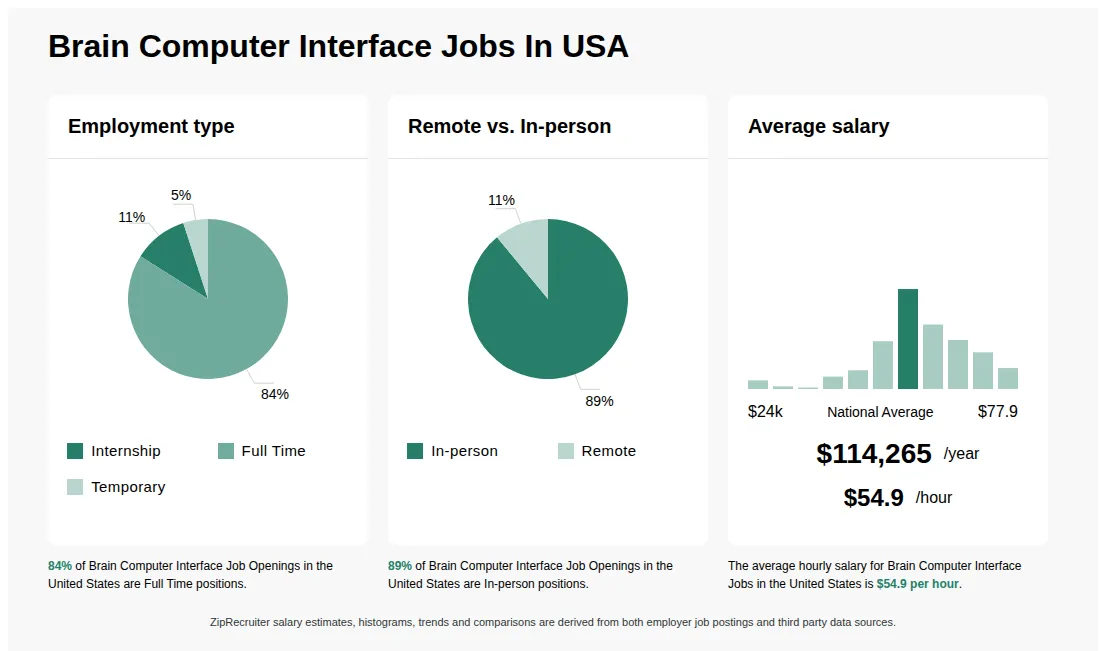
As of Sep 13, 2026, the average hourly pay for brain computer interface in the United States is $54.94, according to ZipRecruiter salary data. Most workers in this role earn between $48.08 and $62.50 per hour, depending on experience, location, and employer.
What is a brain computer interface?
A Brain-Computer Interface (BCI) job involves developing systems that enable direct communication between the brain and external devices. Professionals in this field work on hardware and software to interpret neural signals, often for medical, assistive, or neurotechnology applications. Roles can include research, software engineering, signal processing, and machine learning to improve BCIs' accuracy and functionality. These jobs are common in healthcare, neuroscience, gaming, and AI-driven human augmentation industries.
What are the key skills and qualifications needed to thrive in the brain computer interface position?
To thrive in a Brain Computer Interface role, you typically need a strong background in neuroscience, biomedical engineering, or computer science, coupled with experience in signal processing and neural data analysis. Familiarity with tools such as MATLAB, Python, EEG/MEG systems, and relevant certifications in neurotechnology are highly valuable. Strong problem-solving abilities, collaboration, and effective communication skills are essential for working on multidisciplinary teams and translating research into practical applications. These skills ensure that you can design, develop, and refine advanced BCI systems that meet both technical and user needs in this rapidly evolving field.
What are some common challenges faced by professionals working in brain computer interface roles?
Professionals in Brain Computer Interface roles often face challenges related to accurately interpreting complex neural signals, minimizing noise in data, and ensuring that BCI systems are intuitive for end-users. They frequently collaborate with neuroscientists, engineers, software developers, and clinicians to overcome technical and usability barriers. Balancing research innovation with real-world applicability can be demanding, and staying current with rapidly advancing technology is essential. These challenges make the field dynamic and rewarding for those passionate about shaping the future of human-computer interaction.
More about brain computer interface jobs
What cities are hiring for Brain Computer Interface jobs?
Cities with the most Brain Computer Interface job openings:
What are the most commonly searched types of Brain Computer Interface jobs?
The most popular types of Brain Computer Interface jobs are:
What states have the most Brain Computer Interface jobs?
States with the most job openings for Brain Computer Interface jobs include:
What are popular job titles for Brain Computer Interface?
Popular job titles for Brain Computer Interface:
Research Scientist, Machine Learning (PhD)
New York, NY
Synaptrix Labs
Full-time
Medical, PTO
Re-posted 13 days ago
Job description
About Synaptrix:
Synaptrix is building non-invasive brain-computer interfaces by treating neural decoding as a fundamental machine learning problem.
The brain produces extraordinarily high-dimensional, noisy, non-stationary signals generated by an underlying dynamical system that we can only partially observe. We are developing new models, datasets, and hardware to learn these dynamics and translate them into real-time control of computers, communication systems, mobility devices, and eventually a much broader class of machines.
We are looking for exceptional researchers across machine learning, artificial intelligence, applied mathematics, physics, dynamical systems, computational neuroscience, and related fields.
Prior experience in neuroscience or brain-computer interfaces is not required. We care much more about exceptional research ability, mathematical depth, and the ability to develop new approaches to difficult modeling problems.
What You'll Work On- Develop new machine learning methods for modeling high-dimensional neural and behavioral data, spanning representation learning, generative modeling, sequence modeling, latent-variable models, and learned dynamical systems.
- Learn latent structure and dynamics from noisy, non-stationary, partially observed time-series data.
- Develop approaches to neural decoding that generalize across people, sessions, tasks, and recording conditions.
- Explore problems at the intersection of deep learning, dynamical systems, system identification, control, information theory, optimization, and statistical learning.
- Investigate self-supervised and unsupervised learning methods that can take advantage of large quantities of neural data without requiring dense behavioral labels.
- Design rigorous experiments to understand model scaling, generalization, representation quality, and the limits of non-invasive neural decoding.
- Build simulations and generative models for studying neural signals and testing hypotheses about learned representations and decoding algorithms.
- Work closely with researchers collecting large-scale neural datasets and engineers building the sensing hardware that generates them.
- Translate promising research into real-time systems controlling computers, communication interfaces, wheelchairs, prosthetics, and other machines.
- Build rigorous, reproducible implementations of research ideas and scale successful approaches to large datasets and compute.
- Contribute original research that advances both Synaptrix's systems and the broader scientific understanding of neural decoding.
- PhD or equivalent demonstrated research ability in machine learning, computer science, applied mathematics, physics, statistics, computational neuroscience, electrical engineering, or a related technical field.
- Evidence of exceptional ability to conduct original research.
- Strong mathematical foundations in areas such as linear algebra, probability, optimization, statistics, information theory, or dynamical systems.
- Strong programming ability and experience implementing and evaluating machine learning models in PyTorch, JAX, or equivalent frameworks.
- Experience working with high-dimensional, sequential, scientific, sensory, or otherwise complex datasets.
- Ability to take an ambiguous research problem from first principles through formulation, experimentation, analysis, and implementation.
- Ability to operate independently, question existing assumptions, and pursue technically ambitious ideas.
You may be an especially strong fit if your work has involved one or more of:
- Representation learning and self-supervised learning
- Foundation models
- Generative modeling
- Time-series or sequence modeling
- Latent-variable and state-space models
- Dynamical systems and system identification
- Scientific machine learning
- Inverse problems
- Reinforcement learning and optimal control
- Information theory
- Statistical physics
- Computational neuroscience
- Neural signal processing
- Multimodal learning
- Large-scale distributed model training
None of these backgrounds is individually required. We are interested in exceptional researchers with unusual technical depth, including people whose previous work has had nothing to do with neuroscience.
Research CultureWe are a small research-driven team working on problems where there is no established playbook. We value first-principles thinking, mathematical and experimental rigor, intellectual honesty, speed, and researchers who are willing to question assumptions about what should be possible with non-invasive neural signals.
We care more about important results than credentials, titles, or adherence to a particular modeling paradigm.
Our goal is to make non-invasive brain-computer interfaces capable enough to restore communication and mobility to people with severe disabilities, and ultimately to create a general interface between the human brain and machines.
What We Offer- Competitive salary and meaningful & generous equity ownership
- Comprehensive health benefits
- Paid holidays and unlimited PTO
- Work on ambitious, high-impact problems alongside exceptional researchers and engineers across multiple disciplines
- High ownership and rapid career growth for team members who deliver outsized impact