1

Bioinformatics Jobs (NOW HIRING)

Manager - Bioinformatics

Phoenix, AZ ยท On-site

$150 - $210/hr

Position SummaryThe Manager, Bioinformatics leads a team of bioinformatics scientists responsible for the development, validation, implementation, and support of next-generation sequencing (NGS ...

Bioinformatics Scientist

Winter Park, FL ยท On-site

$170K - $190K/yr

Bioinformatics Scientist (Mid/Senior) Compensation: $150,000 - $180,000 Location: San Francisco, CAJob Type: Full-time (Hybrid)Equity: Highly Competitive Equity About Our ClientVivo HealthStaff has ...

Bioinformatics Scientist

Winter Park, FL ยท On-site

$170K - $190K/yr

Bioinformatics Scientist (Mid/Senior) Compensation: $150,000 - $180,000 Location: San Francisco, CA Job Type: Full-time ( Hybrid ) Equity: Highly Competitive Equity About Our Client Vivo HealthStaff ...

Bioinformatics Scientist

Boston, MA ยท On-site

$170K - $190K/yr

Bioinformatics Scientist (Mid/Senior) Compensation: $170,000 - $190,000 Location: South San Francisco, CA Job Type: Full-time ( Hybrid ) Equity: Highly Competitive Equity About Our Client ...

Bioinformatics Scientist

Boston, MA ยท On-site

$170K - $190K/yr

Bioinformatics Scientist (Mid/Senior) Compensation: $170,000 - $190,000 Location: South San Francisco, CAJob Type: Full-time (Hybrid)Equity: Highly Competitive Equity About Our ClientTechStaffers has ...

Position Summary The Manager, Bioinformatics leads a team of bioinformatics scientists responsible for the development, validation, implementation, and support of next-generation sequencing (NGS ...

Bioinformatics Scientist

Ann Arbor, MI ยท On-site

$170K - $190K/yr

Bioinformatics Scientist (Mid/Senior) Compensation: $170,000 - $190,000 Location: South San Francisco, CA Job Type: Full-time ( Hybrid ) Equity: Highly Competitive Equity About Our Client ...

Bioinformatics Scientist

Boston, MA ยท On-site

$170K - $190K/yr

Bioinformatics Scientist (Mid/Senior) Compensation: $170,000 - $190,000 Location: South San Francisco, CA Job Type: Full-time ( Hybrid ) Equity: Highly Competitive Equity About Our Client ...

Bioinformatics Scientist

Ann Arbor, MI ยท On-site

$170K - $190K/yr

Bioinformatics Scientist (Mid/Senior) Compensation: $170,000 - $190,000 Location: South San Francisco, CA Job Type: Full-time ( Hybrid ) Equity: Highly Competitive Equity About Our Client ...

Bioinformatics Scientist

Winter Park, FL ยท On-site

$150K - $180K/yr

Bioinformatics Scientist (Mid/Senior) Compensation: $150,000 - $180,000 Location: San Francisco, CA Job Type: Full-time ( Hybrid ) Equity: Highly Competitive Equity About Our Client Vivo HealthStaff ...

Position Summary The Manager, Bioinformatics leads a team of bioinformatics scientists responsible for the development, validation, implementation, and support of next-generation sequencing (NGS ...

Bioinformatics Engineer

San Jose, CA

  • Medical

  • Dental

  • Vision

  • Retirement

  • PTO

As a Bioinformatics Engineer at AccuScan Sciences, you will develop, optimize, and maintain bioinformatics pipelines utilizing AWS infrastructure and Nextflow workflow management systems. Your ...

Bioinformatics Scientist (Mid/Senior) Compensation: $170,000 - $190,000 Location: South San Francisco, CA Job Type: Full-time ( Hybrid ) Equity: Highly Competitive Equity About Our Client ...

Bioinformatics Engineer

San Jose, CA ยท On-site

  • Medical

  • Dental

  • Vision

  • Retirement

  • PTO

As a Bioinformatics Engineer at AccuScan Sciences, you will develop, optimize, and maintain bioinformatics pipelines utilizing AWS infrastructure and Nextflow workflow management systems. Your ...

Bioinformatics Engineer

San Jose, CA ยท On-site

  • Medical

  • Dental

  • Vision

  • Retirement

  • PTO

As a Bioinformatics Engineer at AccuScan Sciences, you will develop, optimize, and maintain bioinformatics pipelines utilizing AWS infrastructure and Nextflow workflow management systems. Your ...

Bioinformatics Scientist

Boston, MA ยท On-site

$170K - $190K/yr

Bioinformatics Scientist (Mid/Senior) Compensation: $170,000 - $190,000 Location: South San Francisco, CAJob Type: Full-time (Hybrid)Equity: Highly Competitive Equity About Our ClientTechStaffers has ...

Bioinformatics Scientist (Mid/Senior) Compensation: $170,000 - $190,000 Location: South San Francisco, CA Job Type: Full-time ( Hybrid ) Equity: Highly Competitive Equity About Our Client ...

Bioinformatics Scientist

Bethesda, MD ยท On-site

  • Medical

  • Dental

  • Vision

  • Retirement

  • PTO

Bioinformatics Scientist To be considered for this position, please upload a document as your Cover Letter that answers the six questions below. Applications submitted without this document will not ...

next page

Showing results 1-20

bioinformatics information

See salary details

$59.5K

$94.5K

$149.5K

How much do bioinformatics jobs pay per year?

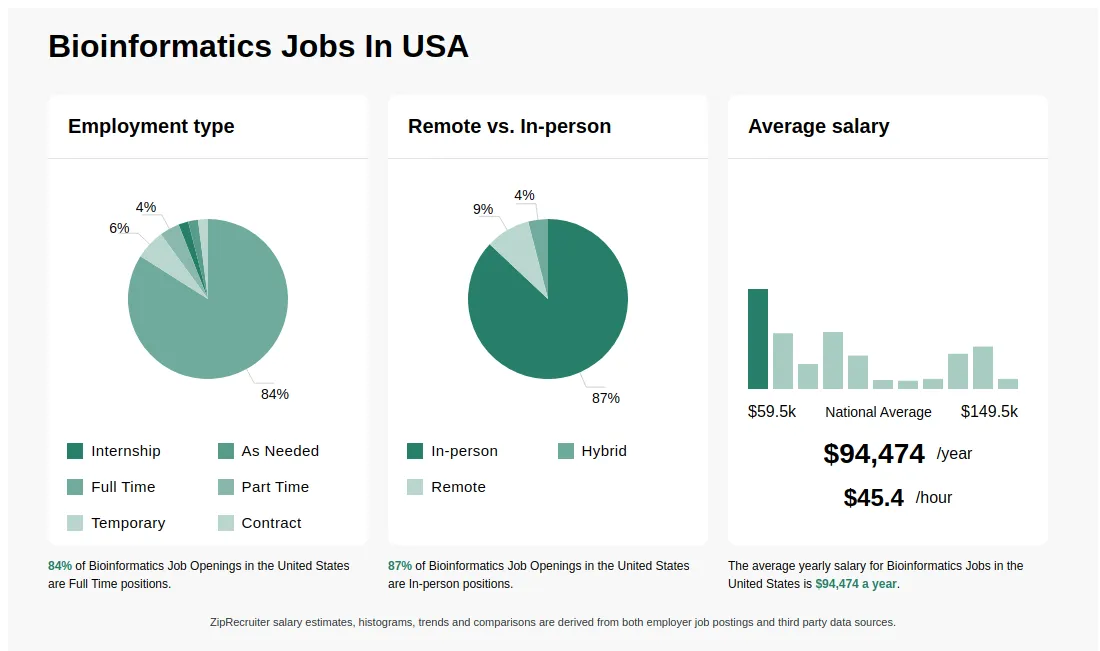
As of Aug 19, 2026, the average yearly pay for bioinformatics in the United States is $94,474.00, according to ZipRecruiter salary data. Most workers in this role earn between $67,500.00 and $129,500.00 per year, depending on experience, location, and employer.

What is bioinformatics?

A Bioinformatics job involves using computational tools and techniques to analyze biological data, such as genomic sequences, protein structures, and clinical information. Professionals in this field work at the intersection of biology, computer science, and statistics to develop algorithms, databases, and software for processing large-scale biological data. Bioinformaticians are employed in academia, pharmaceutical companies, healthcare, and biotechnology sectors to assist with research, drug discovery, and personalized medicine. Key skills include programming, data analysis, and a strong understanding of molecular biology.

What are the typical day-to-day responsibilities of a bioinformatics professional?

A typical day in bioinformatics often involves analyzing large biological datasets, such as genomic or proteomic sequences, using specialized software and programming languages. You might spend time developing or modifying algorithms, visualizing complex data, and applying statistical methods to interpret research findings. Collaborating closely with biologists, data scientists, and clinicians is common to ensure that computational results are aligned with biological questions. Bioinformatics professionals are also expected to document their work, present findings, and stay updated with new tools and advances in the field, making for a dynamic and engaging work environment.

What are the key skills and qualifications needed to thrive in bioinformatics?

To thrive in bioinformatics, you need expertise in biological sciences, strong programming skills (such as Python, R, or Perl), and a solid understanding of statistics, typically supported by a degree in bioinformatics, computational biology, or a related field. Familiarity with bioinformatics databases, software tools (like BLAST, Bioconductor, or Galaxy), and experience with next-generation sequencing data analysis are highly valued. Analytical thinking, problem-solving abilities, and effective communication are essential soft skills for collaborating in interdisciplinary research environments. These skills are crucial for accurately interpreting complex biological data, developing useful computational solutions, and successfully contributing to scientific advancements.

Do bioinformaticians make a lot of money?

Bioinformaticians typically earn competitive salaries that vary based on experience, education, and location. Entry-level positions often start around $60,000 to $80,000 annually, with experienced professionals earning over $100,000, especially in biotech or pharmaceutical industries. Skills in programming, data analysis, and familiarity with tools like Python or R can enhance earning potential.

How hard is it to get a job in bioinformatics?

Securing a job in bioinformatics can be competitive, often requiring a strong background in biology, computer science, or related fields, along with skills in programming, data analysis, and familiarity with tools like Python, R, or Linux. Relevant education such as a master's or Ph.D. and experience with large datasets or sequencing technologies can improve job prospects, but entry-level positions are available for those with relevant skills and training.

What do people who work in bioinformatics do?

Bioinformatics professionals analyze biological data, such as genetic sequences and molecular structures, using computational tools and algorithms. They develop software, interpret large datasets, and collaborate with biologists and healthcare researchers to advance understanding of biological processes and improve medical research.

What jobs can I do with bioinformatics?

Bioinformatics professionals can work as bioinformatics analysts, computational biologists, research scientists, or data scientists in healthcare, pharmaceuticals, biotechnology, and academic research. These roles often require skills in programming, data analysis, and familiarity with biological databases and tools like R, Python, and SQL.

What cities are hiring for Bioinformatics jobs?

Cities with the most Bioinformatics job openings:

What are the most commonly searched types of Bioinformatics jobs?

The most popular types of Bioinformatics jobs are:

Who are the top companies hiring for Bioinformatics jobs?

The top employers for Bioinformatics jobs are:

What states have the most Bioinformatics jobs?

States with the most job openings for Bioinformatics jobs include:

Infographic showing various Bioinformatics job openings in the United States as of August 2026, with employment types broken down into 46% Full Time, 53% Part Time, and 1% Contract. Highlights an 41% Physical, 2% Hybrid, and 57% Remote job distribution, with an average salary of $94,474 per year, or $45.4 per hour.

Bioinformatics Scientist

Healthcare Degree

Rochester, NY โ€ข On-site

Other

Posted yesterday

New


Job description

โ€œDriven by a rapid rollout of sequencing technologies across the nearly 25 years since the first complete human genome was mapped, the science of bioinformatics has fueled an engine of innovation that helps push big biological ideas and data streams into medical practice.โ€

โ€œDriven by a rapid rollout of sequencing technologies across the nearly 25 years since the first complete human genome was mapped, the science of bioinformatics has fueled an engine of innovation that helps push big biological ideas and data streams into medical practice.โ€

Mark Cameron, Associate Professor, Department of Population and Quantitative Health Sciences, School of Medicine, Case Western Reserve University

Bioinformatics is a field that combines analytics and data representation to make sense of the vast amounts of data generated every day. The field takes cues from the worldโ€™s organisms to build a healthier and cleaner future and has many applications in the modern tech landscape.

In the past few decades, the sheer volume of data has increased exponentially, in large part due to the growing repositories of rich biodata from genomics and molecular biology. The Bureau of Labor Statistics reports an uptick in the percentage of bioinformatics and related positions in our economy, such as computer and information research scientists, biomedical scientists, and biomedical engineers.

ONET (an affiliate of the Department of Labor) defines bioinformatics as an occupation for professionals who will โ€œconduct research using bioinformatics theory and methods in areas such as pharmaceuticals, medical technology, biotechnology, computational biology, proteomics, computer information science, biology and medical informatics.โ€ Furthermore, bioinformatics professionals โ€œmay design databases and develop algorithms for processing and analyzing genomic information, or other biological information.โ€

As the preponderance and availability of data grows, the need to interpret that data will keep pace. Mapping cancer genomes, for example, involves serious data input from thoroughly analyzed genetic fragments. As with every other modern medical field, data analytics plays a major role in bioinformatics, even if you have no plans to study engineering or computer science. A basic understanding of data management and presentation are useful, as well.

Featured Bioinformatics & Biotechnology Programs

Dr. Mark Cameron is an associate professor in the Department of Population and Quantitative Health Sciences, School of Medicine, at Case Western Reserve University. He is renowned for his expertise in leveraging genomic technologies and bioinformatic methods to identify biomarkers associated with infectious diseases and chronic inflammatory conditions. His pioneering research delves into computational analysis of gene sequences and protein function, aiming to advance the development of targeted immunotherapies and vaccines. He has a prolific publication record and editorial responsibilities in scientific journals. He holds a PhD in microbiology and immunology and a bachelor of science in biology from Western University, London, Ontario.

HealthcareDegre.com: What is something you wish the public understood about bioinformatic science?

Dr. Cameron: Driven by a rapid rollout of sequencing technologies across the nearly 25 years since the first complete human genome was mapped, the science of bioinformatics has fueled an engine of innovation that helps push big biological ideas and data streams into medical practice.

Bioinformatic scientists and bioinformaticians, however, arenโ€™t simply data wranglers with computers. They are the central processing units of modern biomedical research. They are the translators, so to speak, in the bench-to-beside (and back again) workflow that propels modern medical discovery. They also donโ€™t work alone in the dim light of a computer screen. They are masterclass team scientists collaborating with health care providers, clinical trial coordinators, multidisciplinary scientists, trainees, and industrialists alikeโ€”often all at the same timeโ€”to bring biological and clinical studies to the public.

HealthcareDegre.com: What advice would you give to aspiring bioinformatics science students?

Dr. Cameron: Students thinking of a career in bioinformatics are in for an exciting ride, especially if they enjoy multidisciplinary science. There are many entry points for students interested in a career in STEM since bioinformatics training often runs the gamut from basic biology, statistics, and experimental design to clinical application, drug discovery, and artificial intelligence.

As varied as that training is, there is also a wealth of desirable career options at the end of oneโ€™s program, including academia, government, pharma, and industry. Exciting new genomic technologies arrive on the biomedical research scene daily, each with a seemingly exponential potential for generating data. Bioinformaticians are increasingly critical to the analysis, summary, and translation of all that โ€˜big dataโ€™ towards a better understanding of the biology that surrounds us and/or better public health.

Without bioinformaticians, all that valuable information tends to sit on hard drives. Many of us basic biomedical researchers have had to train in bioinformatics because it permeates modern experimentation. Thereโ€™s never a dull moment in a bioinformaticianโ€™s or bioinformatics scientistโ€™s training and career; in fact, right now, Iโ€™d say the world is their oyster.

Bioinformatics Scientist Specialization & Career Types

There are several bioinformatics scientist specializations and career types available for the scientifically minded. They include informatics research in the following fields:

  • Antibiotic resistance
  • Gene therapy
  • Evolutionary studies
  • Biotechnology
  • Crop improvement
  • Insect resistance
  • Alternative energy sources
  • Zoology
  • Climate change studies
  • Forensic analysis
  • Machine learning
  • Bio-weapon creation
  • Improvement of nutritional quality
  • Development of drought-resistant varieties
  • Veterinary science

Most careers in bioinformatics can be found in computer information science, pharmaceuticals, biotechnology, medical technology, computational biology, proteomics, and medical informatics. Such professionals often develop algorithms, build databases, and present data, studies, and research to other bioinformatics professionals. Databases are typically used for processing and analyzing genomic information or genetic trends.

As an area of study, bioinformatics draws on biology, information technology, computer science, statistics, informatics, mathematical modeling, computational theory, data charting, data analytics, and administration.

Coursework and essential knowledge may include the following subjects: probability, statistics, computing, population genetics, molecular genomic analysis, sustainability mathematics, epigenomic data analysis, biostatistics, biological mathematical modeling, and even computational neuroscience.

Bioinformatics is almost always chosen as a specialization at the graduate level. Most students come from undergraduate courses of study in biology, computer science, chemistry, biochemistry, or bioengineering. In recent years, more and more undergraduate programs in bioinformatics have begun to emerge. Some of them are profiled below.

Bioinformatics is used in conjunction with many other approaches to data analytics to address the highly specialized needs of a wide variety of clients. These jobs include applying analytical theory, computer science, and programming to computer information science, pharmaceuticals, biotechnology, medical technology, computational biology, proteomics, and medical informatics.

Admissions Requirements for Bioinformatics Programs

Admissions requirements for bioinformatics programs generally include a background in the health sciences, computer science, biology, or behavioral sciences.

Bachelorโ€™s programs typically require a minimum GPA of 3.2 and test scores (SAT/ACT) for admission. They include 120 credits of undergraduate work in bioinformatics or psychology and courses in science, humanities, philosophy, analytics, and information technology.

Masterโ€™s degree programs require candidates to submit a competitive GPA, official transcripts, and, in some cases, test scores (GRE) or letters of recommendation. Graduate-level programs in bioinformatics see students dive deeper into the fields of data science, document management, and visual representation to gain a better understanding of what we can learn from all that data we generate.

Bioinformatics Program Accreditation

Students enrolling in academic programs should look into a schoolโ€™s accreditation status. Accreditation ensures that bioinformatics programs meet a set of peer-reviewed standards in their curriculum. A full list of authoritative regional accreditation entities is available on the Council for Higher Education Accreditation (CHEA) website, which is affiliated with the U.S. Department of Education.

On-Campus Bioinformatics Degree Programs

Case Western Reserve University offers a master of science degree in systems biology and bioinformatics. This program has two tracks: translational bioinformatics and molecular and computational biology.

Core courses include current proteomics and bioinformatics for systems biology, and elective courses cover the physiology of organ systems, protein biophysics, the principles of genetic epidemiology, and contemporary approaches to drug discovery, among others.

  • Location: Cleveland, Ohio
  • Duration: Two years
  • Accreditation: Higher Learning Commission

The school offers an innovative bachelor of science program in bioinformatics and data science. Its faculty combines technical, hands-on, and theoretical approaches to create an interdisciplinary degree that primes students for entrance into the field of biodata science. Expect further coursework in the subjects of biology, natural sciences, healthcare administration, and the health sciences.

  • Duration: Three to four years
  • Accreditation: Middle States Commission on Higher Education (MSCHE)

The Rochester Institute of Technology offers an on-campus master of science (MS) in bioinformatics degree that focuses on bioinformatics theory, data programming, proteomics, data management, data science, systems biology, and genetics. Expect additional coursework in the areas of biology, natural sciences, healthcare administration, and the health sciences.

  • Duration: Two to three years
  • Accreditation: Middle States Commission on Higher Education (MSCHE)

The bioinformatics graduate program at UCLA is an interdepartmental degree. Currently, they offer a PhD in bioinformatics but starting with the 2022 application cycle they will also be offering a masterโ€™s of science in bioinformatics. This is a research-centric program and students will be engaged in lab work from the very first year. Upon completion of core studies, students will be expected to develop a thesis and then complete original research on their subject.

Cross-disciplinary collaboration is a strong hallmark of this degree. UCLA has housed the schools of Medicine, Engineering, Life Sciences, Mathematical and Physical Sciences, and Public Health in the same area to facilitate this. As with most PhD programs, admissions are highly competitive. Candidates should submit a strong statement of interest highlighting their research areas of interest along with letters of recommendation and any already completed research.

  • Duration: Five years
  • Accreditation: WASC Senior College and University Commission (WSCUC)

At Harvard Medical School Blavatnik Institute of Biomedical Informatics, students can complete a masterโ€™s of science in biomedical informatics. This degree focuses on using biomedical data for decision-making, scientific inquiry, and problem-solving. It is a residential program, and students must complete their studies on campus.

The accelerated option for this program can take as little as two semesters if the student already has a PhD or is enrolled in an MD program. Otherwise, the degree takes three full-time semesters to complete. To be eligible for admission to this degree, candidates must already have a masterโ€™s or PhD degree. The accelerated degree is 36 credits, while the standard format is 48 credits.

  • Duration: As little as two semesters
  • Accreditation: New England Commission of Higher Education

The computational biology and bioinformatics PhD at Duke University Center for Genomic and Computational Biology has over 55 faculty members from 18 departments across campus. Students receive intensive training in quantitative and biomedical sciences and are required to participate in research projects, weekly seminars, journal clubs, and one-on-one mentoring with faculty.

To help students with their research, there is a strong commitment in this program to sharing data and reproducible analyses. Students will also have the opportunity for professional development and teaching opportunities to prepare them for a career in this field.

  • Duration: At least four years
  • Accreditation: Southern Association of Colleges and Schools Commission on Colleges (SACSCOC)
Online or Hybrid Bioinformatics Degree Programs

Columbia University offers an online master of science (MS) in computational biology degree that focuses on subjects such as data science, bioinformatics programming, bioinformatics computational methods, mathematical biology, and bioengineering.

A graduate degree in computational biology is a sensible next step after undergraduate study in bioinformatics or biosciences. A masterโ€™s degree in computational biology grants recipients many of the same skills conferred by a bioinformatics program.

  • Location: New York, New York
  • Duration: eighteen months to three years
  • Accreditation: Middle States Commission on Higher Education (MSCHE)

Northeastern University offers an online master of science in bioinformatics that focuses on subjects such as bioinformatics programming, bioinformatics computational methods, and ethics in biomedical research. The program also offers a graduate certificate in da