1

Va Medical Coder Jobs in Michigan (NOW HIRING)

Medical, Dental, and Vision available day one * Optional Critical Illness and Accident Insurance ... Knowledge of electrical standards (National Electric Code, ANSI, OSHA, NFPA 79, and UL508A

Mechanical Engineer II (CFD)

Detroit, MI ยท On-site

$90K - $110K/yr

Strong understanding of mechanical systems and energy codes. * Ability to think strategically and ... AL, AZ, AR, FL, GA, IN, MI, MO, NV, OH, OK, SC, TX, UT, VA, WA, WV. Compensation and benefits are ...

Medical, Dental, and Vision available day one * Optional Critical Illness and Accident Insurance ... Knowledge of electrical standards (National Electric Code, ANSI, OSHA, NFPA 79, and UL508A

Medical, Dental, and Vision available day one * Optional Critical Illness and Accident Insurance ... Knowledge of electrical standards (National Electric Code, ANSI, OSHA, NFPA 79, and UL508A

The position is based in Ypsilanti, Michigan or Chantilly, VA and requires a candidate to be a U.S ... Work with software engineers to translate signals and architecture into working code * Develop ...

Showing results 41-56

Va Medical Coder information

See Michigan salary details

$13

$19

$29

How much do va medical coder jobs pay per hour?

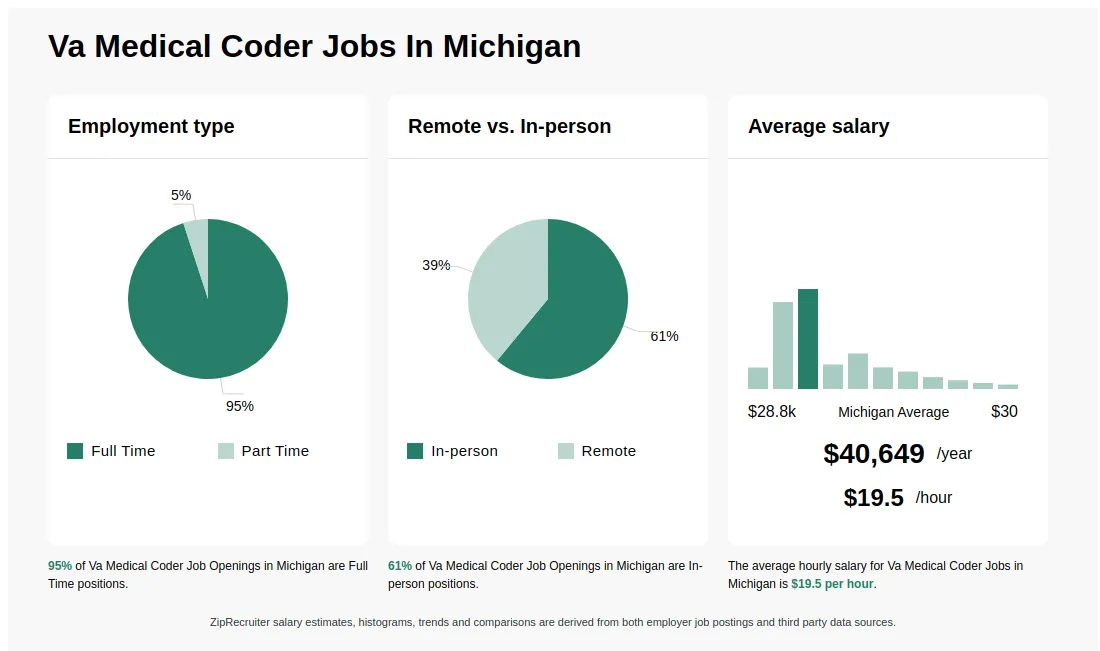
As of Aug 15, 2026, the average hourly pay for va medical coder in Michigan is $19.54, according to ZipRecruiter salary data. Most workers in this role earn between $15.72 and $20.96 per hour, depending on experience, location, and employer.

Does the VA use medical coders?

Yes, the VA employs medical coders to review and assign appropriate codes for patient diagnoses and procedures in their healthcare system. VA medical coders typically need knowledge of medical coding systems like ICD-10 and CPT, and may require certification. They work within the VA's electronic health record environment to ensure accurate billing and record-keeping.

How to become a VA medical coder?

To become a VA medical coder, you typically need to complete a medical coding training program or obtain certification such as the Certified Professional Coder (CPC) or Certified Coding Specialist (CCS). Experience with medical records, coding systems like ICD-10 and CPT, and familiarity with VA healthcare procedures are also important for employment in this role.

What are the typical challenges faced by a VA medical coder and how can they be overcome?

VA Medical Coders often encounter challenges such as keeping up with evolving coding guidelines, accurately interpreting complex medical records, and ensuring compliance with both VA and federal regulations. Staying current through regular training, certification renewals, and active participation in industry forums can help address these challenges. Collaboration with healthcare providers and other coding professionals is also key, as it allows coders to clarify documentation and share best practices. By being proactive in their professional development and communication, VA Medical Coders can maintain high accuracy and efficiency in their work.

What is a VA medical coder?

A VA Medical Coder is responsible for reviewing medical records and assigning standardized codes for diagnoses, procedures, and treatments provided to veterans. These codes help ensure accurate billing, proper data tracking, and compliance with healthcare regulations. VA Medical Coders must understand medical terminology, anatomy, and coding guidelines (ICD, CPT, and HCPCS). They work in VA hospitals, clinics, or remotely to support the Veterans Health Administration. Certification, such as CPC or CCS, is often required for this role.

Is there still a demand for va medical coders?

VA medical coders are in demand due to ongoing needs for accurate medical billing and coding within the Veterans Affairs healthcare system. The role requires knowledge of medical terminology, coding systems like ICD-10 and CPT, and often involves certification, making it a stable career choice with consistent employment opportunities.

What are the key skills and qualifications needed to thrive as a VA medical coder?

To thrive as a VA Medical Coder, you need expertise in medical coding procedures, knowledge of medical terminology, anatomy, and compliance with HIPAA regulations, often supported by certification such as CPC or CCS. Familiarity with coding software, electronic health record (EHR) systems, and VA-specific coding guidelines is crucial. Strong attention to detail, analytical thinking, and effective communication skills set top performers apart in this role. These abilities are vital for ensuring accuracy in coding, maintaining regulatory compliance, and supporting optimized healthcare reimbursement processes within the VA system.

What are the most commonly searched types of Va Medical Coder jobs in Michigan?

The most popular types of Va Medical Coder jobs in Michigan are:

What cities in Michigan are hiring for Va Medical Coder jobs?

Cities in Michigan with the most Va Medical Coder job openings:

Infographic showing various Va Medical Coder job openings in Michigan as of August 2026, with employment types broken down into 86% Full Time, and 14% Contract. Highlights an 100% In-person job distribution, with an average salary of $40,649 per year, or $19.5 per hour.

Nurse (RN/LPN) - VA First Responder Program

Sanford Careers

Grand Rapids, MI โ€ข On-site

$33 - $36.40/hr

Other

Re-posted 11 hours ago


Job description

Looking for a nursing role where your care truly matters? Join Sanford Behavioral Health in supporting Veterans and First Responders on their journey to recovery.

Job Summary

The role of the RN/LPN in Sanford’s Veteran and First Responder program is to assess and identify clients’ needs, then implement and monitor the patient’s medical plan and treatment. This position ensures that patient care is being conducted according to policies and standards set by Sanford Behavioral Health. This role is also responsible for establishing a positive and trusting rapport with Veteran and First Responder clients. As a nurse, this position will provide high-quality, client-centered care to Veterans and Frist Responders struggling with behavioral health and substance abuse challenges.

Night shift Available (3rd shift 7pm - 7am)!

Role and Responsibilities

  • Understanding the unique challenges and culture of Veterans and First Responders.
  • Ensures clients remain medically stable and continuously assesses appropriate level of care using level of care guidelines.
  • Trains, supports, and communicates with resident support specialists on medication administration as well as with other job functions.
  • Communicates client concerns to the provider daily, which includes but is not limited to, acute withdrawal symptoms, medication effectiveness, medication side effects, and/or abnormal vital signs.
  • Works closely with interdisciplinary treatment team to ensure client safety and comfort. This includes clinicians, safety officers, recovery technicians, resident support specialists, and administration.
  • Performs daily assessments on residential clients regarding their substance use disorder, mental health illness, eating disorder, or other medical concerns that may arise.
  • Identifies medical parameters that require additional intervention, or staffing with provider, including laboratory values, vital signs, and one-on-one conversation or observation of behavior.
  • Assesses client suicidality and possibility of danger to self or others.
  • Provides effective communication by directing clients in a clear, concise, and informative manner.
  • Safely administers medications, including narcotics through identifying mechanism of action, contraindications, and interactions of medications used to treat alcohol and drug withdrawal.
  • Educates clients on medications, as needed.
  • De-escalates clients and therapeutically responds to clinical signs/symptoms of withdrawal including increased anxiety, irritability, agitation, and aggression while maintaining professional boundaries and fostering a trusting nurse to client relationship.
  • Utilizes an electronic medical record (EMR) system for all documentation.
  • Obtains appropriate orders from the provider and submits e-prescriptions as needed for all clients.
  • Completes documentation and medication ordering in a timely manner.
  • Works with local emergency departments on coordinating care and incoming transfers.
  • Protects patients’ rights by maintaining confidentiality of medical, personal, and financial information.
  • Meets regularly with the interdisciplinary team to discuss client treatment.
  • Counts all controlled medications every shift and logs appropriately in the medication log.
  • Ensures all orders from providers are carried out and any information about clients and their wellbeing is promptly and clearly communicated to providers as well as during treatment team meetings.
  • Completes admission and discharge paperwork.
  • Assists in other units/departments when there are changes in census, staffing or a need for a higher level of care than what current staffing can provide, as needed.
  • Transports clients using a company vehicle when other staff members are unavailable.
  • Performs blood draws, as ordered by the provider.
  • Collects samples for urinalysis and urine drug screens.
  • Obtains vital signs or orthostatic vital signs, as needed.
  • Attends and stays up to date on trainings and policies, like Handle With Care, Basic Life Support (BLS), and HIPAA.
  • Adheres to the established Code of Ethics, Standards of Practice, Patient Centered Philosophy and employee handbook.
  • Keeps professional license current and in good standing with the state of Michigan.
  • Actively engages with the milieu during periods of downtime.
  • Works collaboratively and autonomously to provide 24/7 nursing care to clients experiencing acute mild to severe signs and symptoms of withdrawal from alcohol and drugs with medical and psychiatric co-morbidities using critical thinking, nursing judgment and standardized assessments including Clinical Opiate Withdrawal (COW) and Clinical Institute Withdrawal Assessment (CIWA) scales.
  • Assesses sedation levels using standardized scales, including Richmond Agitation-Sedation Scale (RASS).
  • Determines appropriate level of care using American Society of Addiction Medicine (ASAM) care guidelines.
  • Conducts alcohol or other drug-focused nursing assessments at time of admission communicating any medical needs or concerns to the provider.
  • Performs stability checks on all clients prior to admission to ensure they meet ASAM 3.7 guidelines for admission.
  • Identifies and responds to drug and alcohol intoxication including signs/symptoms of drug overdose and drug and alcohol withdrawal.
  • Identifies signs/symptoms of severe withdrawal and responds to medical emergencies calmly and safely using evidence-based practices and established protocols. These can include seizures, delirium tremens, overdose, psychosis, and suicidal ideations/attempts.
  • Educates clients on the neuroscience and process of addiction and withdrawal, including leading groups.
  • Helps with Medication Assisted Therapy (MAT) clients, as needed.
  • Facilitates Vivitrol Enrollment for all clients, as needed.
  • Attends mandatory monthly nursing meetings for continuity of care, education and implementing new processes.
  • Performs other duties, as assigned.

Qualifications and Education Requirements

  • Experience working with the Veteran/First Responder population, preferred.
  • Registered Nurse (RN) or Licensed Practical Nurse (LPN) with current licensure in Michigan, required.
  • Current CPR/BLS Certification, required.
  • Two (2) years of experience with extensive knowledge of mental health issues and substance use disorders, preferred.
  • Experience working with trauma, preferred.
  • If a Veteran, honorable discharge, required.
  • Able to work night shift (7pm - 7am)

Knowledge/Skills/Abilities

  • Ability to maintain strict confidentiality on all client records and business-related records, as required under HIPAA guidelines.
  • Knowledge of substance use disorders, eating disorders, mental health illnesses and associated treatments.
  • Ability to access substance abuse withdrawal.
  • Ability to demonstrate attention to detail and efficient time management.
  • Knowledge and proficiency in medication administration.
  • Ability to adhere to and knowledge of all HIPAA guidelines.
  • Ability to demonstrate communication skills, self-motivation, organization skills, critical thinking, and good decision-making abilities.
  • Knowledge of electronic medical records (EMR).
  • Ability to navigate various computer programs efficiently (i.e., email, SharePoint, etc.)
  • Ability to identify own strengths and areas of improvement and communicate needs to supervisor.
  • Demonstrates professional behavior reflective of Sanford’s Mission Statement, Philosophy, and Values.
  • Must be able to relate well to all kinds of people both inside and outside the organization; build appropriate rapport; build constructive and effective relationships; uses diplomacy and tact; can diffuse even high-tension situations comfortably.
  • Must possess positive attitude to enhance a cooperative and energetic work environment.
  • Ability to be accountable and ability to take/give constructive feedback.

Physical Requirements

  • Prolonged periods of standing and walking are required (4-8 hours).
  • Must be able to sit at a desk for various durations while working on a computer.
  • Must be able to lift prone patients with assistance or use of equipment.
  • Must be able to use laboratory equipment, i.e., centrifuge, phlebotomy tools, basic medical equipment, etc.
  • Must be able to adapt to the physical demands of lifting clients, bending, stooping, and stretching with or without assistance.
  • Must be able to safely handle biohazardous materials, i.e., blood and urine, etc.
  • Must be able to perform repetitive tasks such as typing for extended periods of time.
  • Must be able to clearly express and exchange ideas by means of spoken word to impart oral information to employees or others accurately or quickly, engaging in sometimes lengthy conversations or presentations.
  • Must be able to ascend and descend stairs daily.
  • Must be able to seize, hold, grasp, turn or otherwise work with your hand or hands.
  • Must be able to perceive sound by ear to interpret oral information from employees or others accurately or quickly.
  • Must be able to lift and carry medical supplies, medications, etc. weighing up to 45 pounds, as required.
  • May occasionally carry or lift items in excess of 35 pounds, with or without assistance.
  • May occasionally push/pull medical equipment of varying weights, with or without assistance.
  • Work will be performed in an office environment with fluctuating temperatures.

ADA Disclaimer

The employee must be able to perform the essential functions of the position adequately. If requested, reasonable accommodations will be provided to enable employees with disabilities to perform the essential functions of their job, absent undue hardship. All requests must be made to the Human Resource Department in writing.