1

Unlicensed Clinical Psychologist Jobs (NOW HIRING)

This position includes clinical supervision of selected, pre-professional graduate trainees and unlicensed doctoral level psychology staff as assigned by the Directors of Counseling or their designee.

Psychologist- Days $9000 Bonus

Fredonia, KY

$74K - $102K/yr

... unlicensed healthcare team members, and have best in class clinical resources for training ... As a Psychologist in a correctional or detention facility, the role involves providing clinical ...

Clinical Supervisor

Norwalk, CA · On-site

$89K - $107K/yr

... unlicensed clinical staff, ensuring the integration of clinical and non-clinical services while ... Master's degree in social work, psychology, counseling, marriage and family therapy, or a related ...

Showing results 21-40

Unlicensed Clinical Psychologist information

See salary details

$60K

$109.9K

$159K

How much do unlicensed clinical psychologist jobs pay per year?

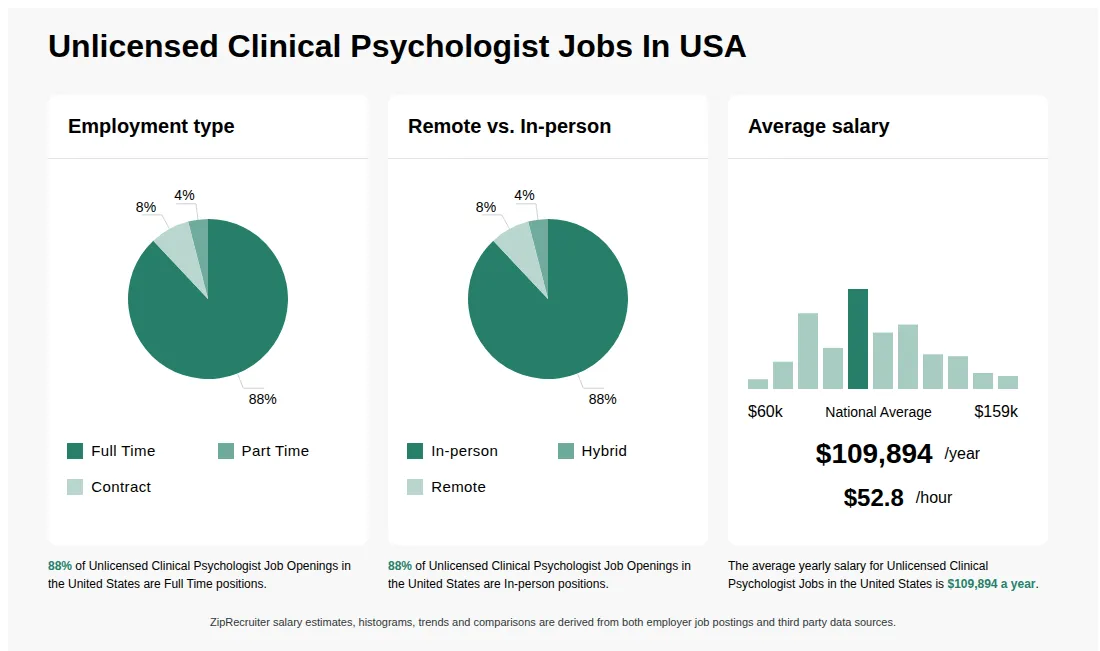
As of Sep 5, 2026, the average yearly pay for unlicensed clinical psychologist in the United States is $109,894.00, according to ZipRecruiter salary data. Most workers in this role earn between $88,500.00 and $122,000.00 per year, depending on experience, location, and employer.

What is an unlicensed clinical psychologist?

An unlicensed clinical psychologist is an individual who has completed the educational requirements for a clinical psychology degree, such as a PhD or PsyD, but has not yet obtained a state license to practice independently. They may work under supervision in clinical settings, often as part of their postdoctoral training, and assist with assessments, therapy, or research. However, they are not legally permitted to provide psychological services independently or use the title 'licensed psychologist' until they fulfill all licensure requirements, which typically include passing relevant exams and completing supervised clinical hours.

What is an unlicensed clinical psychologist?

An unlicensed clinical psychologist is a psychologist who has completed the necessary schooling to become a clinical psychologist but has yet to meet the internship or residency requirements for their state or passed the subsequent licensing exam. An unlicensed clinical psychologist has a master’s degree in psychology, a PsyD, or Ph.D. Their duties involve working in a clinic, counseling practice, or mental health facility while they complete their required residency or internship program. These residency programs typically last two years.

What are the key skills and qualifications needed to thrive as an unlicensed clinical psychologist, and why are they important?

To thrive as an Unlicensed Clinical Psychologist, you typically need a strong academic background in psychology, experience with psychological assessment, and supervised clinical training. Familiarity with standardized diagnostic tools, psychological testing software, and case management systems is commonly required. Exceptional interpersonal skills, active listening, and ethical sensitivity help build rapport and trust with clients, even when working under supervision. These competencies ensure effective client support, accurate assessment, and ethical practice while working toward full licensure.

What are some common challenges faced by unlicensed clinical psychologists in clinical settings?

Unlicensed clinical psychologists often face the challenge of limited autonomy, as they must work under the direct supervision of a licensed psychologist. This can sometimes restrict their ability to make independent treatment decisions and may require additional documentation or case reviews. Another challenge is the need to balance learning and professional growth with providing high-quality care, as supervisors will regularly assess their clinical skills and ethical standards. Despite these challenges, the role offers valuable hands-on experience and opportunities for mentorship, which are essential for eventual licensure and career advancement.

What is the difference between Unlicensed Clinical Psychologist vs Licensed Clinical Psychologist?

AspectUnlicensed Clinical PsychologistLicensed Clinical Psychologist
CredentialsTypically has completed education and training but lacks licensureHolds valid state licensure and certification
Work EnvironmentMay work under supervision or in research settingsPractices independently in clinical settings
Employer & Industry UsageResearch institutions, educational settings, or supervised rolesHospitals, private practices, mental health clinics

Unlicensed Clinical Psychologists have completed their education but lack licensure, limiting their ability to independently provide clinical services. Licensed Clinical Psychologists have met all licensing requirements, allowing them to practice independently. The key difference lies in licensure status, impacting their scope of practice and employment opportunities.

What cities are hiring for Unlicensed Clinical Psychologist jobs?

Cities with the most Unlicensed Clinical Psychologist job openings:

What are the most commonly searched types of Unlicensed Clinical Psychologist jobs?

The most popular types of Unlicensed Clinical Psychologist jobs are:

What states have the most Unlicensed Clinical Psychologist jobs?

States with the most job openings for Unlicensed Clinical Psychologist jobs include:

Infographic showing various Unlicensed Clinical Psychologist job openings in the United States as of August 2026, with employment types broken down into 3% As Needed, 71% Full Time, 18% Part Time, and 8% Contract. Highlights an 95% Physical, 1% Hybrid, and 4% Remote job distribution, with an average salary of $109,894 per year, or $52.8 per hour.

Training Director/Psychologist

Istss

Cleveland, OH • On-site

$70 - $90/hr

Other

Posted 4 days ago


Job description

POSITION OBJECTIVE

The Training Director will be responsible for the development, recruitment, management, and oversight of all Counseling Services training programs, including psychology, social work, and clinical counseling. The training director ensures smooth operation of training program functions as well as clinical supervision necessary for each mental health subfield. Additionally, the training director is a member of the clinical staff and provides age specific, developmentally appropriate clinical counseling and mental health services to students and other members of the university community within an integrated healthcare and wellness model. The training director provides direct service to students; consultation on mental health and wellness issues to faculty, staff and students; and participates in wellness, health promotion and outreach efforts for the Case Western Reserve University, as assigned. This role supports the University Health and Counseling Services mission of enhancing the health and well-being of the student community and providing high quality, multidisciplinary mental health-related services. All members of the University Health and Counseling Services staff are considered essential and are expected to work on-campus in accordance with university guidance.

This position is expected to contribute to building an environment welcoming of all members of our community where all feel safe, supported, respected, and valued.

ESSENTIAL FUNCTIONS
  • Provide direct counseling and mental health services to students presenting with a range of mental health and wellness needs within the established counseling model. Services include same day initial contact sessions, same day crisis management sessions, workshops, and ongoing individual and group counseling sessions. As an Ohio licensed psychologist, may be called on to initiate involuntary hospitalization procedures for students at imminent risk of harm to self or others. (40%)
  • Meet all requirements for maintaining American Psychological Association (APA) accreditation for the University Health and Counseling Services Psychology Doctoral Internship Training program, including communication with the APA Committee on Accreditation regarding credentialing and program maintenance. Manage and ensure compliance with didactic, supervision, and evaluation requirements; and oversee University Health and Counseling Services participation in the Association of Psychology Postdoctoral and Internship Centers (APPIC) selection and match process. Maintain part-time trainee programs in social work and clinical counseling. Maintain up to date knowledge of training and supervision requirements for mental health subfields, including current legal and ethical standards regarding the provision of clinical training. (20%)
  • Develop and manage processes for trainee recruitment, interviews, and selection for: APA-accredited doctoral internship program, social work trainee positions, counseling trainee positions, and psychology practicum trainee positions, and any additional training positions, as assigned. (15%)
  • Administrative responsibility for: a) overseeing clinical supervision processes, including: assigning clinical supervisors in consultation with the leadership team, meeting routinely with supervisors and trainees to address training concerns, clinical evaluation of supervisees and supervisors; b) providing regularly scheduled clinical supervision and training of pre-professional psychology graduate trainees (e.g. psychology practicum students, doctoral interns) and unlicensed doctoral level psychology staff, as assigned; and c) developing and managing didactic training schedule for trainees. (15%)
NONESSENTIAL FUNCTIONS
  • Provide consultation services to university faculty, staff and students on mental health and wellness to help students access appropriate levels of care. (5%)
  • Participate in wellness, health promotion and outreach programming to promote campus-wide mental health and wellness initiatives.
  • Participate in departmental committees and other university activities, as assigned (2.5%)
  • Perform other duties as assigned (2.5%)
CONTACTS

Department: Continuous contact with professional and support staff of the University Health and Counseling Services for scheduling, clinical consultation and collaborative work in an integrated model.

University: Frequent contact with university deans, faculty, staff and administrators to establish and coordinate support for students dealing with mental health and academic issues. Periodic contact throughout the university during public health support efforts.

External: Moderate contact with mental health training programs and training directors in the area. Moderate contact with care providers outside the university to assist in the coordination of care for students being treated in the community.

Students: Continuous contact with students to provide direct counseling and mental health services to students presenting with a range of mental health and wellness needs.

SUPERVISORY RESPONSIBILITY

This position has no direct administrative supervisory responsibility. This position includes clinical supervision of selected, pre-professional graduate trainees and unlicensed doctoral level psychology staff as assigned by the Directors of Counseling or their designee.

QUALIFICATIONS

Experience: Minimum of 4 years professional experience (2 of which must be post-licensure) in mental health care is required. Experience providing clinical supervision required. Experience with adolescent and young adult populations, experience within a university setting, and/or experience with an APA accredited internship program is strongly preferred.

Education: Doctorate degree (Ph.D. or Psy.D.) in Clinical or Counseling Psychology is required. Independent license (or immediately license-eligible) in the state of Ohio as a Psychologist is required.

REQUIRED SKILLS
  • Demonstrated clinical skills: experience and ability to appropriately diagnose and treat a wide variety of clinical conditions and accurately assess risk of harm to self and/or others based on clinical evaluation and/or collateral report.
  • Demonstrated supervision and training skills: ability to provide developmentally appropriate clinical supervision, maintain ethical boundaries, and design and facilitate training seminars.
  • Demonstrated consultation skills: ability to work collaboratively with clinical and non-clinical individuals and teams (both internal/external to the university) in order to appropriately assess the clinical and support needs of students and connect them to the appropriate level of care.
  • Ability to demonstrate concern for understanding and satisfying needs of customers, co-workers and others with economy, efficiency, flexibility, courtesy, good judgement and continuous measurable improvements.
  • Knowledge of and experience with electronic medical record systems and privacy requirements.
  • Adherence to federal and state laws and university protocols designed to protect the privacy rights of students.
  • Ability to meet consistent attendance and demonstrate dependable work habits.
  • Demonstrated history of successful support, education, and advocacy for all students, aligned with the values, mission, and messaging of the university, while adhering to the staff policy on conflict of commitment and interest.
  • Ability to interact with colleagues, supervisors, trainees and customers face to face.
  • Knowledge, experience and training in telehealth.
  • Willingness to learn and work with Artificial Intelligence (AI) tools and technologies.
WORKING CONDITIONS

Standard Health and Counseling offices in a university campus setting.

Full-time professionals are exempt from overtime and are expected to work a minimum of 40 hours per week around the university’s core hours of operation. University Health and Counseling Services clinical work, outreach and campus crisis/emergency response efforts may require University Health and Counseling Services staff to work evenings and weekends. This position may be eligible for hybrid work after successful completion of orientation period.

Staff may be required to adjust their clinical and administrative assignments, as needed, depending on departmental, divisional and university needs. This may involve flexing to cover other clinical roles (e.g., covering acute counseling care responsibilities, covering ongoing counseling responsibilities, alternating between roles, etc.) due to staff absence, changes in the model of care, or other reasons determined by the Assistant Vice President of University Health and Counseling Services or their designee.

Staff are expected to provide services on-site and in-person, with the understanding that there may be aspects of their role and responsibilities that could shift to virtual and/or via hybrid modalities, depending on university requirement, departmental need, public health guidance and/or at the discretion of the Assistant Vice President of University Health and Counseling Services or their designee.

#J-18808-Ljbffr