1

Technical Superintendent Jobs (NOW HIRING)

Assistant Technical Superintendent

Tampa, FL · On-site

$35K - $41K/yr

... Technical Superintendent or other engineering personnel in technical matters relating to the proper functioning of the technical staff * Represent OSG in a professional manner to provide efficient ...

NY · On-site

Ensure assigned superintendents are meeting performance and budget targets for their vessel assignments. * Maintain direct technical accountability for a limited number of assigned vessels. * Ensure ...

New

Technical Superintendents and Assistant Technical Superintendents Required Qualifications Education Bachelor's degree in engineering required. Experience Seven or more years of experience in marine ...

Technical Superintendents and Assistant Technical Superintendents Required Qualifications Education Bachelor's degree in engineering required. Experience Seven or more years of experience in marine ...

Showing results 21-40

Technical Superintendent information

See salary details

$51K

$152.3K

$193.5K

How much do technical superintendent jobs pay per year?

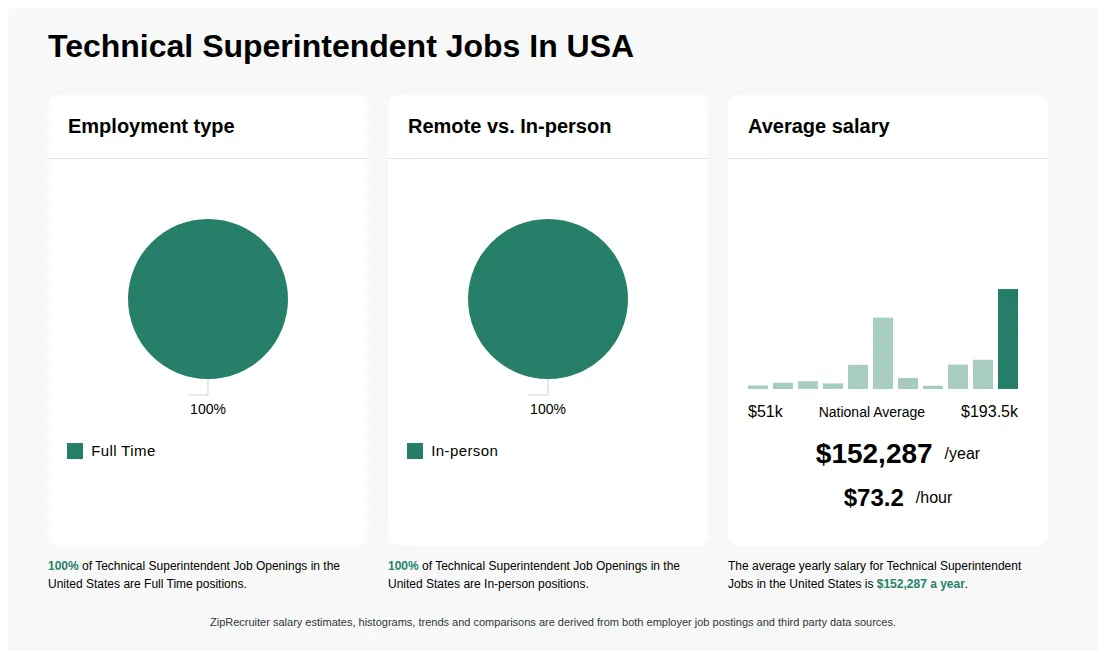
As of Sep 14, 2026, the average yearly pay for technical superintendent in the United States is $152,287.00, according to ZipRecruiter salary data. Most workers in this role earn between $116,500.00 and $181,000.00 per year, depending on experience, location, and employer.

What is a technical superintendent?

A Technical Superintendent is a maritime professional responsible for overseeing the technical management and maintenance of a fleet of ships. Their duties include ensuring vessels are in compliance with safety and environmental regulations, managing repairs and dry-dockings, and coordinating with ship crews and third-party contractors. They also handle budgeting for maintenance and technical operations, as well as resolving any technical issues that arise. Technical Superintendents play a crucial role in ensuring the operational readiness and safety of ships under their care.

What are the key skills and qualifications needed to thrive as a technical superintendent, and why are they important?

To thrive as a Technical Superintendent, you need an in-depth understanding of marine engineering principles, vessel operations, and regulatory compliance, typically supported by a degree in marine engineering or a related field and relevant seafaring experience. Familiarity with planned maintenance systems (PMS), fleet management software, and international maritime regulations (such as IMO and ISM codes) is essential. Strong leadership, problem-solving abilities, and effective communication skills help you manage crews, coordinate repairs, and ensure operational efficiency. These competencies are vital for maintaining vessel safety, minimizing downtime, and ensuring regulatory compliance in the shipping industry.

What are some common challenges a technical superintendent faces when managing multiple vessels, and how can these be effectively addressed?

Technical Superintendents often oversee the maintenance and operational readiness of several vessels at once, which can lead to challenges such as balancing competing priorities, ensuring compliance with safety and environmental regulations, and coordinating repairs within tight schedules. Effective communication with ship crews, vendors, and classification societies is essential to address these challenges. Utilizing strong organizational skills, proactive planning, and digital management tools can help streamline workflows and minimize downtime, ensuring all vessels operate efficiently and within regulatory standards.

What is the difference between Technical Superintendent vs Marine Engineer?

AspectTechnical SuperintendentMarine Engineer
CredentialsEngineering degree, certifications in marine systemsMarine engineering degree, certifications in engine operation
Work EnvironmentOffice-based, ship visits, overseeing multiple vesselsOnboard ship, operating and maintaining engines
Employer & IndustryShipping companies, fleet managementShipping companies, ship operations

The Technical Superintendent manages vessel maintenance and compliance from an office, ensuring fleet standards. Marine Engineers work onboard ships, focusing on engine operation and repairs. While both roles require engineering credentials and are integral to maritime operations, the Technical Superintendent oversees multiple vessels remotely, whereas Marine Engineers are hands-on onboard the ships.

More about Technical Superintendent jobs

What cities are hiring for Technical Superintendent jobs?

Cities with the most Technical Superintendent job openings:

What are the most commonly searched types of Technical Superintendent jobs?

The most popular types of Technical Superintendent jobs are:

Who are the top companies hiring for Technical Superintendent jobs?

The top employers for Technical Superintendent jobs are:

What states have the most Technical Superintendent jobs?

States with the most job openings for Technical Superintendent jobs include:

What are popular job titles related to Technical Superintendent jobs?

For Technical Superintendent jobs, the most frequently searched job titles are:

Infographic showing various Technical Superintendent job openings in the United States as of September 2026, with employment types broken down into 1% Internship, 1% As Needed, 86% Full Time, 9% Part Time, 2% Contract, and 1% Nights. Highlights an 88% Physical, 3% Hybrid, and 9% Remote job distribution, with an average salary of $152,287 per year, or $73.2 per hour.

Assistant Technical Superintendent

Tampa, FL • On-site

$35K - $41K/yr

Full-time

Re-posted 26 days ago


Job description

Purpose of the Position:

Assist Fleet Managers and Superintendents in supporting the repair, maintenance and operation of OSG vessels. 

Core Job Functions:  

  • Assure vessel compliance to OSG Safety, Quality and Environmental (SQE) Policy
  • Assist in the Supervising of maintenance and repair to optimize vessel availability while protecting asset value
  • Logistical support of vendor repairs
  • Assist in creating and monitoring vessel operating budgets
  • Support shore side operations department in repair and maintenance for vessels including routine voyage repairs, regulatory surveys, dry docking shipyard events, emergencies, casualties and modifications.  Extensive shipyard attendance required
  • Attend vessels on regular basis to assure crew compliance to OSG SQE program and to verify vessel maintenance and asset preservation
  • Assist in maintaining technical files including service report, machinery history, and regulatory required documentation
  • Assist in monitoring maintenance budget including routine and major maintenance as well as engine consumables
  • Monitor and assure maintenance software (NS5) is utilized properly, verifying repairs and maintenance are properly reported and standard jobs are followed
  • Participate in office and shipboard ISM audits
  • Assist in tracking and responding to SQE SDRs when associated with technical issues
  • Assist in the tracking and approval of engine spares and stores requirements
  • Assist Technical Superintendent or other engineering personnel in technical matters relating to the proper functioning of the technical staff
  • Represent OSG in a professional manner to provide efficient and economic service to all customers

Core Competencies

  • Bachelor’s degree in marine field, Maritime Academy graduate preferred, or five years equivalent experience required
  • Knowledge of ABS / NS5 or similar software helpful
  • Knowledge and understanding of American Bureau of Shipping, United States Coast Guard and international regulations and protocols relating to company vessels required
  • United State Coast Guard license of Second Assistant or higher preferred
  • Strong computer skills and working knowledge of Microsoft Office products required

Significant Factors:

  • Written and verbal communications at all organizational levels in a clear and concise manner
  • Strong ability to manage multiple tasks requiring solid planning, control, review and cost projection/variance analysis skills
  • Highly developed prioritization and organizational skills and attention to detail
  • High level of analytical skill and process management ability
  • Ability to drive long distances (up to 5 hours) and/or travel by air to various US ports possibly requiring overnight stays
  • Ability to board vessels in port (requires using a gangway with a grade of 30-60 degrees)
  • Ability to climb ladders and navigate over uneven surfaces during vessel visits
  • Ability to board vessels at anchor (climb a Jacob’s ladder from a water taxi)
  • Possess good sensory perception (sight, smell, hearing, touch)
  • Ability to enter and inspect confined spaces
  • Willingness to remain accessible for communication and consultation on an around the clock basis and work unusual hours, including nights and weekends as required