Systems Engineer
Albuquerque, NM · On-site
Job Summary: The Systems Engineer supports the engineering, design, integration, verification, documentation, and lifecycle sustainment of prototype and operational satellite ground systems ...
Quick apply
Albuquerque, NM · On-site
Job Summary: The Systems Engineer supports the engineering, design, integration, verification, documentation, and lifecycle sustainment of prototype and operational satellite ground systems ...
Quick apply
Albuquerque, NM · On-site
Job Summary: The Systems Engineer supports the engineering, design, integration, verification, documentation, and lifecycle sustainment of prototype and operational satellite ground systems ...
Albuquerque, NM · On-site
Job Summary: The Systems Engineer supports the engineering, design, integration, verification, documentation, and lifecycle sustainment of prototype and operational satellite ground systems ...
Quick apply
Albuquerque, NM · On-site
Job Summary: The Systems Engineer supports the engineering, design, integration, verification, documentation, and lifecycle sustainment of prototype and operational satellite ground systems ...
Bellevue, NE · On-site
System Engineer Location: Offutt AFB, NE Minimum Clearance Required: Top Secret with SCI eligibility This position requires the ability to obtain and maintain a Top Secret U.S. Government Security ...
Bellevue, NE · On-site
System Engineer Location: Offutt AFB, NE Minimum Clearance Required: Top Secret with SCI eligibility This position requires the ability to obtain and maintain a Top Secret U.S. Government Security ...
Alexandria, VA · On-site
Job#: 3042401 Systems Engineer Location: Alexandria, Virginia (Onsite) Role Overview A government customer is seeking a Systems Engineer to support a Counter-Unmanned Aircraft Systems (C-UAS) mission.
Alexandria, VA · On-site
Job#: 3042401 Systems Engineer Location: Alexandria, Virginia (Onsite) Role Overview A government customer is seeking a Systems Engineer to support a Counter-Unmanned Aircraft Systems (C-UAS) mission.
Odon, IN · On-site
Precise Systems is seeking a Systems Engineer to support the development, integration, testing, fielding, and lifecycle sustainment of multiple systems. The engineer will apply systems-engineering ...
Odon, IN · On-site
Precise Systems is seeking a Systems Engineer to support the development, integration, testing, fielding, and lifecycle sustainment of multiple systems. The engineer will apply systems-engineering ...
The Systems Engineer is responsible forupdating and maintaining computer systems and networks with software andsecurity patches and evaluating application impact. The target systemsinclude Linux Red ...
The Systems Engineer is responsible forupdating and maintaining computer systems and networks with software andsecurity patches and evaluating application impact. The target systemsinclude Linux Red ...
San Luis Obispo, CA · On-site
$90K - $120K/yr
Systems Engineer Job Summary: The Systems Engineer will play a key role in supporting the development, integration, and delivery of advanced aerospace systems. This position is responsible for ...
Quick apply
San Luis Obispo, CA · On-site
$90K - $120K/yr
Systems Engineer Job Summary: The Systems Engineer will play a key role in supporting the development, integration, and delivery of advanced aerospace systems. This position is responsible for ...
Huntsville, AL · On-site
$88K - $149K/yr
We are seeking a motivated Systems Engineer to join our dynamic, cross-functional team. In this role, you will support the planning, design, and integration of complex technical challenges that ...
Huntsville, AL · On-site
$88K - $149K/yr
We are seeking a motivated Systems Engineer to join our dynamic, cross-functional team. In this role, you will support the planning, design, and integration of complex technical challenges that ...
Clearfield, UT · On-site
$107K - $182K/yr
We are seeking a motivated Junior Systems Engineer to join our dynamic, cross-functional team. In this role, you will support the planning, design, and integration of complex technical challenges ...
Clearfield, UT · On-site
$107K - $182K/yr
We are seeking a motivated Junior Systems Engineer to join our dynamic, cross-functional team. In this role, you will support the planning, design, and integration of complex technical challenges ...
Clearfield, UT · On-site
$107K - $182K/yr
We are seeking a motivated Junior Systems Engineer to join our dynamic, cross-functional team. In this role, you will support the planning, design, and integration of complex technical challenges ...
Clearfield, UT · On-site
$107K - $182K/yr
We are seeking a motivated Junior Systems Engineer to join our dynamic, cross-functional team. In this role, you will support the planning, design, and integration of complex technical challenges ...
Fairfax, VA · On-site
$61K - $113K/yr
Systems Engineer Requisition ID: 1822 Position Location: Fairfax, VA Position Reports To: Manager, Software Engineering Supervises Others: No Trident has built a reputation as a trusted provider of ...
Quick apply
Fairfax, VA · On-site
$61K - $113K/yr
Systems Engineer Requisition ID: 1822 Position Location: Fairfax, VA Position Reports To: Manager, Software Engineering Supervises Others: No Trident has built a reputation as a trusted provider of ...
Huntsville, AL · On-site
$88K - $149K/yr
We are seeking a motivated Systems Engineer to join our dynamic, cross-functional team. In this role, you will support the planning, design, and integration of complex technical challenges that ...
Huntsville, AL · On-site
$88K - $149K/yr
We are seeking a motivated Systems Engineer to join our dynamic, cross-functional team. In this role, you will support the planning, design, and integration of complex technical challenges that ...
Manchester, NH · On-site
$115K - $196K/yr
BAE Systems is looking Systems Engineering Leads to work as part of a cross-functional, multi-disciplinary team to design, integrate, debug, and test next generation EW systems. Focused on delivering ...
Manchester, NH · On-site
$115K - $196K/yr
BAE Systems is looking Systems Engineering Leads to work as part of a cross-functional, multi-disciplinary team to design, integrate, debug, and test next generation EW systems. Focused on delivering ...
Clearfield, UT · On-site
$107K - $182K/yr
We are seeking a motivated Junior Systems Engineer to join our dynamic, cross-functional team. In this role, you will support the planning, design, and integration of complex technical challenges ...
Clearfield, UT · On-site
$107K - $182K/yr
We are seeking a motivated Junior Systems Engineer to join our dynamic, cross-functional team. In this role, you will support the planning, design, and integration of complex technical challenges ...
Huntsville, AL · On-site
$88K - $149K/yr
We are seeking a motivated Systems Engineer to join our dynamic, cross-functional team. In this role, you will support the planning, design, and integration of complex technical challenges that ...
Huntsville, AL · On-site
$88K - $149K/yr
We are seeking a motivated Systems Engineer to join our dynamic, cross-functional team. In this role, you will support the planning, design, and integration of complex technical challenges that ...
Nashua, NH · On-site
$118K - $200K/yr
Are you a Systems Engineer with 2 to 20+ years of experience looking for the next step to grow your career? Do you want to develop products that support a cause greater than yourself? Help us develop ...
Nashua, NH · On-site
$118K - $200K/yr
Are you a Systems Engineer with 2 to 20+ years of experience looking for the next step to grow your career? Do you want to develop products that support a cause greater than yourself? Help us develop ...
The Systems Engineer supports the Tethered Aerostat Radar System (TARS) Program through the development, integration, maintenance, and troubleshooting of complex systems. This role is responsible for ...
The Systems Engineer supports the Tethered Aerostat Radar System (TARS) Program through the development, integration, maintenance, and troubleshooting of complex systems. This role is responsible for ...
El Segundo, CA · On-site
$140K - $170K/yr
Space Systems Integration (SSI) is a fast-growing engineering company that provides aerospace solutions to a variety of government and commercial customers. Our employees are forward-thinking, self ...
Quick apply
El Segundo, CA · On-site
$140K - $170K/yr
Space Systems Integration (SSI) is a fast-growing engineering company that provides aerospace solutions to a variety of government and commercial customers. Our employees are forward-thinking, self ...
Virginia, MN · On-site
$95K - $145K/yr
Engineering Change Proposals; System Requirements documentation; and Work Breakdown Structures. * Participate in Configuration Management activities. * Draft, review, edit, and coordinate staffing of ...
Virginia, MN · On-site
$95K - $145K/yr
Engineering Change Proposals; System Requirements documentation; and Work Breakdown Structures. * Participate in Configuration Management activities. * Draft, review, edit, and coordinate staffing of ...
Washington, DC · On-site
We have an immediate need for a Systems Engineer to provide onsite/hybrid support in the DC/Northern Virginia Area. Responsibilities We are seeking a Systems Engineer to join the DHS Acquisition ...
Washington, DC · On-site
We have an immediate need for a Systems Engineer to provide onsite/hybrid support in the DC/Northern Virginia Area. Responsibilities We are seeking a Systems Engineer to join the DHS Acquisition ...
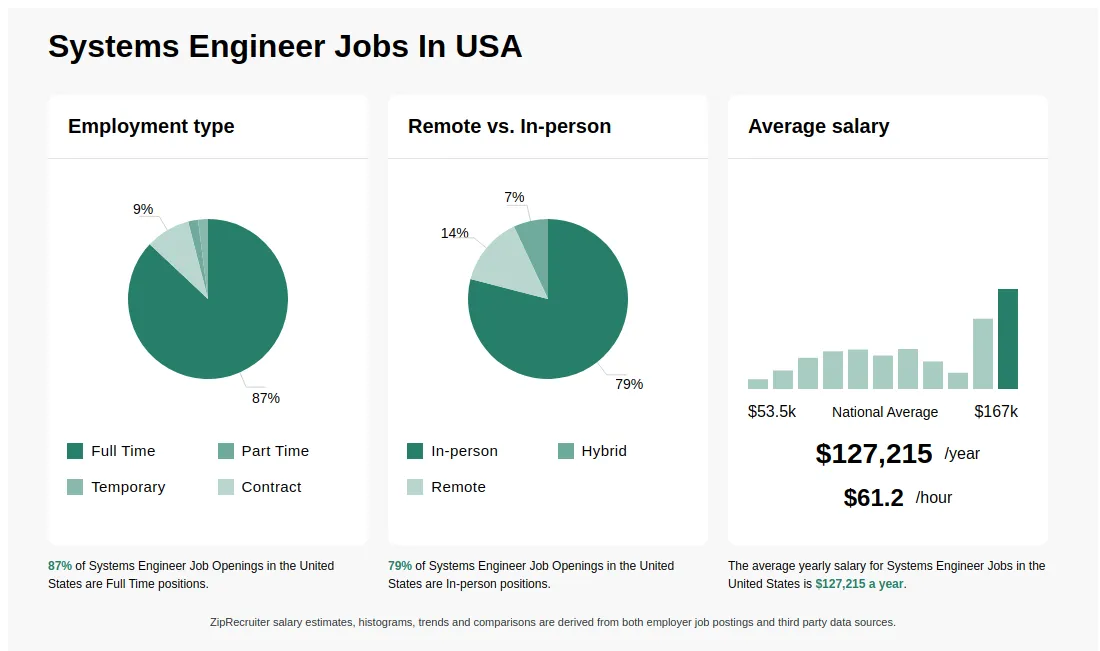
$53.5K - $63.8K
2% of jobs
$63.8K - $74.1K
4% of jobs
$74.1K - $84.5K
7% of jobs
$84.5K - $94.8K
9% of jobs
$97.6K is the 25th percentile. Wages below this are outliers.
$94.8K - $105.1K
10% of jobs
$105.1K - $115.4K
7% of jobs
$115.4K - $125.7K
10% of jobs
The median wage is $127.4K / yr.
$125.7K - $136K
6% of jobs
$136K - $146.4K
3% of jobs
$156.4K is the 75th percentile. Wages above this are outliers.
$146.4K - $156.7K
17% of jobs
$156.7K - $167K
24% of jobs
$53.5K
$127.2K
$167K
The role of a systems engineer varies based on the company they work for, but in every industry systems engineers use computerized systems to keep track of all the moving parts within their organizations. The term systems engineer usually refers to a computer systems engineer, which combines several disciplines to create, purchase, and install a computer system that suits the needs of each particular client. They will also work in a hands-on manner during the installation, acquisition, testing, and implementation phases of the project. Duties typically include making recommendations for scalability, troubleshooting any problems that arise during the use of the system, reviewing a company’s security requirements, and recommending security measures to allow the company to avoid compromising any sensitive data.
| Aspect | Systems Engineer | Network Engineer |
|---|---|---|
| Certifications | CompTIA Network+, Cisco CCNA, Microsoft certifications | CompTIA Network+, Cisco CCNA, Juniper JNCIA |
| Work Environment | Designing, implementing, and managing IT systems and infrastructure | Designing, configuring, and maintaining network hardware and connectivity |
| Industry Usage | IT, technology, enterprise solutions | Telecommunications, IT, networking service providers |
| Common Tasks | System integration, troubleshooting, server management | Network setup, routing, switching, security |
While both roles involve technical expertise in IT infrastructure, Systems Engineers focus on overall system architecture and integration, whereas Network Engineers specialize in network hardware, connectivity, and security. Understanding these differences helps employers and professionals align skills with job requirements.
Cities with the most Systems Engineer job openings:
The most popular types of Systems Engineer jobs are:
The top employers for Systems Engineer jobs are:
States with the most job openings for Systems Engineer jobs include:
For Systems Engineer jobs, the most frequently searched job titles are:

Albuquerque, NM • On-site
Full-time
Medical, Dental, Retirement, PTO
Re-posted 9 days ago
Support the engineering, design, integration, verification, and lifecycle sustainment of satellite ground systems, satellite operations centers, and supporting infrastructure.
Develop, review, and manage system designs and architectures, ensuring system interfaces are well defined and requirements remain compliant.
Support development of mission concepts, system solutions, and conduct analyses to assess technical approaches, risks, and benefits.
Infinity’s niche in the aerospace and defense industry is specialized solutions that help bridge the gap between space and ground. This is no small task, and we owe our success to our team who help us fulfill our mission; to match people with their legacies for betterment of the world. There is always a place at Infinity for a motivated, capable individual seeking a career to better the world. We prioritize supporting our team through exceptional benefits, work-life balance, and structured career development. At Infinity, WE ARE MORE – now, come be more with us!
*Please note this position is contingent on program award.*
Job Summary:
The Systems Engineer supports the engineering, design, integration, verification, documentation, and lifecycle sustainment of prototype and operational satellite ground systems, satellite operations centers, and supporting infrastructure. This role applies a disciplined systems engineering approach across the system lifecycle to define, develop, verify, and maintain system requirements, interfaces, performance metrics, and technical baselines. The Systems Engineer works with Government representatives, internal and external mission partners, and cross-functional teams to develop concepts, mature designs, support integration and test, manage change, and ensure system changes do not adversely impact operational capabilities.
Key Responsibilities:
System Engineering & Architecture:
Requirements, Concepts, and Technical Planning:
Integration, Verification, and Validation:
Mission Coordination and Lifecycle Support:
Qualifications:
Work Environment/Physical Requirements:
This job description is not intended to be all-inclusive. The employee may be required to perform other duties as assigned by their supervisor.
Work Schedule:
This is a full-time position, typically working 40 hours per week. Overtime may be required depending on operational needs.
Infinity Benefits:
Great Company Culture. Infinity firmly believes that our success is due to the happiness and personal satisfaction of our employees.
Health Benefits. 100% Company Paid monthly Medical and Dental premiums for you AND your family.
Prepare for the Future. 401(k) company contribution, with free professional financial planning advisors
Rest and Relaxation. Three weeks' Vacation – and we offer an annual company reward trip after one year of employment.
Health and Wellness. We offer 48 hours of sick leave, in addition to your Vacation, as well as Flex-Spending options (Medical and Dependent Care)
Work that Stays at Work. Genuine work/life balance and flexibility. We know our employees have lives outside of work and we support you in living them!
Education and Professional Training Reimbursement. We support our employees career aspirations and growth through our Education Reimbursement Program!
Profit Sharing Plan. Infinity’s success is due to our employees which is why all eligible employees receive an annual payout based on our Profit-Sharing Plan.
U.S. Citizenship is required.
EOE including disability/vet
To learn more about our company and benefits, please visit: Infinity Careers
Application Deadline: This will be posted for a minimum of 30 business days or until a sufficient candidate pool has been collected. Job posting may come down early due to volume of applicants.

Sourced by ZipRecruiter
Engineering professional services
51 - 200 Employees
Colorado Springs, CO, US
1996