Lead Control Systems Engineer
Pataskala, OH · On-site
$76.14 - $105.50/hr
Pataskala, OH · On-site
$76.14 - $105.50/hr
Columbus, OH · On-site
$85 - $120/hr
Dublin, OH · On-site
$120 - $160/hr
Dublin, OH · On-site
$75 - $95/hr
Columbus, OH · On-site
$75 - $105/hr
Columbus, OH · On-site
$90 - $130/hr
Columbus, OH · On-site
$130 - $170/hr
Ashville, OH · On-site
$150 - $180/hr
Ashville, OH · On-site
$143 - $206/hr
Dublin, OH · On-site
$100 - $125/hr
Dublin, OH · On-site
$80 - $130/hr
Earning an associate degree in computer systems engineering and science is a good start for entry-level opportunities for individuals interested in this career path. In undergrad, you should take courses in network design and maintenance, computer systems programming, business telecommunications, electrical circuits, and computer science. A bachelor’s degree is required for most advanced positions in this field and will provide a more in-depth study of subjects such as data transmission, microprocessors, and security. General coursework includes calculus, computer science, physics, engineering, and specialized classes in differential equations, electromagnetics, computer design, and wireless networking. In order to work in education or academic research, a master’s degree or doctorate in systems engineering will likely be necessary.
If you are interested in a Systems Engineerjob, here are some kinds of positions to explore for this type of work with open positions on ZipRecruiter.
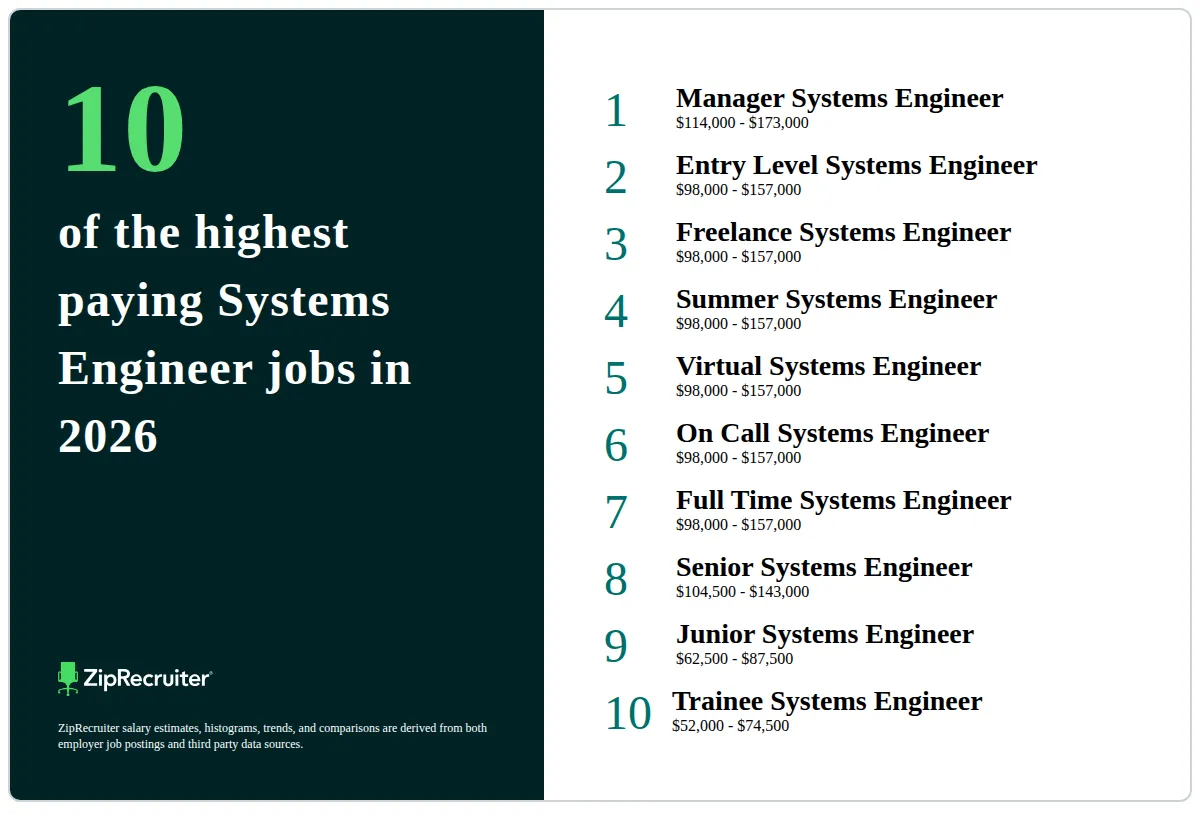
Salary range: $114,000 - $173,000
Managers supervise a team of people; they establish goals, assign tasks, and measure progress. The specific responsibilities of someone in a management position will vary based on the company and industry they work in, but their primary responsibilities remain largely the same. Managers monitor the accomplishments of their staff, focusing on the overall goals of the department. They work with Human Resources to determine and address staffing needs, coordinate and delegate responsibilities, check employee performance, and provide additional training and direction when necessary.
Salary range: $98,000 - $157,000
Entry-level jobs are positions that do not require any previous experience in the role. Most entry-level jobs are aimed at high school or college graduates as a starting point for a future career goal. A college student may have majored in their ideal career field, but will still need to start in an entry-level position to train in a real-world environment. Some students move from internships into entry-level jobs, but most entry-level jobs do not expect a candidate to have any prior employment or on-site training.
Salary range: $98,000 - $157,000
Freelancers are self-employed. As a freelancer, you provide work to clients and invoice them for it. The type of clients you have depends on what kind of services you offer. Your clients can be individuals or companies. A full-time freelancer often has assignments from multiple clients at once. Some common services that people provide as freelancers are: writing, editing, graphic design, web design, marketing, programming, accounting, and bookkeeping. Freelancing is ideal for those who prefer to be their own boss and are willing to market themselves to meet their income goals.
Salary range: $98,000 - $157,000
A virtual job refers to a job that can be performed outside of an employer’s office. Also known as remote, work from home, or telecommuting jobs, these positions have become increasingly common because of technology like telephones, internet, email, and video conference calls, which help to facilitate employer-employee communication.
Salary range: $98,000 - $157,000
Summer jobs are an integral part of American culture for students in their teens and beyond, but not all summer jobs are created equal. The difference between a great summer and an awful one can be the right job. According to Forbes, some good summer jobs for teens are camp counselor, golf caddy, nanny, food service, retail sales, and, of course, internships.
Salary range: $98,000 - $157,000
When most people think of on-call jobs, medical professionals and first responders typically come to mind. For first responders, like firefighters and EMTs, on-call usually means you are sleeping at the station, ready to wake up and respond to a call quickly. Medical workers, on the other hand, may work a more traditional on-call schedule. While some nurses and doctors may sleep at the hospital, especially during their residency, you may also have an on-call shift where you can leave and go home, potentially never actually coming back. If you want a career as a nurse or doctor but do not like this unpredictability, rest assured that the chance of having on-call shifts decreases as you gain seniority and advanced qualifications. Repair workers like electricians may also work on-call. You may occasionally find on-call jobs in retail or customer service sectors, but this is not as common.
Salary range: $98,000 - $157,000
Full-time employment hours are generally determined by the employer. There is no single universal definition; however, various laws and policies govern different types of eligibility and statuses. For example, the Fair Labor Standards Act does not define full-time employment but does require overtime pay after 40 hours of work in a workweek for non-exempt employees. The Affordable Care Act, in determining Applicable Large Employers, defines full-time employees as those working an average of at least 30 hours per week, or 130 hours a month. The H-1B Visa Program defines full-time as 40 hours per week, normally, and in no event would less than 35 hours per week be considered to be full-time employment. In practice, full-time employment is typically between 32 and 40 hours per week.
Salary range: $104,500 - $143,000
The qualifications that you need to start a career as a senior systems engineer include a degree, relevant technical skills and knowledge, and, ideally, professional certification. You can seek a systems engineer position after obtaining a bachelor’s degree in computer science, information technology, or computer engineering. Many employers require you to have at least five years of experience as a systems engineer or in a related job. You can also pursue relevant certifications to stand out from other applicants. For example, if you work with Microsoft systems, you can become a Microsoft Certified Solutions Expert (MCSE).
Salary range: $62,500 - $87,500
The qualifications that you need to become a junior systems engineer include a degree and programming skills. You typically need a bachelor’s degree in computer science or a related subject. Since junior positions are usually for entry-level employees, you do not usually need previous job experience. However, you can obtain experience by working as an intern during your undergraduate studies. You also need knowledge of common programming languages, such as C++, Visual Basic, Java, and Perl. Professional certifications are not a requirement for this career. However, you can pursue accreditation from vendors like Cisco or Microsoft. You can also get vendor-neutral certification from CompTIA.
Salary range: $52,000 - $74,500
The requirements to get a trainee job vary by industry. In some, such as architecture or accounting, you must graduate from an accredited college program before you can begin work. Other industries, such as retail, manufacturing, or telemarketing, may require only a high school diploma or a GED certificate to begin a training program. No matter what profession you are interested in, you should have strong verbal and written communication and an interest in continuing the career.
Salary range: $33,500 - $43,500
An Internship is a position within your desired field that pays little or no money but offers you the opportunity to gain real-world experience. This may set you apart for your future job search. Generally, Internships are almost expected by employers on an entry-level candidate’s resume. You are much more of an asset to an employer if you have some work experience.