
Cryogenic Engineer
Florence, SC · On-site
Summary Our Florence site manufactures GE HealthCare's SIGNA MRI systems which utilize superconducting magnet technology. The engineering, manufacturing, and support teams here are building ...
Florence, SC · On-site
Summary Our Florence site manufactures GE HealthCare's SIGNA MRI systems which utilize superconducting magnet technology. The engineering, manufacturing, and support teams here are building ...
Florence, SC · On-site
Summary Our Florence site manufactures GE HealthCare's SIGNA MRI systems which utilize superconducting magnet technology. The engineering, manufacturing, and support teams here are building ...
Florence, SC · On-site
Design and analyze cryogenic components and systems used in superconducting MRI magnets * Perform ... Lead engineering productivity projects focused on product cost and lifecycle cost reduction ...
Florence, SC · On-site
Design and analyze cryogenic components and systems used in superconducting MRI magnets * Perform ... Lead engineering productivity projects focused on product cost and lifecycle cost reduction ...
Florence, SC · On-site
Performs diverse and complex assignments in support of superconducting magnet cartridge development: cartridge component development, coil winding and cartridge assembly. Assignments may include, but ...
Florence, SC · On-site
Performs diverse and complex assignments in support of superconducting magnet cartridge development: cartridge component development, coil winding and cartridge assembly. Assignments may include, but ...
Florence, SC · On-site
$110 - $165/hr
Summary Our Florence site manufactures GE HealthCare's SIGNA MRI systems which utilize superconducting magnet technology. The engineering, manufacturing, and support teams here are building ...
Florence, SC · On-site
$110 - $165/hr
Summary Our Florence site manufactures GE HealthCare's SIGNA MRI systems which utilize superconducting magnet technology. The engineering, manufacturing, and support teams here are building ...
Littleton, MA · On-site
$71K - $96K/yr
We are seeking high-potential, bilingual engineering talent to join Mevion's China Operations team ... superconducting magnets is highly preferred. Experience with medical device manufacturing or ...
Littleton, MA · On-site
$71K - $96K/yr
We are seeking high-potential, bilingual engineering talent to join Mevion's China Operations team ... superconducting magnets is highly preferred. Experience with medical device manufacturing or ...
$99K - $131K/yr
Experience with HTS cable fabrication, superconducting magnet systems, current lead engineering, cryogenic systems, or related superconducting technologies. * Demonstrated experience designing ...
$99K - $131K/yr
Experience with HTS cable fabrication, superconducting magnet systems, current lead engineering, cryogenic systems, or related superconducting technologies. * Demonstrated experience designing ...
Kearny, NJ · On-site
$85 - $120/hr
... and engineering to create a faster and simpler approach to commercializing fusion energy. The ... superconducting ("HTS") magnets, foundational components of Thea Energy's planar coil stellarator.
Kearny, NJ · On-site
$85 - $120/hr
... and engineering to create a faster and simpler approach to commercializing fusion energy. The ... superconducting ("HTS") magnets, foundational components of Thea Energy's planar coil stellarator.
Knoxville, TN · On-site
The Cryogenic Engineer will be responsible for designing, analyzing, and validating cryogenic systems that support superconducting magnets and other low-temperature components in our stellarator ...
Knoxville, TN · On-site
The Cryogenic Engineer will be responsible for designing, analyzing, and validating cryogenic systems that support superconducting magnets and other low-temperature components in our stellarator ...
Kearny, NJ · On-site
$85 - $120/hr
HTS Magnet Multiphysics Modeling Engineer - Kearny, NJ About the Company Thea Energy is leveraging ... You will support the design, analysis, and testing of high temperature superconducting ('HTS ...
Kearny, NJ · On-site
$85 - $120/hr
HTS Magnet Multiphysics Modeling Engineer - Kearny, NJ About the Company Thea Energy is leveraging ... You will support the design, analysis, and testing of high temperature superconducting ('HTS ...
Kearny, NJ · On-site
$215K - $250K/yr
Thea Energy is seeking a Director - HTS Magnet Engineering to provide strategic and technical leadership over the design, build, and test of high temperature superconducting ("HTS") magnets - the ...
Kearny, NJ · On-site
$215K - $250K/yr
Thea Energy is seeking a Director - HTS Magnet Engineering to provide strategic and technical leadership over the design, build, and test of high temperature superconducting ("HTS") magnets - the ...
Everett, WA · On-site
$100 - $150/hr
Design, build, test, and iterate superconducting magnet systems in both standalone test stands and integrated fusion machines * Develop experimental plans and diagnostics to validate performance ...
Everett, WA · On-site
$100 - $150/hr
Design, build, test, and iterate superconducting magnet systems in both standalone test stands and integrated fusion machines * Develop experimental plans and diagnostics to validate performance ...
Everett, WA · On-site
$134K - $180K/yr
Design, build, test, and iterate superconducting magnet systems in both standalone test stands and integrated fusion machines * Develop experimental plans and diagnostics to validate performance ...
Everett, WA · On-site
$134K - $180K/yr
Design, build, test, and iterate superconducting magnet systems in both standalone test stands and integrated fusion machines * Develop experimental plans and diagnostics to validate performance ...
Kearny, NJ · On-site
$105 - $130/hr
Thea Energy, Inc. in Kearny, NJ, is seeking an experienced Manufacturing Engineer to develop processes and tooling for high temperature superconducting magnets. You will play a crucial role in the ...
Kearny, NJ · On-site
$105 - $130/hr
Thea Energy, Inc. in Kearny, NJ, is seeking an experienced Manufacturing Engineer to develop processes and tooling for high temperature superconducting magnets. You will play a crucial role in the ...
Houston, TX · On-site
$99K - $131K/yr
Experience with HTS cable fabrication, superconducting magnet systems, current lead engineering, cryogenic systems, or related superconducting technologies. * Demonstrated experience designing ...
Houston, TX · On-site
$99K - $131K/yr
Experience with HTS cable fabrication, superconducting magnet systems, current lead engineering, cryogenic systems, or related superconducting technologies. * Demonstrated experience designing ...
Kearny, NJ · On-site
$215 - $250/hr
Thea Energy is seeking a Director - HTS Magnet Engineering to provide strategic and technical leadership over the design, build, and test of high temperature superconducting ("HTS") magnets -- the ...
Kearny, NJ · On-site
$215 - $250/hr
Thea Energy is seeking a Director - HTS Magnet Engineering to provide strategic and technical leadership over the design, build, and test of high temperature superconducting ("HTS") magnets -- the ...
$215K - $250K/yr
Thea Energy is seeking a Director - HTS Magnet Engineering to provide strategic and technical leadership over the design, build, and test of high temperature superconducting ("HTS") magnets -- the ...
Quick apply
$215K - $250K/yr
Thea Energy is seeking a Director - HTS Magnet Engineering to provide strategic and technical leadership over the design, build, and test of high temperature superconducting ("HTS") magnets -- the ...
Devens, MA · On-site
$110K - $185K/yr
The Electromagnetics Analysis Engineer within the R&D team will perform electromagnetic (EM ... Perform electromagnetic analysis of superconducting magnets and inform design decisions * Work with ...
Devens, MA · On-site
$110K - $185K/yr
The Electromagnetics Analysis Engineer within the R&D team will perform electromagnetic (EM ... Perform electromagnetic analysis of superconducting magnets and inform design decisions * Work with ...
$110K - $185K/yr
The Electromagnetics Analysis Engineer within the R&D team will perform electromagnetic (EM ... Perform electromagnetic analysis of superconducting magnets and inform design decisions * Work with ...
Quick apply
$110K - $185K/yr
The Electromagnetics Analysis Engineer within the R&D team will perform electromagnetic (EM ... Perform electromagnetic analysis of superconducting magnets and inform design decisions * Work with ...
Devens, MA · On-site
$110K - $185K/yr
The Electromagnetics Analysis Engineer within the R&D team will perform electromagnetic (EM ... Perform electromagnetic analysis of superconducting magnets and inform design decisions * Work with ...
Devens, MA · On-site
$110K - $185K/yr
The Electromagnetics Analysis Engineer within the R&D team will perform electromagnetic (EM ... Perform electromagnetic analysis of superconducting magnets and inform design decisions * Work with ...
Kearny, NJ · On-site
$110 - $150/hr
Implement quench detection and fast protection logic for superconducting magnets using embedded or ... Bachelor's or Master's degree in Electrical Engineering, Embedded Systems, Power Electronics, or a ...
Kearny, NJ · On-site
$110 - $150/hr
Implement quench detection and fast protection logic for superconducting magnets using embedded or ... Bachelor's or Master's degree in Electrical Engineering, Embedded Systems, Power Electronics, or a ...
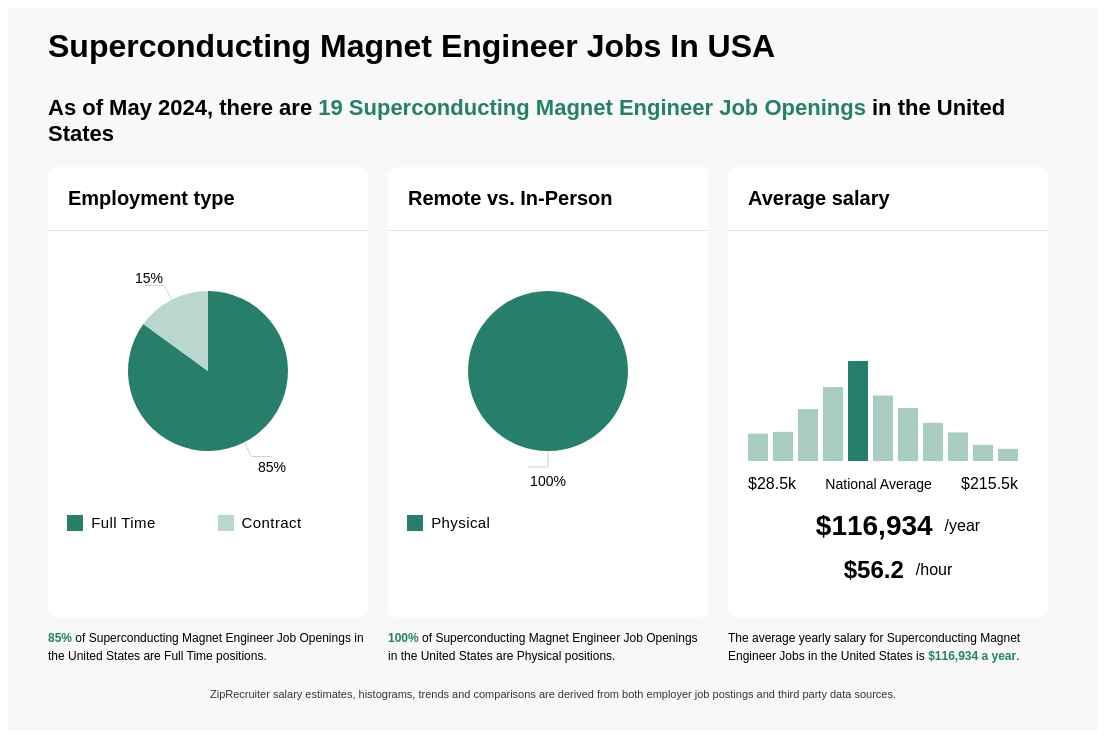
A Superconducting Magnet Engineer designs, develops, and tests superconducting magnet systems used in applications like MRI machines, particle accelerators, and fusion reactors. They work on material selection, cryogenic cooling systems, and electromagnetic performance optimization. Their responsibilities include troubleshooting system issues, ensuring reliability, and collaborating with multidisciplinary teams to improve magnet technology.
Superconducting Magnet Engineers require a deep understanding of electromagnetism, superconducting materials, cryogenics, and typically hold a degree in physics, electrical engineering, or a related field. Experience with CAD software, finite element analysis tools, and familiarity with industry standards for magnet design and testing are highly valued, as are certifications in safety and quality management. Strong problem-solving abilities, attention to detail, and effective communication skills enable successful teamwork and innovation. These competencies are critical for ensuring safe, efficient, and cutting-edge development of superconducting magnet systems in applications like medical imaging, research, and energy sectors.
Superconducting Magnet Engineers often encounter challenges such as ensuring the stability and integrity of magnet systems under extreme cryogenic conditions, troubleshooting performance issues, and adhering to strict safety protocols. Managing the integration of magnets into larger systems and coordinating closely with interdisciplinary teams are also frequent aspects of the role. Engineers may need to rapidly prototype and test solutions to unexpected problems, requiring strong analytical skills and adaptability. Overcoming these challenges is crucial for maintaining high system reliability and advancing technological innovation in sectors like medical imaging, particle physics, and energy research.
Cities with the most Superconducting Magnet Engineer job openings:
The most popular types of Superconducting Magnet Engineer jobs are:
States with the most job openings for Superconducting Magnet Engineer jobs include:
The top searched job categories for Superconducting Magnet Engineer jobs are:
8.3
Based on 138 frontline employees who took The Breakroom Quiz
103rd of 499 rated machine equipment manufacturers
Roles and Responsibilities:
Perform Cryogenic mechanical design and analysis of superconducting magnets and components used in MRI systems, including but not limited to the following:
Thermodynamics and heat transfer analysis, including determination of heat loads, heat budgets and test verification
Thermal & Structural design of cryogenic components
Verification and Validation of cryogenic components and instrumentation
Reliability analysis of cryogenic components and systems
Manufacturing support of cryogenic and vacuum systems
Development of methods to reduce cryogen consumption
Failure analysis of cryogenic components
Development of service tools to support cryogen filling, maintenance & safety of magnets
Installed Base data analysis and reduction. Lead resolution of cryogenic, thermal and vacuum issues relating to Installed Base Systems
Prepare/present design analysis reports and part/assembly drawing reviews
Develop product, component test and purchase specifications
Design leadership of productivity projects (both product cost and life cycle cost reduction)
Required Qualifications:
Masters in mechanical, Thermal, or Cryogenic Engineering or related Engineering Experience.
Hands on hardware experience with cryogenic systems and components
Direct design & analysis experience of cryogenic systems, components & liquid helium systems
FEA and/or CFD experience with ANSYS (preferred)
Desired Characteristics:
Phd in Thermal or Cryogenic Engineering
Expertise with Gifford-McMahon cryogenic refrigeration systems
5+ years' experience in superconducting magnet design
Expertise with high vacuum systems, getters, cryopumps and helium leak testing
Expertise with Liquid Helium and Liquid Nitrogen transfer systems and cryogenic data acquisition systems
Expertise with material properties and machine design at cryogenic temperatures
Experience in a cryogenic component or system-manufacturing environment
#LI-ONSITE
#LI-NS2
We will not sponsor individuals for employment visas, now or in the future, for this job opening.GE HealthCare offers a great work environment, professional development, challenging careers, and competitive compensation. GE HealthCare is anEqual Opportunity Employer. Employment decisions are made without regard to race, color, religion, national or ethnic origin, sex, sexual orientation, gender identity or expression, age, disability, protected veteran status or other characteristics protected by law.
GE HealthCare will only employ those who are legally authorized to work in the United States for this opening. Any offer of employment is conditioned upon the successful completion of a drug screen (as applicable).
While GE HealthCare does not currently require U.S. employees to be vaccinated against COVID-19, some GE HealthCare customers have vaccination mandates that may apply to certain GE HealthCare employees.
Relocation Assistance Provided: Yes
Get the full story on Breakroom


