1

Summer Forest Service Jobs (NOW HIRING)

During Summer, we have shifts available from 6am to 11pm daily. Starting in October, all shifts are ... service and streamline processes without compromising the integrity of the department or Forest ...

During Summer, we have shifts available from 6am to 11pm daily. Starting in October, all shifts are ... service and streamline processes without compromising the integrity of the department or Forest ...

Administrative Assistant

Missoula, MT ยท On-site

$17.75 - $24/hr

Forest Service employees who saw a need for a company that uniquely understood Forest Service ... Plan and coordinate fun events such as our annual holiday party, summer picnic, and weekly BBQs.

Administrative Assistant

Missoula, MT ยท On-site

$17.75 - $24/hr

Forest Service employees who saw a need for a company that uniquely understood Forest Service ... Plan and coordinate fun events such as our annual holiday party, summer picnic, and weekly BBQs.

New

Showing results 21-40

Summer Forest Service information

See salary details

$13

$25

$39

How much do summer forest service jobs pay per hour?

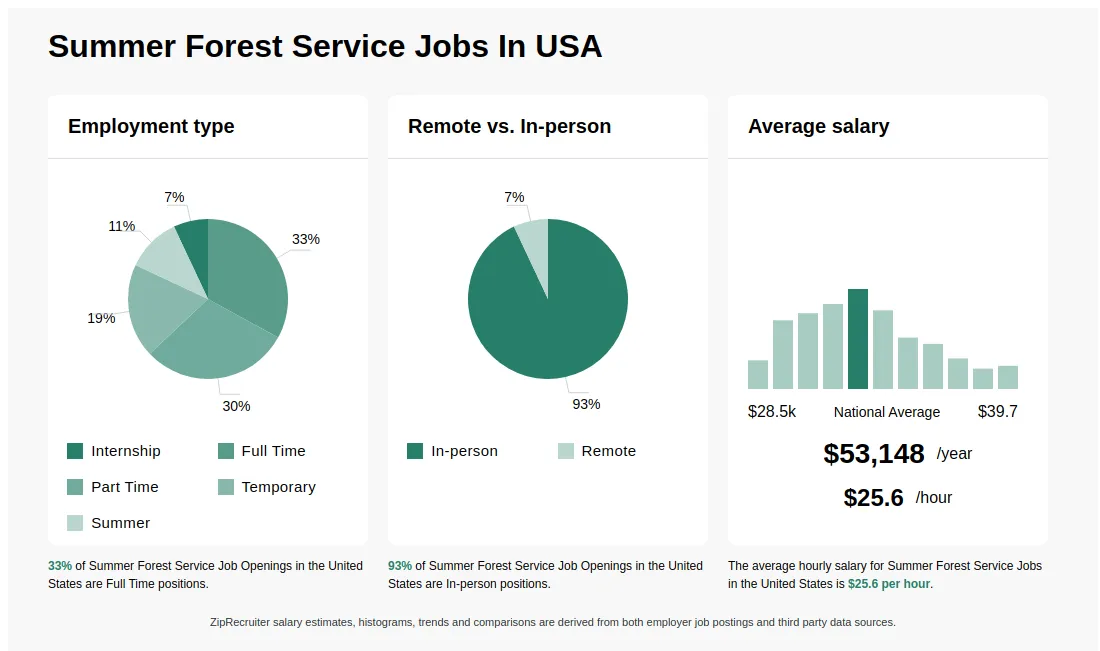
As of Sep 7, 2026, the average hourly pay for summer forest service in the United States is $25.55, according to ZipRecruiter salary data. Most workers in this role earn between $19.95 and $29.81 per hour, depending on experience, location, and employer.

What is a summer forest service job?

Summer Forest Service jobs are seasonal positions offered by the U.S. Forest Service, typically during the summer months. These jobs are ideal for students, recent graduates, or anyone interested in gaining experience in natural resource management, conservation, or outdoor work. Common roles include forestry technicians, trail crew members, fire fighters, and recreation aides. Employees often work outdoors, helping with tasks such as maintaining trails, monitoring wildlife, assisting with fire prevention, and educating visitors. These positions provide hands-on experience and are a great way to start a career in environmental stewardship.

What skills and qualifications are needed to thrive as a summer forest service worker?

To thrive as a Summer Forest Service worker, you generally need knowledge of forestry practices, basic first aid, physical fitness, and a high school diploma or equivalent. Familiarity with GPS devices, chainsaws, hand tools, and fire management equipment is usually required, and certifications such as Wilderness First Aid or wildland firefighting (S-130/190) are often preferred. Strong teamwork, communication, and adaptability help individuals excel in outdoor and often unpredictable environments. These skills ensure safety, effective resource management, and successful completion of conservation and land management tasks.

What are common challenges faced by summer forest service workers, and how can I prepare for them?

Summer Forest Service roles often involve physically demanding tasks, exposure to varying weather conditions, and working in remote areas with limited access to amenities. Employees may encounter challenges such as long hours, adapting to rapidly changing priorities (like responding to wildfires), and collaborating with diverse teams. To prepare, it's helpful to build physical endurance, develop strong communication skills, and familiarize yourself with safety protocols and outdoor equipment. Being adaptable and proactive in learning about local ecosystems can also enhance your effectiveness and experience in the role.

Can you work for the Summer Forest Service without a degree?

The Summer Forest Service typically hires seasonal workers who do not need a college degree, focusing instead on physical fitness, outdoor skills, and relevant certifications such as CPR or chainsaw operation. However, some specialized roles or higher-level positions may require a degree or specific experience. Entry-level positions often prioritize work ethic and ability to perform outdoor tasks over formal education.

Is the Summer Forest Service hiring seasonal firefighters?

Yes, the Summer Forest Service typically hires seasonal firefighters each year to assist with wildfire suppression and forest management. These positions often require physical fitness, firefighting training, and sometimes certifications such as S-130 and S-190. Hiring processes usually begin in early spring, with employment lasting through the summer months.
More about Summer Forest Service jobs

What cities are hiring for Summer Forest Service jobs?

Cities with the most Summer Forest Service job openings:

What are the most commonly searched types of Forest Service jobs?

The most popular types of Forest Service jobs are:

What states have the most Summer Forest Service jobs?

States with the most job openings for Summer Forest Service jobs include:

Infographic showing various Summer Forest Service job openings in the United States as of August 2026, with employment types broken down into 1% As Needed, 77% Full Time, 19% Part Time, and 3% Contract. Highlights an 92% Physical, 1% Hybrid, and 7% Remote job distribution, with an average salary of $53,148 per year, or $25.6 per hour.

Forest Ecology Research Technician

University of Minnesota

Minneapolis, MN โ€ข On-site

$23.59/hr

Part-time

Re-posted 3 days ago


Key responsibilities

  • Establish new experiments, including site delineation and planting.

  • Monitor the growth of experimental plants, conduct vegetation and tree disease surveys, and collect environmental data.

  • Assist with experimental needs such as re-locating experimental units, weeding plots, maintaining deer fences, removing fallen trees, and processing lab samples and data entry.


Job description

About the Job
 

Forest Ecology Research Technician
(Research Plot Technician, 4926)

Bargaining unit consideration begins on 05/06/2026 and ends on 05/13/2026

This posting does not constitute an announcement of open positions but is used to establish a pool of applicants should openings become available. Applications will be retained for consideration should openings occur. Applications will not be individually acknowledged upon receipt. Appointments may be renewable based on need, funding availability, and satisfactory performance.
 

Hourly position with a variable schedule based on operational needs. Typical work hours are Monday through Friday, 8:00 a.m. to 4:30 p.m., with occasional evening and weekend shifts as required. Overtime and consecutive Sunday work are not conditions of employment.

Visa Language: Please note, this position is not eligible for H-1B or Green Card sponsorship. This position does not offer a STEM OPT training program.
65% Field Work
20% Flexible
15% St. Paul Campus

Job Duties
The Forest Ecology and Tree Biology lab in the Department of Forest Resources at the University of Minnesota seeks interested applicants with a background or interest in field biology, ecology, plant ecophysiology, environmental science, forestry, or a related field to take vital roles in several large scale experiments that address restoration of Mississippi River floodplains, understanding oak wilt disease impacts on oak woodlands, interactions between fire and disease, using native plants to control buckthorn, forest responses to climate change and novel disturbances, and more. Duties vary by season and project and may include (90%) establishing new experiments (site delineation and planting); Re-locating experimental units; monitoring the growth of experimental plants, both buckthorn and planted species; vegetation and tree disease surveys, collecting environmental data with sensor networks, measuring plant species composition; weeding experimental plots; maintaining deer fences; removing fallen trees; and generally assisting with experimental needs. There may also be lab sample processing and data entry (10%). Employees will work as a team (or occasionally solo, for example with data entry), supervised by Dr. Rebecca Montgomery or Dr. Mike Schuster, depending on the project. This job can have non-standard hours due to the nature of field research so people should be comfortable with a sometimes unpredictable work schedule and possess a positive attitude for long field days.

Qualifications
 

Required Qualifications
High school graduation and two (2) years of related education and/or related experience. 
Interest in field biology, ecology, forestry, restoration, plant propagation or environmental science
Dependable, motivated, with integrity and a strong work ethic
Strong skills in communicating and working with other team members across differences
Flexible team structure: work alone (rarely) or as a pair or trio for different tasks
Attention to detail in repetitive work, and diligent adherence to standardized protocols
Flexible work hours: adapt daily plans to weather; early starts in summer to avoid the heat; some post-sunset light measurements will likely be needed during late summer
Willing to work in a wide range of field conditions, including varied weather, steep terrain, and biting insects

Preferred Qualifications
Experience identifying woody and herbaceous plants in the Great Lakes region
Strong organizational skills, and proficiency in Google Drive for data management
Drivers license, though not required

Pay and Benefits
 

Pay Range: $23.17/hr (Step 1) - $23.59/hour (Step 2); depending on education/qualifications/experience


Retirement plan options are available for Civil Service, Faculty, Labor-Represented, Professional & Administrative, and Temp Casual classifications.  Learn more about retirement plans.

How To Apply
 

Applications must be submitted online.  To be considered for this position, please click the Apply button and follow the instructions.  You will have the opportunity to complete an online application for the position and attach a resume.

Additional documents may be attached after application by accessing your "My Job Applications" page and uploading documents in the "My Cover Letters and Attachments" section.

To request an accommodation during the application process, please e-mail employ@umn.edu or call (612) 624-8647.

Diversity
 

The University recognizes and values the importance of diversity and inclusion in enriching the employment experience of its employees and in supporting the academic mission.  The University is committed to attracting and retaining employees with varying identities and backgrounds.

The University of Minnesota provides equal access to and opportunity in its programs, facilities, and employment without regard to race, color, creed, religion, national origin, gender, age, marital status, disability, public assistance status, veteran status, sexual orientation, gender identity, or gender expression.  To learn more about diversity at the U:  http://diversity.umn.edu

Employment Requirements
 

Any offer of employment is contingent upon the successful completion of a background check. Our presumption is that prospective employees are eligible to work here. Criminal convictions do not automatically disqualify finalists from employment.

About University of Minnesota
 

The University of Minnesota, Twin Cities (UMTC)

The University of Minnesota, Twin Cities (UMTC), is among the largest public research universities in the country, offering undergraduate, graduate, and professional students a multitude of opportunities for study and research. Located at the heart of one of the nation's most vibrant, diverse metropolitan communities, students on the campuses in Minneapolis and St. Paul benefit from extensive partnerships with world-renowned health centers, international corporations, government agencies, and arts, nonprofit, and public service organizations.

At the University of Minnesota, we are proud to be recognized by the Star Tribune as a Top Workplace for 2021, as well as by Forbes as Best Employers for Women and one of Americas Best Employers (2015, 2018, 2019, 2023), Best Employer for Diversity (2019, 2020), Best Employer for New Grads (2018, 2019), and Best Employer by State (2019, 2022).