
Studio Assistant -Art
Macon, GA · On-site
$10/hr
Studio Assistant -Art Studio Assistant for Art Department studio courses to include the following disciplines: Ceramics/Sculpture/Photography/Painting. Assist in mixing clay, organization of tools ...
Macon, GA · On-site
$10/hr
Studio Assistant -Art Studio Assistant for Art Department studio courses to include the following disciplines: Ceramics/Sculpture/Photography/Painting. Assist in mixing clay, organization of tools ...
Macon, GA · On-site
$10/hr
Studio Assistant -Art Studio Assistant for Art Department studio courses to include the following disciplines: Ceramics/Sculpture/Photography/Painting. Assist in mixing clay, organization of tools ...
Cleveland, OH · On-site
$15/hr
The Studio assistant will have the opportunity to assist in several areas of Community Arts: Community Arts Center, Studio Go mobile art van, and Community Arts signature programs and events. Based ...
Cleveland, OH · On-site
$15/hr
The Studio assistant will have the opportunity to assist in several areas of Community Arts: Community Arts Center, Studio Go mobile art van, and Community Arts signature programs and events. Based ...
Be Seen First
Maple Grove, MN · On-site
$13 - $16/hr (+ commission)
Part-Time Studio Assistant - Color Me Mine (Maple Grove, MN) Are you friendly, creative, and love working with people? Color Me Mine in Clackamas is looking for a Part-Time Studio Assistant to join ...
Quick apply
Be Seen First
Maple Grove, MN · On-site
$13 - $16/hr (+ commission)
Part-Time Studio Assistant - Color Me Mine (Maple Grove, MN) Are you friendly, creative, and love working with people? Color Me Mine in Clackamas is looking for a Part-Time Studio Assistant to join ...
Delray Beach, FL · On-site
$15/hr
We are looking for a confident, results-oriented team member to join our new Perspire Sauna Studio in West Delray! This isn't just a job, it's an opportunity to become a wellness guide and a key part ...
Quick apply
Delray Beach, FL · On-site
$15/hr
We are looking for a confident, results-oriented team member to join our new Perspire Sauna Studio in West Delray! This isn't just a job, it's an opportunity to become a wellness guide and a key part ...
Be Seen First
Maple Grove, MN · On-site
$13 - $16/hr (+ commission)
Part-Time Studio Assistant - Color Me Mine (Maple Grove, MN) Are you friendly, creative, and love working with people? Color Me Mine in Clackamas is looking for a Part-Time Studio Assistant to join ...
Quick apply
Be Seen First
Maple Grove, MN · On-site
$13 - $16/hr (+ commission)
Part-Time Studio Assistant - Color Me Mine (Maple Grove, MN) Are you friendly, creative, and love working with people? Color Me Mine in Clackamas is looking for a Part-Time Studio Assistant to join ...
Be Seen First
Woodbury, MN · On-site
$13 - $16/hr (+ commission)
Part-Time Studio Assistant - Color Me Mine (Woodbury, MN) Are you friendly, creative, and love working with people? Color Me Mine in Woodbury is looking for a Part-Time Studio Assistant to join our ...
Quick apply
Be Seen First
Woodbury, MN · On-site
$13 - $16/hr (+ commission)
Part-Time Studio Assistant - Color Me Mine (Woodbury, MN) Are you friendly, creative, and love working with people? Color Me Mine in Woodbury is looking for a Part-Time Studio Assistant to join our ...
Be Seen First
Woodbury, MN · On-site
$13 - $16/hr (+ commission)
Part-Time Studio Assistant - Color Me Mine (Woodbury, MN) Are you friendly, creative, and love working with people? Color Me Mine in Woodbury is looking for a Part-Time Studio Assistant to join our ...
Quick apply
Be Seen First
Woodbury, MN · On-site
$13 - $16/hr (+ commission)
Part-Time Studio Assistant - Color Me Mine (Woodbury, MN) Are you friendly, creative, and love working with people? Color Me Mine in Woodbury is looking for a Part-Time Studio Assistant to join our ...
Innovation Hub Studio Assistant 2026 - 2027 Apply now Job no: 497339 Full time/Part time: Part-time Location: South Orange Categories: Student Employment JOB SUMMARY The Innovation Hub Studio ...
Innovation Hub Studio Assistant 2026 - 2027 Apply now Job no: 497339 Full time/Part time: Part-time Location: South Orange Categories: Student Employment JOB SUMMARY The Innovation Hub Studio ...
Innovation Hub Studio Assistant 2026 - 2027 Job no: 497339 Full time/Part time: Part-time Location: South Orange Categories: Student Employment JOB SUMMARY The Innovation Hub Studio Assistant ...
Innovation Hub Studio Assistant 2026 - 2027 Job no: 497339 Full time/Part time: Part-time Location: South Orange Categories: Student Employment JOB SUMMARY The Innovation Hub Studio Assistant ...
Chicago, IL · On-site
$17/hr
Role Description The Floral Studio Assistant is a part-time role based in Glenview, IL and pays $17 an hour. This role supports day-to-day studio operations, including color-correcting (painting ...
New
Chicago, IL · On-site
$17/hr
Role Description The Floral Studio Assistant is a part-time role based in Glenview, IL and pays $17 an hour. This role supports day-to-day studio operations, including color-correcting (painting ...
New
Manhasset, NY · On-site
$20 - $25/hr
Studio Assisting The Junior Photographer and Studio Assistant will assist and work closely with our lead photographer on a daily basis, helping to keep studio running smoothly and efficiently.
Manhasset, NY · On-site
$20 - $25/hr
Studio Assisting The Junior Photographer and Studio Assistant will assist and work closely with our lead photographer on a daily basis, helping to keep studio running smoothly and efficiently.
Pittsburgh, PA · On-site
$15 - $20/hr
Studio 39 Fitness in Pittsburgh, PA is looking for an energetic and motivated Fitness Studio Sales Assistant to join our team to work part-time evening and weekend morning shifts! This is a fantastic ...
Quick apply
Pittsburgh, PA · On-site
$15 - $20/hr
Studio 39 Fitness in Pittsburgh, PA is looking for an energetic and motivated Fitness Studio Sales Assistant to join our team to work part-time evening and weekend morning shifts! This is a fantastic ...
Studio Assisting The Junior Photographer and Studio Assistant will assist and work closely with our lead photographer on a daily basis, helping to keep studio running smoothly and efficiently.
Quick apply
Studio Assisting The Junior Photographer and Studio Assistant will assist and work closely with our lead photographer on a daily basis, helping to keep studio running smoothly and efficiently.
Pittsburgh, PA · On-site
$15 - $20/hr
Studio 39 Fitness in Pittsburgh, PA is looking for an energetic and motivated Fitness Studio Sales Assistant to join our team to work part-time evening and weekend morning shifts! This is a fantastic ...
Quick apply
Pittsburgh, PA · On-site
$15 - $20/hr
Studio 39 Fitness in Pittsburgh, PA is looking for an energetic and motivated Fitness Studio Sales Assistant to join our team to work part-time evening and weekend morning shifts! This is a fantastic ...
Dallas, TX · On-site
Ongoing training and support Position Responsibilities: * Assist the Studio Director with studio operations and manage from the Front Desk * Provide a high level of Customer Service * Acts as main ...
Dallas, TX · On-site
Ongoing training and support Position Responsibilities: * Assist the Studio Director with studio operations and manage from the Front Desk * Provide a high level of Customer Service * Acts as main ...
College of Theology - GCU Recording Studio Assistant (FWS) Grand Canyon University is seeking a GCU Recording Studio Assistant to support the mission of Grand Canyon University through GCU's College ...
College of Theology - GCU Recording Studio Assistant (FWS) Grand Canyon University is seeking a GCU Recording Studio Assistant to support the mission of Grand Canyon University through GCU's College ...
Dallas, TX · On-site
Ongoing training and support Position Responsibilities: * Assist the Studio Director with studio operations and manage from the Front Desk * Provide a high level of Customer Service * Acts as main ...
Dallas, TX · On-site
Ongoing training and support Position Responsibilities: * Assist the Studio Director with studio operations and manage from the Front Desk * Provide a high level of Customer Service * Acts as main ...
Big Rapids, MI · On-site
$14 - $14.49/hr
Architecture Studio Assistant (Student Position) Job no: 498038 Work type: Student Employment - General Location: Big Rapids, MI 49307 Categories: Student Employment - General Position Title:
Big Rapids, MI · On-site
$14 - $14.49/hr
Architecture Studio Assistant (Student Position) Job no: 498038 Work type: Student Employment - General Location: Big Rapids, MI 49307 Categories: Student Employment - General Position Title:
College of Theology - GCU Recording Studio Assistant (FWS) Grand Canyon University is seeking a GCU Recording Studio Assistant to support the mission of Grand Canyon University through GCU's College ...
College of Theology - GCU Recording Studio Assistant (FWS) Grand Canyon University is seeking a GCU Recording Studio Assistant to support the mission of Grand Canyon University through GCU's College ...
Cameron Park, CA · On-site
$18 - $24/hr
About the Role We are seeking a reliable, self-driven Order Fulfillment & Studio Assistant to support online order fulfillment, inventory organization, seasonal events, and day-to-day studio ...
Quick apply
Cameron Park, CA · On-site
$18 - $24/hr
About the Role We are seeking a reliable, self-driven Order Fulfillment & Studio Assistant to support online order fulfillment, inventory organization, seasonal events, and day-to-day studio ...
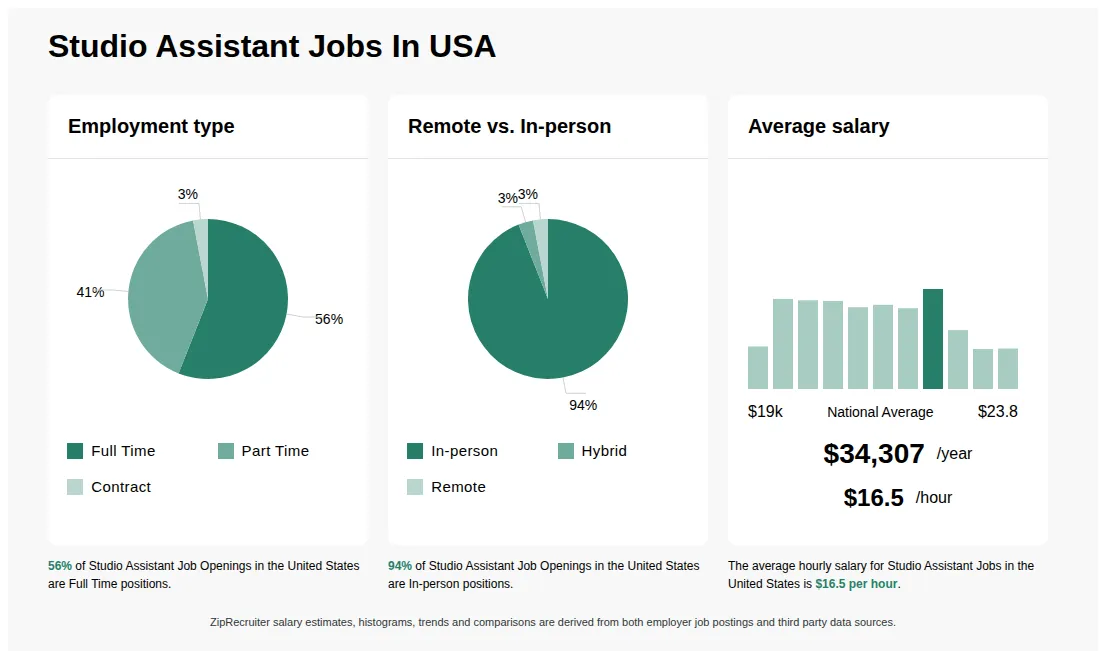
$9.13 - $10.47
5% of jobs
$10.47 - $11.80
11% of jobs
$12.80 is the 25th percentile. Wages below this are outliers.
$11.80 - $13.13
11% of jobs
$13.13 - $14.47
11% of jobs
$14.47 - $15.80
10% of jobs
The median wage is $15.87 / hr.
$15.80 - $17.13
10% of jobs
$17.13 - $18.47
10% of jobs
$18.99 is the 75th percentile. Wages above this are outliers.
$18.47 - $19.80
12% of jobs
$19.80 - $21.13
7% of jobs
$21.13 - $22.47
5% of jobs
$22.47 - $23.80
5% of jobs
$9
$16
$23
Studio assistant is a position found in many industries, include fashion, photography, music, film and television, and beauty. If you work as a studio assistant in the music industry, your duties include updating logs, setting up recording equipment, and laying cable before a session. An artist’s or photographer’s studio assistant, on the other hand, may have more administrative responsibilities, such as scheduling meetings with clients, answering email, running errands, and coordinating the artist’s daily work plan. In a beauty salon, a studio assistant may work the reception desk, answer phones, and help with clean-up.
| Aspect | Studio Assistant | Art Assistant |
|---|---|---|
| Required Credentials | High school diploma or equivalent; some roles may prefer art or design coursework | High school diploma; some positions may require art-related coursework or certifications |
| Work Environment | Art studios, creative spaces, or production environments | Art studios, galleries, or exhibition spaces |
| Employer & Industry Usage | Used in creative industries like design, photography, and fine arts | Common in art galleries, museums, and art production settings |
| Common Search & Comparison Intent | Often compared for roles supporting artists and studio operations | Compared when assisting with art projects, exhibitions, or gallery work |
While both roles support artistic environments, a Studio Assistant typically handles a broader range of studio operations, including setup, maintenance, and administrative tasks. An Art Assistant often focuses more on supporting specific art projects, exhibitions, or artists directly. Understanding these differences helps clarify job expectations and career paths in creative industries.
Cities with the most Studio Assistant job openings:
The most popular types of Studio jobs are:
The top employers for Studio Assistant jobs are:
States with the most job openings for Studio Assistant jobs include:
The top searched job categories for Studio Assistant jobs are:
7.8
Based on 8 frontline employees who took The Breakroom Quiz
236th of 628 rated colleges and universities
Get the full story on Breakroom

Sourced by ZipRecruiter
Colleges, universities, and professional schools
1,001 - 5,000 Employees
Macon, GA, US
1833