Middle School Athletic Director Reports To: Traip Academy Athletic Director, Middle School Principal and Assistant Principal Employment Status: Stipend Position - School Year 2026-2027 Date: June ...
Middle School Athletic Director Reports To: Traip Academy Athletic Director, Middle School Principal and Assistant Principal Employment Status: Stipend Position - School Year 2026-2027 Date: June ...

School Athletic Director
Chicago, IL · On-site
Description - External Athletic Director * Chicago Public Schools (CPS) is the third-largest school district in the United States, serving over 330,000 students across 500 schools and employing ...
School Athletic Director
Chicago, IL · On-site
Description - External Athletic Director * Chicago Public Schools (CPS) is the third-largest school district in the United States, serving over 330,000 students across 500 schools and employing ...
School Athletic Director
Chicago, IL · On-site
Description - External Athletic Director * Chicago Public Schools (CPS) is the third-largest school district in the United States, serving over 330,000 students across 500 schools and employing ...
School Athletic Director
Chicago, IL · On-site
Description - External Athletic Director * Chicago Public Schools (CPS) is the third-largest school district in the United States, serving over 330,000 students across 500 schools and employing ...
Middle School Athletic Director Reports To: Traip Academy Athletic Director, Middle School Principal and Assistant Principal Employment Status: Stipend Position - School Year 2026-2027 Date: June ...
Middle School Athletic Director Reports To: Traip Academy Athletic Director, Middle School Principal and Assistant Principal Employment Status: Stipend Position - School Year 2026-2027 Date: June ...
Licensed School Athletic Director Chicago Public Schools (CPS) is a district on the rise, serving over 325,000 students in 500+ schools and employing over 45,000 people, most of them teachers. CPS ...
Licensed School Athletic Director Chicago Public Schools (CPS) is a district on the rise, serving over 325,000 students in 500+ schools and employing over 45,000 people, most of them teachers. CPS ...
School Athletic Director (ESP) Chicago Public Schools (CPS) is a district on the rise, serving over 325,000 students in 500+ schools and employing over 45,000 people, most of them teachers. CPS has ...
School Athletic Director (ESP) Chicago Public Schools (CPS) is a district on the rise, serving over 325,000 students in 500+ schools and employing over 45,000 people, most of them teachers. CPS has ...
School Athletic Director (ESP) Chicago Public Schools (CPS) is a district on the rise, serving over 325,000 students in 500+ schools and employing over 45,000 people, most of them teachers. CPS has ...
School Athletic Director (ESP) Chicago Public Schools (CPS) is a district on the rise, serving over 325,000 students in 500+ schools and employing over 45,000 people, most of them teachers. CPS has ...
Middle School Athletic Director LOCATION: Green Bank Elementary Middle School CLASSIFICATION : Extra-Duty Assignment REPORTS TO: Head Principal and/or Athletic Director EVALUATION: Evaluations ...
Middle School Athletic Director LOCATION: Green Bank Elementary Middle School CLASSIFICATION : Extra-Duty Assignment REPORTS TO: Head Principal and/or Athletic Director EVALUATION: Evaluations ...

Middle School Athletic Director (GBEMS)
Green Bank, WV · On-site
$2.4K/wk
Middle School Athletic Director LOCATION: Green Bank Elementary Middle School CLASSIFICATION : Extra-Duty Assignment REPORTS TO: Head Principal and/or Athletic Director EVALUATION: Evaluations ...
Middle School Athletic Director (GBEMS)
Green Bank, WV · On-site
$2.4K/wk
Middle School Athletic Director LOCATION: Green Bank Elementary Middle School CLASSIFICATION : Extra-Duty Assignment REPORTS TO: Head Principal and/or Athletic Director EVALUATION: Evaluations ...
Licensed School Athletic Director Chicago Public Schools (CPS) is a district on the rise, serving over 325,000 students in 500+ schools and employing over 45,000 people, most of them teachers. CPS ...
Licensed School Athletic Director Chicago Public Schools (CPS) is a district on the rise, serving over 325,000 students in 500+ schools and employing over 45,000 people, most of them teachers. CPS ...
Licensed School Athletic Director Chicago Public Schools (CPS) is a district on the rise, serving over 325,000 students in 500+ schools and employing over 45,000 people, most of them teachers. CPS ...
Licensed School Athletic Director Chicago Public Schools (CPS) is a district on the rise, serving over 325,000 students in 500+ schools and employing over 45,000 people, most of them teachers. CPS ...
Licensed School Athletic Director Chicago Public Schools (CPS) is a district on the rise, serving over 325,000 students in 500+ schools and employing over 45,000 people, most of them teachers. CPS ...
Licensed School Athletic Director Chicago Public Schools (CPS) is a district on the rise, serving over 325,000 students in 500+ schools and employing over 45,000 people, most of them teachers. CPS ...
School Athletic Director (ESP) Chicago Public Schools (CPS) is a district on the rise, serving over 325,000 students in 500+ schools and employing over 45,000 people, most of them teachers. CPS has ...
School Athletic Director (ESP) Chicago Public Schools (CPS) is a district on the rise, serving over 325,000 students in 500+ schools and employing over 45,000 people, most of them teachers. CPS has ...
School Athletic Director (ESP) Chicago Public Schools (CPS) is a district on the rise, serving over 325,000 students in 500+ schools and employing over 45,000 people, most of them teachers. CPS has ...
School Athletic Director (ESP) Chicago Public Schools (CPS) is a district on the rise, serving over 325,000 students in 500+ schools and employing over 45,000 people, most of them teachers. CPS has ...
School Athletic Director (ESP) Chicago Public Schools (CPS) is a district on the rise, serving over 325,000 students in 500+ schools and employing over 45,000 people, most of them teachers. CPS has ...
School Athletic Director (ESP) Chicago Public Schools (CPS) is a district on the rise, serving over 325,000 students in 500+ schools and employing over 45,000 people, most of them teachers. CPS has ...
Licensed School Athletic Director Chicago Public Schools (CPS) is a district on the rise, serving over 325,000 students in 500+ schools and employing over 45,000 people, most of them teachers. CPS ...
Licensed School Athletic Director Chicago Public Schools (CPS) is a district on the rise, serving over 325,000 students in 500+ schools and employing over 45,000 people, most of them teachers. CPS ...
Licensed School Athletic Director Chicago Public Schools (CPS) is a district on the rise, serving over 325,000 students in 500+ schools and employing over 45,000 people, most of them teachers. CPS ...
Licensed School Athletic Director Chicago Public Schools (CPS) is a district on the rise, serving over 325,000 students in 500+ schools and employing over 45,000 people, most of them teachers. CPS ...
Licensed School Athletic Director Chicago Public Schools (CPS) is a district on the rise, serving over 325,000 students in 500+ schools and employing over 45,000 people, most of them teachers. CPS ...
Licensed School Athletic Director Chicago Public Schools (CPS) is a district on the rise, serving over 325,000 students in 500+ schools and employing over 45,000 people, most of them teachers. CPS ...
School Athletic Director (ESP) Chicago Public Schools (CPS) is a district on the rise, serving over 325,000 students in 500+ schools and employing over 45,000 people, most of them teachers. CPS has ...
School Athletic Director (ESP) Chicago Public Schools (CPS) is a district on the rise, serving over 325,000 students in 500+ schools and employing over 45,000 people, most of them teachers. CPS has ...

Middle School Athletic Director
Hemlock, MI · On-site
$2.5K - $4.0K/wk
POSITION OPENING Middle School Athletic Director Stipend Position REQUIRED QUALIFICATIONS * Meet requirements for background check and fingerprinting. * Demonstrated leadership experience in ...
Middle School Athletic Director
Hemlock, MI · On-site
$2.5K - $4.0K/wk
POSITION OPENING Middle School Athletic Director Stipend Position REQUIRED QUALIFICATIONS * Meet requirements for background check and fingerprinting. * Demonstrated leadership experience in ...
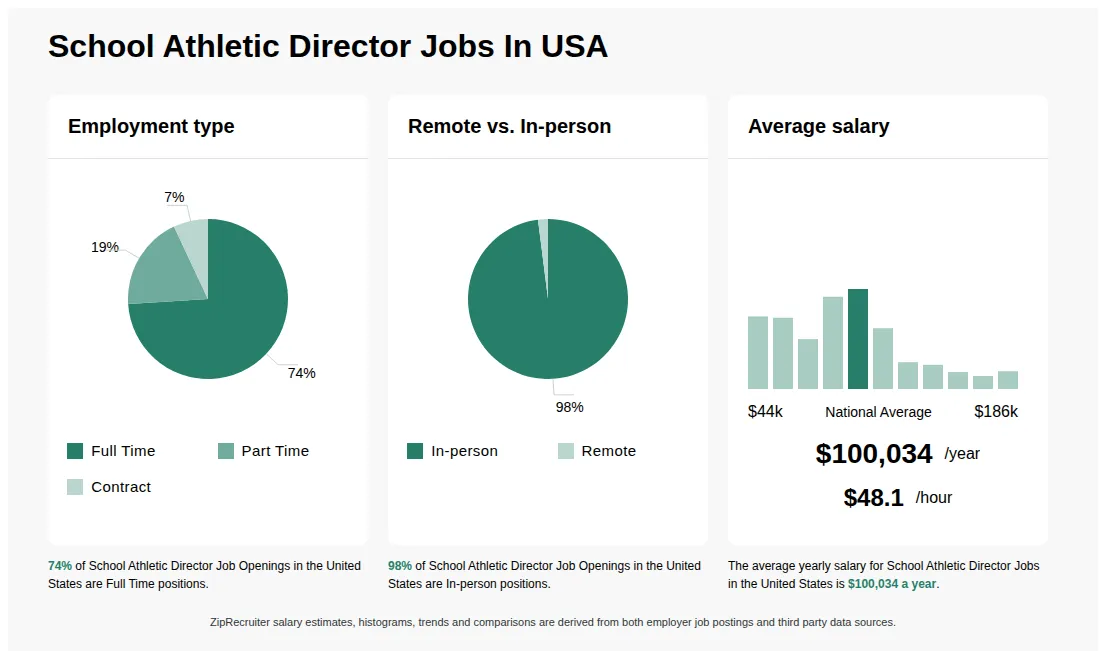
School Athletic Director information
See salary details
$44K - $56.9K
14% of jobs
$67.8K is the 25th percentile. Wages below this are outliers.
$56.9K - $69.8K
14% of jobs
$69.8K - $82.7K
9% of jobs
The median wage is $93.2K / yr.
$82.7K - $95.6K
17% of jobs
$95.6K - $108.5K
19% of jobs
$112.1K is the 75th percentile. Wages above this are outliers.
$108.5K - $121.5K
11% of jobs
$121.5K - $134.4K
4% of jobs
$134.4K - $147.3K
4% of jobs
$147.3K - $160.2K
3% of jobs
$160.2K - $173.1K
2% of jobs
$173.1K - $186K
3% of jobs
$44K
$100K
$186K
How much do school athletic director jobs pay per year?
As of Sep 3, 2026, the average yearly pay for school athletic director in the United States is $100,034.00, according to ZipRecruiter salary data. Most workers in this role earn between $71,500.00 and $117,500.00 per year, depending on experience, location, and employer.
What does a school athletic director do?
A School Athletic Director oversees the athletic programs at a school, including managing sports teams, hiring coaches, scheduling games, and ensuring compliance with regulations. They are responsible for budgeting, maintaining athletic facilities, and promoting student-athlete well-being and academic achievement. Athletic Directors serve as leaders and liaisons between the school administration, coaches, students, and the community.
What does a school athletic director do?
A school athletic director manages the sports programs at a school. These positions are available at high schools and colleges. In this career, your duties include hiring coaches, obtaining equipment, creating budgets for the athletic program, and scheduling games. You are also usually in charge of travel arrangements. Your responsibilities may include facilities management and the promotion of athletic events and activities. You ensure that each team at the school has enough participation and interest. You also ensure that the program operates under all relevant regulations and that athletes and teams abide by school policies, which you help to set.
What are the key skills and qualifications needed to thrive as a school athletic director, and why are they important?
To thrive as a School Athletic Director, you need a strong background in sports management, leadership, and educational administration, typically supported by a bachelor's or master's degree in a related field. Familiarity with athletic scheduling software, budget management systems, and knowledge of regulatory bodies like the NFHS or state athletic associations is essential. Exceptional communication, organizational skills, and the ability to build relationships with students, coaches, and the community set top candidates apart. These competencies ensure effective program management, compliance, and a positive athletic experience for all stakeholders.
What are some common challenges faced by school athletic directors when managing multiple sports programs?
School Athletic Directors often juggle numerous responsibilities, including scheduling games, coordinating with coaches, and ensuring compliance with school and athletic association policies. A common challenge is balancing the needs and resources of various teams, especially when facilities or funding are limited. Effective communication and strong organizational skills are essential to address scheduling conflicts, transportation logistics, and maintaining positive relationships with students, parents, and staff. Proactively addressing these challenges helps create a supportive environment for student-athletes and staff alike.
What is the difference between School Athletic Director vs School Sports Coach?
| Aspect | School Athletic Director | School Sports Coach |
|---|---|---|
| Required Credentials | High school diploma or equivalent; often a coaching certification or athletic administration degree | High school diploma or equivalent; coaching certification often preferred |
| Work Environment | Administrative office, athletic facilities, meetings with staff and students | Playing fields, gymnasiums, training sessions, game days |
| Employer & Industry Usage | Schools, districts, athletic departments | Schools, youth leagues, sports clubs |
The main difference is that the School Athletic Director oversees the entire athletic program, manages staff, budgets, and compliance, while the School Sports Coach focuses on training athletes, developing skills, and leading teams during practices and games. Both roles are essential in school sports but serve different functions within the athletic department.
How hard is it to get a job as a school athletic director?
Securing a position as a school athletic director typically requires relevant experience in sports management or coaching, along with a bachelor's degree in a related field; many roles also prefer candidates with a master's degree and certification in athletic administration. Competition can be moderate to high, depending on the school district and location, and strong leadership, organizational, and communication skills are essential. The job often involves working during school hours and evenings, with responsibilities including overseeing athletic programs, budgets, and compliance with regulations.
How much do school athletic directors get paid?
School athletic directors typically earn a median annual salary of around $60,000 to $80,000, depending on the school district, level of experience, and geographic location. Salaries can vary widely, with some earning over $100,000 in larger or more competitive districts, and often include responsibilities such as managing sports programs, budgets, and staff. Many athletic directors also hold relevant certifications and have backgrounds in sports management or education.
Is there a demand for school athletic directors?
The demand for school athletic directors is expected to grow as schools prioritize student activities and sports programs. Employment opportunities are typically available in public and private schools, with candidates often needing relevant experience and certifications in sports management or education. Job growth varies by region and school district size but generally remains steady due to the importance of extracurricular activities in schools.
What qualifications do you need to be a school athletic director?
A school athletic director typically needs a bachelor's degree in physical education, sports management, or a related field, along with experience in coaching or athletic administration. Many positions also require certification or licensure in sports management or related areas, and strong organizational and leadership skills are essential for managing athletic programs and staff.
More about School Athletic Director jobs
What cities are hiring for School Athletic Director jobs?
Cities with the most School Athletic Director job openings:
Who are the top companies hiring for School Athletic Director jobs?
The top employers for School Athletic Director jobs are:
What states have the most School Athletic Director jobs?
States with the most job openings for School Athletic Director jobs include:
What job categories do people searching School Athletic Director jobs look for?
The top searched job categories for School Athletic Director jobs are:
- High School Athletic Director
- Athletics Director Salary
- Full Time International School Athletic Director
- High School Assistant Athletic Director
- Internship International School Athletic Director
- Athletic Director Facilities
- Tournament Director
- High School Athletic Training
- Remote Assistant Athletic Director
- Part Time Assistant Athletic Director
Full-time
This job post has expired 3 days ago. Applications are no longer accepted.
Job description
Position Type:
Athletics/Activities/Co-Curricular Advisor
Date Posted:
7/6/2026
Location:
Shapleigh School
Shapleigh School Athletic Director
Job Title: Middle School Athletic Director
Reports To: Traip Academy Athletic Director, Middle School Principal and Assistant Principal
Employment Status: Stipend Position - School Year 2026-2027
Date: June 10th, 2026
Job Summary:
The Middle School Athletic Director (AD) is responsible for the leadership, organization, and oversight of the school's interscholastic athletic programs. The Middle School AD ensures that all athletic activities support student development, promote sportsmanship, and comply with school district policies, state athletic association regulations, and educational goals.
Key Responsibilities:
Program Oversight & Development
• Work in conjunction with the Traip Academy Athletic Director to plan, implement, and evaluate all middle school athletic programs.
• Ensure athletic programs promote safety, equity, and character development.
• Coordinate with coaches to develop and schedule practices.
• Recruit, support, and evaluate coaches in collaboration with the Traip Academy Athletic Director
Scheduling & Logistics
• Assist in the coordination of schedules for games, meets and practices.
• Work with the Traip AD to Secure facilities for home and off-site events.
• Assist with transportation schedules and the necessary supervision for away games.
• Ensure officials are scheduled for all home contests.
Compliance & Safety
• Enforce rules and regulations of the school district.
• Ensure all athletes complete required health physicals and consent forms in conjunction with School Nurse.
• Promote and ensure adherence to safety protocols and concussion policies.
Budget & Equipment
• Assist Traip AD in managing the athletic department budget for Middle Level sports.
• Assist Traip AD with inventory and purchase of athletic uniforms, equipment, and supplies.
• Ensure equipment is maintained, stored, and used properly.
Communication & Public Relations
• Communicate regularly with coaches, parents, and school staff.
• Assist Traip AD to promote athletic events through school announcements, school website and social media. Create a communications plan that provides weekly updates to students, staff and parents/families.
• Act as a liaison between the athletic department, administration, community partners, and parent organizations.
Leadership & Culture
• Model and foster good sportsmanship and a positive school culture.
• Resolve conflicts involving students, parents, or coaches as needed with the assistance of the Traip AD
Qualifications:
Education and Experience:
• Bachelor's degree in education, sports management, or a related field (required).
• Prior experience in coaching or athletic program coordination (preferred).
• Experience working with middle school-aged students (preferred).
Skills and Competencies:
• Strong organizational, interpersonal, and leadership skills.
• Knowledge of middle school athletics and child development.
• Ability to manage multiple tasks and prioritize responsibilities.
• Proficiency in scheduling software and basic technology tools.
Work Environment:
• Work may be performed in an office, gymnasium, athletic field, or off-site locations.
• Must be available for afternoon and early evening events
You must submit to a Criminal History Record Check through the State of Maine Education Department.
Required Application Materials:
Completed Applitrack Application
Resume
Cover Letter
Transcripts (Not required for School Nutrition or Custodial positions)
Unofficial transcripts are acceptable for initial application; Official transcripts will be required upon job offer.
A copy of current certification (if applicable)
3 current letters of reference
Letters of reference must be dated, signed, and written within the last 3 years
Internal candidates may apply in writing tohumanresources@kitteryschools.com
Kittery Schools is an Equal Opportunity Employer. Kittery School District ensures equal employment opportunities regardless of race, creed, gender, color, national origin, religion, age, sexual orientation, or disability. Kittery Schools has a policy of active recruitment of qualified minority teachers and non-certified employees. Any individual needing assistance in completing an application for any opening should contact the Department of Human Resources
Athletics/Activities/Co-Curricular Advisor
Date Posted:
7/6/2026
Location:
Shapleigh School
Shapleigh School Athletic Director
Job Title: Middle School Athletic Director
Reports To: Traip Academy Athletic Director, Middle School Principal and Assistant Principal
Employment Status: Stipend Position - School Year 2026-2027
Date: June 10th, 2026
Job Summary:
The Middle School Athletic Director (AD) is responsible for the leadership, organization, and oversight of the school's interscholastic athletic programs. The Middle School AD ensures that all athletic activities support student development, promote sportsmanship, and comply with school district policies, state athletic association regulations, and educational goals.
Key Responsibilities:
Program Oversight & Development
• Work in conjunction with the Traip Academy Athletic Director to plan, implement, and evaluate all middle school athletic programs.
• Ensure athletic programs promote safety, equity, and character development.
• Coordinate with coaches to develop and schedule practices.
• Recruit, support, and evaluate coaches in collaboration with the Traip Academy Athletic Director
Scheduling & Logistics
• Assist in the coordination of schedules for games, meets and practices.
• Work with the Traip AD to Secure facilities for home and off-site events.
• Assist with transportation schedules and the necessary supervision for away games.
• Ensure officials are scheduled for all home contests.
Compliance & Safety
• Enforce rules and regulations of the school district.
• Ensure all athletes complete required health physicals and consent forms in conjunction with School Nurse.
• Promote and ensure adherence to safety protocols and concussion policies.
Budget & Equipment
• Assist Traip AD in managing the athletic department budget for Middle Level sports.
• Assist Traip AD with inventory and purchase of athletic uniforms, equipment, and supplies.
• Ensure equipment is maintained, stored, and used properly.
Communication & Public Relations
• Communicate regularly with coaches, parents, and school staff.
• Assist Traip AD to promote athletic events through school announcements, school website and social media. Create a communications plan that provides weekly updates to students, staff and parents/families.
• Act as a liaison between the athletic department, administration, community partners, and parent organizations.
Leadership & Culture
• Model and foster good sportsmanship and a positive school culture.
• Resolve conflicts involving students, parents, or coaches as needed with the assistance of the Traip AD
Qualifications:
Education and Experience:
• Bachelor's degree in education, sports management, or a related field (required).
• Prior experience in coaching or athletic program coordination (preferred).
• Experience working with middle school-aged students (preferred).
Skills and Competencies:
• Strong organizational, interpersonal, and leadership skills.
• Knowledge of middle school athletics and child development.
• Ability to manage multiple tasks and prioritize responsibilities.
• Proficiency in scheduling software and basic technology tools.
Work Environment:
• Work may be performed in an office, gymnasium, athletic field, or off-site locations.
• Must be available for afternoon and early evening events
You must submit to a Criminal History Record Check through the State of Maine Education Department.
Required Application Materials:
Completed Applitrack Application
Resume
Cover Letter
Transcripts (Not required for School Nutrition or Custodial positions)
Unofficial transcripts are acceptable for initial application; Official transcripts will be required upon job offer.
A copy of current certification (if applicable)
3 current letters of reference
Letters of reference must be dated, signed, and written within the last 3 years
Internal candidates may apply in writing tohumanresources@kitteryschools.com
Kittery Schools is an Equal Opportunity Employer. Kittery School District ensures equal employment opportunities regardless of race, creed, gender, color, national origin, religion, age, sexual orientation, or disability. Kittery Schools has a policy of active recruitment of qualified minority teachers and non-certified employees. Any individual needing assistance in completing an application for any opening should contact the Department of Human Resources