Cisco XDR, security telemetry, and integrations across the Cisco security portfolio * Cloud and ... Remote What you can expect from Optiv * A company committed to our inclusive value through our ...
Cisco XDR, security telemetry, and integrations across the Cisco security portfolio * Cloud and ... Remote What you can expect from Optiv * A company committed to our inclusive value through our ...
Cisco XDR, security telemetry, and integrations across the Cisco security portfolio * Cloud and ... Remote What you can expect from Optiv * A company committed to our inclusive value through our ...
Cisco XDR, security telemetry, and integrations across the Cisco security portfolio * Cloud and ... Remote What you can expect from Optiv * A company committed to our inclusive value through our ...
Cisco XDR, security telemetry, and integrations across the Cisco security portfolio * Cloud and ... Remote What you can expect from Optiv * A company committed to our inclusive value through our ...
Cisco XDR, security telemetry, and integrations across the Cisco security portfolio * Cloud and ... Remote What you can expect from Optiv * A company committed to our inclusive value through our ...
Cisco XDR, security telemetry, and integrations across the Cisco security portfolio * Cloud and ... Remote What you can expect from Optiv * A company committed to our inclusive value through our ...
Cisco XDR, security telemetry, and integrations across the Cisco security portfolio * Cloud and ... Remote What you can expect from Optiv * A company committed to our inclusive value through our ...

You will work from telemetry, manufacturing, inventory, field-return, and unstructured support data ... This position is based in Bastrop, TX (Austin area) and requires being on-site; hybrid or remote ...
You will work from telemetry, manufacturing, inventory, field-return, and unstructured support data ... This position is based in Bastrop, TX (Austin area) and requires being on-site; hybrid or remote ...

Senior Staff Agentic AI Engineer
Frisco, TX · On-site +1
$99K - $134K/yr
Telemetry Reports To : Director and above Direct Reports : 0 Work Environment * Normal office environment. (Remote or Hybrid), 3 to 4 days per month are required in office if within 60 miles of a ...
Senior Staff Agentic AI Engineer
Frisco, TX · On-site +1
$99K - $134K/yr
Telemetry Reports To : Director and above Direct Reports : 0 Work Environment * Normal office environment. (Remote or Hybrid), 3 to 4 days per month are required in office if within 60 miles of a ...

Counter-Threat Intelligence Engineer
Dallas, TX · On-site +1
... telemetry, network telemetry, and ticketing/workflow platforms. * Ability to write clear threat ... Experience in education technology, SaaS, cloud-first, remote-first, or regulated environments.
Counter-Threat Intelligence Engineer
Dallas, TX · On-site +1
... telemetry, network telemetry, and ticketing/workflow platforms. * Ability to write clear threat ... Experience in education technology, SaaS, cloud-first, remote-first, or regulated environments.
Principal Security Engineer
Plano, TX · Remote
... telemetry. Automate secure configuration, patching, vulnerability remediation, credential and certificate management, backup protection, recovery, remote administration, and system lifecycle ...
Principal Security Engineer
Plano, TX · Remote
... telemetry. Automate secure configuration, patching, vulnerability remediation, credential and certificate management, backup protection, recovery, remote administration, and system lifecycle ...

Future Openings - SRE Support Engineer - Observability
Austin, TX · On-site +1
$56.50 - $75/hr
Location: Remote | Time Zone: (US, Canada, Brazil, Chile, Colombia, Mexico) (8AM-5PM Pacific ... Support OpenTelemetry, tracing, and telemetry pipelines , including investigation of gaps in ...
Future Openings - SRE Support Engineer - Observability
Austin, TX · On-site +1
$56.50 - $75/hr
Location: Remote | Time Zone: (US, Canada, Brazil, Chile, Colombia, Mexico) (8AM-5PM Pacific ... Support OpenTelemetry, tracing, and telemetry pipelines , including investigation of gaps in ...

Data Engineer II - General Motors Insurance
Fort Worth, TX · Remote
$58K - $165K/yr
Remote work opportunity Why GM Financial Technology Innovation isn't just a talking point at GM ... Experience in working with vehicle telemetry and auto insurance data is a plus. * Creating and ...
Data Engineer II - General Motors Insurance
Fort Worth, TX · Remote
$58K - $165K/yr
Remote work opportunity Why GM Financial Technology Innovation isn't just a talking point at GM ... Experience in working with vehicle telemetry and auto insurance data is a plus. * Creating and ...

Senior Support Engineer
Dallas, TX · On-site +1
Global Services & Delivery Location: [Remote / Hybrid - specify] Reports to: Head of Customer ... Diagnose deep technical issues across APIs, identity and authentication, integrations, telemetry ...
Quick apply
Senior Support Engineer
Dallas, TX · On-site +1
Global Services & Delivery Location: [Remote / Hybrid - specify] Reports to: Head of Customer ... Diagnose deep technical issues across APIs, identity and authentication, integrations, telemetry ...

Underwriter
Dallas, TX · Remote
... security telemetry with traditional underwriting principles to deliver unmatched value to our ... This role is remote but requires you to be based in or willing to relocate to the Dallas, TX area.
Underwriter
Dallas, TX · Remote
... security telemetry with traditional underwriting principles to deliver unmatched value to our ... This role is remote but requires you to be based in or willing to relocate to the Dallas, TX area.

US-TX-REMOTE Position Role Type: Remote U.S. Citizen, U.S. Person, or Immigration Status ... Improve operability and reliability through structured logging, telemetry, monitoring, alerting ...
US-TX-REMOTE Position Role Type: Remote U.S. Citizen, U.S. Person, or Immigration Status ... Improve operability and reliability through structured logging, telemetry, monitoring, alerting ...

Copilot Studio Architect-Microsoft Services Consulting
Dallas, TX · On-site +1
$140K - $179K/yr
Remote (US or Canada) Rate: $140,000-$180,000 USD (rates vary in Canada) Position Overview We are ... Establish monitoring, logging, telemetry, and AI evaluation standards Consulting & Client ...
Copilot Studio Architect-Microsoft Services Consulting
Dallas, TX · On-site +1
$140K - $179K/yr
Remote (US or Canada) Rate: $140,000-$180,000 USD (rates vary in Canada) Position Overview We are ... Establish monitoring, logging, telemetry, and AI evaluation standards Consulting & Client ...

Payment Integrity Analyst II
Fort Worth, TX · Remote
$66K - $101K/yr
This is a remote position. ESSENTIAL FUNCTIONS AND RESPONSIBILITIES: * Reviews, analyzes, and ... R., Telemetry, Medical/Surgical, OB or L&D, Geriatrics and Orthopedics * Knowledge of worker ...
Payment Integrity Analyst II
Fort Worth, TX · Remote
$66K - $101K/yr
This is a remote position. ESSENTIAL FUNCTIONS AND RESPONSIBILITIES: * Reviews, analyzes, and ... R., Telemetry, Medical/Surgical, OB or L&D, Geriatrics and Orthopedics * Knowledge of worker ...

Principal Advanced Threat Response Analyst This role has been designated as 'Remote/Teleworker ... network telemetry data. * Develop and execute purple team exercises, simulating advanced ...
Principal Advanced Threat Response Analyst This role has been designated as 'Remote/Teleworker ... network telemetry data. * Develop and execute purple team exercises, simulating advanced ...
Payment Integrity Analyst II
Fort Worth, TX · Remote
$66K - $101K/yr
This is a remote position. ESSENTIAL FUNCTIONS & RESPONSIBILITIES: * Reviews, analyzes, and ... R., Telemetry, Medical/Surgical, OB or L&D, Geriatrics and Orthopedics * Knowledge of worker ...
Payment Integrity Analyst II
Fort Worth, TX · Remote
$66K - $101K/yr
This is a remote position. ESSENTIAL FUNCTIONS & RESPONSIBILITIES: * Reviews, analyzes, and ... R., Telemetry, Medical/Surgical, OB or L&D, Geriatrics and Orthopedics * Knowledge of worker ...
Payment Integrity Analyst II
Fort Worth, TX · Remote
$66K - $101K/yr
This is a remote position. ESSENTIAL FUNCTIONS AND RESPONSIBILITIES: * Reviews, analyzes, and ... R., Telemetry, Medical/Surgical, OB or L&D, Geriatrics and Orthopedics * Knowledge of worker ...
Quick apply
Payment Integrity Analyst II
Fort Worth, TX · Remote
$66K - $101K/yr
This is a remote position. ESSENTIAL FUNCTIONS AND RESPONSIBILITIES: * Reviews, analyzes, and ... R., Telemetry, Medical/Surgical, OB or L&D, Geriatrics and Orthopedics * Knowledge of worker ...
Remote Type: Full-time Team: Cost Optimisation (CO) - Product Engineering Reports to: Director of ... Design and build distributed data pipelines that process cloud billing, usage, and AI telemetry.
Quick apply
Remote Type: Full-time Team: Cost Optimisation (CO) - Product Engineering Reports to: Director of ... Design and build distributed data pipelines that process cloud billing, usage, and AI telemetry.

Sr Software Engineer, DevOps
Round Rock, TX · On-site +1
$49.25 - $67.50/hr
Will consider remote applicants for the right skillset. Position may be hybrid, with a blend of in ... Telemetry standards: Own the OpenTelemetry standard for the platform, including instrumentation ...
Sr Software Engineer, DevOps
Round Rock, TX · On-site +1
$49.25 - $67.50/hr
Will consider remote applicants for the right skillset. Position may be hybrid, with a blend of in ... Telemetry standards: Own the OpenTelemetry standard for the platform, including instrumentation ...
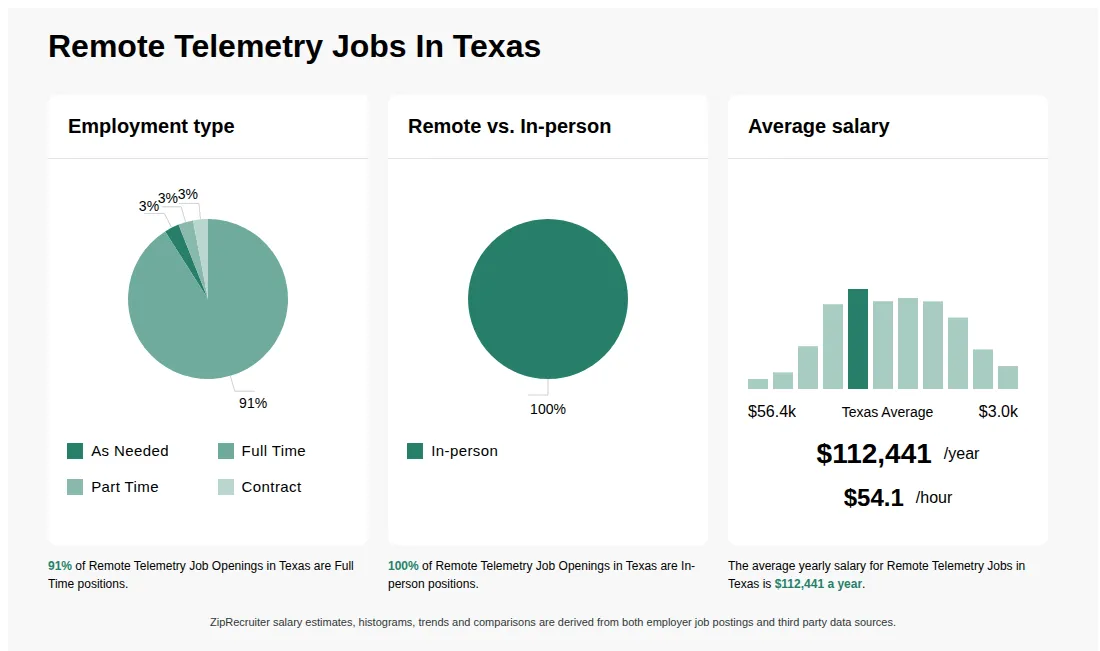
Remote Telemetry information
See Texas salary details
$1.1K - $1.3K
1% of jobs
$1.3K - $1.4K
2% of jobs
$1.4K - $1.6K
6% of jobs
$1.6K - $1.8K
13% of jobs
$1.8K is the 25th percentile. Wages below this are outliers.
$1.8K - $2K
16% of jobs
The median wage is $2.1K / yr.
$2K - $2.1K
14% of jobs
$2.1K - $2.3K
14% of jobs
$2.4K is the 75th percentile. Wages above this are outliers.
$2.3K - $2.5K
14% of jobs
$2.5K - $2.7K
11% of jobs
$2.7K - $2.8K
6% of jobs
$2.8K - $3K
3% of jobs
$1.1K
$2.2K
$3K
How much do remote telemetry jobs pay per week?
As of Sep 14, 2026, the average weekly pay for remote telemetry in Texas is $2,162.33, according to ZipRecruiter salary data. Most workers in this role earn between $1,809.62 and $2,473.08 per week, depending on experience, location, and employer.
What is remote telemetry?
A Remote Telemetry job involves monitoring and analyzing data from remote sensors, equipment, or systems to ensure proper operation and performance. This role is common in industries like healthcare, energy, manufacturing, and aerospace, where real-time data collection is critical. Responsibilities may include configuring telemetry systems, troubleshooting connectivity issues, and interpreting data trends to prevent failures. Many positions require expertise in network communications, data analysis, and industry-specific software. Remote telemetry professionals help optimize performance, reduce downtime, and improve operational efficiency.
What are the key skills and qualifications needed to thrive in remote telemetry?
To thrive in Remote Telemetry, you need a solid understanding of telemetry systems, data analysis, and remote monitoring, often requiring a background in engineering, IT, or healthcare. Familiarity with telemetry software, remote monitoring tools, networking protocols, and sometimes certifications like CompTIA Network+ or relevant healthcare credentials is beneficial. Strong attention to detail, problem-solving abilities, and effective communication stand out as vital soft skills for this position. These skills ensure accurate data interpretation, rapid troubleshooting, and effective collaboration within distributed teams to maintain operational integrity.
What are some typical challenges faced by professionals working in remote telemetry roles?
Professionals in remote telemetry roles often encounter challenges such as managing and interpreting large volumes of real-time data from dispersed locations, ensuring the reliability of monitoring systems, and troubleshooting technical issues without on-site access. Additionally, they must coordinate effectively with multiple teams, sometimes across different time zones, to resolve anomalies or respond to alerts quickly. Adapting to evolving technologies and maintaining security in data transmissions are also common aspects of the role. To thrive, strong organization, proactive communication, and a continuous learning mindset are essential for success in this dynamic environment.
What are popular job titles related to Remote Telemetry jobs in Texas?
For Remote Telemetry jobs in Texas, the most frequently searched job titles are:
What job categories do people searching Remote Telemetry jobs in Texas look for?
The top searched job categories for Remote Telemetry jobs in Texas are:
What cities in Texas are hiring for Remote Telemetry jobs?
Cities in Texas with the most Remote Telemetry job openings:

Principal Cybersecurity Advisor-Cisco Networking and Security | Remote, USA
Dallas, TX • Remote
Optiv Security, Inc.
• Network Security • 1 - 5K employees1,001 - 5,000 employees
Full-time
Posted 18 days ago
Job description
This position will be fully remote and can be hired anywhere in the continental U.S.
The Principal Cybersecurity Advisor serves as a senior technical leader within Optiv's Cisco Center of Excellence. This individual brings broad, current experience across Cisco enterprise networking and network security and helps clients translate business requirements, cyber risk, and infrastructure priorities into practical architecture strategies.
The Principal Advisor leads technical discovery and solution strategy for complex Cisco opportunities, advises client executives and technical stakeholders, and connects Cisco capabilities with Optiv services and the broader security portfolio. The role also develops reusable technical assets, supports field enablement, and helps regional Client Solutions Advisors engage Cisco opportunities with greater consistency and confidence.
This is an individual-contributor technical leadership role. It works across organizational boundaries through expertise and influence rather than direct authority over regional Client Solutions Advisors, sales teams, Partner Alliances, marketing, or delivery organizations.
How you'll make an impact
Define and maintain the Cisco COE's technical strategy across enterprise networking, network security, secure access, segmentation, digital experience, and related Cisco architectures.
Lead technical discovery for complex client opportunities and translate business goals, risk, operating requirements, and existing investments into clear architecture recommendations.
Advise CISOs, CIOs, network leaders, security leaders, architects, and engineering teams on Cisco strategy, modernization options, architectural tradeoffs, and multiyear roadmaps.
Lead the technical portion of Cisco pursuits from early qualification through solution design, proposal development, technical validation, and client decision.
Partner with account teams and domain-aligned advisors to identify and develop qualified Cisco opportunities. Commercial account ownership and forecasting remain with the appropriate sales and business leaders.
Develop reference architectures that connect Cisco networking and security capabilities with Splunk, ThousandEyes, identity, cloud, managed services, and other relevant parts of the Optiv portfolio.
Create reusable workshops, whiteboard sessions, demonstrations, decision frameworks, technical presentations, and solution assets that can be used across regions.
Help establish and maintain lab capabilities for Cisco demonstrations, integrations, proofs of concept, and technical evaluations.
Provide senior technical guidance for proposals, statements of work, RFP responses, and client-facing recommendations involving Cisco technologies.
Work with Optiv Services to define clear pre-sales-to-delivery handoffs and confirm that proposed solutions are supportable and aligned with client expectations.
Partner with Cisco technical teams and Partner Alliances while keeping technical solution ownership, partner governance, and commercial responsibilities clearly separated.
Support regional Client Solutions Advisors through mentoring, pursuit assistance, technical review, and Cisco-specific enablement without replacing regional people leadership.
Work with the Secure Networking COE and other domain teams on shared opportunities while remaining accountable for Cisco-specific technical strategy and expertise.
Monitor changes across Cisco's portfolio and convert relevant developments into field guidance, client conversations, and practical solution plays.
Represent Optiv in selected client briefings, executive sessions, industry events, partner meetings, and technical forums.
Capture client and field feedback and use it to improve Cisco solutions, enablement, and reusable assets.
What we 're looking for
10 or more years of relevant experience in cybersecurity, enterprise networking, solution architecture, consulting, or technical pre-sales.
Demonstrated depth across Cisco enterprise networking and network security, with current knowledge in several of the following areas.
Enterprise routing, switching, wireless, and segmentation
Catalyst, Meraki, software-defined networking, and SD-WAN
Cisco Secure Firewall and hybrid mesh firewall strategy
Cisco ISE, network access control, and identity-based policy
Cisco Secure Access, SSE, SASE, and zero-trust architectures
ThousandEyes and digital experience visibility
Cisco XDR, security telemetry, and integrations across the Cisco security portfolio
Cloud and multicloud networking and security
Experience leading architecture discussions and technical pursuits involving complex client environments.
Strong client-facing communication skills, including executive discovery, whiteboarding, presentations, and written recommendations.
Ability to connect technical decisions to business risk, resilience, operating cost, investment protection, and measurable outcomes.
Experience influencing opportunities through technical qualification, competitive positioning, solution development, objection handling, and client decision.
Ability to work independently in a distributed organization and lead through influence across teams that have different reporting structures and priorities.
Sound judgment about when Cisco is the right fit and when a client-first recommendation requires a different or broader solution.
Ability to travel within the United States and Canada as client and business needs require.
Preferred Qualifications
CCIE Enterprise Infrastructure, CCIE Security, CCNP Enterprise, CCNP Security, or comparable demonstrated expertise.
CISSP, CCSP, CISM, GIAC, or another relevant security certification.
Working knowledge of Splunk, security operations, security data platforms, and observability use cases.
Experience connecting Cisco telemetry and security capabilities with Splunk or other analytics platforms.
Experience in a cybersecurity integrator, consulting organization, vendor technical sales organization, or enterprise architecture function.
Experience developing repeatable offerings, reference architectures, workshops, demonstrations, or field enablement programs.
Experience working with professional services, managed services, sales, marketing, and partner organizations while maintaining clear accountability boundaries.
Public speaking, published technical content, or participation in relevant professional communities.
#LI-SM1
#LI-Remote
What you can expect from Optiv
A company committed to our inclusive value through our Employee Resource Groups
Work/life balance
Professional training resources
Creative problem-solving and the ability to tackle unique, complex projects
Volunteer Opportunities. "Optiv Chips In" encourages employees to volunteer and engage with their teams and communities.
The ability and technology necessary to productively work remotely/from home (where applicable)
EEO Statement
Optiv is an equal opportunity employer. All qualified applicants for employment will be considered without regard to race, color, religion, sex, gender identity or expression, sexual orientation, pregnancy, age 40 and over, marital status, genetic information, national origin, status as an individual with a disability, military or veteran status, or any other basis protected by federal, state, or local law.
Optiv respects your privacy.By providing your information through this page or applying for a job at Optiv, you acknowledge that Optiv will collect, use, and process your information, which may include personal information and sensitive personal information, in connection with Optiv's selection and recruitment activities. For additional details on how Optiv uses and protects your personal information in the application process, click here to view ourApplicant Privacy Notice. If you sign up to receive notifications of job postings, you may unsubscribe at any time.

About Optiv
Sourced by ZipRecruiter
Industry
Network security
Company size
1,001 - 5,000 Employees
Headquarters location
Denver, CO, US
Year founded
2015