
Syntricate Technologies is seeking an experienced Senior GIS Programmer/Analyst to join their GIS administration team within the IT department. The ideal candidate will have extensive experience in ...
Syntricate Technologies is seeking an experienced Senior GIS Programmer/Analyst to join their GIS administration team within the IT department. The ideal candidate will have extensive experience in ...

GIS Developer / Enterprise Specialist Employment Type: Full Time Location ... Falls Church, VA. (Remote within the Continental US but strong preference will be given to ...
New
GIS Developer / Enterprise Specialist Employment Type: Full Time Location ... Falls Church, VA. (Remote within the Continental US but strong preference will be given to ...
New

GIS Developer, DevOps, Geospatial Scripting & Application Support Opportunities
Golden, CO · On-site +1
Work arrangements vary by opportunity and may include remote, hybrid, telework-approved, or on-site ... GIS Developers * GIS DevOps Specialists * Geospatial Application Developers Responsibilities will ...
GIS Developer, DevOps, Geospatial Scripting & Application Support Opportunities
Golden, CO · On-site +1
Work arrangements vary by opportunity and may include remote, hybrid, telework-approved, or on-site ... GIS Developers * GIS DevOps Specialists * Geospatial Application Developers Responsibilities will ...
Senior GIS Developer
Silver Spring, MD · Remote
$113K - $140K/yr
Job/Project Overview Vanguard DevOps (www.vanguard-devops.ai) is seeking a highly experienced GIS Developer with expert knowledge of ArgGIS Pro, ArcGIS Online and strong proven Python coding ...
Quick apply
Senior GIS Developer
Silver Spring, MD · Remote
$113K - $140K/yr
Job/Project Overview Vanguard DevOps (www.vanguard-devops.ai) is seeking a highly experienced GIS Developer with expert knowledge of ArgGIS Pro, ArcGIS Online and strong proven Python coding ...
Work arrangements vary by opportunity and may include remote, hybrid, telework-approved, or on-site ... GIS Developers * GIS DevOps Specialists * Geospatial Application Developers Responsibilities will ...
Quick apply
Work arrangements vary by opportunity and may include remote, hybrid, telework-approved, or on-site ... GIS Developers * GIS DevOps Specialists * Geospatial Application Developers Responsibilities will ...

GIS Program Manager
Baton Rouge, LA · Remote
$65K - $88K/yr
Our client State of Louisiana is seeking a remote GIS Program Manager with 5+ years' experience leading development teams enhancing ArcGIS Desktop and ArcGIS Pro software along with familiarity on ...
GIS Program Manager
Baton Rouge, LA · Remote
$65K - $88K/yr
Our client State of Louisiana is seeking a remote GIS Program Manager with 5+ years' experience leading development teams enhancing ArcGIS Desktop and ArcGIS Pro software along with familiarity on ...
GIS Program Manager
Baton Rouge, LA · Remote
$65K - $88K/yr
Our client State of Louisiana is seeking a remote GIS Program Manager with 5+ years' experience leading development teams enhancing ArcGIS Desktop and ArcGIS Pro software along with familiarity on ...
GIS Program Manager
Baton Rouge, LA · Remote
$65K - $88K/yr
Our client State of Louisiana is seeking a remote GIS Program Manager with 5+ years' experience leading development teams enhancing ArcGIS Desktop and ArcGIS Pro software along with familiarity on ...

In this role, you will drive geospatial data and tooling needs for a large-scale project, working closely with GIS engineers to source, manage, and prepare geospatial data for AI/ML applications.
In this role, you will drive geospatial data and tooling needs for a large-scale project, working closely with GIS engineers to source, manage, and prepare geospatial data for AI/ML applications.

GIS Developer 4 Client: DBHDS - State of Virginia Location ... Richmond, VA (Remote) Need candidate within 2hrs drivable distance Job ID: 774079 Interview Mode:
Quick apply
GIS Developer 4 Client: DBHDS - State of Virginia Location ... Richmond, VA (Remote) Need candidate within 2hrs drivable distance Job ID: 774079 Interview Mode:
GIS Developer / Enterprise Specialist Employment Type: Full Time Location ... Falls Church,VA. (Remote within the Continental US but strong preference will be given to ...
New
GIS Developer / Enterprise Specialist Employment Type: Full Time Location ... Falls Church,VA. (Remote within the Continental US but strong preference will be given to ...
New

GIS Developer/Architect
New York, NY · Remote
Experience integrating GIS with enterprise asset systems * Utility Network schema implementation * Integration with Maximo, Trimble, Granite * Data migration and testing * Process preservation and ...
Quick apply
GIS Developer/Architect
New York, NY · Remote
Experience integrating GIS with enterprise asset systems * Utility Network schema implementation * Integration with Maximo, Trimble, Granite * Data migration and testing * Process preservation and ...

GIS Data Engineer
Birmingham, AL · Remote
Support the Senior GIS Developer in building and maintaining GIS data workflows using open-source ... Remote-friendly culture with an optional annual hunting trip. Essential Job Function We are an ...
GIS Data Engineer
Birmingham, AL · Remote
Support the Senior GIS Developer in building and maintaining GIS data workflows using open-source ... Remote-friendly culture with an optional annual hunting trip. Essential Job Function We are an ...
They are seeking a Senior EAM/GIS Developer-GIS Analyst with expertise in Esri ArcGIS to develop and maintain geospatial datasets and collaborate with cross-functional teams on GIS applications.
They are seeking a Senior EAM/GIS Developer-GIS Analyst with expertise in Esri ArcGIS to develop and maintain geospatial datasets and collaborate with cross-functional teams on GIS applications.

PlanIT Group, LLC is a company specializing in GIS solutions, and they are seeking a GIS Map Developer - Level III to work with GIS software and platforms. The role involves analyzing business ...
PlanIT Group, LLC is a company specializing in GIS solutions, and they are seeking a GIS Map Developer - Level III to work with GIS software and platforms. The role involves analyzing business ...
GIS Data Engineer
Birmingham, AL · Remote
Support the Senior GIS Developer in building and maintaining GIS data workflows using open-source ... Remote-friendly culture with an optional annual hunting trip. Essential Job Function We are an ...
GIS Data Engineer
Birmingham, AL · Remote
Support the Senior GIS Developer in building and maintaining GIS data workflows using open-source ... Remote-friendly culture with an optional annual hunting trip. Essential Job Function We are an ...
Experience integrating GIS with enterprise asset systems * Utility Network schema implementation * Integration with Maximo, Trimble, Granite * Data migration and testing * Process preservation and ...
Quick apply
Experience integrating GIS with enterprise asset systems * Utility Network schema implementation * Integration with Maximo, Trimble, Granite * Data migration and testing * Process preservation and ...

GIS and Website Developer Location ... Jackson, MS (remote however locals preferred) Duration: 12 months Position type: C2C Visa Type:
Quick apply
GIS and Website Developer Location ... Jackson, MS (remote however locals preferred) Duration: 12 months Position type: C2C Visa Type:
GIS Coordinator Remote (Ohio and Indiana only)
Indianapolis, IN · On-site +1
$37/hr
GIS Coordinator Location: Indianapolis, IN Pay Rate: $37/H W2 (No Benefits) Interview Type: Webcam and Inperson Work mode: Remote Client: IDOH Skills Knowledge of geospatial concepts Knowledge of ...
GIS Coordinator Remote (Ohio and Indiana only)
Indianapolis, IN · On-site +1
$37/hr
GIS Coordinator Location: Indianapolis, IN Pay Rate: $37/H W2 (No Benefits) Interview Type: Webcam and Inperson Work mode: Remote Client: IDOH Skills Knowledge of geospatial concepts Knowledge of ...
This role requires strong technical expertise with ESRI technologies, GIS programming, spatial ... Work Location Remote work is available; however, remote employees must: * Reside within 50 miles of ...
Quick apply
This role requires strong technical expertise with ESRI technologies, GIS programming, spatial ... Work Location Remote work is available; however, remote employees must: * Reside within 50 miles of ...
This role requires strong technical expertise with ESRI technologies, GIS programming, spatial ... Work Location Remote work is available; however, remote employees must: * Reside within 50 miles of ...
Quick apply
This role requires strong technical expertise with ESRI technologies, GIS programming, spatial ... Work Location Remote work is available; however, remote employees must: * Reside within 50 miles of ...
Remote Gis Developer information
See salary details
$24.04 - $28.50
1% of jobs
$28.50 - $32.95
8% of jobs
$32.95 - $37.41
8% of jobs
$39.42 is the 25th percentile. Wages below this are outliers.
$37.41 - $41.87
16% of jobs
$41.87 - $46.33
13% of jobs
The median wage is $47.75 / hr.
$46.33 - $50.79
12% of jobs
$50.79 - $55.24
8% of jobs
$57.70 is the 75th percentile. Wages above this are outliers.
$55.24 - $59.70
16% of jobs
$59.70 - $64.16
8% of jobs
$64.16 - $68.62
6% of jobs
$68.62 - $73.08
3% of jobs
$24
$49
$73
How much do remote gis developer jobs pay per hour?
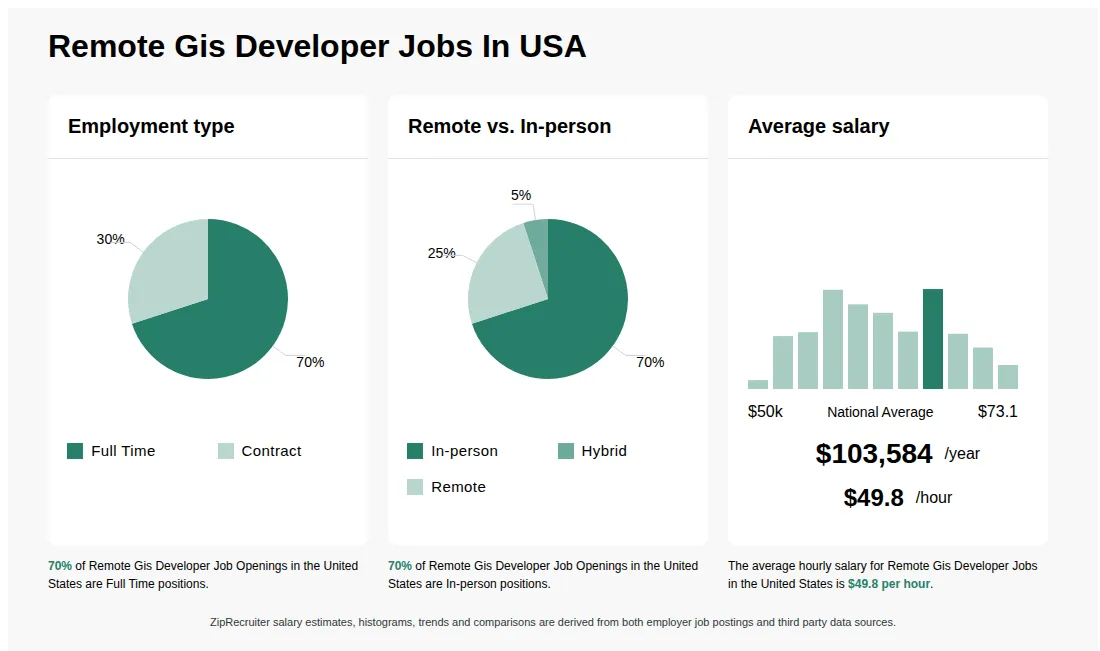
As of Sep 5, 2026, the average hourly pay for remote gis developer in the United States is $49.80, according to ZipRecruiter salary data. Most workers in this role earn between $39.90 and $58.65 per hour, depending on experience, location, and employer.
What is a remote GIS developer?
Remote GIS Developers are professionals who use Geographic Information Systems (GIS) to design, develop, and maintain spatial data applications while working from a location outside of a traditional office. They create maps, analyze geospatial data, and build tools or platforms that help organizations make location-based decisions. These developers often collaborate with teams using online communication tools and may work for industries such as urban planning, environmental science, or logistics. Their technical skills typically include programming languages like Python or JavaScript, as well as experience with GIS software such as ArcGIS or QGIS.
What does a remote GIS developer do?
As a remote GIS developer, your job is to analyze, design, program, and document software that uses a geographic information system. These systems are often used for virtual cartography, spatial and geospatial business planning, and other needs that involve managing or expanding into currently unoccupied areas. Many details of this telecommute job vary based on the employer's needs. Some remote GIS developers work with government agencies to create and manage utility systems while others focus on determining the most efficient route to build a road connecting to a particular destination. Remote GIS developers may use existing data sets or help collect new information.
What are the key skills and qualifications needed to thrive as a remote GIS developer?
To thrive as a Remote GIS Developer, you need strong programming skills (such as Python or JavaScript), experience with spatial databases, and a background in geography or geospatial sciences. Familiarity with GIS platforms like Esri ArcGIS, QGIS, remote sensing tools, and APIs, as well as certifications such as Esri Technical Certification, are often required. Effective problem-solving, self-motivation, and clear communication are essential soft skills for collaborating across distributed teams and managing independent tasks. These skills ensure accurate geospatial solutions, seamless integration with client systems, and successful project delivery in a remote environment.
What are some common challenges remote GIS developers face and how can they effectively collaborate with geographically dispersed teams?
Remote GIS Developers often encounter challenges such as coordinating across time zones, ensuring data consistency, and maintaining clear communication with team members who may have different technical backgrounds. Effective collaboration typically involves using version control systems, project management tools, and regular virtual meetings to discuss progress and address issues. Leveraging cloud-based GIS platforms and clear documentation practices also helps streamline workflows and minimize misunderstandings, enabling remote teams to work efficiently and cohesively.
What is the difference between Remote Gis Developer vs Remote GIS Analyst?
| Aspect | Remote GIS Developer | Remote GIS Analyst |
|---|---|---|
| Required Credentials | Bachelor's in GIS, Geography, Computer Science; programming skills | Bachelor's in GIS, Geography; data analysis skills |
| Work Environment | Collaborates with developers, software teams; coding-focused | Analyzes spatial data; reports and visualization tasks |
| Employer & Industry Usage | Tech companies, mapping firms, government agencies | Urban planning, environmental agencies, consulting firms |
| Search & Comparison Intent | Technical development, programming roles | Data analysis, spatial insights |
Remote GIS Developers focus on creating and maintaining GIS software and applications, requiring programming skills and technical expertise. Remote GIS Analysts primarily interpret spatial data, generate reports, and support decision-making. While both roles work remotely within GIS-related fields, their core responsibilities and skill sets differ, making this comparison useful for job seekers exploring technical versus analytical GIS careers.
More about Remote Gis Developer jobs
What cities are hiring for Remote Gis Developer jobs?
Cities with the most Remote Gis Developer job openings:
What are the most commonly searched types of Gis Developer jobs?
The most popular types of Gis Developer jobs are:
What states have the most Remote Gis Developer jobs?
States with the most job openings for Remote Gis Developer jobs include:
What job categories do people searching Remote Gis Developer jobs look for?
The top searched job categories for Remote Gis Developer jobs are:
Job description
Job Summary:
Syntricate Technologies is seeking an experienced Senior GIS Programmer/Analyst to join their GIS administration team within the IT department. The ideal candidate will have extensive experience in GIS technologies and applications, specifically in the utility distribution business.
Responsibilities:
• GIS Data and System administration
• Application and script development
• Testing and Quality Assurance
• Developing and maintaining system and task documentation
• GIS data processing
• Full lifecycle management of customer requests (Requirements gathering, development, testing, production implementation)
• Development and maintenance of integrations with major IT systems
• Troubleshooting and analysis
• Needs analysis and reporting for system upgrades and enhancements
• Research and implementation of new technologies
Qualifications:
Required:
• Bachelor's degree in Geography, Math, Computer Science, Engineering, Geographic Information Systems or related field
• At least 6 years of experience in use and administration of ArcGIS and ArcFM applications in an enterprise environment.
• At least 6 years of experience developing and enhancing customizations in ArcGIS/ArcFM with Visual Studio, Team Foundation Server, C#.NET, ArcObjects, ArcGIS Runtime, ArcFM objects, SQL and PLSQL.
• At least 6 years of experience with development, administration and maintenance of an Oracle/SDE enterprise geodatabase.
• At least 6 years of experience with administration and maintenance of Enterprise Online and ArcGIS Enterprise
• At least 6 years of experience with customer support in an enterprise GIS environment.
• Ability to design solutions and complete assignments independently.
• Systems analysis and proactive problem-solving skills.
• Written and oral communication skills
• Administration of Windows operating systems.
Preferred:
• Experience in Esri Geometric Network and knowledge of Utility Network implementation/migration
• Experience with using, supporting and customizing AutoCAD, Autodesk Utility Design (AUD)
• Experience with Service Oriented Architecture and Oracle AQ messaging
• ArcFM Web, Geocortex Workflow Designer development, Geocortex Essentials Manager administration
• Python scripting including use of arcpy library
• HTML5 application development including use of ESRI JavaScript API
• Microsoft IIS administration
• Safe Software FME Workbench and FME Server
• Microsoft Team Foundation Server administration
• Arcade scripting
• Microsoft MVVM design pattern with Xamarin & MAUI framework.
• ArcGIS Pro SDK for .Net with Microsoft framework.
Company:
Syntricate Technologies offers quality assurance, validation, regulatory, business analysis, and project management services. Founded in 2004, the company is headquartered in Boston, USA, with a team of 51-200 employees. The company is currently Growth Stage.
Syntricate Technologies is seeking an experienced Senior GIS Programmer/Analyst to join their GIS administration team within the IT department. The ideal candidate will have extensive experience in GIS technologies and applications, specifically in the utility distribution business.
Responsibilities:
• GIS Data and System administration
• Application and script development
• Testing and Quality Assurance
• Developing and maintaining system and task documentation
• GIS data processing
• Full lifecycle management of customer requests (Requirements gathering, development, testing, production implementation)
• Development and maintenance of integrations with major IT systems
• Troubleshooting and analysis
• Needs analysis and reporting for system upgrades and enhancements
• Research and implementation of new technologies
Qualifications:
Required:
• Bachelor's degree in Geography, Math, Computer Science, Engineering, Geographic Information Systems or related field
• At least 6 years of experience in use and administration of ArcGIS and ArcFM applications in an enterprise environment.
• At least 6 years of experience developing and enhancing customizations in ArcGIS/ArcFM with Visual Studio, Team Foundation Server, C#.NET, ArcObjects, ArcGIS Runtime, ArcFM objects, SQL and PLSQL.
• At least 6 years of experience with development, administration and maintenance of an Oracle/SDE enterprise geodatabase.
• At least 6 years of experience with administration and maintenance of Enterprise Online and ArcGIS Enterprise
• At least 6 years of experience with customer support in an enterprise GIS environment.
• Ability to design solutions and complete assignments independently.
• Systems analysis and proactive problem-solving skills.
• Written and oral communication skills
• Administration of Windows operating systems.
Preferred:
• Experience in Esri Geometric Network and knowledge of Utility Network implementation/migration
• Experience with using, supporting and customizing AutoCAD, Autodesk Utility Design (AUD)
• Experience with Service Oriented Architecture and Oracle AQ messaging
• ArcFM Web, Geocortex Workflow Designer development, Geocortex Essentials Manager administration
• Python scripting including use of arcpy library
• HTML5 application development including use of ESRI JavaScript API
• Microsoft IIS administration
• Safe Software FME Workbench and FME Server
• Microsoft Team Foundation Server administration
• Arcade scripting
• Microsoft MVVM design pattern with Xamarin & MAUI framework.
• ArcGIS Pro SDK for .Net with Microsoft framework.
Company:
Syntricate Technologies offers quality assurance, validation, regulatory, business analysis, and project management services. Founded in 2004, the company is headquartered in Boston, USA, with a team of 51-200 employees. The company is currently Growth Stage.

About Syntricate Technologies
Sourced by ZipRecruiter
Industry
It services
Company size
51 - 200 Employees
Headquarters location
Boston, MA, US