2

Remote Eating Disorder Jobs (NOW HIRING)

next page

Showing results 1-20

Remote Eating Disorder information

See salary details

$15

$27

$37

How much do remote eating disorder jobs pay per hour?

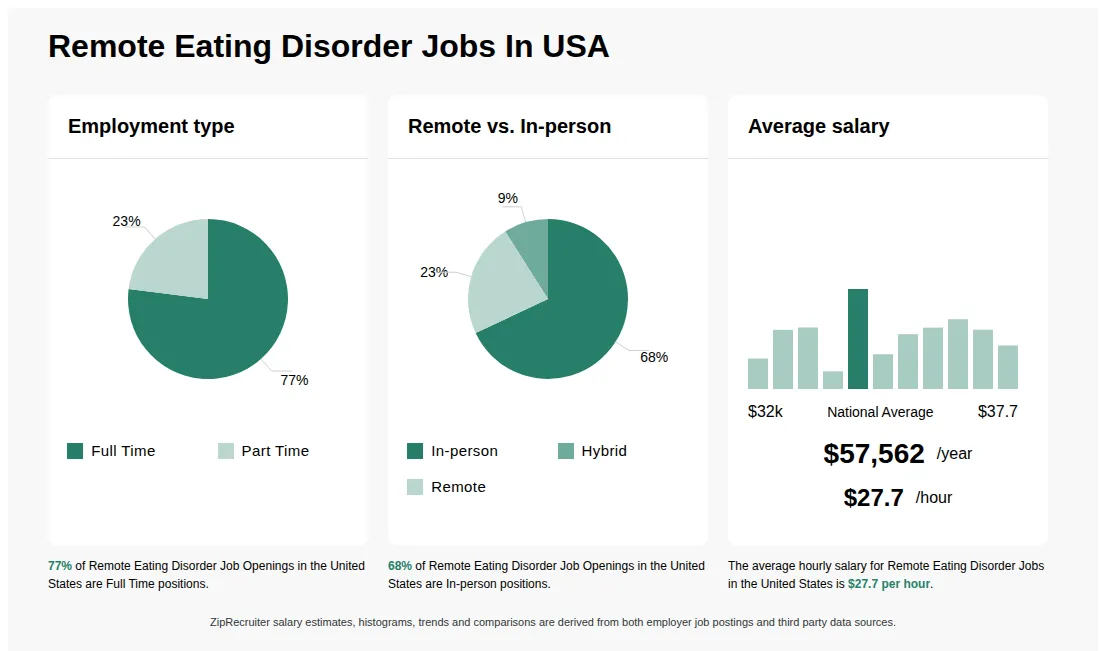
As of Jul 2, 2026, the average hourly pay for remote eating disorder in the United States is $27.67, according to ZipRecruiter salary data. Most workers in this role earn between $21.63 and $33.17 per hour, depending on experience, location, and employer.

What are some common challenges faced by remote eating disorder therapists, and how can they be addressed?

Remote eating disorder therapists often face challenges such as building rapport with clients over video calls, ensuring privacy and confidentiality, and recognizing non-verbal cues that may be less apparent online. To address these issues, therapists can use secure telehealth platforms, establish clear communication guidelines, and regularly check in with clients about their comfort and safety. Additionally, collaborating closely with other healthcare professionals and utilizing digital tools for meal monitoring and progress tracking can enhance support for clients.

What is the difference between Remote Eating Disorder vs Remote Nutrition Therapist?

AspectRemote Eating DisorderRemote Nutrition Therapist
Required CredentialsCertified Eating Disorder Specialist (CEDS), Registered Dietitian (RD)Registered Dietitian (RD), Nutrition Certification
Work EnvironmentTelehealth, private practice, clinicsTelehealth, private practice, healthcare facilities
Industry UsageSpecialized in eating disorder treatment and recoveryGeneral nutrition counseling and diet planning
Common Search IntentFocus on eating disorder recovery servicesFocus on general nutrition advice and diet management

Remote Eating Disorder professionals specialize in treating eating disorders like anorexia and bulimia, often requiring specific certifications such as CEDS. Remote Nutrition Therapists provide broader nutritional guidance and diet planning, typically with RD credentials. While both work remotely and in healthcare settings, their focus areas and certifications differ, making them distinct roles within the nutrition and mental health industry.

What is a Remote Eating Disorder Specialist?

A Remote Eating Disorder Specialist is a mental health professional who provides assessment, support, and treatment to individuals struggling with eating disorders through virtual platforms, such as video calls or online messaging. These specialists can include therapists, dietitians, or counselors who are trained in evidence-based approaches like Cognitive Behavioral Therapy (CBT) or Family-Based Treatment (FBT). Remote care allows clients to access expert help regardless of their location, making treatment more accessible and flexible. This approach can be particularly helpful for individuals who may not have local resources or who prefer the privacy and convenience of remote sessions.

What are the key skills and qualifications needed to thrive as a Remote Eating Disorder Therapist, and why are they important?

To thrive as a Remote Eating Disorder Therapist, you need a relevant mental health degree (such as psychology, counseling, or social work), appropriate licensure, and specialized training in treating eating disorders. Familiarity with telehealth platforms, electronic health records (EHRs), and evidence-based therapeutic modalities like CBT or Family-Based Therapy is typically required. Exceptional empathy, active listening, and strong communication skills are essential for building trust and effectively supporting clients in a virtual setting. These skills and qualifications are crucial for delivering effective, ethical, and compassionate care to clients remotely, ensuring their safety and progress.

What is a Remote Eating Disorder job?

A Remote Eating Disorder job typically involves providing virtual support, therapy, or treatment for individuals struggling with eating disorders. Professionals in this field may include therapists, dietitians, health coaches, or support staff who work with clients via telehealth platforms. Responsibilities can include conducting assessments, offering counseling or nutritional guidance, and developing treatment plans. These roles allow professionals to work from home while helping individuals recover from disordered eating behaviors.

More about Remote Eating Disorder jobs
What cities are hiring for Remote Eating Disorder jobs? Cities with the most Remote Eating Disorder job openings:
What are the most commonly searched types of Eating Disorder jobs? The most popular types of Eating Disorder jobs are:
What states have the most Remote Eating Disorder jobs? States with the most job openings for Remote Eating Disorder jobs include:
Infographic showing various Remote Eating Disorder job openings in the United States as of June 2026, with employment types broken down into 4% As Needed, 57% Full Time, 35% Part Time, 2% Contract, and 2% Nights. Highlights an 93% Physical, 2% Hybrid, and 5% Remote job distribution, with an average salary of $57,562 per year, or $27.7 per hour.
Youth Mental Health & Crisis Care Consultant - Remote

Youth Mental Health & Crisis Care Consultant - Remote

micro1 AI

Toledo, OH โ€ข Remote

$50 - $90/hr

Part-time

Posted 3 days ago


Job description

Role Title: Child & Online Safety Expert


Role Type: Contractor


Location: Remote


micro1 is engaging Child & Online Safety Experts to contribute to a high-impact customer project focused on online safety and mental-health support for young people. In this role, you'll apply your expertise to help train next-generation AI systems. Your work will shape how models learn, reason, and perform through high-quality, real-world input. No prior experience in AI is required โ€” your domain knowledge is what matters. This opportunity centers on developing a robust mental-health safety evaluation framework for vulnerable youth online, leveraging your deep knowledge of crisis-care and digital risk assessment.


Scope of Work

  1. Develop comprehensive taxonomies related to self-harm, suicide prevention, eating disorders, and emotional dependency in digital contexts.
  2. Establish best-practice standards for digital support and clinical safety regarding youth and adolescent mental health.
  3. Create detection frameworks to identify, flag, and evaluate potentially harmful online content and advice related to mental-health crises for minors.
  4. Design and refine clinical response rubrics and escalation protocols for at-risk individuals in digital environments.
  5. Collaborate with project leads to ensure that all evaluation benchmarks and guidelines are grounded in current research and clinical best practices.
  6. Offer insights on CSAM-adjacent policy and online exploitation dynamics, enhancing digital child safety protocols.
  7. Deliver clear, actionable written and verbal feedback that shapes the ongoing development of AI safety tools and frameworks.


Preferred Qualifications

  1. Licensed therapist, psychiatrist, clinician, or mental-health professional with direct crisis-care experience.
  2. 5+ years of focused work in adolescent mental health, suicide prevention, eating-disorder intervention, or related fields; 8โ€“20 years welcomed for senior contributors.
  3. Demonstrated expertise in clinical risk assessment and intervention in digital or online settings.
  4. Advanced degree, specialized certification, or equivalent operational experience in mental-health or child safety domains.
  5. Experience evaluating or implementing CSAM-adjacent policies, or working within child online exploitation prevention initiatives.
  6. Strong written and verbal communication skills, with the ability to distill complex information for diverse audiences.
  7. High credibility and a recognized track record of impact in clinical, crisis-response, or safety evaluation communities.