2

Remote Coder Jobs in New York (NOW HIRING)

Senior Coder

Lake Success, NY · Remote

$66K - $108K/yr

Performs coding and abstracting duties to assure accurate completion of coding for all assigned patient records. Job Responsibility 1.Analyzes and interprets the medical record in its entirety to ...

Successful completion of coding courses in anatomy, physiology and medical terminology * 1 year of Hospital and/or Physician Coding * 1 year coding at mid-level facilities or clinics * 1 year coding ...

Be Seen First

PIP Adjuster

Newark, NJ · Remote

$55K - $65K/yr

Certified Professional Coder (CPC) - PIP Medical Bill Review Expert Location: Remote (Nationwide, excluding CA) Schedule: Monday - Friday, Standard EST Business Hours Employment Type: Full-Time, ...

Be Seen First

PIP Adjuster

Newark, NJ · Remote

$55K - $65K/yr

Certified Professional Coder (CPC) - PIP Medical Bill Review Expert Location: Remote (Nationwide, excluding CA) Schedule: Monday - Friday, Standard EST Business Hours Employment Type: Full-Time, ...

next page

Showing results 1-20

People also search for

Remote Coder information

See New York salary details

$17

$30

$47

How much do remote coder jobs pay per hour?

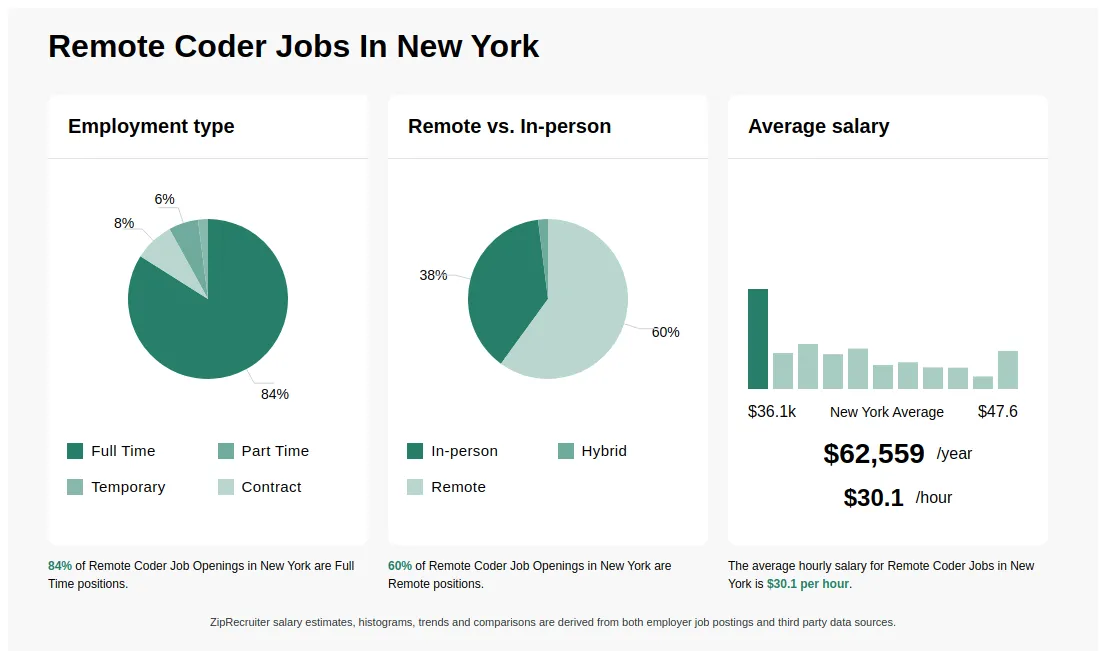
As of Jun 10, 2026, the average hourly pay for remote coder in New York is $30.08, according to ZipRecruiter salary data. Most workers in this role earn between $20.77 and $37.88 per hour, depending on experience, location, and employer.

What is the difference between Remote Coder vs Medical Biller?

AspectRemote CoderMedical Biller
Required CredentialsCertification in medical coding (e.g., CPC)Certification in medical billing or coding (e.g., CPC, CPC-A)
Work EnvironmentRemote or in healthcare facilitiesRemote or in healthcare offices
Industry UsageHealthcare, insurance companies, hospitalsHealthcare providers, billing companies, hospitals
Job FocusAssigning codes for diagnoses and proceduresProcessing insurance claims and payments

Remote Coders primarily focus on reviewing medical records and assigning appropriate codes for billing and documentation, while Medical Billers handle submitting claims and following up on payments. Both roles often require similar certifications and can be performed remotely, but their core responsibilities differ within the healthcare revenue cycle.

What is a Remote Coder?

A Remote Coder is a professional who writes and maintains computer code for software applications while working from a location outside of a traditional office, often from home or any place with internet connectivity. Remote Coders collaborate with teams using online tools and are responsible for tasks such as debugging, code reviews, and implementing features. This role offers flexibility and may require strong communication skills and self-motivation to meet project deadlines. Remote Coders can work in various industries, including technology, healthcare, and finance.

What Does a Remote Coder Do?

Remote medical coders handle patient information to ensure their medical services are billed properly to their insurance company. This administrative position is sometimes referred to as medical records technicians or health information technicians. Unlike coders who work in the office, remote medical coders work from home or another location outside of the office. Remote medical coders collect, research, and file patient medical information. As a remote medical coder, your primary responsibilities include making sure that all the data in a patient’s record is accurate and up-to-date, organizing patient data within multiple databases, and using medical codes to determine reimbursement for insurance billing purposes.

What are the key skills and qualifications needed to thrive as a Remote Coder, and why are they important?

To thrive as a Remote Coder, you need in-depth knowledge of medical coding systems, anatomy, and healthcare regulations, typically supported by a certification such as CPC, CCS, or CCA. Familiarity with electronic health records (EHR) software, coding tools like ICD-10-CM/PCS, CPT, and online coding platforms is essential. Strong attention to detail, time management, and self-motivation are critical soft skills for accuracy and productivity in a remote setting. These skills ensure precise coding, compliance with healthcare standards, and reliable performance while working independently.

What are some common challenges faced by remote coders and how can they be effectively managed?

Remote coders often encounter challenges such as maintaining clear communication with team members across time zones, managing distractions in a home environment, and staying motivated without in-person supervision. To address these, it's important to utilize collaboration tools (like Slack or Zoom), set up a dedicated workspace, and establish a structured daily routine. Regular check-ins with your team and proactive communication can also help ensure alignment on project goals and deadlines.
What are the most commonly searched types of Coder jobs in New York? The most popular types of Coder jobs in New York are:
What cities in New York are hiring for Remote Coder jobs? Cities in New York with the most Remote Coder job openings:
Infographic showing various Remote Coder job openings in New York as of June 2026, with employment types broken down into 11% As Needed, 56% Full Time, 11% Part Time, and 22% Contract. Highlights an 100% Remote job distribution, with an average salary of $62,559 per year, or $30.1 per hour.
Senior Coder

Senior Coder

Northwell

Lake Success, NY • Remote

$66K - $108K/yr

Other

Posted 28 days ago


Job description

Performs coding and abstracting duties to assure accurate completion of coding for all assigned patient records.

Job Responsibility

1.Analyzes and interprets the medical record in its entirety to ensure accurate, complete and consistent selection of diagnoses and procedures to assure the production of quality healthcare data and accurate facility payment.
2.Applies understanding of basic anatomy and physiology to interpret clinical documentation and identify applicable codes.
3.Utilizes resources and reference materials (e.g., manuals, online resources: Official Coding Guidelines (OCG), AHA Coding Clinic, Center for Medicare Services and CPT Assistant) to identify appropriate codes and reference code applicability, rules and guidelines.
4.Applies the Uniform Hospital Discharge Data Set (UHDDS) definitions as well as any additional regulatory guidelines and/ or coding references to select the principal diagnosis, secondary diagnoses, all significant procedures, indicating the patient's acuity, severity of illness and risk of mortality (if applicable), as documented in the medical record.
5.Codes and reports diagnoses and their associated present on Admission (POA) Indicator and procedures.
6.Accurately assigns discharge disposition for all records as required and in accordance with the Centers for Medicare and Medicaid Services (CMS) rules and regulations.
7.Make determinations on medical coding and takes initiative to complete reviews and coding independently, to avoid delays in the workflow process. 8.Manages multiple work demands simultaneously to maintain relevant efficiency and turnaround time standards for completing coding/DRG assignment.
9.Assigns and reports all other data elements required for Statewide Planning and Research Cooperative System (SPARCS) data collection, Congenital Malformations and Expirations.
10.For outpatient encounters, applies coding conventions and official coding guidelines approved by the Current Procedural Terminology (CPT) rules established by the American Medical Association (AMA), and any other official rules and guidelines established for use with the mandated outpatient procedure code sets.
11.Assigns appropriate discharge physician in the system.
12.Generates compliant physician queries to clarify any incomplete/ambiguous or conflicting documentation and applies post-query responses to make final coding determinations.
13.Demonstrates basic knowledge of the impact of coding decisions on revenue cycle.
14.Assists in the education of physicians and other clinicians by advocating proper documentation practices, further specificity, resequencing and inclusion of diagnoses or procedures when needed to more accurately reflect the acuity, severity of illness and risk of mortality as indicated.
15.Attends and participates in required hospital education programs in order to maintain and enhance their coding skills and stay abreast of changes in codes, coding guidelines and regulations.
16.Completes moderately complex assignments that require an ability to recognize the need to occasionally deviate from accepted practices.
17.Exercises independent judgment on basic or moderately complex issues regarding job and related tasks.
18.Works independently under minimal supervision within established guidelines and procedures.
19.Requires minimal instruction on day-to-day work; majority of work is self-directed; receives instruction on new assignments.
20.Works with lead on resolution of day-to-day technical/procedural challenges.
21.May provide work guidance to team members to ensure accurate and timely completion of tasks.
22.Performs related duties as required. All responsibilities noted here are considered essential functions of the job under the Americans with Disabilities Act. Duties not mentioned here, but considered related are not essential functions.

Job Qualification

High School Diploma or equivalent, required.
3-5 years of technical experience, required.
Certified Coding Specialist (CCS) or Certified Professional Coder (CPC) or Certified Coding Specialist-Physician (CCSP) or Certified Inpatient Coder (CIC) or Certified Outpatient Coder (COC) or Certified Coding Associate (CCA) or RHIA or RHIT certification, required.


*Additional Salary Detail
The salary range and/or hourly rate listed is a good faith determination of potential base compensation that may be offered to a successful applicant for this position at the time of this job advertisement and may be modified in the future.When determining a team member's base salary and/or rate, several factors may be considered as applicable (e.g., location, specialty, service line, years of relevant experience, education, credentials, negotiated contracts, budget and internal equity).