1

Quantum Computing Jobs (NOW HIRING)

This role is ideal for a technically strong quantum computing professional who is passionate about translating advanced quantum algorithms into practical solutions for real-world mission challenges.

At Atom Computing, we build quantum computers using arrays of optically trapped neutral atoms that will empower customers to achieve unprecedented computational breakthroughs. Join a world-class team ...

Quantum Engineer

Boulder, CO · On-site

$160 - $185/hr

At Atom Computing, we build quantum computers using arrays of optically trapped neutral atoms that will empower customers to achieve unprecedented computational breakthroughs. Join a world-class team ...

Principal Quantum Engineer

Boulder, CO · On-site

$200K - $230K/yr

At Atom Computing, we build quantum computers using arrays of optically trapped neutral atoms that will empower customers to achieve unprecedented computational breakthroughs. Join a world-class team ...

Principal Quantum Engineer

Allenspark, CO · On-site

$200K - $230K/yr

At Atom Computing, we build quantum computers using arrays of optically trapped neutral atoms that will empower customers to achieve unprecedented computational breakthroughs. Join a world-class team ...

Senior Quantum Engineer

Boulder, CO · On-site

$185K - $210K/yr

At Atom Computing, we build quantum computers using arrays of optically trapped neutral atoms that will empower customers to achieve unprecedented computational breakthroughs. Join a world-class team ...

Showing results 41-60

Quantum Computing information

See salary details

$27.5K

$131.2K

$214.5K

How much do quantum computing jobs pay per year?

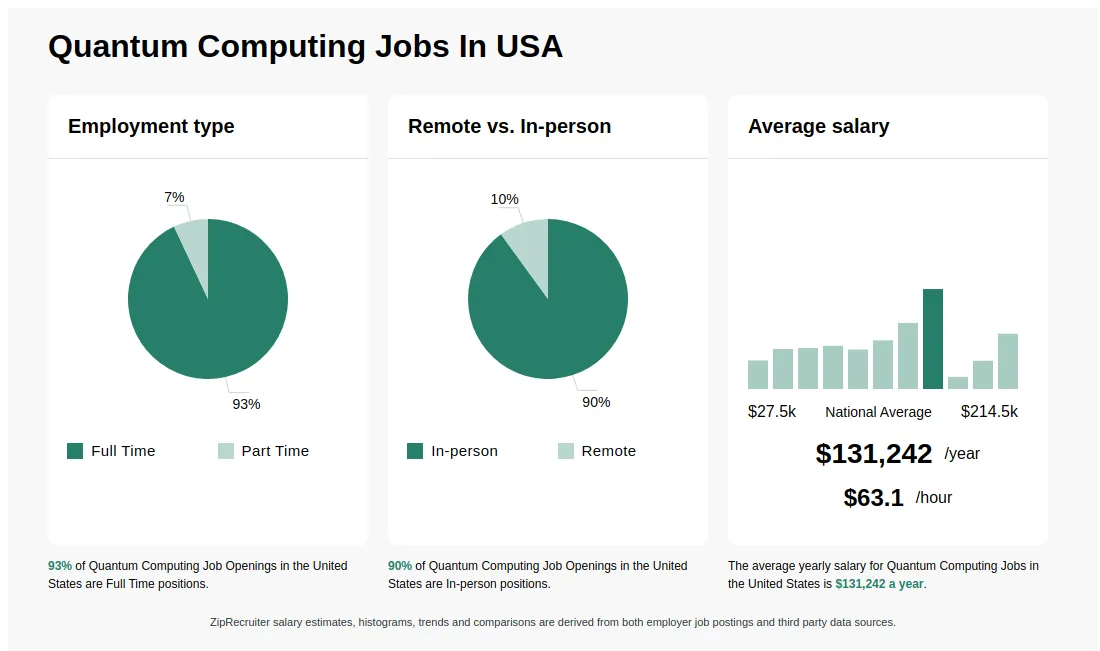
As of Sep 4, 2026, the average yearly pay for quantum computing in the United States is $131,242.00, according to ZipRecruiter salary data. Most workers in this role earn between $86,000.00 and $160,000.00 per year, depending on experience, location, and employer.

What is quantum computing?

A Quantum Computing job involves researching, developing, and applying quantum mechanics principles to create advanced computing systems. Professionals in this field work on algorithms, hardware, and software that leverage quantum bits (qubits) to solve complex problems faster than classical computers. Roles include quantum software engineer, quantum physicist, and research scientist, often requiring expertise in physics, mathematics, and computer science. These jobs are typically found in academia, tech companies, and government research labs focused on advancing quantum technology.

What does someone working in quantum computing do?

Professionals in quantum computing spend their days developing and testing quantum algorithms, collaborating with physicists and engineers on hardware advancements, and running experiments on quantum simulators or actual devices. They often work in interdisciplinary teams and engage in regular code reviews, technical discussions, and research collaborations. Keeping up with the latest scientific literature and participating in internal or external seminars is also common. This dynamic workflow ensures that team members stay informed about cutting-edge developments and continuously contribute to innovative projects.

What are the key skills and qualifications needed to thrive in quantum computing?

To thrive in quantum computing, you typically need a strong background in physics, mathematics, and computer science, often supported by a graduate degree in a relevant field. Familiarity with quantum programming languages (such as Qiskit or Cirq), quantum hardware platforms, and experience with simulation tools are frequently required. Analytical thinking, problem-solving, and the ability to communicate complex concepts clearly are valuable soft skills. These competencies are essential for developing and implementing quantum algorithms, collaborating on interdisciplinary teams, and advancing this rapidly evolving field.

Is it hard to get a job in quantum computing?

Getting a job in quantum computing can be competitive due to the specialized skills required, such as knowledge of quantum algorithms, programming languages like Qiskit or Cirq, and a strong background in physics or computer science. Candidates often need advanced degrees and experience with quantum hardware or simulation tools to improve their chances.

Is quantum computing a good career?

Quantum computing is a rapidly growing field with roles such as quantum software engineers, researchers, and hardware developers. It requires strong backgrounds in physics, computer science, and mathematics, along with skills in programming languages like Python and familiarity with quantum algorithms. Careers in this area can be highly specialized and competitive but offer opportunities in academia, industry, and government research labs.

Is quantum computing well paid?

Quantum computing professionals, such as researchers and engineers, typically earn high salaries due to the specialized skills and advanced knowledge required in the field. Salaries can vary based on experience, education, and location, but generally, roles in quantum computing are well compensated compared to many other tech positions. Advanced degrees and expertise in quantum algorithms, hardware, or software can further increase earning potential.
More about Quantum Computing jobs

What cities are hiring for Quantum Computing jobs?

Cities with the most Quantum Computing job openings:

What are the most commonly searched types of Quantum Computing jobs?

The most popular types of Quantum Computing jobs are:

What states have the most Quantum Computing jobs?

States with the most job openings for Quantum Computing jobs include:

Infographic showing various Quantum Computing job openings in the United States as of August 2026, with employment types broken down into 86% Full Time, 12% Part Time, and 2% Contract. Highlights an 81% Physical, 3% Hybrid, and 16% Remote job distribution, with an average salary of $131,242 per year, or $63.1 per hour.

Quantum Computing Research Scientist - Quantum Error Correction - Vice President

JPMorgan Chase & Co.

Manhattan, NY • On-site

$180 - $240/hr

Other

Re-posted 3 days ago


JPMorgan Chase & Co. rating

7.9

Company rating: 7.9 out of 10

Based on 500 frontline employees who took The Breakroom Quiz

77th of 174 rated banks


Job description

Are you looking for an exciting opportunity to join a dynamic and growing team in a fast paced and challenging area? This is a unique opportunity for you to work with Global Technology Applied Research (GTAR) center at JPMorganChase. The goal of GTAR is to design and conduct research across multiple frontier technologies, in order to enable novel discoveries and inventions, and to inform and develop next-generation solutions for the firm’s clients and businesses.

As a Senior Associate quantum computing researcher within The Global Technology Applied Research (GTAR), you will develop, investigate, and optimize (both analytically and numerically) protocols for universal fault-tolerant quantum computation, implement these protocols for experimental validation, and use these protocols to execute quantum algorithms fault-tolerantly on quantum computing hardware.

Job responsibilities
  • Develop circuit gadgets and protocols for universal fault-tolerant quantum computation (FTQC)

  • Numerically investigate and optimize fault-tolerant gadgets for real-world execution on quantum computing hardware

  • Implement and experimentally validate protocols for universal FTQC on quantum computing hardware

  • Document analytical, numerical, and experimental results in scientific papers

  • Implement, maintain, and manage a codebase that colleagues without expertise in quantum error correction (QEC) or fault-tolerance can use to run quantum algorithms fault-tolerantly on quantum computing hardware

Required qualifications, capabilities, and skills
  • Ph.D. degree in computer science, physics, math, engineering, or related fields, or equivalent experience
  • Competency in the basics of qubit-based stabilizer QEC: stabilizer and subsystem codes; CSS codes; parity check matrices; logical and gauge operators; thresholds and pseudo-thresholds; Clifford and non-Clifford gates; Shor, Steane, and Knill QEC; code distance and effective (circuit) distance
  • Experience with analytical and numerical circuit-level investigation of QEC and FTQC: constructing circuits for QEC cycles, state preparation, and logical operations; specifying noise models; building detector error models; running numerical simulations; decoding; computing logical error rates
  • Experience building quantum circuits in a major software framework such as Cirq, Qiskit, or Pytket
  • Fluency in at least one of: Python, Julia, C++, Rust
  • Strong oral and written communication skills, strong scientific publication record
Preferred qualifications, capabilities, and skills
  • Experience developing a successful research program focused on the development of protocols for universal FTQC
  • Experience designing fault-tolerant gadgets for state preparation and logical gates
  • Understanding of magic-state distillation and cultivation protocols
  • Understanding of generalized code surgery, code adapters and extractors
  • Understanding of concatenated code constructions and code families
  • Understanding of dynamical codes
  • Understanding of ZX calculus and fault-tolerant rewrites and experience with circuit-level quantum compilation
#J-18808-Ljbffr

What JPMorgan Chase & Co. employees say

Pay

Benefits

Hours and flexibility

Workplace

Get the full story on Breakroom